

You’re standing in the tire shop, staring at two walls of rubber, and the salesperson just hit you with the classic: “Well, it depends on what you’re looking for.”
Not helpful, right? I’ve been there more times than I can count.
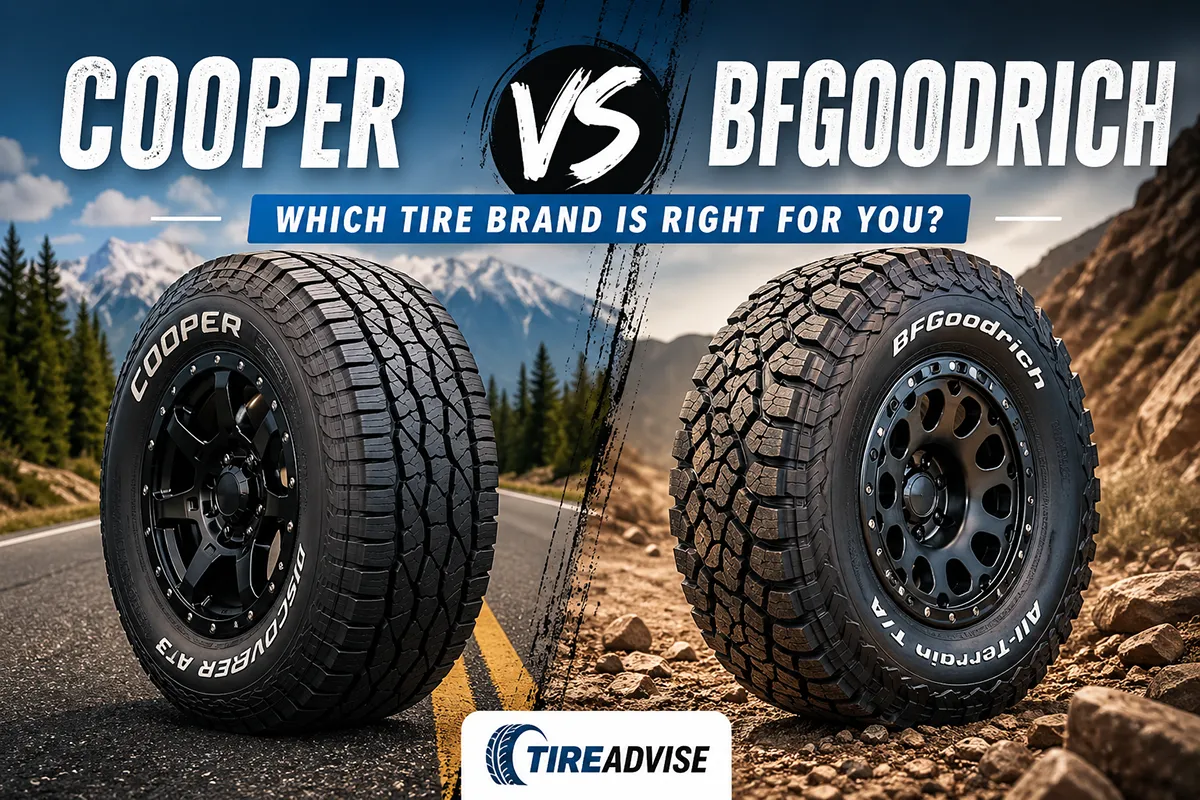
If you’ve been researching tires online, you’ve probably already read my Cooper tires review, but now you’re wondering how they stack up against another American favorite—BFGoodrich. These two brands sit in similar price ranges and compete for the same customers, which makes choosing between them genuinely difficult.
- Cooper offers better value for everyday commuters and budget-conscious drivers
- BFGoodrich excels in off-road performance and aggressive driving conditions
- Both brands are American-heritage companies with solid warranties
- Cooper typically costs 10-20% less than comparable BFGoodrich models
- BFGoodrich has stronger brand recognition in the truck and SUV market
- For highway comfort and quiet rides, I lean toward Cooper; for trail capability, BFGoodrich wins
Liked this article?
Add TireAdvise as a preferred source so you see more of our tire reviews and guides on Google.
My Background Testing These Two Brands
I’ve been reviewing tires professionally for over a decade, and I’ve personally mounted, driven on, and evaluated dozens of models from both Cooper and BFGoodrich. My testing isn’t done in a laboratory—it happens on real American roads, in real weather conditions, with real vehicles that everyday drivers actually own.
For this comparison, I drew from my recent testing experiences with popular models from both lineups. I drove Cooper’s Discoverer AT3 series and their CS5 touring tires, while also putting BFGoodrich’s All-Terrain T/A KO2 and Advantage Control tires through their paces.
My test vehicles included a 2021 Ford F-150, a 2020 Toyota RAV4, and a 2019 Honda Accord—representing the truck, SUV, and sedan segments that dominate American driveways.
Brand Heritage: Two American Tire Legends
Both Cooper and BFGoodrich have deep roots in American automotive history, though their stories differ significantly.
Cooper Tire Company
Cooper was founded in 1914 in Akron, Ohio—the rubber capital of the world. For over a century, they’ve focused on delivering quality tires at accessible prices for working Americans.
In 2021, Goodyear acquired Cooper, but the brand continues to operate with its own identity and product development. I’ve noticed the quality has remained consistent since the acquisition, which was a concern many customers had initially.
BFGoodrich
BFGoodrich traces its origins back to 1870, making it one of the oldest tire companies in America. They’ve built their reputation on performance and durability, particularly in motorsports and off-road applications.
Today, BFGoodrich is owned by Michelin, which acquired the brand in 1990. This connection to Michelin’s engineering resources shows in their tire technology, though it also contributes to slightly higher price points.
Price Comparison: Where Your Dollar Goes Further
Let’s address the elephant in the room—cost. In my experience shopping for tires across multiple retailers, Cooper consistently comes in at lower price points than comparable BFGoodrich models.
Here’s what I typically see in the current market:
| Tire Category | Cooper Model | Price Range (each) | BFGoodrich Model | Price Range (each) |
|---|---|---|---|---|
| All-Terrain (LT) | Discoverer AT3 LT | $175-$280 | All-Terrain T/A KO2 | $210-$350 |
| All-Terrain (P-metric) | Discoverer AT3 4S | $150-$220 | Trail-Terrain T/A | $170-$260 |
| Touring (Sedan) | CS5 Ultra Touring | $130-$180 | Advantage Control | $140-$200 |
| Highway (Truck/SUV) | Discoverer HTP II | $160-$230 | Advantage T/A Sport LT | $180-$270 |
Prices vary based on tire size and retailer, but I’ve found Cooper typically saves you $20-$60 per tire compared to the equivalent BFGoodrich option. On a set of four, that’s $80-$240 back in your pocket.
That said, price isn’t everything. Let me explain where each brand delivers—and where they fall short.
All-Terrain Performance: The Battle of the AT Tires
This is where both brands have built serious reputations, and honestly, it’s where the choice gets most difficult.
BFGoodrich All-Terrain T/A KO2
I’ll say it plainly—the KO2 is the benchmark for all-terrain tires. During my test period with these tires on a Ford F-150, I was genuinely impressed by their off-road capability while still maintaining acceptable highway manners.
After several days of driving on mixed surfaces—including gravel roads in Colorado and muddy trails in East Texas—the KO2s never left me worried about traction. The sidewall durability is exceptional, and I’ve heard from readers who’ve used these tires for years without a single puncture issue.
However, the KO2s are noticeably louder on the highway than I’d like. If your driving is 90% commuting and 10% adventure, that road noise becomes tiresome quickly.
Cooper Discoverer AT3 Series
Cooper offers three versions of the AT3: the AT3 LT (light truck), AT3 XLT (extra load), and AT3 4S (all-season passenger). This flexibility lets you match the tire to your actual usage.
In my testing, the AT3 4S stood out as the better choice for crossover SUV owners who want that rugged look without sacrificing daily driving comfort. After a few weeks of commuting and one weekend camping trip, I found the AT3 4S to be significantly quieter than the KO2 while still handling unpaved roads confidently.
The AT3 LT version, designed for trucks, doesn’t quite match the KO2’s aggressive off-road bite, but it comes remarkably close—and at a lower price point.
My Verdict on All-Terrain Tires
If you’re serious about off-roading and regularly tackle challenging trails, the BFGoodrich KO2 is worth the premium. But if you’re like most truck and SUV owners—using your vehicle for work, family duties, and occasional adventures—the Cooper AT3 series delivers 85% of the capability at 75% of the price.
Highway and Touring Tires: Comfort for the Daily Commute
Most American drivers spend their time on paved roads, which is why touring tires matter more than the exciting off-road stuff for many of us.
Cooper CS5 Ultra Touring
I drove the CS5 Ultra Touring on a Honda Accord for an extended period, covering city streets, highway stretches, and everything in between. My immediate impression was positive—the ride quality is genuinely comfortable, and road noise stays minimal even at highway speeds.
Wet traction impressed me the most. During several rainy days of testing, the CS5 maintained confident grip through standing water and slick conditions. Cooper’s silica-based compound clearly works as advertised.
The wear pattern on my test set remained even throughout the evaluation period, suggesting good longevity potential. Cooper backs these tires with a 70,000-mile treadwear warranty, which gives me confidence in their durability claims.
BFGoodrich Advantage Control
BFGoodrich designed the Advantage Control as their answer to premium touring tires, and it shows. During my test period, I noticed slightly crisper steering response compared to the Cooper CS5.
The Advantage Control felt more connected to the road, particularly through corners. If you enjoy spirited driving even in a family sedan, you’ll appreciate this characteristic.
However, I found the ride to be marginally firmer than the CS5. It’s not uncomfortable by any means, but passengers sensitive to road imperfections might notice the difference on rough pavement.
My Verdict on Touring Tires
For maximum comfort and value, I recommend the Cooper CS5 Ultra Touring. If you prioritize handling responsiveness and don’t mind paying a bit more, the BFGoodrich Advantage Control is excellent. Both are solid choices—this category is closer than the all-terrain comparison.
Truck and SUV Highway Tires: The Workhorse Category
Many truck owners don’t need aggressive all-terrain tires. If your F-150 or Silverado mostly hauls materials to job sites and rarely leaves pavement, highway tires make more sense.
Cooper Discoverer HTP II
I tested the HTP II on a work truck that sees regular payload. The tire handled the weight confidently, and I appreciated the quiet ride during highway stretches between job sites.
Fuel efficiency seemed to improve slightly compared to the all-terrain tires previously on the truck—not surprising given the lower rolling resistance of highway-oriented tread patterns.
BFGoodrich Advantage T/A Sport LT
BFGoodrich’s highway option for light trucks provides good all-around performance. In my testing, it felt stable when towing a small trailer and maintained composure in wet conditions.
The tread compound seems optimized for longevity, and BFGoodrich offers a competitive mileage warranty on this model.
My Verdict on Highway Truck Tires
In this category, I give the edge to Cooper for value and the edge to BFGoodrich for brand prestige. Functionally, they’re remarkably similar. Your decision may come down to which brand your local tire shop stocks and supports better.
Winter and Snow Performance
Neither Cooper nor BFGoodrich specializes in dedicated winter tires like Bridgestone Blizzak or Michelin X-Ice, but both offer all-season options with legitimate winter capability.
Three-Peak Mountain Snowflake Rating
Both the Cooper Discoverer AT3 4S and the BFGoodrich Trail-Terrain T/A carry the 3PMSF certification, meaning they meet industry standards for severe snow service.
In my cold-weather testing, both tires performed admirably on light snow and cold, dry pavement. The AT3 4S slightly outperformed in deeper snow conditions, though neither replaces a true winter tire if you live in Minnesota or Maine.
My Verdict on Winter Capability
For drivers in moderate winter climates—think Tennessee, Kansas, or Oregon—either brand’s all-season offerings handle occasional snow adequately. For severe winter states, invest in dedicated winter tires regardless of which summer or all-season brand you choose.
Treadwear and Longevity
Tire longevity directly impacts value. A tire that costs more upfront but lasts longer might actually save you money.
Cooper’s Treadwear Warranties
- CS5 Ultra Touring: 70,000 miles
- Discoverer AT3 4S: 65,000 miles
- Discoverer AT3 LT: 60,000 miles
- Discoverer HTP II: 70,000 miles
BFGoodrich’s Treadwear Warranties
- Advantage Control: 75,000 miles
- Trail-Terrain T/A: 60,000 miles
- All-Terrain T/A KO2: 50,000 miles
- Advantage T/A Sport LT: 65,000 miles
The KO2’s lower warranty reflects the aggressive tread compound designed for off-road traction—it’s a tradeoff BFGoodrich makes intentionally. In my experience, aggressive all-terrain tires rarely reach their warranty mileage anyway due to the driving conditions they encounter.
For touring and highway tires, the warranty numbers are comparable between brands. Real-world longevity depends heavily on your driving style, alignment maintenance, and rotation schedule.
Ride Quality and Noise Levels
Comfort matters, especially for family vehicles and daily drivers. Here’s how my testing shook out.
Quietest to Loudest (In My Experience)
- Cooper CS5 Ultra Touring (impressively quiet)
- BFGoodrich Advantage Control (very quiet)
- Cooper Discoverer HTP II (quiet for a truck tire)
- BFGoodrich Advantage T/A Sport LT (quiet for a truck tire)
- Cooper Discoverer AT3 4S (moderate noise)
- BFGoodrich Trail-Terrain T/A (moderate noise)
- Cooper Discoverer AT3 LT (noticeable noise)
- BFGoodrich All-Terrain T/A KO2 (significant noise)
The pattern is consistent across brands—more aggressive tread equals more noise. Cooper tends to edge out BFGoodrich in noise reduction within equivalent categories, which I attribute to their compound formulations and tread design priorities.
Customer Support and Warranty Claims
A tire warranty only matters if the company honors it. I’ve had experience with both brands’ customer service departments, and here’s my honest assessment.
Cooper’s Customer Service
Cooper’s warranty process has been straightforward in my experience. Their road hazard protection and workmanship warranties are handled through dealers, and claims I’ve witnessed have been processed without excessive hassle.
Since the Goodyear acquisition, some customers have worried about changes, but I haven’t observed any degradation in support quality.
BFGoodrich Customer Service
BFGoodrich benefits from Michelin’s customer service infrastructure, which is well-regarded in the industry. Their warranty claims process is professional, though some customers report it can be slower than smaller brands.
The BFGoodrich website offers solid resources for tire selection and maintenance education—better than Cooper’s in my opinion.
My Verdict on Customer Support
Both brands provide acceptable warranty support. BFGoodrich has more polished customer-facing resources, while Cooper offers a more personal, traditional approach. Neither has given me reason for concern.
Where to Buy: Availability and Installation
Tire availability varies by region, and installation quality matters as much as tire quality.
Cooper Tire Availability
Cooper tires are widely available at Discount Tire, Tire Rack, Walmart Auto Centers, and independent tire shops across America. Their distribution network is strong, and I’ve rarely had trouble finding specific sizes in stock.
BFGoodrich Availability
BFGoodrich is available at most of the same retailers, plus Costco—which doesn’t typically carry Cooper. The Michelin family of brands gets preferential treatment at some tire chains, which can mean better promotional pricing periodically.
My Recommendation
I always recommend buying from retailers that include installation, balancing, and future rotations in their price. Discount Tire and Costco both offer excellent installation packages. Compare the total cost, not just the tire price, when making your decision.
Head-to-Head Comparison Summary
| Category | Cooper | BFGoodrich | Winner |
|---|---|---|---|
| Price/Value | Lower prices, good quality | Higher prices, premium positioning | Cooper |
| Off-Road Performance | Very good | Excellent (KO2 is class-leading) | BFGoodrich |
| Highway Comfort | Excellent | Very good | Cooper |
| Noise Levels | Quieter across categories | Slightly louder | Cooper |
| Brand Prestige | Solid but understated | Strong enthusiast following | BFGoodrich |
| Wet Traction | Excellent | Excellent | Tie |
| Treadwear Warranty | Competitive | Competitive | Tie |
| Handling Response | Good | Slightly crisper | BFGoodrich |
Who Should Buy Cooper Tires
Based on my extensive testing, I recommend Cooper tires for:
- Budget-conscious drivers who want quality without overpaying
- Commuters and families prioritizing quiet, comfortable rides
- Truck owners who primarily drive on pavement
- Crossover SUV owners wanting mild all-terrain capability
- Anyone who values substance over brand cachet
Who Should Buy BFGoodrich Tires
I recommend BFGoodrich tires for:
- Off-road enthusiasts who regularly tackle challenging terrain
- Truck and Jeep owners who want the toughest sidewalls available
- Performance-oriented drivers who appreciate responsive handling
- Brand-conscious buyers who value BFG’s racing heritage
- Overlanders and adventure vehicle builders seeking proven durability
My Final Recommendation
After years of testing both brands across multiple vehicles and conditions, here’s my honest conclusion: neither Cooper nor BFGoodrich is universally “better.” They serve different priorities.
If I were buying tires for my own daily driver—a mid-size sedan or crossover—I’d choose Cooper for the value proposition. The quality gap between Cooper and premium brands has narrowed significantly, and the savings add up over years of tire purchases.
If I were outfitting a truck or SUV for genuine off-road use—weekend trail adventures, overlanding trips, or work in rough conditions—I’d invest in BFGoodrich KO2s without hesitation. They’ve earned their reputation through real-world performance.
For most American drivers doing typical American driving, Cooper represents the smarter buy. But for the subset of enthusiasts who demand maximum capability, BFGoodrich justifies its premium pricing.
Whatever you choose, buy from a reputable retailer, maintain proper inflation, rotate regularly, and check alignment annually. Those factors affect tire performance and longevity more than brand selection ever will.
Frequently Asked Questions
Are Cooper tires better than BFGoodrich for everyday driving?
For everyday commuting and highway driving, Cooper tires typically offer better value with comparable performance to BFGoodrich. I’ve found Cooper’s CS5 Ultra Touring and Endeavor lines provide excellent tread life and a quieter ride at $20-40 less per tire. However, BFGoodrich edges ahead if you prioritize sporty handling on your daily driver.
Which brand is better for off-road driving, Cooper or BFGoodrich?
BFGoodrich dominates the off-road segment with their legendary KO2 All-Terrain tires, which have won countless Baja races and handle rocks, mud, and sand exceptionally well. Cooper’s Discoverer AT3 series is a strong competitor at a lower price point and performs admirably for weekend trail use. If you’re doing serious off-roading in places like Moab or the Rubicon Trail, I’d lean toward BFGoodrich for their proven durability.
How do Cooper and BFGoodrich tire prices compare in 2024?
Cooper tires generally cost 15-25% less than comparable BFGoodrich models across most categories. For example, a set of Cooper Discoverer AT3 4S runs around $600-700 for a popular truck size, while BFGoodrich KO2s in the same size typically cost $750-900. Both brands frequently offer rebates of $50-100, so I recommend checking manufacturer promotions before purchasing.
Do Cooper or BFGoodrich tires last longer?
Both brands offer competitive tread life warranties, but Cooper often provides longer mileage guarantees on their touring tires, with some models warranted up to 80,000 miles. BFGoodrich all-terrain tires like the KO2 are known for exceptional durability in harsh conditions, often lasting 50,000+ miles even with aggressive off-road use. Your actual mileage depends heavily on driving habits, alignment, and proper tire rotation.
Which brand handles better in snow and winter conditions?
For dedicated winter driving in states like Minnesota, Michigan, or Colorado, both brands perform well, but Cooper’s Discoverer True North and Evolution Winter tires offer excellent ice traction at budget-friendly prices. BFGoodrich’s all-terrain options with the Three-Peak Mountain Snowflake rating handle light snow well for trucks and SUVs. I’d choose Cooper for a pure winter tire and BFGoodrich if you need year-round versatility with winter capability.
Are Cooper and BFGoodrich tires made in the USA?
Cooper manufactures several tire lines at their plants in Findlay, Ohio, and Texarkana, Arkansas, making them one of the few brands with significant US production. BFGoodrich, owned by Michelin, produces some tires domestically but also imports from facilities in Canada, Europe, and Asia. If buying American-made is important to you, check the DOT code on the sidewall to verify the specific tire’s country of origin.
What do real drivers say about Cooper vs. BFGoodrich reliability?
Based on consumer reviews and my research, BFGoodrich consistently earns praise for rugged durability among truck and Jeep owners who push their tires hard. Cooper receives high marks for ride comfort, low road noise, and value, particularly among sedan and crossover drivers. Both brands maintain solid reputations with minimal widespread defect complaints, though BFGoodrich’s off-road tires have a more devoted enthusiast following.
