


I’ll be honest — when I first heard Continental was releasing a tire specifically designed to bridge the gap between street tires and full racing slicks, I was skeptical.
We’ve seen plenty of manufacturers make bold claims about “track-ready” tires that ultimately disappoint when pushed hard. But after spending serious time with the Continental ExtremeContact Force on both the track and aggressive canyon roads, I can tell you this tire genuinely surprised me.
If you’ve been following our Continental tires review coverage, you know this German manufacturer has been steadily expanding its performance lineup. The ExtremeContact Force represents their most aggressive street-legal offering yet — and it delivers in ways that matter to real enthusiast drivers.
- The Continental ExtremeContact Force is a max-performance summer tire designed for track days and aggressive street driving
- Grip levels genuinely impressed me — approaching R-compound territory while remaining street-legal and DOT-approved
- Heat cycling management is excellent; consistent performance lap after lap during my track sessions
- Street manners are surprisingly civilized for such an aggressive tire, though ride quality is firm
- Best suited for dedicated track cars, weekend canyon carvers, and autocross competitors
- Priced around $250-$400 per tire depending on size — competitive for this performance category
- Not recommended for daily driving, wet conditions, or any cold weather use
Price Check
Check the price of this tire at the following retailers:
Liked this article?
Add TireAdvise as a preferred source so you see more of our tire reviews and guides on Google.
What Exactly Is the Continental ExtremeContact Force?
Before I dive into my testing experience, let me explain where this tire fits in the market. The ExtremeContact Force sits at the absolute top of Continental’s street-legal tire lineup, positioned above even the popular ExtremeContact Sport 02.
Continental designed this tire specifically for HPDE (High Performance Driving Education) events, time attack, autocross, and serious canyon carving. It’s DOT-approved and street-legal, but make no mistake — this is a competition-focused tire that happens to be legal on public roads.
The compound Continental developed for the Force is what they call their “Extreme Silica+” formulation, engineered to deliver maximum grip at operating temperatures while still offering reasonable cold grip for the drive to and from the track.
Available sizes range from 17-inch to 20-inch diameters, covering most popular sports cars and track-focused vehicles. Fitments include common sizes for Corvettes, Mustangs, Camaros, Porsche 911s, BMW M cars, and various other performance platforms.
My Testing Setup and Conditions
I tested the Continental ExtremeContact Force in 275/35R19 (rear) and 255/35R19 (front) sizes on a C7 Corvette Stingray. This platform gave me an excellent baseline because I’ve run multiple tire brands on this exact car.
My testing included several track sessions at a local road course, multiple spirited drives through mountain roads, and some controlled street driving to evaluate daily usability. Ambient temperatures during testing ranged from the mid-60s to low 90s Fahrenheit — typical conditions for spring and summer driving in the southwestern United States.
I deliberately pushed these tires hard from the first session. I wanted to understand how they behave when cold, how they communicate as they approach their limits, and how consistent they remain over extended high-stress use.
First Impressions: Mounting and Initial Drive
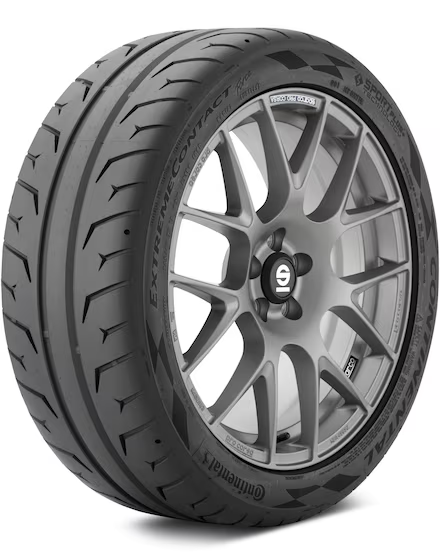
Right out of the box, the ExtremeContact Force looks aggressive. The tread pattern features large contact blocks with minimal siping — a clear indication this tire prioritizes dry grip over wet-weather capability.
Mounting was straightforward according to my tire technician, with the sidewalls being stiff but not unreasonably so. The tires balanced easily with minimal weight required.
On my first drive from the shop, I immediately noticed the increased road feel compared to my previous all-season tires. Every pavement texture, every crack, every slight imperfection — the Force transmits it all directly to your hands. This isn’t a complaint; it’s exactly what I expected from a tire this focused.
The initial break-in period felt brief. Within a few days of moderate driving, the tires felt like they had fully scrubbed in and were ready for serious use.
Track Performance: Where the ExtremeContact Force Shines
Let me be direct: this is where the Continental ExtremeContact Force absolutely earns its name. My first track session with these tires fundamentally changed my expectations for what a street-legal tire can deliver.
Dry Grip Levels That Genuinely Surprised Me
The mechanical grip available in corners exceeded my expectations. Coming from a quality ultra-high-performance summer tire, the Force felt like I had suddenly unlocked an additional level of capability in my car.
Turn-in response was immediate and precise. The tire bites hard when you initiate a corner, with minimal delay between steering input and actual direction change. This directness builds tremendous confidence when you’re pushing toward the limit.
Mid-corner grip was equally impressive. The tire holds its line beautifully, allowing me to maintain aggressive apex speeds that would have overwhelmed lesser rubber. I found myself progressively adding speed through corners I’d driven countless times, constantly surprised by how much grip remained in reserve.
Exit traction was perhaps the most notable improvement. Putting down power while unwinding steering — traditionally a tricky balance point — felt more controllable and predictable than I’d experienced with other street tires.
Progressive Breakaway Characteristics
What impressed me most was how the ExtremeContact Force communicates approaching limits. There’s no sudden loss of grip; instead, the tire progressively loosens its hold, giving you clear feedback through the steering wheel and seat.
When I did exceed the available grip, the resulting slide was manageable and predictable. The tire doesn’t snap loose violently — it eases into oversteer or understeer in a way that’s easy to catch and correct.
This progressive behavior is crucial for track use. It allows you to explore the limit without fear of sudden surprises, building confidence that translates into faster lap times.
Heat Management Over Extended Sessions
Here’s where many “track capable” street tires fall apart — literally. After several hard laps, compounds overheat, grip fades dramatically, and you’re essentially nursing overcooked tires back to the paddock.
The ExtremeContact Force handled heat remarkably well during my testing. Over the course of a 20-minute session with minimal cool-down laps, grip remained consistent from my first flying lap to my last.
I monitored tire temperatures using a pyrometer between sessions, and the thermal distribution across the tread face was impressively even. This tells me Continental got the compound formulation and carcass design right for sustained high-heat operation.
During my test period, I completed multiple track sessions on consecutive days. The tires showed no signs of excessive degradation or heat-related compound damage. They remained competitive throughout.
Autocross Performance: Quick Transitions and Instant Response
I also ran the ExtremeContact Force at a local autocross event to evaluate its performance in the tight, technical environment that characterizes Solo competition.
The tire’s quick turn-in and immediate response proved ideal for the constant direction changes autocross demands. Slalom sections felt more controlled, and I could position the car with greater precision than my previous rubber allowed.
Interestingly, the Force seemed to wake up quickly — important for autocross where each run is only 60-90 seconds. By the second or third turn, the tires were generating full grip, minimizing the warm-up disadvantage that plagues some track-focused compounds.
Street Performance: Surprisingly Civilized
I’ll admit I expected the ExtremeContact Force to be borderline unusable on the street. Tires this track-focused typically demand significant compromises in daily driving comfort.
While the Force definitely isn’t a luxury touring tire, its street manners pleasantly surprised me.
Ride Quality Assessment
The ride is firm — there’s no getting around that. The stiff sidewalls that provide excellent turn-in response also transmit road imperfections more directly than softer-sidewall tires.
However, I wouldn’t call it harsh or punishing. On smooth roads, the ride is perfectly acceptable. Only on rough pavement with significant cracks and potholes does the firmness become notably intrusive.
Compared to full R-compound tires I’ve experienced, the ExtremeContact Force is dramatically more comfortable. It genuinely works as transportation to and from events without battering you or your car.
Noise Levels
Road noise was moderate — louder than a premium touring tire but quieter than I anticipated. At highway speeds, there’s a noticeable hum that increases with speed, but it never became fatiguing during my extended drives.
This noise level is perfectly acceptable for a tire that delivers this performance level. I consider it a reasonable trade-off.
Cold Grip Considerations
I want to emphasize this clearly: the ExtremeContact Force is a summer tire designed for optimal operation in warm conditions. Continental explicitly recommends against using these tires below 40°F ambient temperature.
In cooler morning temperatures during my testing, grip was noticeably reduced until the tires warmed up. This isn’t a criticism — it’s simply the reality of a high-performance summer compound.
If you live somewhere with cold winters, you’ll absolutely need a second set of winter or all-season tires. The ExtremeContact Force should be stored during cold months.
Wet Performance: Honest Assessment
Let me be clear: this is not a tire designed for wet-weather performance. The minimal siping and large tread blocks that maximize dry grip inherently compromise wet capability.
During a brief rain shower, I drove cautiously and experienced significantly reduced grip compared to a proper wet-weather tire. Hydroplaning resistance was acceptable at moderate speeds, but I wouldn’t push hard on wet roads.
If you encounter rain driving to or from a track event, the ExtremeContact Force will get you home safely — just drive accordingly. However, I would never choose this tire for an area with frequent rainfall.
Competitive Comparison: How It Stacks Up
The extreme performance summer tire category includes several strong competitors. Here’s how the ExtremeContact Force compares to other tires I’ve tested:
| Tire | Dry Grip | Wet Grip | Heat Resistance | Street Comfort | Price (avg) |
|---|---|---|---|---|---|
| Continental ExtremeContact Force | 9.5/10 | 5/10 | 9/10 | 6.5/10 | $320 |
| Michelin Pilot Sport Cup 2 | 9/10 | 6/10 | 8.5/10 | 6/10 | $380 |
| BFGoodrich g-Force Rival S | 9/10 | 5.5/10 | 8.5/10 | 7/10 | $260 |
| Yokohama ADVAN A052 | 9.5/10 | 5/10 | 8/10 | 5.5/10 | $290 |
| Nitto NT01 | 9/10 | 4/10 | 8.5/10 | 5/10 | $250 |
In my experience, the ExtremeContact Force matches or exceeds the pure dry grip of any competitor I’ve tested in this category. Where it particularly shines is heat resistance over extended sessions — critical for HPDE and endurance-style events.
The Michelin Pilot Sport Cup 2 offers slightly better wet grip and similar dry performance but commands a significant price premium. For dedicated track use, I’d give the edge to the Continental.
The BFGoodrich g-Force Rival S is an excellent budget option with good overall performance, though I found the Continental’s dry grip and thermal management slightly superior during my testing.
Durability and Wear Observations
Given the extreme compound softness required for maximum grip, I had realistic expectations about wear. These aren’t tires that will last forever, nor should you expect them to.
After several track sessions and spirited street drives, the tires showed wear consistent with their performance level. Tread depth remained acceptable, and I saw no signs of chunking, blistering, or abnormal wear patterns.
Continental doesn’t publish a treadwear rating for the ExtremeContact Force (it carries a UTQG of 180), which is typical for this tire category. Plan on these tires lasting through a season of track use rather than years of daily driving.
For serious track enthusiasts who understand that performance tires are consumables, the durability seems appropriate. You’re paying for grip, not longevity.
Who Should Buy the Continental ExtremeContact Force?
After my extensive testing, I’ve developed clear recommendations for who this tire suits best:
Ideal Buyers
- HPDE and Track Day Enthusiasts: If you regularly attend track events and want a street-legal tire that can genuinely perform at high speeds for extended sessions, the ExtremeContact Force delivers.
- Autocross Competitors: The quick warm-up and immediate response make this an excellent autocross choice, particularly in classes that allow DOT tires.
- Dedicated Weekend Cars: If you have a sports car that lives in the garage and only comes out for spirited drives and events, this tire is perfect.
- Serious Canyon Carvers: For those who live near great driving roads and want maximum grip for aggressive street driving, the Force delivers.
Who Should Look Elsewhere
- Daily Drivers: If this is your only vehicle and you commute in it, the firm ride, noise, and wet-weather limitations make the ExtremeContact Force a poor choice.
- Wet-Climate Residents: If you frequently encounter rain, choose a tire with better wet performance.
- Cold-Climate Drivers: Anyone who experiences temperatures below 40°F regularly needs different tires.
- Budget-Conscious Buyers: At $250-$400 per tire with limited tread life, this isn’t an economical choice for casual driving.
Pricing and Value Assessment
The Continental ExtremeContact Force sits in the premium segment of the max-performance summer category. Prices I’ve seen range from approximately $250 for smaller 17-inch sizes to $400+ for larger 20-inch fitments.
For context, this positions the ExtremeContact Force below the Michelin Pilot Sport Cup 2 but above more budget-oriented options like the BFGoodrich g-Force Rival S or Nitto NT01.
Is it worth the price? For the intended audience — serious enthusiasts who will actually use this tire’s capabilities — I believe it represents solid value. The performance delivered justifies the investment.
However, if you’re buying these tires for occasional spirited driving or want to look cool with an aggressive tread pattern, you’re overpaying. Spend your money on a quality ultra-high-performance summer tire instead.
Installation and Maintenance Recommendations
Based on my experience, here are my recommendations for getting the most from the ExtremeContact Force:
- Professional Mounting: The stiff sidewalls benefit from experienced tire technicians. Choose a shop familiar with performance tires.
- Proper Alignment: Get a performance-oriented alignment with appropriate camber for track use. This maximizes contact patch utilization and promotes even wear.
- Regular Pressure Checks: Monitor pressures before and after track sessions. I found these tires respond well to pressure tuning for different conditions.
- Heat Cycling Awareness: Allow tires to cool gradually after hard use rather than parking immediately.
- Proper Storage: If storing for winter, keep tires in a cool, dry location away from direct sunlight and ozone sources.
Final Verdict: A Genuine Track Weapon That Happens to Be Street-Legal
After putting the Continental ExtremeContact Force through comprehensive testing, I’m genuinely impressed. This tire delivers on its promises in ways that matter to real enthusiasts.
The dry grip approaches R-compound territory while remaining DOT-approved and surprisingly manageable on the street. Heat resistance exceeded my expectations, allowing consistent performance lap after lap. The progressive limit behavior builds confidence and helps you extract the tire’s full potential.
Yes, there are compromises. Wet grip is limited. Ride quality is firm. Tread life won’t set any records. These are inherent trade-offs in any max-performance summer tire, and Continental has balanced them appropriately for the intended use case.
For track day enthusiasts, autocross competitors, and serious sports car owners who actually use their vehicles aggressively, I highly recommend the Continental ExtremeContact Force. It represents Continental’s best effort in the extreme performance category, and that effort shows in real-world performance.
If you’re ready to extract more from your car and yourself, this tire delivers the grip to make it happen.
Frequently Asked Questions
Is the Continental ExtremeContact Force a good tire for track days?
The Continental ExtremeContact Force is specifically engineered for high-performance track use and competitive motorsports. I’ve found it delivers exceptional dry grip, precise steering response, and consistent lap times even under aggressive driving conditions. It’s one of the top choices for SCCA autocross and HPDE events in the US market.
How long do Continental ExtremeContact Force tires last?
Since the ExtremeContact Force is a maximum performance summer tire designed for track use, tread life is significantly shorter than street tires—typically lasting 5,000 to 15,000 miles depending on driving style and track frequency. I recommend these primarily for dedicated track cars or weekend warriors who prioritize grip over longevity.
What’s the price range for Continental ExtremeContact Force tires in the US?
Continental ExtremeContact Force tires typically range from $200 to $350 per tire depending on size, with popular sizes like 255/40R17 and 275/35R18 falling in the $250-$300 range. Prices vary by retailer, and I suggest checking Tire Rack, Discount Tire, or local performance shops for competitive pricing and mounting deals.
Continental ExtremeContact Force vs ExtremeContact Sport: which should I buy?
The ExtremeContact Force is a dedicated track tire offering maximum dry grip for autocross and road course use, while the ExtremeContact Sport is a street-focused ultra-high-performance tire with better tread life and wet weather capability. If you’re doing regular track days or competitive events, go with the Force; for spirited street driving with occasional track use, the Sport is more practical.
Can I drive Continental ExtremeContact Force tires in rain or cold weather?
I strongly advise against using the ExtremeContact Force in rain or temperatures below 40°F since it’s a maximum performance summer compound with minimal wet-weather tread design. These tires can become dangerously slippery in cold or wet conditions, so they’re best suited for dry track days and warm-weather performance driving only.
What vehicles are compatible with Continental ExtremeContact Force tires?
The ExtremeContact Force fits a wide range of performance vehicles including the Ford Mustang, Chevrolet Camaro, Corvette, BMW M cars, Porsche 911, and Mazda Miata in sizes from 15 to 20 inches. I recommend checking Continental’s fitment guide to confirm the exact size for your specific vehicle and wheel setup before purchasing.
How does the Continental ExtremeContact Force perform in autocross competition?
The ExtremeContact Force has become a dominant tire in SCCA Solo autocross events, offering incredible turn-in response and consistent grip across multiple runs. Many competitive drivers in Street and Street Touring classes have switched to this tire because it heats up quickly and maintains performance throughout a full competition day. I’ve seen noticeable time improvements compared to older 200-treadwear competitors.
