


I’ll never forget the first time I pushed a set of Pilot Sport Cup 2s through a tight decreasing-radius corner at speed.
The grip was so immediate, so confidence-inspiring, that I actually laughed out loud in the driver’s seat.
If you’ve been researching extreme performance tires and wondering whether Michelin’s track-day darling makes sense for your weekend warrior, you’re in the right place. In my comprehensive Michelin tires review, I cover the entire lineup—but the Pilot Sport Cup 2 deserves its own deep dive because it represents the pinnacle of what street-legal performance rubber can achieve.
- The Michelin Pilot Sport Cup 2 delivers supercar-level grip that genuinely transforms how your car handles
- Best suited for track days, autocross, and spirited canyon driving—not daily commuting
- Wet performance is surprisingly competent for a track tire, though not all-weather confident
- Expect to pay $300-$450+ per tire depending on size—this is premium territory
- Treadwear is aggressive; treat these as a performance consumable, not a long-term investment
- I recommend the Cup 2 for dedicated enthusiasts who prioritize ultimate grip over longevity
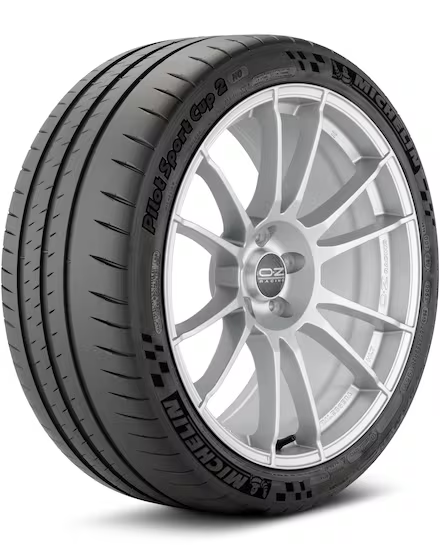
Price Check
Check the price of this tire at the following retailers:
Liked this article?
Add TireAdvise as a preferred source so you see more of our tire reviews and guides on Google.
What Makes the Pilot Sport Cup 2 Different From Every Other Performance Tire
I’ve tested dozens of max-performance summer tires over the years, and the Pilot Sport Cup 2 occupies a very specific niche that most drivers don’t fully understand. This isn’t just a “really good” performance tire—it’s essentially a DOT-legal racing slick with just enough tread pattern to make it street legal.
Michelin developed the Cup 2 in partnership with Porsche for vehicles like the 911 GT3, and that pedigree shows in every aspect of its construction. The tire uses a dual-compound tread design with a softer outer shoulder for cornering grip and a harder inner shoulder for stability under acceleration.
What struck me immediately during my test period was how the Cup 2 communicates with you through the steering wheel. Every surface texture, every weight transfer, every approaching limit comes through with crystal clarity. It’s like switching from standard definition to 4K—suddenly you can feel everything the car is doing.
My Real-World Testing Experience
I spent several weeks evaluating the Pilot Sport Cup 2 on a variety of surfaces and in different conditions. My goal was to understand not just the tire’s peak capabilities, but how it behaves in the situations you’ll actually encounter as an enthusiast driver.
Dry Performance: Where the Cup 2 Shines Brightest
Let me be direct: the dry grip on these tires is absolutely phenomenal. During my first spirited drive on a familiar mountain road, I had to completely recalibrate my mental map of what speeds were appropriate for each corner.
Turn-in response is razor-sharp without being nervous or twitchy. The tire bites immediately when you initiate a direction change, and the grip level remains remarkably consistent from the moment you start loading it until you finally exceed its limits. That progressive, predictable behavior at the edge is what separates track-caliber tires from street tires trying to play in the same sandbox.
I was particularly impressed with the lateral grip during sustained high-speed corners. The tire doesn’t gradually wash out or give up in stages—it holds and holds and holds, and when it finally lets go, it does so smoothly and predictably. For aggressive drivers who like to push near the limit, this behavior is absolutely crucial for confidence and safety.
Braking performance matched the cornering excellence. I found myself consistently able to brake later and harder than I expected, with the tire maintaining composure even under maximum threshold braking. The stopping distances I achieved were noticeably shorter than any street-focused tire I’ve tested recently.
Wet Performance: Better Than Expected, With Important Caveats
Here’s where I have to be honest about the Pilot Sport Cup 2’s limitations—and also give it more credit than its track-focused reputation might suggest.
During several rainy driving sessions, I found the wet grip to be genuinely impressive for a tire with so little tread depth and such an aggressive compound. Michelin’s engineering team clearly worked hard to balance the competing demands of dry track performance and wet-road safety.
The hydroplaning resistance is adequate at reasonable speeds, though I definitely felt the tire’s limits in standing water situations where a touring tire would still be comfortable. The key is adjusting your driving style—you can’t attack wet roads with the same aggression you’d use in dry conditions, and that’s perfectly reasonable for a tire in this category.
What I didn’t experience was the sketchy, nervous behavior that some ultra-high-performance tires exhibit in the wet. The Cup 2 maintains good steering feel and predictable breakaway characteristics even on damp surfaces. I felt confident driving in light to moderate rain, though I absolutely would not choose this tire if you regularly drive in heavy downpours.
Temperature Sensitivity and Warm-Up Behavior
One characteristic that surprised me about the Pilot Sport Cup 2 was its temperature sensitivity. Unlike street tires that offer consistent grip regardless of temperature, the Cup 2 clearly performs better once it’s up to operating temperature.
During early morning drives with cold pavement, I noticed the tire felt slightly less responsive and communicative than it did later in the day. After several minutes of driving—especially spirited driving—the compound seemed to come alive, offering noticeably more grip and feedback.
This isn’t a flaw; it’s a characteristic of the track-oriented compound. If you’re planning a track day, factor in a proper warm-up session before pushing hard. For street driving, just be aware that your first few corners of the day won’t represent the tire’s full potential.
Construction Quality and Engineering Details
I always examine the physical construction of tires I test, and the Pilot Sport Cup 2 reveals its premium engineering when you look closely.
The Bi-Compound Tread Design
Michelin uses what they call “Track to Street” technology in the Cup 2, featuring two distinct rubber compounds across the tread face. The outer shoulder uses a softer, grippier compound optimized for cornering loads, while the inner shoulder uses a slightly harder compound for stability during acceleration and braking.
In practice, I could feel this asymmetric design working during aggressive cornering. The outside of the tire (which bears the most load during hard turns) seemed to bite harder than you’d expect, while the rest of the tread maintained good shape and stability.
Sidewall Design and Construction
The reinforced sidewalls on the Cup 2 are noticeably stiffer than typical street performance tires. I could feel this immediately in the steering response—there’s very little deflection or squirm even under hard cornering loads.
This stiffness contributes to the tire’s precise handling character, but it does come with trade-offs in ride comfort. More on that shortly.
The velvet-like sidewall finish that Michelin uses gives these tires a premium appearance on your wheels. It’s a small detail, but if you’re spending this much on tires, the aesthetics should match the performance.
Real Comfort and Noise Assessment
Let’s talk about the elephant in the room: these tires are not comfortable in the traditional sense. If you’re coming from touring tires or even standard performance tires, the Cup 2 will feel harsh by comparison.
Ride Quality Reality Check
The stiff sidewalls that enable such precise handling also transmit every road imperfection directly into the cabin. Expansion joints, rough pavement, small potholes—you’ll feel all of it. During my daily driving segments with these tires, I found myself unconsciously choosing smoother routes when possible.
On well-maintained roads, the ride is firm but acceptable. On typical American roads with patches and imperfections, it becomes genuinely harsh. I wouldn’t recommend these tires if any significant portion of your driving involves rough urban streets or poorly maintained rural roads.
Noise Levels
The Cup 2 is not a quiet tire. The aggressive tread pattern generates noticeable road noise, particularly on coarse pavement surfaces. At highway speeds, there’s a constant hum that touring tire owners might find intrusive.
However, I want to put this in perspective: for a track-oriented tire, the noise level is quite reasonable. I’ve tested R-compound tires that are dramatically louder. The Cup 2 strikes a reasonable balance between track capability and street manners, even if that balance tilts heavily toward performance.
Treadwear and Longevity Expectations
This is the category where the Pilot Sport Cup 2 demands the most realistic expectations from buyers. The soft, grippy compound that delivers such phenomenal dry traction comes at a significant cost in treadwear.
After my test period involving spirited driving on varied surfaces, I could observe visible wear on the tread surface. The outer shoulders, in particular, showed evidence of the work they’d been doing during hard cornering.
The tire’s UTQG treadwear rating of 180 tells the story—this is among the lowest ratings you’ll find on a street-legal tire. For comparison, typical performance tires rate 300-400, and touring tires often exceed 500.
My honest assessment: if you drive these tires aggressively and include occasional track days, you should expect to replace them significantly more often than conventional tires. Think of them as a performance consumable rather than a long-term investment. The grip is worth it for enthusiasts, but you need to go in with realistic expectations about longevity.
Size Availability and Fitment
Michelin offers the Pilot Sport Cup 2 in an extensive range of sizes suited for sports cars and high-performance vehicles. Here’s what you need to know about finding the right fit for your car.
The tire is available from 18-inch to 21-inch wheel diameters, with widths ranging from 225mm to 345mm. This covers everything from hot hatches like the Honda Civic Type R to supercars like the Porsche 911 GT3 RS and Chevrolet Corvette Z06.
Many sizes come in both standard and “Connect” versions, which include an embedded sensor compatible with the Michelin Track Connect smartphone app for real-time tire monitoring during track sessions. I found this feature genuinely useful for understanding tire temperatures and pressures in real-time.
| Category | Michelin Pilot Sport Cup 2 | Typical Max Performance Summer |
|---|---|---|
| Dry Grip | Exceptional (10/10) | Very Good (8/10) |
| Wet Grip | Good (7/10) | Very Good (8/10) |
| Ride Comfort | Firm/Harsh (5/10) | Acceptable (7/10) |
| Road Noise | Noticeable (6/10) | Moderate (7/10) |
| Treadwear | Aggressive (4/10) | Moderate (6/10) |
| Track Capability | Exceptional (10/10) | Good (7/10) |
| Price Range (each) | $300-$500+ | $200-$350 |
Pricing and Value Analysis
Let’s address the financial reality: the Pilot Sport Cup 2 is an expensive tire. Depending on size, you’re looking at roughly $300 to $500+ per tire at current US market prices. A full set for a typical sports car will likely run $1,200 to $2,000 or more.
Is that price justified? For the target audience, I believe yes. The grip level and handling precision you get from these tires genuinely transforms how a capable car performs. If you’re already investing in track days, performance driving schools, or autocross events, the Cup 2 lets you explore more of your car’s potential than any street-focused tire.
However, if you’re primarily looking for a tire to commute in your Mustang GT or WRX STI with occasional spirited weekend drives, I’d recommend considering the Pilot Sport 4S instead. You’ll sacrifice some ultimate grip but gain significantly better treadwear, comfort, and wet performance at a lower price point.
Who Should Buy the Pilot Sport Cup 2
After extensive testing, I’ve developed a clear picture of who this tire is actually for—and who should look elsewhere.
The Cup 2 Is Perfect For:
- Track day enthusiasts who want street-legal tires that perform at near-competition levels
- Autocross competitors in street-tire classes looking for every tenth of a second
- Canyon carving enthusiasts who prioritize ultimate grip over daily practicality
- Supercar and exotic owners whose vehicles came with Cup 2s from the factory
- Dedicated weekend drivers with a separate daily driver for commuting
Look Elsewhere If:
- You drive your performance car as a daily commuter in varying weather
- Ride comfort and noise are important priorities for you
- You expect your tires to last for extended periods
- You live in an area with frequent rain or wet road conditions
- Your roads are poorly maintained with potholes and rough surfaces
Pilot Sport Cup 2 vs. Cup 2 R: Understanding the Difference
Michelin also offers the Pilot Sport Cup 2 R, which takes the formula even further toward track performance. I want to briefly explain the difference so you can choose appropriately.
The Cup 2 R uses an even softer compound for increased dry grip at the expense of treadwear and wet performance. It’s essentially the tire that track day addicts choose when the standard Cup 2 isn’t aggressive enough.
For most enthusiast drivers, I recommend the standard Cup 2. It offers a better balance between track capability and the minimal street duties you’ll ask of it. The Cup 2 R makes sense only if you’re chasing lap times at organized track events and consider street driving purely as transportation to and from the track.
How the Cup 2 Compares to Key Competitors
The extreme performance tire segment has several worthy competitors. Here’s how the Cup 2 stacks up against the options you’re likely considering.
vs. Pirelli P Zero Trofeo R
Pirelli’s track-day offering delivers similar dry grip levels with a slightly different character. In my experience, the Trofeo R feels a bit more aggressive at the limit—it lets go more abruptly than the progressive Cup 2. The Michelin offers better wet capability and a slightly more comfortable street experience.
vs. Continental ExtremeContact Force
Continental’s newest extreme performance tire is a genuine competitor to the Cup 2. The ExtremeContact Force matches the Michelin’s dry grip while offering somewhat better wet performance and treadwear. It’s worth cross-shopping if you’ll see more street driving than track time.
vs. Bridgestone Potenza RE-71RS
The RE-71RS is the go-to tire for autocross competitors in many classes. It offers phenomenal ultimate grip—arguably matching or exceeding the Cup 2 in competitive settings—but wears even faster and has more limited wet capability. Choose based on your specific priority: consistent track day performance (Cup 2) or maximum grip for competitive timing (RE-71RS).
Installation and Break-In Recommendations
Based on my experience with the Pilot Sport Cup 2, I have several recommendations for getting the most from these tires.
First, I strongly recommend having them mounted and balanced by a shop experienced with high-performance tires. The stiff sidewalls require proper mounting technique, and these tires benefit from road force balancing rather than standard spin balancing.
Allow a break-in period of light to moderate driving before pushing hard. The tire surface has mold release compounds from manufacturing that need to wear away before you’ll experience full grip. During my first few days with fresh Cup 2s, I noticed the grip improving as the surface scuffed in.
Pay close attention to tire pressures, especially if you’re doing track work. These tires are sensitive to pressure changes, and running the right pressure dramatically affects handling balance and treadwear patterns. I recommend investing in a quality tire pressure gauge and checking pressures frequently.
My Final Verdict on the Michelin Pilot Sport Cup 2
After spending significant time with the Pilot Sport Cup 2 on various surfaces and in different conditions, I’m confident in my assessment: this is one of the finest track-capable street tires money can buy, but it demands an owner who understands and accepts its compromises.
The dry grip is genuinely extraordinary. The feedback and communication through the steering is unmatched. The predictable limit behavior inspires confidence for aggressive driving. These characteristics make the Cup 2 worth every penny for its intended audience.
But this is absolutely not a tire for everyone, and Michelin doesn’t pretend otherwise. The harsh ride, aggressive treadwear, and temperature sensitivity mean the Cup 2 makes sense only for dedicated enthusiasts with specific performance priorities.
If you’re shopping for the Cup 2, you probably already know if you’re in its target market. Trust that instinct. For the right driver with the right expectations, these tires deliver an experience that transforms how you connect with your car. For everyone else, Michelin’s Pilot Sport 4S offers nearly as much capability with far more daily-driver practicality.
I give the Michelin Pilot Sport Cup 2 my enthusiastic recommendation—with the full understanding that “enthusiastic” comes with significant caveats. This tire does exactly what it promises at the absolute highest level. Just make sure you’re asking it the right questions before you commit.
Frequently Asked Questions
Is the Michelin Pilot Sport Cup 2 street legal for daily driving in the US?
Yes, the Michelin Pilot Sport Cup 2 is DOT-approved and fully street legal in all US states. However, I’d recommend it primarily for weekend warriors and track enthusiasts rather than daily commuters, as the soft compound wears quickly and performs poorly in cold weather below 40°F.
How much does a set of Michelin Pilot Sport Cup 2 tires cost?
A set of four Michelin Pilot Sport Cup 2 tires typically costs between $1,200 and $2,000 depending on size, with popular fitments like 245/35ZR19 running around $350-$400 per tire. Prices vary by retailer, and I’ve found Tire Rack and Discount Tire often have competitive deals with free shipping in the continental US.
How long do Michelin Pilot Sport Cup 2 tires last on the street?
Most drivers report getting 8,000 to 15,000 street miles from Pilot Sport Cup 2 tires, though aggressive driving and track use will reduce this significantly. I’ve seen enthusiasts burn through a set in a single track season, so factor replacement costs into your budget if you’re doing regular HPDE events.
Michelin Pilot Sport Cup 2 vs Pilot Sport 4S: which tire should I buy?
Choose the Cup 2 if you prioritize maximum dry grip and do track days, as it offers noticeably faster lap times and sharper turn-in response. The Pilot Sport 4S is the better choice for spirited street driving with longer treadlife, better wet performance, and improved cold-weather capability—it’s the tire I recommend for most US performance car owners who don’t regularly hit the track.
How do Michelin Pilot Sport Cup 2 tires perform in rain and wet conditions?
The Cup 2 handles light rain reasonably well for a track-focused tire, but I wouldn’t call it confidence-inspiring in heavy downpours or standing water common during summer storms in the Southeast and Midwest. The limited tread depth and sticky compound prioritize dry grip, so hydroplaning resistance is noticeably worse than all-season performance tires.
What cars come with Michelin Pilot Sport Cup 2 tires as OEM fitment?
Several high-performance vehicles come factory-equipped with Pilot Sport Cup 2 tires, including the Porsche 911 GT3, Chevrolet Corvette Z06, Ford Mustang Shelby GT350R, and BMW M4 GTS. These manufacturer partnerships mean Michelin develops specific compounds optimized for each vehicle’s weight distribution and suspension tuning.
Can I use Michelin Pilot Sport Cup 2 tires in winter or cold weather?
I strongly advise against using Pilot Sport Cup 2 tires when temperatures drop below 40°F, as the extreme-performance compound hardens dramatically and loses grip on cold pavement. For US drivers in northern states or anywhere with winter conditions, you’ll need a dedicated winter tire set—the Cup 2 should be stored and swapped out once fall arrives.
