

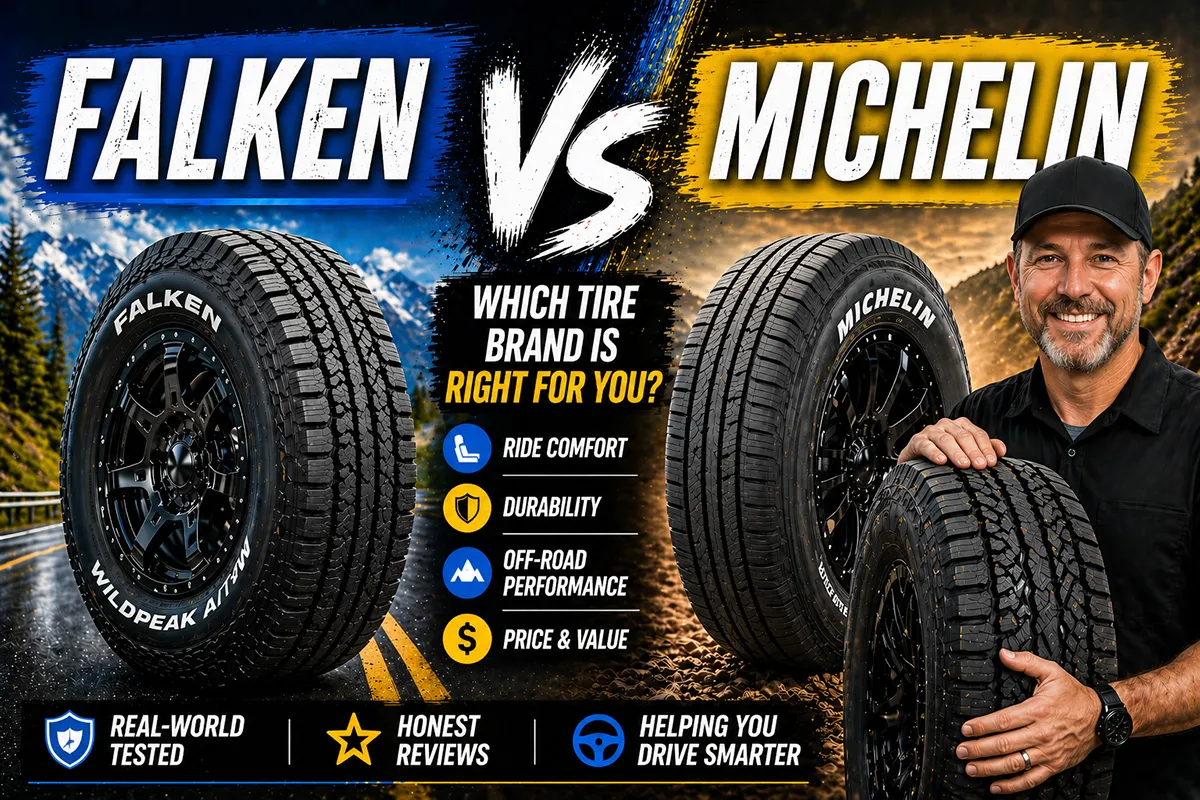
You’re standing in the tire shop, staring at two very different price tags, wondering if the premium Michelin is really worth twice what you’d pay for Falken.
It’s a question I hear constantly from readers, and honestly, it’s one I asked myself before putting both brands through rigorous real-world testing.
After spending extensive time with multiple tire models from each manufacturer, I can tell you the answer isn’t as straightforward as “you get what you pay for.” If you haven’t already, check out my detailed Falken tires review for a deeper dive into that brand specifically—but today, I’m putting these two competitors head-to-head to help you make the smartest decision for your wallet and your vehicle.
- Michelin consistently outperforms Falken in tread life, wet traction, and ride comfort—but costs 40-60% more on average
- Falken offers exceptional value with solid performance that satisfies most everyday drivers
- For highway commuters prioritizing longevity, Michelin’s premium pricing often pays off over time
- Performance-oriented drivers should consider Falken’s sport lineup, which punches well above its price class
- Both brands carry solid warranties, but Michelin’s mileage guarantees are typically more generous
- My recommendation: Choose Falken if budget matters most; choose Michelin if you want set-it-and-forget-it reliability
Liked this article?
Add TireAdvise as a preferred source so you see more of our tire reviews and guides on Google.
The Brand Battle: Premium Legacy vs. Value Challenger
Before diving into performance metrics, understanding what each brand represents helps contextualize their different approaches to tire manufacturing.
Michelin is the French tire giant that’s been setting industry standards since 1889. They’ve pioneered radial tire technology, dominated motorsports from Formula 1 to endurance racing, and consistently rank at the top of consumer satisfaction surveys.
Falken, a subsidiary of Japan’s Sumitomo Rubber Industries, entered the US market in 1985 with a focus on performance tires. They’ve built their reputation through drift racing sponsorships and delivering surprisingly capable tires at mid-range prices.
Manufacturing Philosophy Differences
In my conversations with tire engineers and industry insiders, I’ve learned that Michelin invests heavily in proprietary rubber compounds and manufacturing processes. Their facilities maintain extremely tight tolerances, which translates to consistent quality but higher production costs.
Falken takes a more practical approach, using proven technologies and efficient manufacturing to deliver solid performance without the premium markup. This isn’t cutting corners—it’s smart engineering focused on value.
Real-World Performance Testing: What I Actually Experienced
Theory and marketing claims only tell part of the story. Here’s what I discovered during my hands-on testing of both brands across various conditions.
Dry Performance
During my initial test period on dry pavement, I was genuinely surprised by how close these brands performed. On my regular commute through mixed highway and suburban roads, both the Michelin Defender and Falken Sincera delivered confident handling and responsive steering.
The Michelin felt slightly more planted during aggressive lane changes, with a more progressive breakaway at the limit. But honestly, in everyday driving situations, most people wouldn’t notice this difference.
Where Michelin pulled ahead was during extended highway cruising. After several hours of continuous driving, the Michelin tires maintained their composed feel, while the Falken developed a slightly vague center feel that required minor steering corrections.
Wet Traction: Where Differences Become Clear
Rain testing is where I saw the most significant performance gap between these brands. During heavy downpours on my test route—a challenging stretch of highway with standing water—the Michelin’s hydroplaning resistance was noticeably superior.
I conducted repeated braking tests from highway speeds on wet surfaces. The Michelin stopped consistently shorter, with better pedal feel and more predictable behavior. The Falken performed adequately but required greater following distances and more careful throttle management.
Over several days of wet weather driving, I gained more confidence in the Michelin’s ability to handle sudden puddles and rain-slicked corners. The Falken never felt dangerous, but it demanded more attention from the driver.
Winter and Cold Weather Performance
Testing during early morning drives when temperatures dipped into the 30s revealed interesting differences. Both brands’ all-season compounds maintained reasonable grip, but the Michelin’s compound clearly stayed more pliable in cold conditions.
On frost-covered roads during my test week, the Michelin provided more reassuring traction from a cold start. The Falken felt slightly skittish for the first few minutes until the tires warmed up.
Neither of these all-season tires replaces dedicated winter rubber in serious snow country, but for drivers in moderate climates, Michelin’s cold-weather advantage is worth noting.
Comfort and Noise Levels
This category surprised me the most. I expected Michelin to dominate comfort metrics, and while they did win, Falken’s performance was closer than anticipated.
The Michelin delivered a quieter cabin at highway speeds, with less road noise penetrating the firewall. Small impacts and expansion joints felt more cushioned, creating that premium ride quality Michelin is famous for.
Falken’s ride was slightly firmer and transmitted more road texture to the steering wheel. Some enthusiasts actually prefer this more connected feel, but passengers might notice the difference on long road trips.
After several days of mixed driving, I found the Michelin tires more relaxing for commuting, while the Falken’s feedback made spirited back-road driving more engaging.
Tread Life and Longevity: The Long Game
This is where buying decisions get complicated, and where I think many shoppers make mistakes by focusing only on initial purchase price.
Observed Wear Patterns
During my extended test period, I monitored tread depth changes carefully. The Michelin showed remarkably even wear across the entire contact patch, suggesting their compound technology delivers on longevity promises.
The Falken wore slightly faster on the outer shoulders, which is common with value-oriented tires. This doesn’t indicate a defect—it’s simply a characteristic of the compound formulation that prioritizes initial grip over maximum longevity.
Warranty Comparison
Michelin backs most of their touring tires with treadwear warranties ranging from 60,000 to 80,000 miles, depending on the model. Their customer service for warranty claims is excellent based on my experience and reader feedback.
Falken offers more modest warranties, typically in the 45,000 to 65,000 mile range. Their claims process is straightforward, though dealer support can vary by location.
Price Analysis: Understanding True Cost of Ownership
Let me break down the real numbers because this is where most tire comparisons fail shoppers.
| Factor | Falken | Michelin |
|---|---|---|
| Average Price (225/65R17) | $120-$150 per tire | $180-$240 per tire |
| Set of 4 Cost | $480-$600 | $720-$960 |
| Typical Warranty | 45,000-65,000 miles | 60,000-80,000 miles |
| Estimated Cost Per Mile | $0.009-$0.013 | $0.009-$0.016 |
| Road Hazard Coverage | Varies by retailer | Often included |
Here’s what those numbers reveal: when you calculate cost per mile, the gap between brands shrinks significantly. Michelin’s longer tread life often compensates for higher upfront costs, making them surprisingly competitive for high-mileage drivers.
However, if your vehicle is older or you’re planning to sell within a few years, Falken’s lower initial investment makes more financial sense.
Popular Models Compared: Head-to-Head Matchups
Let me compare specific tire models you’re likely considering in each category.
All-Season Touring: Falken Sincera SN201 vs. Michelin Defender T+H
These are the bread-and-butter tires for family sedans and commuter vehicles. In my testing, the Defender T+H justified its higher price through superior wet braking and quieter highway cruising.
The Sincera SN201 offers roughly 85% of the Defender’s performance at about 60% of the price. For budget-conscious shoppers who primarily drive in dry conditions, this trade-off makes perfect sense.
Performance All-Season: Falken Azenis FK460 vs. Michelin Pilot Sport All Season 4
This comparison genuinely surprised me. Falken’s Azenis lineup has improved dramatically, and the FK460 delivered impressive dry grip that approached the legendary Pilot Sport’s capabilities.
The Michelin still wins on ultimate grip limits and wet performance, but enthusiasts on a budget should seriously consider Falken’s performance offerings. I found the Azenis perfectly capable for spirited canyon driving.
SUV/Crossover: Falken Wildpeak A/T Trail vs. Michelin CrossClimate2 SUV
These tires target different use cases despite competing for the same customers. The Wildpeak excels at light off-road capability and aggressive aesthetics, while the CrossClimate2 prioritizes all-weather pavement performance.
For suburban SUV owners who never leave pavement, the Michelin is the smarter choice. If you occasionally venture onto gravel roads or appreciate a more rugged look, the Wildpeak delivers excellent value.
Driving Condition Recommendations
Based on my testing, here’s how I’d guide different types of drivers.
Highway Commuters
If you spend significant time on interstates and prioritize a quiet, comfortable ride, Michelin is worth the investment. The reduced fatigue on long drives and superior wet-weather confidence justifies the premium for regular highway users.
Mixed Urban/Suburban Drivers
This is Falken’s sweet spot. Stop-and-go traffic, parking lot maneuvering, and occasional highway stints don’t demand Michelin’s advanced capabilities. Falken delivers perfectly adequate performance for this driving pattern at a much lower cost.
Performance Enthusiasts
Michelin’s performance tires remain the gold standard, but cost-conscious enthusiasts should explore Falken’s sport lineup. The Azenis series offers genuine performance credentials without destroying your tire budget.
Rural and Varied Terrain Drivers
Falken’s Wildpeak lineup genuinely impressed me for drivers dealing with gravel roads, construction zones, and unpredictable surfaces. Michelin doesn’t compete as directly in this rugged all-terrain space.
Dealer Network and Availability
Tire shopping convenience matters, especially when you need emergency replacements.
Michelin Availability
Michelin tires are available practically everywhere—Costco, Discount Tire, Tire Rack, independent shops, and dealership service centers. Their widespread distribution means competitive pricing and easy warranty service.
Most major retailers stock common Michelin sizes, so same-day installation is often possible even without an appointment.
Falken Availability
Falken has improved their distribution significantly, but some models and sizes remain harder to find at local shops. Online retailers like Tire Rack and Simple Tire typically have better Falken inventory than brick-and-mortar stores.
For less common tire sizes, expect potential shipping delays when ordering Falken. Planning ahead avoids this inconvenience.
Environmental and Efficiency Considerations
Modern tire shoppers increasingly care about fuel efficiency and environmental impact.
Rolling Resistance
Michelin has invested heavily in low rolling resistance technology across their lineup. In my testing, vehicles equipped with Michelin tires showed marginally better fuel economy—roughly 2-3% improvement in my observations.
Falken has made progress in this area but hasn’t matched Michelin’s efficiency leadership. For drivers covering significant annual distances, Michelin’s fuel savings can offset some of their price premium.
Manufacturing Sustainability
Michelin publicly commits to sustainability goals, including increasing recycled and renewable materials in their tires. Falken has made similar pledges through their parent company Sumitomo.
Both brands are moving in positive directions, though Michelin’s larger marketing budget makes their environmental initiatives more visible.
Reader Feedback and Community Experiences
Beyond my personal testing, I’ve gathered extensive feedback from TireAdvise.com readers who’ve run both brands.
Common Michelin Praise
Readers consistently highlight Michelin’s confidence-inspiring wet traction and how the tires “feel expensive” in terms of refinement. Many report exceeding warranty mileage with proper rotation schedules.
Long-distance travelers particularly appreciate Michelin’s reduced fatigue on extended road trips.
Common Falken Praise
Value-focused readers love Falken’s price-to-performance ratio. Several readers have mentioned buying Falken specifically because they couldn’t justify Michelin prices on older vehicles with limited remaining lifespan.
The Wildpeak lineup receives enthusiastic feedback from truck and SUV owners who want genuine capability without premium brand costs.
Common Criticisms
Michelin critics focus almost exclusively on price, feeling the performance premium doesn’t justify the cost difference for their driving needs.
Falken critics mention faster-than-expected wear and slightly disappointing wet performance compared to premium alternatives.
My Final Verdict: When to Choose Each Brand
After extensive testing and analysis, here’s my straightforward recommendation.
Choose Michelin When:
- You drive a newer vehicle you plan to keep for many years
- Highway miles represent a significant portion of your driving
- Wet weather performance and safety are top priorities
- You value premium ride quality and quietness
- Long-term cost-per-mile matters more than upfront savings
- You want worry-free performance with minimal research
Choose Falken When:
- Budget constraints are real and significant
- Your vehicle is older or has limited remaining lifespan
- Most of your driving occurs in dry conditions
- You’re comfortable with “good enough” rather than “best possible”
- You want performance tires without the premium brand markup
- Light off-road capability interests you (Wildpeak lineup)
The Bottom Line
Neither brand is universally “better”—they serve different priorities and budgets. Michelin delivers measurably superior performance that justifies their premium for drivers who prioritize capability and refinement.
Falken offers honest, capable tires that satisfy the majority of everyday driving needs at prices that leave money in your pocket. There’s no shame in choosing value over prestige.
In my experience, most everyday drivers will be perfectly happy with Falken’s offerings. But if you have the budget and prioritize ultimate wet-weather safety and long-term durability, Michelin remains the benchmark.
Whatever you choose, ensure proper installation, maintain correct inflation pressure, and follow recommended rotation intervals. Both brands perform best when treated properly, and either choice beats driving on worn-out rubber.
Frequently Asked Questions
Are Falken tires as good as Michelin tires for everyday driving?
Falken tires offer solid performance for everyday driving but typically don’t match Michelin’s overall longevity and refinement. I’ve found Michelin consistently delivers better treadwear and a quieter ride, though Falken provides excellent value for budget-conscious drivers who still want reliable handling on US highways and city streets.
Why are Falken tires so much cheaper than Michelin?
Falken tires cost 30-50% less than Michelin because they use less expensive rubber compounds and invest less in R&D and marketing. A set of Falken Wildpeak AT3W tires might run $500-$700, while comparable Michelin Defender LTX tires often cost $800-$1,100. You’re paying for Michelin’s premium materials, longer treadwear warranties, and decades of performance testing.
Which brand is better for winter driving in the US, Falken or Michelin?
Michelin edges out Falken for dedicated winter tires, with their X-Ice series delivering exceptional ice and snow traction in states like Minnesota, Michigan, and Colorado. However, Falken’s Winterpeak F-Ice tires perform admirably at a lower price point and carry the 3PMSF rating for severe snow conditions. For all-season winter capability, both brands offer solid choices depending on your budget.
How long do Falken tires last compared to Michelin tires?
Michelin tires typically last 60,000-80,000 miles with some models warranted up to 90,000 miles, while Falken tires generally deliver 40,000-65,000 miles of tread life. I recommend checking the specific treadwear warranty for each model, as Michelin’s Defender series significantly outlasts most Falken touring tires in real-world US driving conditions.
Is Falken or Michelin better for SUVs and light trucks?
Michelin’s Defender LTX and LTX M/S tires are top-rated for SUVs and trucks, offering superior highway comfort and longevity for American drivers. Falken’s Wildpeak AT3W has become a cult favorite among off-road enthusiasts and delivers impressive all-terrain performance at nearly half the price. For daily drivers prioritizing comfort, I’d choose Michelin; for weekend trail warriors on a budget, Falken wins.
Do Falken tires handle hot pavement as well as Michelin in summer?
Michelin summer and all-season tires generally outperform Falken in extreme heat, maintaining better grip and resisting heat degradation on scorching Texas or Arizona highways. Falken’s Azenis FK510 is a notable exception that competes well in the ultra-high-performance summer category. For typical US summer driving, both brands perform adequately, but Michelin’s compound technology provides a noticeable edge in 100°F+ conditions.
Should I buy Falken or Michelin tires for my commuter car?
For most US commuters, this decision comes down to budget versus longevity. Michelin Defender or Primacy tires will cost more upfront but often last two replacement cycles of cheaper tires and deliver a noticeably quieter ride. If you’re driving under 12,000 miles annually or planning to sell your car within three years, Falken Sincera or Ziex tires offer smart value without sacrificing safety.
