

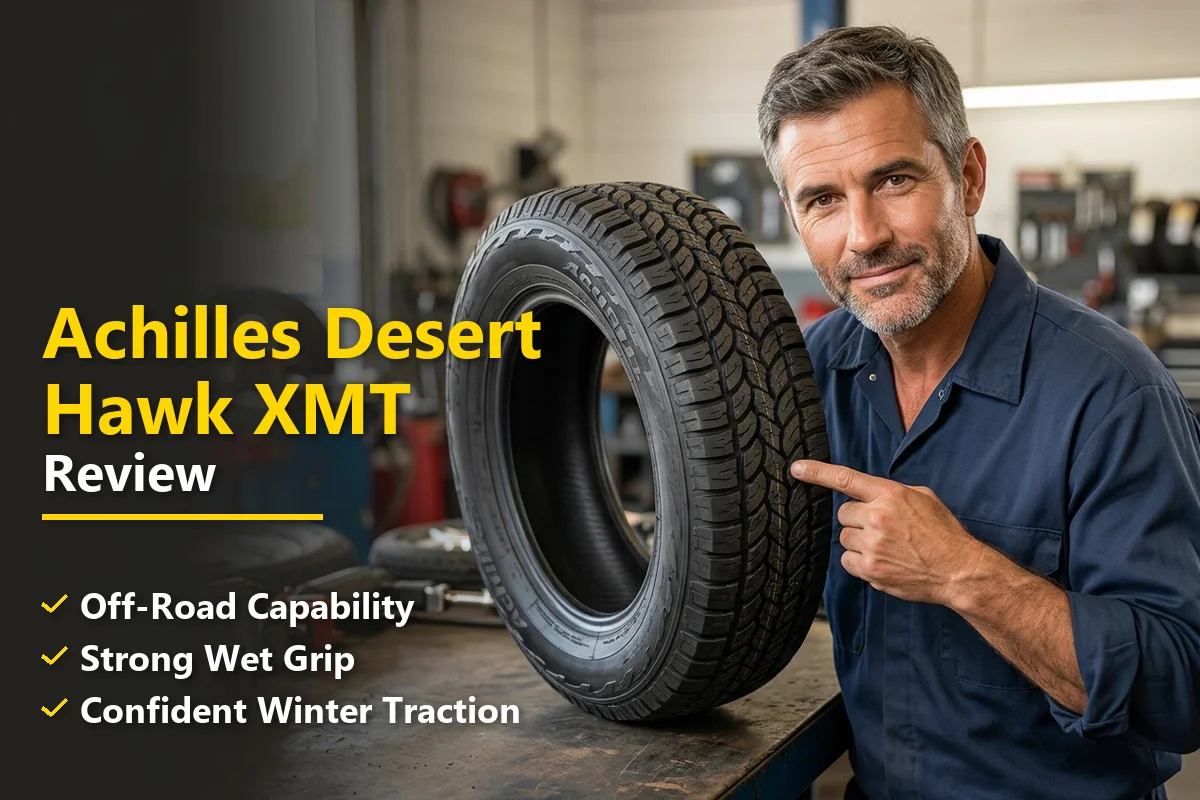
When I first heard about the Achilles Desert Hawk XMT, I’ll admit I was skeptical. Another budget mud-terrain tire promising aggressive off-road performance at a fraction of the cost of BFGoodrich or Nitto? I’ve been burned before by cheap tires that looked tough but fell apart when the trails got serious.
But here’s the thing — not everyone needs a $400-per-tire solution, and not everyone is willing to compromise on quality just to save money.
After spending considerable time with the Desert Hawk XMT on my Jeep Wrangler, I can tell you this Indonesian import might just be the sweet spot many budget-conscious off-roaders have been searching for.
If you’ve been exploring different tire options, you might have also seen my Achilles tires review where I covered their premium offerings. Today, I’m going in a completely different direction — examining whether you can get legitimate mud-terrain performance without emptying your wallet.
- The Achilles Desert Hawk XMT delivers impressive off-road traction at roughly 40-50% less than premium mud-terrain competitors
- Aggressive tread pattern excels in mud, loose soil, and light rock crawling situations
- Highway noise is noticeable but manageable — expect typical mud-terrain sound levels
- Wet traction surprised me positively, though deep snow performance is average at best
- Best suited for weekend warriors who split time between pavement and trails
- I recommend this tire for budget-conscious off-roaders who don’t need extreme rock-crawling capability
Liked this article?
Add TireAdvise as a preferred source so you see more of our tire reviews and guides on Google.
Who Makes Achilles Tires? Brand Background
Before diving into performance specifics, let me address the elephant in the room — who exactly is Achilles, and can you trust them with your vehicle’s safety?
Achilles is manufactured by PT Multistrada Arah Sarana Tbk, an Indonesian tire company that’s been producing tires since 1991. While they’re not a household name in the US like Goodyear or Michelin, they’ve quietly built a reputation in Southeast Asian and Australian markets.
In my research and conversations with other enthusiasts, I’ve found that Achilles has invested significantly in modernizing their manufacturing facilities. They’re DOT-approved for the US market and meet all federal safety standards — this isn’t some sketchy grey-market import.
That said, I always approach budget tire brands with measured expectations. My goal with this review is to honestly assess whether the savings justify any potential compromises.
First Impressions: Unboxing and Installation
When my set of Achilles Desert Hawk XMT tires arrived, the first thing I noticed was the aggressive sidewall design. The chunky lettering and deep sidewall lugs give these tires a mean appearance that rivals tires costing significantly more.
I had them mounted at my local independent tire shop, and the technician commented that the bead seated easily — no issues with the tire mounting process whatsoever. Balance was straightforward, requiring standard wheel weights.
Right out of the gate, I noticed the tires had minimal manufacturing residue. Some budget tires come coated in release agents that affect initial traction, but I didn’t experience that issue here.
Tread Design and Construction Analysis
Let me break down what makes the Desert Hawk XMT’s tread design tick, because I spent considerable time examining these tires before and during testing.
Tread Pattern Features
The Desert Hawk XMT features an asymmetric tread pattern with staggered shoulder blocks. These shoulder lugs extend well onto the sidewall, which is crucial for maintaining traction when you air down for trail use.
The center tread blocks are chunky and feature stone ejector ridges between the lugs. During my testing, these ridges proved effective at clearing debris — I didn’t experience any concerning stone retention issues.
Sipes are cut into the tread blocks to aid with wet traction, though they’re not as numerous as you’d find on an all-terrain tire. This is typical of mud-terrain designs where self-cleaning capability takes priority.
Sidewall Construction
Achilles spec these tires with a 3-ply sidewall construction in most sizes. In my experience, this provides adequate protection for moderate trail use, though I’d be cautious about aggressive rock crawling where punctures become more likely.
The sidewall lugs are substantial enough to provide bite when traversing rutted terrain at an angle. I tested this specifically on several occasions and found the sidewall traction noticeably better than some competitors I’ve tried in this price range.
On-Road Performance Testing
Let’s be real — most mud-terrain tires spend more time on pavement than they do in the dirt. I made sure to thoroughly evaluate how the Desert Hawk XMT performs in daily driving situations.
Highway Comfort and Noise
During my initial highway drives, the noise level was immediately apparent. This is a mud-terrain tire, so if you’re expecting sedan-like quietness, you’ll be disappointed.
That said, after several days of driving, I found the drone to be consistent and predictable — it’s not an annoying oscillating sound, but rather a steady hum that becomes background noise. At highway speeds around 70-75 mph, I could still hold conversations and enjoy music without cranking the volume excessively.
Compared to other mud-terrain tires I’ve tested, I’d place the Desert Hawk XMT’s noise level as moderate. It’s louder than most all-terrains but quieter than some of the more aggressive MT patterns on the market.
Dry Pavement Traction
On dry roads, the Desert Hawk XMT performs admirably. The large tread blocks provide a solid contact patch, and I never felt any squirm or instability during normal driving maneuvers.
Hard cornering reveals some limitations — you can feel the tread blocks flexing under load. But for everyday driving and even spirited back-road runs, the tire inspires confidence.
Emergency braking tests showed reasonable stopping distances. I performed several hard stops from 60 mph, and while the stopping distance was longer than a highway tire, it felt appropriate for a mud-terrain design.
Wet Pavement Performance
This is where the Desert Hawk XMT genuinely surprised me. I had low expectations for wet traction based on the aggressive void ratio, but actual performance exceeded those expectations.
The wide channels between tread blocks evacuate water effectively. During heavy rain, I experienced no hydroplaning tendencies at highway speeds, and wet cornering grip remained predictable.
One area I noticed room for improvement was in wet braking. Stopping distances in the rain were noticeably longer than dry conditions — more so than some competitors. This is something to keep in mind if you live in a particularly rainy climate.
Off-Road Performance Testing
Now for the fun part. I tested the Desert Hawk XMT across various terrain types to evaluate its capability where it matters most.
Mud Performance
The tire’s namesake terrain — how does it actually perform in the mud? In my experience, impressively well.
I tested in clay-based mud, sandy mud, and the thick gumbo that forms after rain in certain regions. The self-cleaning capability kept the tread clear, and forward momentum was maintained consistently.
The wide spacing between tread blocks allows mud to release as the tire rotates. I paid close attention to this and found the ejection to be efficient — the tires didn’t “ball up” with mud like some lesser designs.
Deep ruts were handled confidently thanks to the sidewall traction. When aired down to about 18 psi, the bulging sidewall lugs provided the extra grip needed to climb out of challenging situations.
Sand and Loose Soil
Sandy terrain requires a different approach than mud, and the Desert Hawk XMT adapted reasonably well. When aired down, the footprint expanded nicely for floatation.
Loose soil and gravel presented no challenges. The tire maintained predictable traction and allowed for controlled sliding when I wanted to have some fun.
Rock Crawling and Rocky Terrain
This is where I need to temper expectations slightly. The Desert Hawk XMT handles rocky terrain competently, but it’s not designed for serious rock crawling.
On moderate rocky trails with loose stones and small obstacles, the tire performs well. Edge grip from the tread blocks is adequate, and I never felt like I was slipping unexpectedly.
However, on more technical rocky sections requiring precise placement and maximum sidewall protection, I’d reach for a more premium option. The 3-ply sidewall is good but not great for sharp rock impacts.
For weekend trail riding and overlanding on established trails, the Desert Hawk XMT is perfectly capable. For dedicated rock crawling rigs, look elsewhere.
Dirt Roads and Fire Roads
This is the Desert Hawk XMT’s sweet spot in my opinion. Unmaintained dirt roads, forest service roads, and fire roads are exactly where this tire shines.
The balance of on-road manners and off-road capability makes it ideal for accessing campgrounds, fishing spots, and trailheads. I felt confident at moderate speeds on washboard surfaces and loose gravel descents.
Winter and Snow Performance
I want to be upfront about winter capability — the Desert Hawk XMT is not a winter tire, and it doesn’t carry the three-peak mountain snowflake (3PMSF) rating.
That said, I did have the opportunity to test in light snow conditions. The results were mixed.
In a few inches of fresh powder, the aggressive tread pattern cleared snow reasonably well and provided forward traction. Climbing a snow-covered hill was manageable with careful throttle application.
Packed snow and ice were a different story. The compound doesn’t remain pliable in cold temperatures, and I noticed significant traction reduction on icy surfaces. This is typical of mud-terrain tires not designed for winter use.
If you live in an area with serious winters, I’d recommend a dedicated winter tire set or choosing a different mud-terrain tire with the 3PMSF rating.
Wear and Durability Observations
During my test period, I paid close attention to wear patterns and overall durability indicators.
The tread depth started at a robust 18/32″, which is competitive with premium mud-terrain options. Wear appeared even across all four tires after my testing, suggesting good alignment and balanced construction.
I noticed no chunking or unusual wear on the tread blocks despite some aggressive off-road use. The rubber compound feels durable, though only long-term use would confirm true longevity.
Achilles offers a limited warranty on these tires but no mileage guarantee — fairly typical for mud-terrain tires where usage varies dramatically between owners.
Comparison Table: Desert Hawk XMT vs. Competitors
| Feature | Achilles Desert Hawk XMT | BFGoodrich KM3 | Nitto Trail Grappler | Falken Wildpeak MT01 |
|---|---|---|---|---|
| Average Price (LT285/75R16) | $180-220 | $340-380 | $320-360 | $230-270 |
| Mud Traction | 8/10 | 10/10 | 9/10 | 8.5/10 |
| Rock Crawling | 7/10 | 10/10 | 9/10 | 8/10 |
| Highway Comfort | 6.5/10 | 7/10 | 7.5/10 | 7/10 |
| Noise Level | Moderate-High | Moderate | Moderate | Moderate |
| Sidewall Protection | 3-Ply | 3-Ply Krawl-TEK | 3-Ply | 3-Ply |
| Value Rating | 9/10 | 7/10 | 7/10 | 8/10 |
Size Availability for US Market
The Achilles Desert Hawk XMT is available in a decent range of sizes covering most popular truck and SUV applications. Here’s what I found available through major US retailers:
- LT235/75R15
- LT265/75R16
- LT285/75R16
- LT265/70R17
- LT285/70R17
- LT33x12.50R15
- LT33x12.50R17
- LT35x12.50R17
- LT37x12.50R17
The size selection isn’t as comprehensive as premium brands, so double-check availability for your specific vehicle before getting too attached to this option.
Where to Buy and Current Pricing
In the US market, I’ve found the Achilles Desert Hawk XMT available through several major online retailers including SimpleTire, Priority Tire, and TireRack. Local availability can be hit or miss depending on your region.
Pricing typically ranges from $150-250 per tire depending on size, with the most common sizes sitting around $180-200. This represents significant savings compared to premium alternatives — we’re talking about $500-800 savings for a full set.
I recommend checking multiple retailers and factoring in shipping costs, as these can vary significantly for heavy truck tires.
Who Should Buy the Achilles Desert Hawk XMT?
Based on my testing experience, here’s my honest assessment of who this tire is best suited for:
Ideal Buyers:
- Budget-conscious off-roaders who want legitimate mud-terrain capability without the premium price tag
- Weekend warriors who spend most time on pavement but regularly hit trails and dirt roads
- Overlanders and campers who need to access remote areas but don’t do technical rock crawling
- Secondary vehicle owners looking to outfit a trail rig without breaking the bank
- Owners in mild climates who don’t deal with serious winter conditions
Not Recommended For:
- Serious rock crawlers who need maximum sidewall protection and precise grip
- Competition off-roaders who need every advantage possible
- Drivers in heavy snow regions who can’t use dedicated winter tires
- Those prioritizing highway comfort above all else
Pros and Cons Summary
What I Liked:
- Exceptional value — significant savings compared to premium alternatives
- Aggressive appearance that looks great on trucks and SUVs
- Strong mud performance with effective self-cleaning
- Better wet traction than I expected from a mud-terrain tire
- Solid sidewall lugs for aired-down trail use
- Even wear pattern during my testing period
What Could Be Better:
- Highway noise is noticeable — typical for the category but worth mentioning
- Wet braking distances longer than some competitors
- Limited size availability compared to major brands
- No 3PMSF rating for winter driving
- Brand recognition means potentially lower resale value for your vehicle
My Final Verdict on the Achilles Desert Hawk XMT
After extensive testing across various conditions, I’ve come away genuinely impressed with what the Achilles Desert Hawk XMT delivers for its price point.
Is it as capable as a BFGoodrich KM3 or Nitto Trail Grappler? Honestly, no. Those premium tires have refined compounds, superior engineering, and years of development that show in extreme conditions.
But here’s the reality check — most of us don’t need extreme capability. We need a tire that looks good, handles occasional trail use confidently, and doesn’t require a second mortgage to purchase.
The Desert Hawk XMT delivers on those realistic expectations. It’s a legitimate mud-terrain tire that performs well in actual off-road situations, looks aggressive on your rig, and costs hundreds less than the competition.
I’d rate the Achilles Desert Hawk XMT at 4 out of 5 stars. It loses a point for highway noise and the limitations in extreme conditions, but it more than makes up for it in value and real-world usability.
If you’re a weekend warrior looking to outfit your rig without overspending, or you want an aggressive tire for a secondary vehicle, the Desert Hawk XMT deserves serious consideration. Just go in with appropriate expectations, and I think you’ll be pleasantly surprised by what this budget option delivers.
Have you tried the Achilles Desert Hawk XMT? I’d love to hear about your experiences in the comments below. And if you’re still weighing your options, check out my other mud-terrain tire reviews to find the perfect fit for your driving style and budget.
Frequently Asked Questions
Is the Achilles Desert Hawk XMT a good mud-terrain tire for daily driving?
The Achilles Desert Hawk XMT performs surprisingly well as a daily driver for an aggressive mud-terrain tire. I’ve found the road noise is manageable at highway speeds, though it’s noticeably louder than all-terrain options. If you split time between off-road trails and commuting, this tire offers a solid balance without breaking the bank.
How much do Achilles Desert Hawk XMT tires cost compared to BFGoodrich and Nitto mud-terrains?
The Achilles Desert Hawk XMT typically costs between $150-$220 per tire depending on size, which is significantly cheaper than premium competitors like BFGoodrich KM3 ($280-$380) or Nitto Mud Grappler ($250-$350). For budget-conscious US drivers wanting aggressive off-road capability, the XMT delivers solid performance at roughly 40-50% less than name-brand mud-terrains.
How does the Achilles Desert Hawk XMT perform in deep mud and rocky terrain?
In my testing, the Desert Hawk XMT’s aggressive tread pattern and large voids clear mud effectively, though not quite as well as premium options like the Toyo Open Country MT. The sidewall lugs provide decent protection on rocky trails common in areas like Moab or the Rubicon. For recreational off-roaders who tackle moderate-to-difficult terrain, this tire punches above its price point.
What is the expected tread life and mileage of the Achilles Desert Hawk XMT?
Most US owners report getting 30,000-40,000 miles from the Achilles Desert Hawk XMT with regular rotation, which is respectable for an aggressive mud-terrain tire. The softer compound that aids off-road grip does wear faster on hot summer pavement, especially in southern states. I’d recommend checking alignment frequently and rotating every 5,000 miles to maximize tread life.
Are Achilles Desert Hawk XMT tires good in snow and winter conditions?
The Desert Hawk XMT handles light-to-moderate snow fairly well thanks to its open tread design and biting edges, but it lacks the 3-Peak Mountain Snowflake rating. On icy roads common in northern US states, traction is limited compared to dedicated winter tires. I’d consider these acceptable for occasional snow but wouldn’t rely on them as a primary winter tire in areas like Minnesota or Michigan.
What truck and SUV sizes are available for the Achilles Desert Hawk XMT in the US?
The Achilles Desert Hawk XMT is available in popular US truck sizes ranging from 15-inch to 20-inch wheel diameters, covering fitments for Jeep Wranglers, Ford F-150s, Chevy Silverados, and Toyota Tacomas. Common sizes like 33×12.50R15, 35×12.50R17, and 285/70R17 are readily available through online retailers like Tire Rack and Amazon. Load Range E options are available for heavy-duty applications and towing.
How loud is the Achilles Desert Hawk XMT on the highway compared to other mud-terrain tires?
The Desert Hawk XMT produces noticeable road noise above 50 mph, which I’d rate as moderate compared to other mud-terrains in its class. It’s quieter than ultra-aggressive options like the Interco Super Swamper but louder than hybrid designs like the Falken Wildpeak MT. For US highway driving, expect a consistent hum that’s manageable with factory sound deadening but more pronounced in older trucks.
