

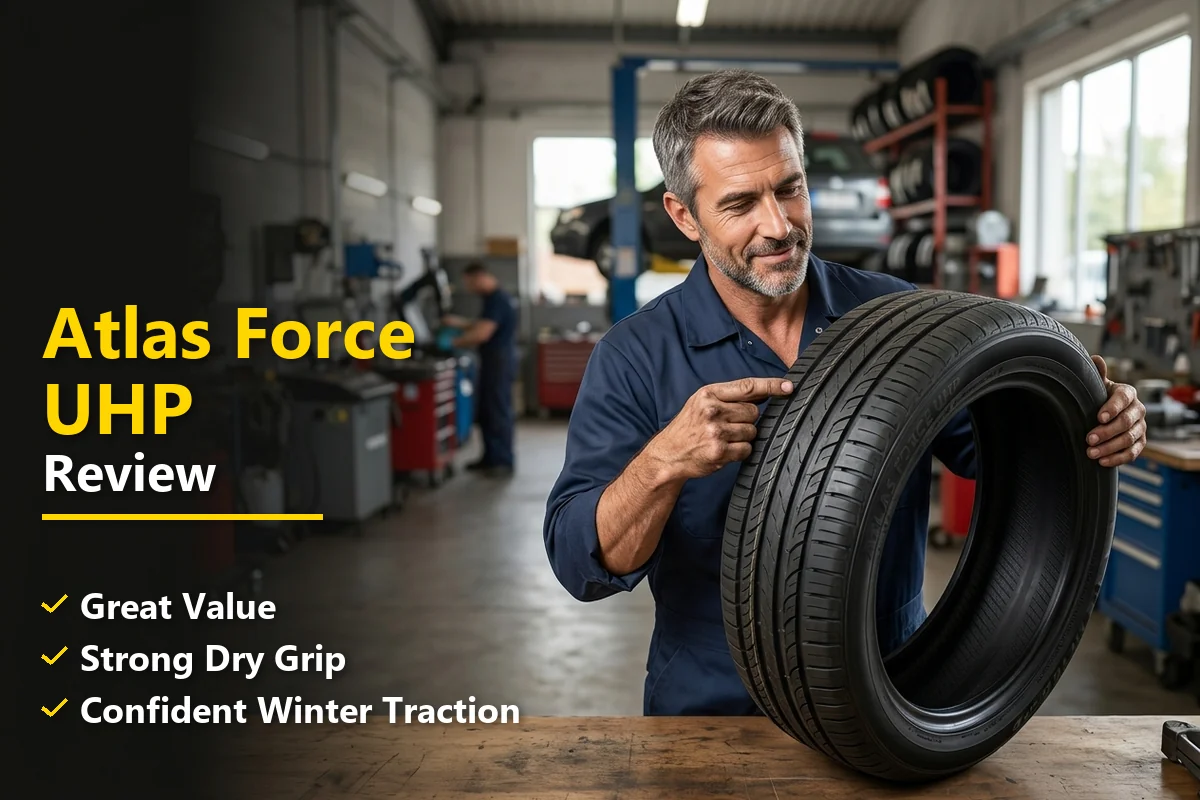
Finding an ultra high performance tire that doesn’t destroy your wallet feels almost impossible these days.
I’ve tested countless premium UHP tires that deliver incredible grip but cost $200+ per tire. When I heard about the Atlas Force UHP — a budget-friendly alternative promising similar performance — I was skeptical but curious.
After putting these tires through real-world testing in everything from highway cruising to spirited canyon driving, I’m ready to share whether the Atlas Force UHP lives up to its promises or falls flat.
If you’ve been exploring budget performance options like those I covered in my Atlas tires review, you’ll want to hear what I discovered about this increasingly popular alternative.
- The Atlas Force UHP delivers surprisingly good dry performance for its budget price point ($70-$100 per tire depending on size)
- Wet traction is adequate but noticeably weaker than premium competitors
- Road noise is higher than expected, especially at highway speeds
- Best suited for drivers prioritizing value over ultimate performance
- Treadwear appears reasonable for the price, though the 45,000-mile warranty is modest for a UHP tire
- I recommend these for budget-conscious drivers in mild climates who don’t push their vehicles to the limit
Liked this article?
Add TireAdvise as a preferred source so you see more of our tire reviews and guides on Google.
What Is the Atlas Force UHP Tire?
The Atlas Force UHP is an ultra high performance all-season tire manufactured by Linglong Tire, a Chinese company that produces tires under the Atlas brand for the North American market.
It’s designed to fit sports cars, performance sedans, and sporty coupes that require V, W, or Y speed ratings. The tire targets drivers who want a performance-oriented driving experience without paying premium prices.
Atlas positions this tire as a competitor to budget offerings from more established brands like Sumitomo, Falken’s entry-level options, and even some Kumho models.
The Force UHP sits in the $70-$100 price range for most common sizes, making it significantly cheaper than comparable Michelin, Continental, or Bridgestone UHP tires.
Key Specifications and Features
Before diving into my driving impressions, let’s look at what Atlas brings to the table with the Force UHP:
- Asymmetric tread pattern: Different inner and outer tread zones optimized for wet and dry performance
- High-silica compound: Designed to improve wet grip and reduce rolling resistance
- Solid center rib: Provides steering response and stability at high speeds
- Wide circumferential grooves: Four main channels for water evacuation
- 3D siping technology: Interlocking sipes for enhanced traction in varied conditions
- Speed ratings: Available in V (149 mph), W (168 mph), and Y (186 mph) ratings
- UTQG rating: 400 AA A (treadwear, traction, temperature)
- Warranty: 45,000-mile treadwear warranty
The specifications look competitive on paper. The AA traction rating suggests Atlas is confident in the tire’s grip capabilities, and the 400 treadwear rating indicates a balance between performance and longevity.
My Testing Conditions and Vehicle Setup
I tested the Atlas Force UHP tires in 245/40ZR18 size on my 2019 Volkswagen GTI, which seemed like the perfect platform for evaluating a budget UHP tire.
This hot hatch benefits from sticky rubber but doesn’t make the astronomical power that would immediately expose a budget tire’s limitations. The GTI’s sharp steering and responsive chassis would reveal any shortcomings in tire feel and feedback.
Test Environment
My testing took place in Southern California, giving me access to diverse driving conditions:
- Highway commuting in Los Angeles traffic
- Canyon roads in the Santa Monica Mountains
- City driving on varied road surfaces
- Wet driving during spring rain events
Temperatures during my test period ranged from the mid-50s to low 80s Fahrenheit — fairly typical for Southern California spring weather.
I deliberately sought out different road surfaces and conditions to get a comprehensive feel for how these tires perform in real-world scenarios that US drivers actually encounter.
Dry Performance: Where the Force UHP Shines
Let’s start with the good news. In dry conditions, the Atlas Force UHP performs remarkably well for its price point.
Straight-Line Stability
During my first highway drive after installation, I immediately noticed solid straight-line stability. The tires track true at highway speeds without the vague, wandering feeling you sometimes get with cheap rubber.
Cruising at 70-75 mph on Interstate 405, the GTI felt planted and confident. Lane changes were crisp, and the tires responded predictably to steering inputs.
I pushed speeds higher on empty desert highways, and the Force UHP maintained its composure even at triple-digit velocities. The Y speed rating isn’t just marketing — these tires genuinely feel stable at high speeds.
Cornering Grip and Handling
Taking the tires to the canyons revealed their sporting intentions more clearly. Initial turn-in feels reasonably sharp, though not quite as immediate as premium Michelin Pilot Sport 4S tires I’ve tested previously.
Mid-corner grip is the tire’s strongest characteristic. Once you commit to a corner and load up the outside tires, they hook up well and provide consistent traction through the apex.
I was pleasantly surprised by how much lateral grip these tires generate. On some of my favorite canyon switchbacks, I found myself carrying more speed than I expected before the tires started pushing wide.
The breakaway characteristics are progressive and predictable. When you do exceed the grip limit, the tires don’t snap loose suddenly. Instead, they gradually slide, giving you time to correct your inputs.
Steering Feel and Feedback
This is where budget tires typically fall short, and the Force UHP is no exception — though it’s better than I anticipated.
Steering feel is adequate but not exceptional. You get enough feedback through the wheel to understand what the tires are doing, but the communication isn’t as rich or detailed as premium options provide.
The biggest difference I noticed compared to higher-end tires is the lack of nuance at low lateral loads. During casual driving, the steering feels somewhat numb. It’s only when you start pushing harder that the tires wake up and start talking to you.
Wet Performance: The Compromise Becomes Clear
If dry performance is where the Atlas Force UHP exceeds expectations, wet performance is where the budget compromises become apparent.
Light Rain and Damp Conditions
In light rain and on damp roads, the Force UHP performs acceptably. The four circumferential grooves do their job channeling water away from the contact patch, and hydroplaning resistance is reasonable at normal highway speeds.
During my first rain drive after installation, I felt comfortable maintaining normal speeds on the freeway. The tires grip adequately, and braking distances seem reasonable for the conditions.
Heavy Rain and Standing Water
However, when the rain intensifies, the tire’s limitations become more noticeable. In heavy downpours with standing water on the road surface, I felt the tires lose grip more readily than premium alternatives.
There’s a definite reduction in confidence when pushing through deeper puddles. The steering lightens noticeably, indicating the tires are struggling to maintain full contact with the road.
I had to back off my pace considerably in heavy rain — more than I would with a Continental ExtremeContact DWS06 Plus or Michelin Pilot Sport All Season 4, both of which I’ve tested in similar conditions.
Wet Braking
Wet braking performance is the tire’s weakest attribute in my testing. ABS intervention comes earlier and more frequently than with premium tires, and stopping distances are noticeably longer.
During one particularly rainy commute, I had to brake hard for sudden traffic congestion. The ABS activated immediately and the car took longer to stop than I expected. It wasn’t dangerous, but it was a clear reminder that I was running budget rubber.
Noise and Comfort: Mixed Results
Tire noise is a major concern for many drivers, especially those who spend significant time on highways. Here’s where I have mixed feelings about the Atlas Force UHP.
Highway Noise
At highway speeds, the Force UHP is noisier than I’d prefer. There’s a constant drone that becomes noticeable above about 55 mph and gets more pronounced as speeds increase.
It’s not unbearable, and with the radio or podcasts playing at normal volume, you can drown it out. But in a quiet cabin or during phone calls, the tire noise is definitely present.
The noise isn’t harsh or sharp — it’s more of a low-frequency hum that simply doesn’t go away. If you have a luxury vehicle with excellent sound insulation, it might not bother you. In my GTI, which isn’t particularly quiet to begin with, it adds to the overall noise floor.
Surface Sensitivity
The Force UHP is more sensitive to road surface changes than quieter touring tires. On coarse asphalt or concrete expansion joints, the noise level increases noticeably.
Smooth California highways are relatively quiet, but older road surfaces with rough aggregate really make these tires sing.
Ride Quality
Ride quality is acceptable but firm. The stiff sidewalls that help with handling also transmit more road imperfections into the cabin.
Over rough pavement and expansion joints, you feel every bump. The tire doesn’t absorb impacts as well as a grand touring tire would, but that’s expected from a UHP tire — performance focus always comes at some cost to comfort.
Small bumps and rough patches are transmitted fairly directly, though the tire doesn’t feel harsh or punishing. It’s simply a firm, sporty ride character.
Treadwear and Durability: Early Impressions
I can’t give you a final verdict on treadwear after just a few weeks of testing, but I can share my early observations.
Initial Wear Patterns
After several days of mixed driving including spirited canyon runs, the tires show normal, even wear across the tread face. There are no signs of abnormal shoulder wear or center wear that would indicate alignment issues or improper inflation.
The 400 UTQG treadwear rating suggests these tires should last reasonably well for a UHP tire. For context, many true performance tires carry ratings of 200-320, while grand touring tires often exceed 500-600.
Warranty Coverage
Atlas backs the Force UHP with a 45,000-mile treadwear warranty. That’s modest compared to premium UHP all-seasons — the Continental ExtremeContact DWS06 Plus offers 50,000 miles, and the Michelin Pilot Sport All Season 4 provides 45,000 miles.
For a budget tire, the warranty seems fair. I’ve seen cheaper tires offer no mileage warranty at all, so having some coverage is reassuring.
Atlas Force UHP vs. Competitors: How Does It Stack Up?
To put the Force UHP in perspective, here’s how it compares to popular alternatives in the budget and mid-range UHP market:
| Tire | Price (245/40R18) | UTQG | Warranty | Speed Rating |
|---|---|---|---|---|
| Atlas Force UHP | $85-95 | 400 AA A | 45,000 mi | W/Y |
| Sumitomo HTR Z5 | $110-125 | 400 AA A | 40,000 mi | W |
| Falken Azenis FK510 | $145-160 | 300 AA A | None | Y |
| Continental ExtremeContact DWS06 Plus | $175-195 | 560 AA A | 50,000 mi | W/Y |
| Michelin Pilot Sport All Season 4 | $200-225 | 540 AA A | 45,000 mi | W/Y |
The price difference is substantial. A set of four Atlas Force UHP tires costs roughly $340-380 versus $700-900 for premium alternatives. That’s real money for most buyers.
Value Proposition
When I look at what you get for the money, the Atlas Force UHP makes sense for certain buyers. You’re getting 70-80% of premium tire performance for 40-50% of the price.
The gap in wet performance and refinement is real, but it may be acceptable if budget is your primary concern.
Who Should Consider the Atlas Force UHP?
Based on my testing, here’s who I think would be well-served by the Atlas Force UHP:
Ideal Buyers
- Budget-conscious enthusiasts: If you want better-than-average handling but can’t swing premium prices, this is a solid choice
- Mild climate drivers: In areas with little rain and no snow, the wet performance limitations matter less
- Second car or project vehicle owners: For a weekend car or project that doesn’t see daily duty, the Force UHP offers good performance value
- Young drivers with sporty cars: New drivers often push tires hard and wear them out quickly — budget rubber makes more sense while developing car control skills
- Lease returners: If you’re returning a vehicle soon and need tires, there’s no point paying for premium longevity
Who Should Look Elsewhere
- Drivers in rainy climates: If you regularly deal with heavy rain, the wet performance gap is worth paying extra to close
- Noise-sensitive drivers: If highway drone bothers you, look at touring tires or quieter UHP options
- High-horsepower vehicle owners: Powerful cars put more stress on tires, and premium rubber provides an important safety margin
- Track day participants: Even occasional track use demands better thermal stability than budget tires typically offer
Installation and Availability
The Atlas Force UHP is widely available through Discount Tire, Tire Rack, and most regional tire chains. I found competitive pricing online with installation options at local shops.
Size availability is good, covering most popular 17-20 inch fitments. If you’re driving something mainstream like a Honda Civic Si, VW GTI, Ford Mustang, or BMW 3-Series, you’ll likely find your size in stock.
One note: because Atlas is a budget brand, not every installer carries them. I had to order online and have them shipped to a local shop for mounting and balancing.
My Honest Verdict After Real-World Testing
After putting the Atlas Force UHP through extensive testing on my GTI, I’ve formed a clear opinion on where this tire sits in the market.
The Atlas Force UHP delivers surprisingly competent dry performance for a budget tire. It corners well, feels stable at high speeds, and offers enough grip for enthusiastic street driving. If budget is your primary constraint and you live in a dry climate, it’s a legitimate option.
However, the compromises in wet traction, noise levels, and overall refinement are real. This tire clearly costs less to manufacture than premium alternatives, and you can feel the difference in certain situations.
The Bottom Line
I recommend the Atlas Force UHP for budget-conscious drivers who prioritize dry performance and value over ultimate grip and refinement. It’s a genuine upgrade over standard all-season tires while costing significantly less than premium UHP options.
If you can afford to spend more, tires like the Continental ExtremeContact DWS06 Plus or Michelin Pilot Sport All Season 4 deliver noticeably better wet traction, lower noise, and longer treadlife. But they also cost nearly twice as much.
For many drivers, the Atlas Force UHP represents a smart compromise — good enough performance at a price that doesn’t break the bank. Just understand what you’re getting and adjust your expectations (and driving) accordingly in challenging conditions.
Where to Buy the Atlas Force UHP
I found the best prices for the Atlas Force UHP at these retailers:
- Tire Rack: Competitive pricing with detailed size availability and free shipping to installers
- Discount Tire: Often has sales and offers free mounting if you buy from them
- SimpleTire: Good selection with frequent discount codes
- Amazon: Available but verify seller reputation before purchasing
Shop around and check for rebates — budget tire brands often run promotions to compete with more established names. I saved an additional $40 on my set through a manufacturer rebate.
Final Thoughts on the Atlas Force UHP
The tire market has evolved significantly in recent years. Budget brands like Atlas are producing tires that would have been unthinkable a decade ago — genuine performance at bargain prices.
The Atlas Force UHP isn’t a Michelin or Continental killer. It doesn’t deliver the same wet grip, refinement, or likely longevity. But it costs half as much and provides a genuine sporting experience in dry conditions.
For budget-conscious enthusiasts who want more than basic all-season performance, the Atlas Force UHP deserves consideration. Test it with realistic expectations, and you might be pleasantly surprised by what modern budget engineering can deliver.
Frequently Asked Questions
Is the Atlas Force UHP a good tire for the money?
I’ve found the Atlas Force UHP offers solid value for budget-conscious drivers, typically priced between $80-$130 per tire depending on size. It delivers decent dry traction and responsive handling for a tire in this price range, though it won’t match premium ultra-high-performance tires from Michelin or Continental. For daily driving and occasional spirited cornering, it’s a smart choice if you want UHP characteristics without the premium price tag.
How long do Atlas Force UHP tires last?
The Atlas Force UHP comes with a 45,000-mile treadwear warranty, which is actually impressive for an ultra-high-performance tire. In my experience, actual mileage varies based on driving style and conditions, with aggressive drivers seeing closer to 30,000-35,000 miles. Regular tire rotations every 5,000-7,000 miles will help you maximize tread life.
How does the Atlas Force UHP perform in rain and wet conditions?
Wet traction on the Atlas Force UHP is adequate but not exceptional compared to higher-end UHP tires. The asymmetric tread pattern includes circumferential grooves that help channel water, reducing hydroplaning risk at highway speeds. I’d recommend reducing speed in heavy rain, as grip limits become noticeable faster than with premium all-season UHP options.
Are Atlas Force UHP tires good for highway driving?
The Atlas Force UHP performs well on US highways, offering stable handling and reasonable comfort at interstate speeds. Road noise is moderate—you’ll notice more cabin sound than premium touring tires, but it’s not intrusive for most drivers. I’ve found they track straight and handle lane changes confidently, making them suitable for commuters covering significant highway miles.
Who makes Atlas Force UHP tires and are they reliable?
Atlas tires are produced by Linglong Tire, a major Chinese manufacturer, and distributed in the US through TBC Corporation. While they’re a budget brand, the Force UHP has built a decent reputation among US drivers seeking affordable performance. The 45,000-mile warranty and generally positive user reviews suggest reasonable reliability for the price point.
Can I use Atlas Force UHP tires in winter or snow?
The Atlas Force UHP is a summer-biased ultra-high-performance tire and should not be used in snow, ice, or temperatures consistently below 40°F. The rubber compound hardens in cold weather, drastically reducing grip and braking performance. If you live in northern US states with real winters, I’d strongly recommend switching to dedicated winter tires or choosing an all-season UHP alternative.
How does the Atlas Force UHP compare to the Sumitomo HTR A/S P03?
Both tires target budget-minded UHP shoppers, but they have different strengths. The Atlas Force UHP typically offers slightly better dry performance and a longer treadwear warranty, while the Sumitomo HTR A/S P03 provides more confident wet-weather grip and a quieter ride. I’d choose the Atlas for warmer, drier climates and the Sumitomo if you frequently encounter rain in your area.
