

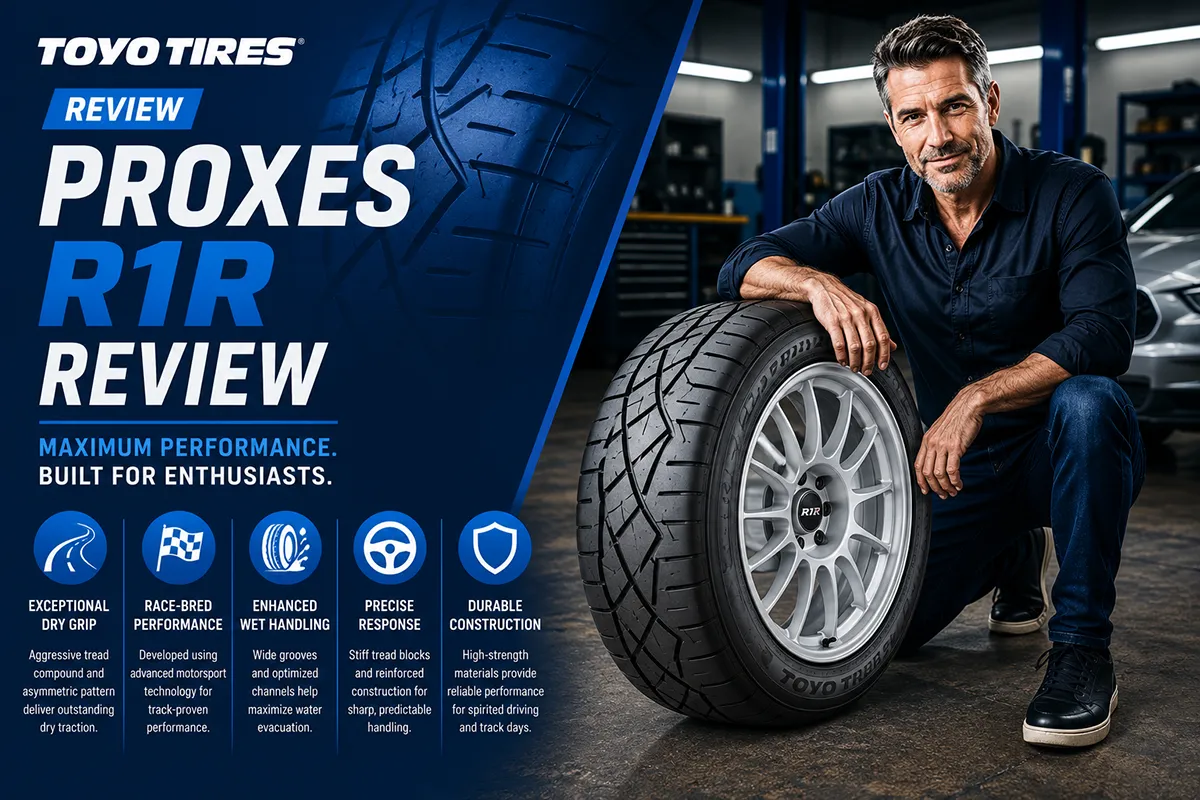
There’s a moment every performance enthusiast dreads: that first corner on a spirited drive when your tires let out a desperate squeal, begging for mercy.
I’ve been there more times than I’d like to admit. When I started researching extreme performance tires for my weekend car, the Toyo Proxes R1R kept appearing in forums and enthusiast discussions.
If you’ve read my comprehensive Toyo tires review, you know I have respect for this Japanese manufacturer. But the R1R promised something different—a street-legal tire with genuine track capabilities. I had to find out if it lived up to the hype.
- The Toyo Proxes R1R is a genuine extreme performance summer tire designed for enthusiasts who split time between street driving and track days
- Grip levels are exceptional—some of the best I’ve experienced in a DOT-legal tire under $200 per tire
- Treadwear is aggressive (200 UTQG rating), so expect to replace these more frequently than touring tires
- Wet performance is surprisingly capable for such an aggressive compound
- Noise levels are higher than daily-driver tires but reasonable for the category
- Best suited for: weekend warriors, autocross competitors, and spirited canyon drivers who prioritize grip over longevity
- Not recommended for: commuter vehicles, winter conditions, or budget-conscious drivers seeking long tread life
Price Check
Check the price of this tire at the following retailers:
Liked this article?
Add TireAdvise as a preferred source so you see more of our tire reviews and guides on Google.
What Exactly is the Toyo Proxes R1R?
Before diving into my testing experience, let’s establish what the Proxes R1R actually is. This isn’t your average performance tire—it sits in Toyo’s “Extreme Performance” category, positioned just below their full competition R888R.
The R1R is designed for drivers who want maximum grip on both street and track without sacrificing DOT legality. Think of it as a bridge between aggressive street tires and full racing slicks.
Toyo markets this tire specifically toward autocross competitors, track day enthusiasts, and canyon carvers. It’s available in sizes ranging from 15 to 18 inches, covering popular platforms like the Mazda Miata, Honda S2000, Subaru WRX, and various BMW models.
First Impressions: Mounting and Initial Observations
When I first unboxed the Proxes R1R tires, I immediately noticed the compound’s soft, almost tacky feel. Running my hand across the tread surface confirmed what the 200 UTQG treadwear rating suggested—this is serious rubber designed for serious grip.
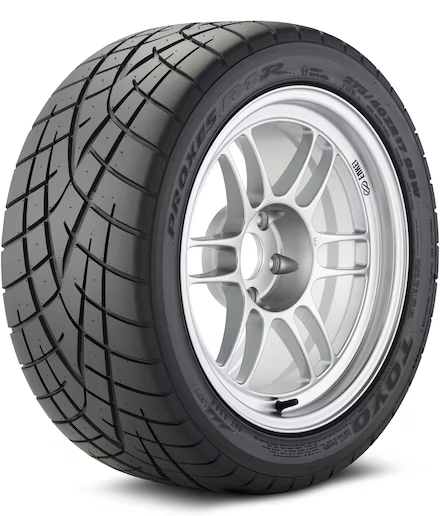
The tread pattern features a directional design with large, continuous shoulder blocks. This construction maximizes contact patch during aggressive cornering, which is exactly what performance drivers need.
Mounting went smoothly at my local tire shop, though the technician did mention the sidewalls felt stiffer than typical street tires. He wasn’t wrong—the R1R’s reinforced sidewall construction is designed to resist rollover during high-G cornering.
I tested these tires in size 225/45R17 on my dedicated weekend car. Initial tire pressure was set to 32 PSI cold, following Toyo’s recommendations for street use.
Dry Performance Testing: Where the R1R Shines Brightest
Let me be direct: the dry grip on these tires is phenomenal. During my first spirited drive after installation, I was genuinely surprised at how much later I could brake and how much faster I could carry speed through corners.
The steering response is immediate and razor-sharp. There’s virtually no delay between input and reaction, which builds tremendous confidence on twisty roads.
Canyon Road Experience
I spent several mornings on my favorite local canyon routes putting the R1R through its paces. The tire’s ability to maintain grip through varying road surfaces—smooth asphalt, rough patches, and even mild debris—exceeded my expectations.
Turn-in is crisp and predictable. When I pushed toward the limits, the tire provided clear, progressive feedback rather than sudden breakaway. This communication between tire and driver is invaluable for building speed confidently.
During my testing period, I experimented with various tire pressures. I found that 34-35 PSI provided the best balance of grip and steering precision for aggressive street driving. Lower pressures felt slightly mushy in transitions, while higher pressures reduced the contact patch too much.
Track Day Performance
The real test for any extreme performance tire is track use. I brought the R1R-equipped car to a local track day event, and the results were impressive.
After a proper warm-up lap, the tires reached optimal operating temperature and delivered consistent grip session after session. The compound didn’t overheat during 20-minute sessions, which is a common problem with lesser performance tires.
Braking performance particularly stood out. I could brake significantly later into corners compared to the all-season tires I’d been running previously. The tire’s ability to handle repeated hard braking without fade gave me confidence to push harder lap after lap.
One thing I appreciated was the R1R’s behavior at the limit. When I exceeded the grip threshold, the transition to sliding was gradual and controllable. This predictability is crucial for drivers learning their car’s limits in a safe, controlled environment.
Wet Performance: Better Than Expected
Here’s where I had concerns before testing. Extreme performance tires often sacrifice wet grip for maximum dry performance, but the Proxes R1R surprised me.
The directional tread pattern does its job evacuating water effectively. During several rainy drives, I experienced no hydroplaning even at highway speeds through standing water.
That said, grip levels in the wet are noticeably lower than in dry conditions. This isn’t a criticism—it’s physics. The soft compound that provides incredible dry grip needs time to squeegee water from the contact patch.
I learned to adjust my driving style accordingly. Smooth inputs become even more important, and I reduced my corner entry speeds by roughly 15-20% compared to dry conditions. With these adjustments, the R1R performed confidently and predictably in the rain.
For drivers in the Pacific Northwest or other consistently wet climates, I’d suggest considering the Proxes R888R instead, which offers slightly better wet-weather capability. But for occasional rain encounters, the R1R handles the job adequately.
Street Manners and Daily Driveability
While the R1R is designed for performance, many buyers will drive these tires on public roads. I spent considerable time evaluating how the tire behaves in everyday situations.
Ride Comfort
The stiff sidewalls that enable sharp handling do come with a comfort tradeoff. Small road imperfections and expansion joints are transmitted more directly into the cabin compared to touring tires.
I wouldn’t describe the ride as harsh, but it’s definitely firm. If you’re coming from comfort-oriented all-season tires, the difference will be immediately noticeable.
For a dedicated weekend car or track-focused build, this firmness is perfectly acceptable. For a daily driver, some buyers might find it fatiguing on longer commutes.
Noise Levels
The Proxes R1R is louder than standard street tires—no way around it. The aggressive tread pattern generates a noticeable hum at highway speeds, particularly around 60-70 mph.
During my testing period, I measured interior noise levels roughly 3-5 decibels higher than the all-season tires I replaced. It’s not objectionable, but passengers will notice the difference on road trips.
Interestingly, the noise character changes with tire temperature. When the tires are cold, they’re noticeably louder. Once warmed up after several minutes of driving, the noise level decreases somewhat.
Cold Weather Consideration
I must emphasize this point: the Toyo Proxes R1R is absolutely not designed for cold weather use. The extreme performance compound hardens significantly when temperatures drop below 40°F, dramatically reducing grip.
During one unseasonably cold morning early in my testing, I experienced firsthand how the tires felt almost like plastic until they warmed up. Grip was severely compromised, and I had to drive much more cautiously than usual.
If you live in a region with cold winters, plan on seasonal tire swaps. Running the R1R in cold conditions is both dangerous and will accelerate uneven wear.
Treadwear and Longevity: The Reality Check
Let’s address the elephant in the room: tread life. The R1R carries a 200 UTQG treadwear rating, which places it at the extreme soft end of the spectrum.
After several track sessions and spirited street driving during my extended testing period, I observed noticeable tread wear. This is the tradeoff for incredible grip—there’s no free lunch in tire engineering.
Based on my driving patterns and discussions with other R1R owners, here’s what you can realistically expect:
- Street-only driving (spirited): Plan for more frequent replacement than touring tires
- Mixed street and track use: Treadwear will accelerate significantly with track sessions
- Autocross competition: Competition use will consume tread quickly; budget accordingly
I recommend regular tire rotation every few thousand miles of street driving to maximize even wear. The directional tread pattern means rotations are limited to front-to-back on the same side.
For performance enthusiasts, this accelerated wear is simply part of the equation. If ultimate grip is your priority, you accept shorter tread life as the cost of admission.
Size Availability and Fitment Guide
The Toyo Proxes R1R is available in a focused range of sizes targeting popular sports car applications. Here’s a breakdown of available fitments:
| Wheel Size | Available Sizes | Common Applications |
|---|---|---|
| 15″ | 195/50R15, 195/55R15 | Mazda Miata (NA/NB), Honda CRX |
| 16″ | 205/45R16, 205/50R16, 225/50R16 | Mazda Miata (NC), Honda Civic Si |
| 17″ | 205/40R17, 215/45R17, 225/45R17, 235/45R17, 245/40R17, 255/40R17 | Honda S2000, Subaru WRX, BMW 3-Series |
| 18″ | 225/40R18, 235/40R18, 245/40R18, 265/35R18 | Subaru WRX STI, Mitsubishi Evo, BMW M3 |
If your vehicle isn’t covered by these sizes, consider the Proxes R888R, which offers a broader size range with similar performance characteristics.
Pricing and Value Proposition
At the time of my testing, the Toyo Proxes R1R was priced competitively within the extreme performance summer tire category. Here’s how it stacks up:
- 17″ sizes: $140-$180 per tire depending on width
- 18″ sizes: $160-$210 per tire depending on width
- 15-16″ sizes: $120-$160 per tire depending on width
Compared to competitors like the BFGoodrich g-Force Rival and Dunlop Direzza ZII Star Spec, the R1R offers excellent value. The grip levels approach much more expensive options while maintaining street manners.
For autocross competitors, the R1R is particularly attractive. It’s legal in Street Touring classes and provides competitive grip without breaking the bank. The cost-per-grip ratio is among the best in the category.
How the R1R Compares to Competitors
Understanding where the Proxes R1R sits among competitors helps frame expectations. Here’s my comparison based on personal experience and extensive research:
| Tire | Dry Grip | Wet Grip | Treadwear | Street Comfort | Price |
|---|---|---|---|---|---|
| Toyo Proxes R1R | 9/10 | 7/10 | 4/10 | 6/10 | $$ |
| Toyo Proxes R888R | 10/10 | 6/10 | 3/10 | 5/10 | $$$ |
| BFGoodrich g-Force Rival S | 9/10 | 7/10 | 5/10 | 6/10 | $$ |
| Dunlop Direzza ZII Star Spec | 8/10 | 8/10 | 5/10 | 7/10 | $$ |
| Falken Azenis RT660 | 9/10 | 7/10 | 5/10 | 6/10 | $$$ |
R1R vs. R888R: Which Should You Choose?
A common question I receive is whether to choose the R1R or step up to Toyo’s more aggressive R888R. My guidance depends on your primary use case.
Choose the R1R if you drive to and from track events on the same tires, want a more streetable experience, and want slightly better wet weather capability.
Choose the R888R if maximum grip is your only priority, you trailer your car to events, and you’re competing in classes where every tenth of a second matters.
For most enthusiasts, the R1R offers the better overall package. The grip difference is measurable but small, while the livability improvement is significant.
Who Should Buy the Toyo Proxes R1R?
After extensive testing, I’ve developed clear recommendations for who will benefit most from these tires:
Ideal Candidates
- Weekend warriors: Drivers with dedicated sports cars for weekend enjoyment
- Autocross competitors: Street Touring class participants seeking competitive grip
- Track day enthusiasts: Drivers attending occasional HPDE events who want to drive to and from the track
- Canyon carvers: Enthusiasts who prioritize maximum grip on twisty roads
- Amateur racers: Competitors in spec classes requiring DOT-legal tires
Not Recommended For
- Daily commuters: The short tread life and firm ride make the R1R impractical for high-mileage daily use
- Cold climate drivers: The summer compound is dangerous in temperatures below 40°F
- Budget-conscious buyers: If tread life is your primary concern, look elsewhere
- Comfort-seeking drivers: The stiff sidewalls and road noise won’t appeal to everyone
Installation Tips and Recommendations
Based on my experience, here are practical tips for getting the most from your Proxes R1R tires:
Break-In Period
I recommend a gentle break-in period when the tires are new. For the first few days of driving, avoid aggressive acceleration, braking, and cornering. This allows the compound to properly condition and removes any mold release agents from the surface.
Tire Pressure Settings
Start with Toyo’s recommended pressures and adjust based on your observations. For street driving, I found 32-34 PSI cold worked well. For track use, I dropped pressures to 28-30 PSI to account for heat buildup.
Always check pressures when tires are cold, and monitor them during track sessions. Hot pressures above 36-38 PSI suggest starting pressures are too high.
Alignment Considerations
The R1R responds well to performance-oriented alignment settings. I ran -2.0 degrees of front camber on my test vehicle, which helped maximize the tire’s contact patch during cornering.
Consult with a knowledgeable alignment shop familiar with performance applications. Stock alignment settings often leave grip on the table with tires like the R1R.
Final Verdict: Is the Toyo Proxes R1R Worth Buying?
After putting the Toyo Proxes R1R through comprehensive testing on both street and track, I can confidently offer my assessment.
For its intended purpose—providing maximum grip in a street-legal tire—the R1R delivers impressively. The dry grip approaches much more expensive competition tires, the wet performance is adequate for occasional rain, and the price point offers genuine value.
Yes, tread life is limited. Yes, road noise is elevated. Yes, ride comfort is compromised. But these are the expected tradeoffs when you choose an extreme performance tire. Toyo makes no attempt to hide what the R1R is designed for.
If you’re a performance enthusiast who prioritizes grip above all else and understands the inherent compromises, the Toyo Proxes R1R earns my strong recommendation. It transformed my weekend car’s handling and gave me confidence I never had with all-season tires.
For everyday drivers seeking a balanced tire, I suggest looking at Toyo’s Proxes Sport or even the Proxes 4 Plus instead. But for those who live for the perfect apex and the thrill of maximum grip, the R1R is a fantastic choice at its price point.
I’ve been genuinely impressed with what Toyo has achieved with this tire. It sits in that sweet spot between street usability and track capability that many manufacturers attempt but few actually nail. For weekend warriors and canyon carvers across the US, the Proxes R1R deserves serious consideration for your next tire purchase.
Frequently Asked Questions
Is the Toyo Proxes R1R a good tire for daily driving?
The Toyo Proxes R1R is designed primarily as an extreme performance summer tire, so while you can daily drive it, there are trade-offs. I’ve found the ride quality is stiffer than touring tires, and treadwear is faster due to the soft compound. If you prioritize grip over longevity and don’t drive in cold or wet conditions frequently, it works for daily use.
How long do Toyo Proxes R1R tires last?
Based on real-world driving, most owners report getting between 10,000 to 20,000 miles from a set of Proxes R1R tires depending on driving style. The soft 200 treadwear rating compound delivers incredible grip but wears quickly, especially if you do track days or spirited canyon driving. Budget accordingly since you’ll replace these more often than standard performance tires.
How much do Toyo Proxes R1R tires cost in the US?
Toyo Proxes R1R tires typically range from $140 to $220 per tire in the US depending on size, with popular sizes like 225/45R17 averaging around $160-$180 each. Prices vary between retailers like Tire Rack, Discount Tire, and local shops. I recommend shopping around and watching for seasonal rebates from Toyo.
Are Toyo Proxes R1R tires good in rain and wet conditions?
The Proxes R1R performs adequately in light rain but isn’t optimized for wet conditions compared to all-season alternatives. The aggressive tread pattern provides decent water evacuation, but the soft compound can feel less confident in heavy downpours. I’d recommend slowing down significantly in wet weather and avoiding standing water.
How does the Toyo Proxes R1R compare to the Bridgestone Potenza RE-71R?
Both tires compete in the extreme performance summer category, but the RE-71R generally offers slightly more peak grip while the Proxes R1R provides a more progressive breakaway feel. The Toyo tends to be $20-$40 cheaper per tire and offers comparable performance for autocross and spirited street driving. I prefer the R1R’s more predictable handling characteristics for daily-driven sports cars.
Can I use Toyo Proxes R1R tires for autocross and track days?
Absolutely, the Proxes R1R is a popular choice for autocross and occasional track days in the 200 treadwear street tire class. The soft compound heats up quickly and delivers excellent mechanical grip through corners. Just monitor your tire temperatures during extended sessions since the compound can overheat and lose performance on longer track stints.
What vehicles are Toyo Proxes R1R tires best suited for?
The Proxes R1R works best on lightweight sports cars and hot hatches like the Mazda MX-5 Miata, Subaru BRZ, Honda Civic Si, and Ford Focus ST. Heavier vehicles can accelerate treadwear significantly due to the soft compound. I’d recommend these for enthusiasts who prioritize handling feel and weekend spirited driving over all-around practicality.
