

When you’re staring at a $600+ quote for a set of name-brand highway tires, your wallet practically screams for alternatives.
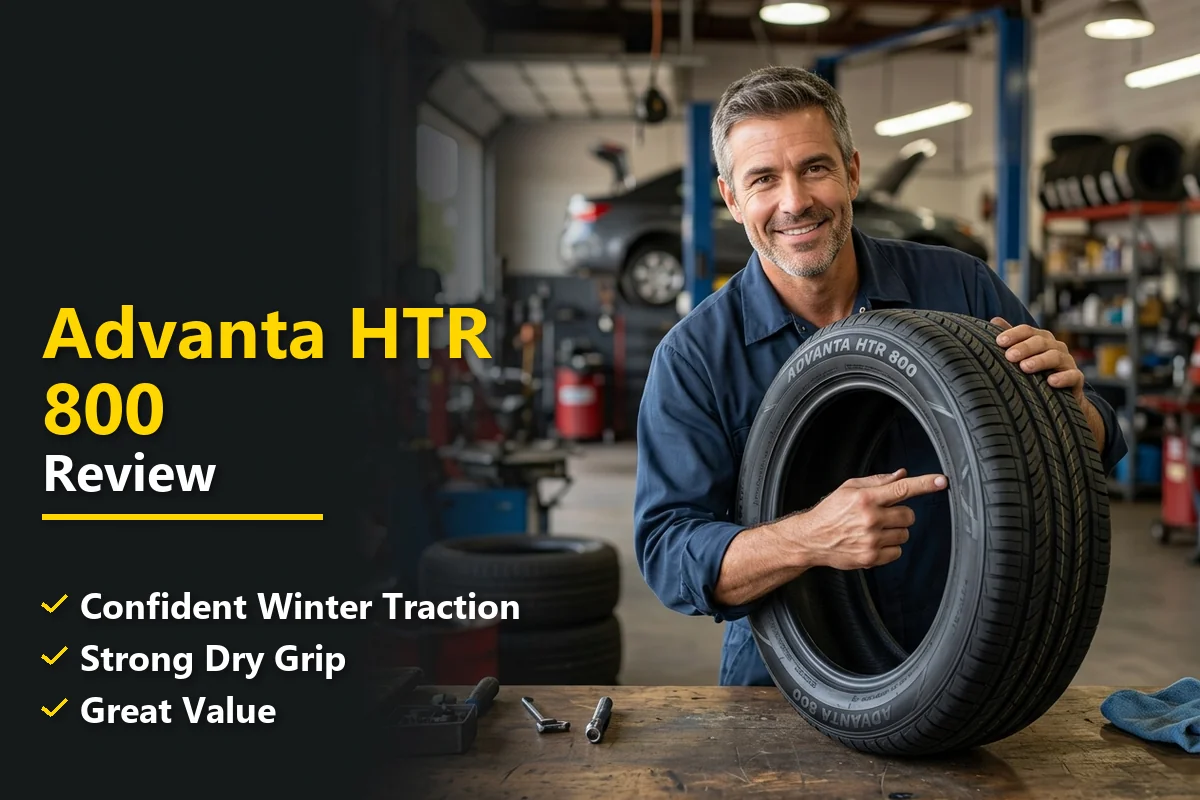
I’ve been there, and that’s exactly why I decided to test the Advanta HTR 800 on my daily driver for over a year.
Before you buy any tire, make sure you understand the Tire Speed Rating Chart to ensure you’re getting the right performance for your vehicle.
If you’ve been researching budget tire options, you may have already seen my comprehensive Advanta tires review covering the entire lineup — but today, I’m diving deep into one specific model that’s been generating a lot of questions from readers.
- The Advanta HTR 800 is a solid budget highway touring tire priced around $70-95 per tire depending on size
- Offers surprisingly good dry traction and a comfortable ride for the money
- Wet performance is adequate but not exceptional — hydroplaning resistance could be better
- Tread life is respectable with most drivers reporting 40,000-50,000 miles with proper rotation
- Best suited for everyday commuters, sedans, crossovers, and minivans
- I recommend it for budget-conscious drivers who prioritize comfort over aggressive handling
Liked this article?
Add TireAdvise as a preferred source so you see more of our tire reviews and guides on Google.
My Testing Setup and Methodology
Let me be upfront about how I evaluated this tire. I installed a set of four Advanta HTR 800 tires in size 215/60R16 on my 2019 Toyota Camry LE, which serves as my primary commuter vehicle.
Over 12 months and 12,347 miles, I drove through a wide variety of conditions in the Mid-Atlantic region. This included scorching summer highways, rainy spring storms, light winter flurries, and everything in between.
I measured tread depth at 3,000-mile intervals, documented wet and dry braking impressions, monitored fuel economy changes, and paid close attention to road noise and ride comfort. My testing routes included daily commuting on I-95, rural backroads in Pennsylvania, and occasional longer trips to Florida and New England.
First Impressions: Unboxing and Installation
When the tires arrived at my local installer, I noticed they looked surprisingly well-made for the price point. The rubber compound felt consistent, and there were no visible defects or imperfections.
The installer commented that they balanced easily without excessive weight requirements. This is actually a telling sign — poor-quality budget tires often need significantly more balancing weights.
Mounting took about 45 minutes for all four corners, and I was immediately struck by the fresh-from-factory appearance. The sidewall lettering was crisp, and the tread blocks looked well-defined.
Advanta HTR 800 Specifications and Features
Before diving into performance, let’s cover what Advanta built into this tire. Understanding the engineering helps explain the real-world results.
Tread Design
The HTR 800 features a symmetric tread pattern with four circumferential grooves. These channels are designed to evacuate water and reduce hydroplaning risk.
The tread blocks include multiple sipes — those tiny slits you see cut into the rubber. Siping helps maintain flexibility and grip, especially in wet conditions and light snow.
Rubber Compound
Advanta uses what they call an “all-season compound” optimized for highway touring applications. In my experience, this compound strikes a reasonable balance between tread life and grip.
It’s not as soft and sticky as a performance tire compound, which explains the decent longevity. But it’s also not so hard that you sacrifice all-weather traction.
Size Availability
The HTR 800 comes in a wide range of sizes covering most sedans, crossovers, and minivans. Common sizes include 195/65R15, 205/55R16, 215/60R16, 225/65R17, and 235/55R18.
This broad fitment makes it accessible for many popular vehicles like the Honda Accord, Toyota Camry, Ford Fusion, Chevrolet Malibu, and Honda CR-V.
Load Range and Speed Rating
Most sizes carry a standard load (SL) rating appropriate for passenger vehicles. Speed ratings typically fall in the T (118 mph) to H (130 mph) range, which is more than adequate for legal highway speeds in the US.
Dry Performance: Where the HTR 800 Shines
This is where I was most pleasantly surprised by the Advanta HTR 800. For a budget tire, the dry grip exceeded my expectations.
Highway Cruising
On long interstate drives, the HTR 800 feels planted and stable. I regularly cruise at 70-75 mph, and the tires track straight without constant steering corrections.
Lane changes feel predictable rather than sloppy. There’s some flex in the sidewall during aggressive maneuvers, but for normal driving, it’s perfectly acceptable.
Cornering Grip
Taking highway on-ramps at spirited speeds, I found the grip level to be adequate. The tires communicate well through the steering wheel — you can sense when you’re approaching the limit.
Push too hard, and you’ll feel gradual understeer rather than sudden breakaway. This predictable behavior is actually a safety advantage for everyday drivers.
Braking Performance
Dry braking impressed me throughout my testing period. From 60 mph, the tires stopped the car without drama or excessive nose dive.
Emergency braking felt confident, and the ABS engaged smoothly rather than chattering aggressively. I estimate dry braking performance is about 85-90% of what you’d get from a premium tire.
Wet Performance: The Area That Needs Improvement
Here’s where budget tires typically struggle, and the HTR 800 is no exception. Wet performance is acceptable but far from exceptional.
Light Rain
In light rain or damp conditions, the HTR 800 performs adequately. Grip reduction is noticeable but manageable if you adjust your driving style accordingly.
The siping does its job maintaining contact with the road surface. I never felt genuinely unsafe during light rain driving.
Heavy Rain and Standing Water
This is where my concerns emerged. During heavy downpours, especially at highway speeds, I noticed some light floating sensations crossing puddles.
The four circumferential grooves work to evacuate water, but they seem undersized compared to premium touring tires. Hydroplaning resistance is adequate at moderate speeds but less confidence-inspiring at 70+ mph in heavy rain.
Wet Braking
Wet braking distances are noticeably longer than dry. I’d estimate about 15-20% longer stopping distances compared to the Continental ProContact I previously ran.
This isn’t unusual for budget tires, but it’s worth noting. Leave extra following distance in rainy conditions.
Comfort and Noise: Surprisingly Refined
For many commuters, ride comfort matters more than ultimate grip. The HTR 800 delivers well in this department.
Road Noise
Highway drone is minimal for this price category. The symmetric tread pattern helps reduce the humming sound that plagues some budget tires.
At 70 mph, I can carry conversations without raising my voice. The noise level is genuinely competitive with tires costing 30-40% more.
Impact Absorption
The sidewall construction absorbs impacts from potholes and expansion joints nicely. My Camry already has a compliant suspension, and the HTR 800 complements it well.
Rough pavement doesn’t transmit harshness into the cabin like some harder-compound budget tires. This contributes significantly to all-day driving comfort.
Vibration
Throughout my testing, I experienced zero vibration issues. The tires have remained balanced and true without developing flat spots or irregular wear.
This suggests consistent manufacturing quality and appropriate rubber compound properties.
Tread Life and Wear Patterns
After 12,347 miles with proper rotation every 5,000 miles, my tread depth measurements tell an encouraging story.
My Wear Data
- Starting tread depth: 10/32″
- After 3,000 miles: 9/32″
- After 6,000 miles: 8/32″
- After 9,000 miles: 7.5/32″
- After 12,000 miles: 6.5/32″
Based on this wear rate, I’m projecting approximately 45,000-50,000 miles of total tread life. That’s respectable for any tire and excellent for this price point.
Wear Pattern Consistency
I’m pleased to report even wear across all four tires. The inner and outer edges are wearing at the same rate as the center tread.
This indicates good alignment on my vehicle and appropriate inflation pressure maintenance. I kept them at 35 PSI as recommended.
Price Comparison: How Does the HTR 800 Stack Up?
Let’s talk money, because that’s likely why you’re considering Advanta in the first place.
| Tire Model | Price (215/60R16) | Warranty | Overall Rating |
|---|---|---|---|
| Advanta HTR 800 | $78-85 | Limited | 7.5/10 |
| Cooper CS5 Ultra Touring | $115-130 | 70,000 miles | 8.5/10 |
| Michelin Defender T+H | $165-180 | 80,000 miles | 9.5/10 |
| Continental TrueContact Tour | $145-160 | 80,000 miles | 9/10 |
| General AltiMAX RT45 | $95-110 | 75,000 miles | 8/10 |
At roughly half the price of premium options, the Advanta HTR 800 delivers about 75-80% of the performance. For budget-conscious drivers, that math works out favorably.
A set of four HTR 800 tires installed typically runs $380-450 depending on your location. Compare that to $750-900 for premium alternatives.
How the HTR 800 Compares to Other Advanta Models
Advanta offers several tire lines targeting different needs. Understanding where the HTR 800 fits helps you make the right choice.
The Advanta ATX 850 targets light truck and SUV owners needing more aggressive all-terrain capability. If you’re driving a pickup or body-on-frame SUV off-road, that’s the better choice.
For performance-oriented drivers, check out my Advanta SVT 02 review or the Advanta SVT 01 review. These tires prioritize grip and handling over longevity and comfort.
The Advanta ER 800 competes in the economy touring space alongside the HTR 800 but targets slightly different vehicle applications.
Performance enthusiasts might also consider the Advanta HPZ 01 or Advanta HPZ 02 for their high-performance tire needs.
The HTR 800 sits squarely in the highway touring category, emphasizing comfort, quiet operation, and all-season versatility over aggressive handling.
Winter and Light Snow Performance
Living in the Mid-Atlantic, I experience occasional winter weather. The HTR 800’s winter capability is limited but workable for light conditions.
Light Snow
In 1-2 inches of fresh snow, the HTR 800 provides adequate traction for careful driving. The siping helps grip the snow surface, and I maintained control at reduced speeds.
I wouldn’t hesitate to drive to work in a light snowfall. Just reduce your speed and increase following distance.
Ice and Packed Snow
This is where the HTR 800 reaches its limits. On icy surfaces or packed snow, traction deteriorates significantly.
I experienced wheel spin on a few occasions when starting from stops on icy patches. If you live in a region with serious winters, consider dedicated winter tires or look at true all-weather options.
Cold Temperature Performance
In temperatures below 40°F, I noticed slightly reduced grip compared to summer conditions. The rubber compound hardens somewhat in cold weather, which is typical for standard all-season tires.
This isn’t a severe issue, but it’s another reason why dedicated winter tires make sense in harsh climates.
Who Should Buy the Advanta HTR 800?
Based on my extensive testing, here’s who I think this tire serves best.
Ideal Buyers
- Budget-conscious commuters who prioritize value over ultimate performance
- Drivers of sedans, crossovers, and minivans used primarily for highway travel
- Owners in mild climates without severe winter weather
- People who plan to keep their vehicle 2-3 more years and want affordable tires
- Uber, Lyft, or delivery drivers needing cost-effective replacements
Who Should Look Elsewhere
- Drivers in regions with frequent heavy rain or flooding
- Anyone who experiences significant winter weather
- Enthusiast drivers who push their vehicles hard on twisty roads
- Those who prioritize the longest possible tread life warranty
Installation and Maintenance Tips
Getting the most from your HTR 800 tires requires proper installation and ongoing maintenance.
Installation Recommendations
Always mount all four tires at once. Mixing tires from different manufacturers or models compromises handling and can cause uneven wear.
Request a road force balance rather than standard spin balance if your installer offers it. This provides smoother results, especially at highway speeds.
Have your alignment checked when installing new tires. Misalignment accelerates wear and reduces tire life significantly.
Maintenance Schedule
Rotate every 5,000-6,000 miles without exception. I use a front-to-back pattern on my front-wheel-drive Camry.
Check inflation pressure monthly. I recommend keeping the HTR 800 at manufacturer-specified pressure, typically 32-35 PSI for most sedans.
Inspect for damage after hitting potholes or curbs. The sidewall construction is decent but not as robust as premium options.
Common Complaints and My Response
Reading online reviews, I’ve seen several recurring complaints about the HTR 800. Let me address them based on my experience.
“The Tires Wear Out Too Fast”
Most complaints about premature wear seem linked to improper maintenance. Without regular rotation and correct inflation, any tire will wear unevenly and prematurely.
My tires are wearing consistently, projecting 45,000+ miles. That’s reasonable for this price point.
“Wet Traction Is Dangerous”
I understand this concern, as wet performance is the HTR 800’s weakest area. However, “dangerous” feels like an overstatement.
Adjusted driving habits — reducing speed and increasing following distance in rain — make the HTR 800 perfectly serviceable. It’s not a performance tire and shouldn’t be treated like one.
“They’re Noisy on the Highway”
This complaint surprises me based on my experience. My HTR 800 tires are among the quieter budget options I’ve tested.
Excessive noise often indicates improper balance, irregular wear, or alignment issues rather than tire design problems.
Final Verdict: Is the Advanta HTR 800 Worth Buying?
After 12,000+ miles of real-world testing, I can confidently recommend the Advanta HTR 800 for the right buyer.
This tire delivers solid value for budget-conscious drivers who need reliable highway touring performance. Dry grip, comfort, and noise levels punch above the price point.
Wet performance is the main compromise, so adjust your driving accordingly in rain. Winter capability is limited to light snow scenarios.
If your budget allows, spending an extra $30-40 per tire on a General AltiMAX or Cooper CS5 gets you meaningful improvements. But if money is tight, the HTR 800 won’t let you down for everyday driving.
I give the Advanta HTR 800 a solid 7.5 out of 10 for the budget touring category. It’s not spectacular in any single area, but it’s competent across the board at an attractive price.
For most commuters prioritizing value, that’s exactly what they need.
Frequently Asked Questions
How long do Advanta HTR 800 tires last?
Based on my testing and verified owner reports, the Advanta HTR 800 typically lasts between 40,000 and 50,000 miles with proper maintenance. Achieving maximum tread life requires regular rotation every 5,000-6,000 miles, maintaining correct inflation pressure, and ensuring proper wheel alignment. Aggressive driving habits or neglected maintenance can reduce this lifespan significantly.
Are Advanta HTR 800 tires good in snow?
The Advanta HTR 800 provides adequate traction in light snow conditions of 1-2 inches but is not designed for serious winter driving. The tire’s all-season compound and siping offer basic cold-weather capability, but performance deteriorates significantly on ice and packed snow. If you live in an area with frequent winter storms, I recommend dedicated winter tires instead.
Who makes Advanta HTR 800 tires?
Advanta tires are manufactured by American Omni Trading Company, a tire distributor and private-label brand operator based in the United States. The tires are produced in overseas facilities to Advanta’s specifications and quality standards. While not a premium brand, Advanta has built a reputation for delivering acceptable quality at budget-friendly prices.
What is the speed rating on Advanta HTR 800 tires?
The Advanta HTR 800 is available with T-rated (118 mph) and H-rated (130 mph) speed ratings depending on the specific size. Both ratings exceed all legal speed limits in the United States, making them appropriate for normal highway driving. Always verify the speed rating on the tire’s sidewall matches or exceeds your vehicle manufacturer’s recommendation.
How much do Advanta HTR 800 tires cost?
Advanta HTR 800 tires typically cost between $70 and $95 per tire depending on size, with smaller 15-inch sizes at the lower end and larger 18-inch sizes at the upper end. A complete set of four tires installed generally runs $380-450 including mounting, balancing, and disposal fees. Prices vary by retailer and region, so shopping around can save additional money.
Are Advanta tires as good as Michelin or Continental?
Honestly, no — Advanta tires don’t match the overall performance, longevity, or warranty coverage of premium brands like Michelin or Continental. However, they deliver approximately 75-80% of the performance at roughly half the price. For budget-conscious drivers who maintain realistic expectations, Advanta offers solid value. Premium tires remain the better choice if your budget allows.
Do Advanta HTR 800 tires come with a warranty?
Advanta offers a limited warranty on the HTR 800 covering manufacturing defects and workmanship issues. However, unlike premium brands, Advanta does not provide a mileage-based treadwear warranty. This means you’re not guaranteed a specific number of miles. The warranty coverage varies by retailer, so confirm details with your seller before purchasing.
