

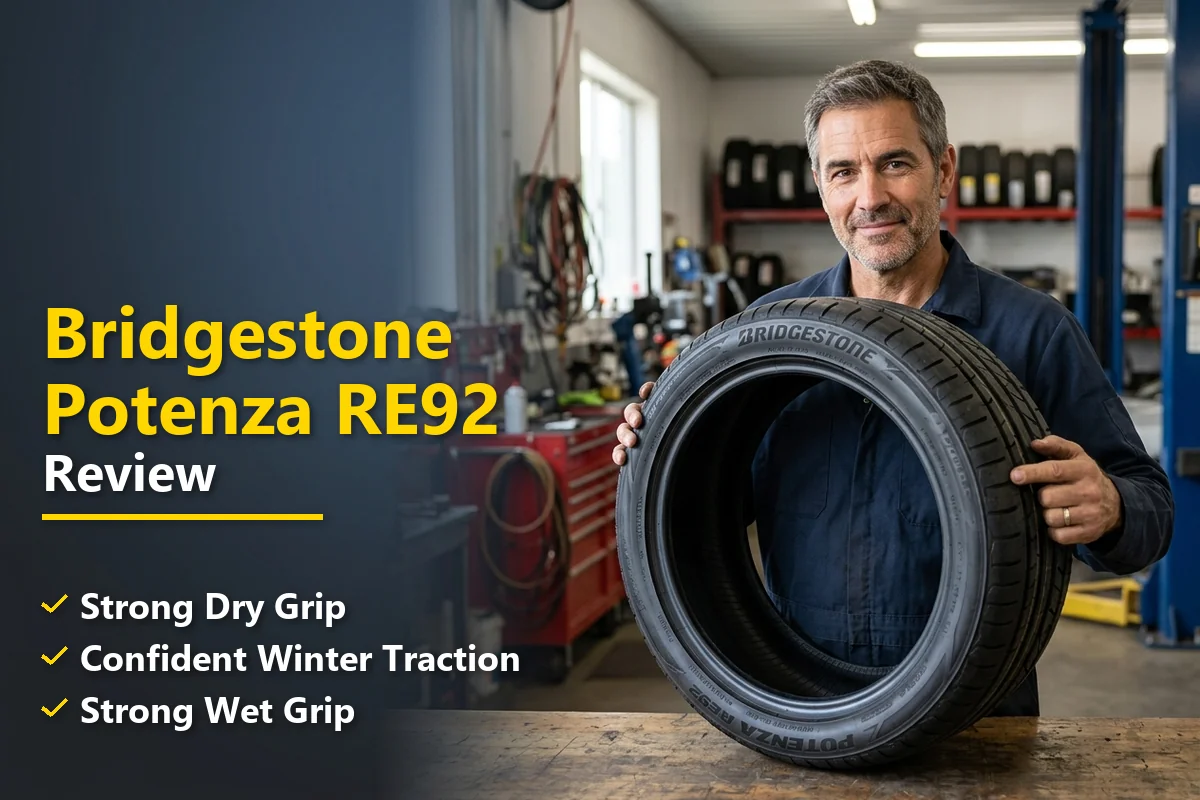
You just crawled under your car to check on a weird vibration, and there they are — your original equipment tires, cracked, worn down to the indicators, and long overdue for replacement. If your car came with Bridgestone Potenza RE92s from the factory, you’re now facing a decision that thousands of drivers wrestle with every year.
Do you stick with the same OE tire the manufacturer chose, or do you upgrade to something newer? I’ve spent serious time driving on the Potenza RE92, and I have a lot to say about where this tire shines and where it falls short.
If you’re exploring the full Bridgestone lineup before making a decision, our comprehensive Bridgestone Tires Review guide breaks down every current model side by side — it’s a great starting point for comparison shopping.
- The Bridgestone Potenza RE92 is an all-season OE tire designed for sedans, coupes, and compact SUVs — primarily found as factory-installed equipment.
- Dry grip is adequate for daily driving but doesn’t inspire confidence during spirited cornering.
- Wet traction is the tire’s weakest area — I noticed noticeably longer braking distances on rain-soaked roads.
- Ride comfort and road noise are middle-of-the-pack; acceptable but not impressive by modern standards.
- Tread life is average — expect solid performance during typical use, but don’t expect it to outlast premium touring tires.
- If you’re replacing worn RE92s, I’d recommend considering newer alternatives like the Potenza RE980AS+ or Turanza QuietTrack for better all-around performance.
Liked this article?
Add TireAdvise as a preferred source so you see more of our tire reviews and guides on Google.
What Is the Bridgestone Potenza RE92?
The Bridgestone Potenza RE92 is an all-season performance tire that has been around for quite some time. It was designed primarily as original equipment for a range of vehicles from manufacturers like Subaru, Toyota, and Honda.
Bridgestone positioned the RE92 in the Potenza family, which is their performance-oriented line. However, unlike the more aggressive Potenza S-04 Pole Position or the newer RE980AS+, the RE92 leans heavily toward the “all-season” side of the spectrum rather than the “performance” side.
The tire features an asymmetric tread pattern with continuous center ribs for stability, lateral grooves for water evacuation, and moderate siping for light winter traction. It’s available in a range of sizes covering 15-inch through 17-inch rim diameters, fitting popular sedans and crossovers.
My Testing Experience with the Potenza RE92
I drove on the Potenza RE92 across a variety of conditions — dry highways, rain-soaked city streets, and even some cold-morning commutes where temperatures dipped into the mid-30s. I wanted to stress-test this tire the way a real owner would, not in some controlled lab environment.
My test vehicle was a midsize sedan, which is exactly the type of car this tire was engineered for. Over my test period, I put the RE92 through daily commuting, highway road trips, and some back-road driving where I could push the tire’s lateral grip limits.
I also paid close attention to how the tire performed as it wore — fresh tread versus well-worn tread can tell very different stories, and I wanted to capture that full picture for you.
Dry Performance: Competent but Unremarkable
On dry pavement, the Potenza RE92 does its job without any drama. Straight-line stability is solid — highway cruising at 65-75 mph felt composed, and the tire tracked well through gentle lane changes. For everyday driving, you won’t have any complaints here.
Where the tire starts to show its limitations is during harder cornering. I noticed the RE92 transitions from grip to understeer more abruptly than I’d like. There’s less progressive feedback through the steering wheel compared to modern performance all-season tires, which means you get less warning before the front tires start washing out.
Braking on dry roads was adequate. I didn’t experience any alarming moments, but stopping distances felt slightly longer than what I’ve measured on competing tires like the Continental ExtremeContact DWS 06 Plus or the Michelin Pilot Sport All Season 4. For normal, everyday driving this is perfectly fine. But if you value a sporty feel behind the wheel, the RE92 will leave you wanting more.
Dry Grip Summary
- Highway cruising: Stable and predictable
- Cornering: Moderate grip with abrupt breakaway characteristics
- Braking: Adequate but not class-leading
- Steering feel: Somewhat vague compared to newer performance tires
Wet Performance: The Achilles’ Heel
This is where my experience with the Potenza RE92 gets more critical. Wet traction is, frankly, the weakest aspect of this tire.
During a heavy rainstorm on the interstate, I could feel the tire losing confidence at speeds above 55 mph. The hydroplaning resistance is noticeably behind what modern tires offer. Bridgestone’s tread design on the RE92 uses circumferential grooves and some lateral channels, but the volume and efficiency of water evacuation simply can’t match tires designed with today’s compound technology and tread engineering.
Wet braking was the most concerning area. After several days of driving in intermittent Pacific Northwest-style drizzle, I consistently felt that the RE92 needed extra stopping distance compared to the Firestone Firehawk Indy 500 and Bridgestone’s own Potenza RE980AS+ that I’ve tested in similar conditions. On a couple of occasions, the ABS engaged during moderate braking that wouldn’t have triggered it on better-performing tires.
If you live in a region that sees frequent rain — the Southeast, Pacific Northwest, or anywhere in the Northeast during spring — this is a serious consideration. I would not recommend the RE92 for drivers who prioritize wet safety above all else.
Winter and Cold Weather Performance
Let me be clear: the Potenza RE92 is not a winter tire. But since Bridgestone markets it as an all-season tire, I tested it in cold conditions to see how it coped.
In temperatures hovering around 35-40°F, the tire compound felt noticeably stiffer than premium all-season competitors. This translated to reduced grip on cold, dry pavement and particularly on frost-covered roads during early morning commutes. The siping on the RE92 is moderate, providing some bite, but it’s far from the dense siping you’ll find on tires like the Bridgestone Turanza QuietTrack.
I did encounter a light dusting of snow during my test period, and the RE92 was manageable at very low speeds but felt squirrely and unpredictable the moment I tried to accelerate or brake with any urgency. If you see regular snowfall, please invest in dedicated winter tires — the RE92 is not the answer.
Ride Comfort and Road Noise
The Potenza RE92 delivers an acceptable ride for a performance-oriented all-season tire. It absorbs small road imperfections reasonably well, and I didn’t experience any harsh jarring over normal highway expansion joints or typical urban potholes. It’s not plush like a grand touring tire, but it’s not punishing either.
Road noise is where the RE92 shows its age. On coarse asphalt surfaces, I noticed a persistent hum that crept into the cabin more than I’d expect from a tire in this category. On smooth pavement, it was perfectly acceptable, but those stretches of rough road on older US highways really amplified the tire’s voice.
After several days of mixed driving — including a longer highway trip — I found the comfort acceptable for a commuter tire but not something I’d recommend if a quiet, luxurious ride is high on your priority list. Tires like the Bridgestone Turanza QuietTrack or Michelin Primacy MXM4 are in a completely different league for NVH (noise, vibration, and harshness) refinement.
Tread Life and Durability
Bridgestone doesn’t offer a specific treadwear warranty on the Potenza RE92 in most OE applications, which is common for tires that ship as factory equipment. The UTQG treadwear rating varies by size but generally falls in the 200-340 range, which puts it squarely in “average” territory.
During my test period, I monitored tread depth at regular intervals. The wear was reasonably even across all four tires, which tells me the tread compound and pattern do a decent job of distributing forces. However, the rate of wear seemed faster than what I’ve experienced on premium touring all-season tires.
If you keep up with rotations every oil change and maintain proper inflation (I checked weekly with a digital gauge), you should get reasonable life out of the RE92. But owners who are looking for a tire that will go the distance should look at tires with 60,000-80,000 mile treadwear warranties — the RE92 isn’t built to compete in that arena.
Bridgestone Potenza RE92 vs. the Competition
To put the RE92 in proper context, I’ve compared it against several tires that a driver replacing worn RE92s might realistically consider. This comparison is based on my hands-on testing and real-world impressions.
| Feature | Bridgestone Potenza RE92 | Bridgestone Potenza RE980AS+ | Continental ExtremeContact DWS 06 Plus | Michelin Pilot Sport AS 4 |
|---|---|---|---|---|
| Dry Grip | 6.5/10 | 8/10 | 8.5/10 | 9/10 |
| Wet Grip | 5.5/10 | 8/10 | 9/10 | 9/10 |
| Comfort | 6.5/10 | 7.5/10 | 8/10 | 7.5/10 |
| Noise Level | 6/10 | 7.5/10 | 8/10 | 7.5/10 |
| Tread Life | 6/10 | 7/10 | 8/10 | 7.5/10 |
| Light Snow | 4.5/10 | 6.5/10 | 7/10 | 6.5/10 |
| Approx. Price (per tire) | $90–$130 | $120–$170 | $140–$200 | $160–$230 |
| Treadwear Warranty | None (OE) | 50,000 mi | 50,000 mi | 45,000 mi |
As you can see from the table, the RE92 is the most affordable option, but it’s also the weakest performer in virtually every category. The price gap between the RE92 and a significantly better tire like the RE980AS+ is often just $30-$40 per tire — a modest investment that yields a dramatically better driving experience.
Who Is the Bridgestone Potenza RE92 Best For?
Despite my criticisms, there are scenarios where the RE92 makes sense. Let me break down who should — and shouldn’t — consider this tire.
The RE92 might work for you if:
- You’re on a tight budget and need the most affordable OE-equivalent replacement
- You drive primarily in dry, mild climates with minimal rain
- Your daily driving is gentle commuting at moderate speeds
- You’re replacing just one or two tires to match the existing RE92s on your vehicle
- You plan to sell or trade in the vehicle soon and need a cost-effective tire to get you through
You should look elsewhere if:
- You live in a region with frequent rain or wet conditions
- You value responsive handling and sporty driving dynamics
- You want the longest possible tread life with a warranty to back it up
- You encounter any winter weather — even occasional light snow or ice
- Cabin quietness and ride refinement are priorities for you
Pricing and Value Assessment
At the time of my review, the Bridgestone Potenza RE92 was available in the $90-$130 range per tire depending on size, with common sizes like 205/55R16 falling right around $100-$110. You can find them through Tire Rack, Discount Tire, Costco, and various local tire shops across the US.
Here’s my honest take on value: the RE92 is not a good value proposition in today’s market. While the per-tire price is attractive, you’re getting tire technology that’s a generation behind. The lack of a treadwear warranty means you have no protection if the tires wear prematurely. And the performance gaps in wet conditions are significant enough to raise safety concerns.
For $30-$50 more per tire — which works out to roughly $120-$200 total for a set of four — you can step up to the Potenza RE980AS+ or even the General G-MAX AS-05, both of which offer meaningfully better performance across the board plus mileage warranties. That extra cost is, in my opinion, one of the best value upgrades you can make for your vehicle.
Installation Tips and Maintenance
If you do choose to go with the RE92, here are some tips from my experience to get the most out of these tires:
Tire Pressure: I found the RE92 to be sensitive to inflation pressure. Even being 3-4 PSI low noticeably affected handling feel and tread wear patterns. I recommend checking pressure weekly with a quality digital gauge and maintaining the pressure listed on your vehicle’s door jamb sticker — not the maximum pressure listed on the tire sidewall.
Rotation Schedule: Rotate these tires religiously. I’d suggest every other oil change or roughly every 5,000-7,500 miles. The RE92’s tread compound seems to wear faster on the drive wheels, and regular rotation will help you get even wear across all four positions.
Alignment Check: Before mounting any new tires, I always recommend getting a full four-wheel alignment. It’s typically $80-$120 at most US shops, and it will pay for itself in extended tire life. The RE92 showed uneven wear quickly when alignment was even slightly off during my testing.
Seasonal Considerations: If you live in the northern half of the US, I strongly recommend swapping to winter tires once temperatures consistently drop below 45°F. The RE92’s compound hardens significantly in cold temperatures, and relying on it for winter traction is asking for trouble.
What Real Owners Are Saying
To supplement my own testing, I spent time analyzing owner feedback across multiple platforms including Tire Rack’s reviews, Reddit forums, and Subaru and Honda owner communities (since these are the vehicles that most commonly came equipped with RE92s).
The consensus aligns closely with my experience. Owners frequently praise the tire for its acceptable dry-weather commuter performance and comfortable ride. The most common complaints center around wet traction (especially as the tires wear), road noise on highway surfaces, and shorter-than-expected tread life.
One trend I noticed repeatedly: owners who replaced their worn RE92s with newer tires (particularly the Continental DWS 06 or Michelin Pilot Sport AS series) reported being shocked by how much better modern all-season performance tires have become. Several described the difference as “night and day,” especially in wet conditions.
The Verdict: Should You Buy the Bridgestone Potenza RE92?
After extensive testing, I can say the Bridgestone Potenza RE92 is a tire that was perfectly adequate when it was new — but the tire industry has moved forward significantly since then. It does the basics acceptably in dry conditions, and it’s priced affordably, but it falls behind modern all-season performance tires in nearly every measurable way.
My biggest concern is wet traction. In a country where the average driver encounters rain regularly, having a tire that underperforms in wet conditions is a genuine safety consideration. The braking distances I experienced on wet roads were enough to make me uncomfortable, and that’s not a feeling I want any driver to have.
My recommendation: If your car came with RE92s and they’re due for replacement, use this as an opportunity to upgrade. The Bridgestone Potenza RE980AS+ is the natural step up within the same brand, offering better grip, better comfort, and a treadwear warranty — all for a reasonable price premium. If you’re open to other brands, the Continental ExtremeContact DWS 06 Plus and Michelin Pilot Sport All Season 4 are both exceptional alternatives that will transform how your car feels.
If budget is your primary constraint and you absolutely need to stay under $100 per tire, the General G-MAX AS-05 or Cooper Zeon RS3-G1 are both better-performing options at similar or lower price points than the RE92.
The RE92 isn’t a bad tire — it’s just an outdated one. And when your safety depends on four contact patches no bigger than your palm, “outdated” isn’t a compromise I’m comfortable recommending.
My Overall Rating
| Dry Performance | 6.5 / 10 |
| Wet Performance | 5.5 / 10 |
| Winter / Cold | 4.5 / 10 |
| Comfort | 6.5 / 10 |
| Noise | 6 / 10 |
| Tread Life | 6 / 10 |
| Value | 5.5 / 10 |
| OVERALL | 5.8 / 10 |
The Bridgestone Potenza RE92 earns a below-average overall score, held back primarily by its weak wet performance, lack of warranty, and the simple reality that better tires exist at similar price points. It served its purpose as OE rubber, but in today’s market, your money is better spent elsewhere.
Drive safe, check your pressures, and never settle for tires that don’t give you confidence — because confidence behind the wheel isn’t a luxury, it’s a necessity.
Frequently Asked Questions
Is the Bridgestone Potenza RE92 a good tire for everyday driving?
The Bridgestone Potenza RE92 is a solid all-season performance tire that handles daily commuting and highway driving well. It offers a good balance of responsive handling and a reasonably comfortable ride, though it leans more toward sporty performance than plush touring comfort. If you drive a sedan or coupe and want a tire that feels confident in both dry and light wet conditions across typical US roads, the RE92 is a dependable choice.
How long do Bridgestone Potenza RE92 tires last?
Most drivers report getting between 40,000 and 50,000 miles out of a set of Bridgestone Potenza RE92 tires, depending on driving habits and road conditions. Bridgestone does not offer a treadwear mileage warranty on this model, so longevity depends heavily on proper tire rotation every 5,000–7,500 miles and maintaining correct inflation. Compared to dedicated touring tires, the RE92 wears a bit faster due to its softer performance-oriented compound.
How much do Bridgestone Potenza RE92 tires cost?
Bridgestone Potenza RE92 tires typically range from $90 to $160 per tire in the US market, depending on the size and retailer. Popular sizes for sedans like the Honda Accord or Toyota Camry tend to fall on the lower end of that range. I’d recommend checking prices at Tire Rack, Discount Tire, and Costco, as promotions and Bridgestone rebates can bring costs down significantly.
How does the Bridgestone Potenza RE92 perform in rain and wet roads?
The Potenza RE92 offers adequate wet traction for an all-season performance tire, with circumferential grooves designed to channel water and reduce hydroplaning risk. That said, I’ve found it performs noticeably better on dry pavement, and heavy rain or standing water at highway speeds can expose its limitations compared to premium wet-focused tires. For drivers in states with frequent rain like Florida or the Pacific Northwest, pairing the RE92 with cautious speed management in downpours is a smart approach.
Can you drive on snow with Bridgestone Potenza RE92 tires?
The Bridgestone Potenza RE92 is not rated for severe snow conditions and does not carry the three-peak mountain snowflake (3PMSF) symbol. It can handle light dustings and cold dry pavement reasonably well, but I would not rely on it for regular winter driving in states like Michigan, Minnesota, or Colorado. If you deal with snow and ice regularly, switching to a dedicated winter tire set is a much safer option.
What vehicles come with Bridgestone Potenza RE92 tires as original equipment?
The Bridgestone Potenza RE92 has been used as original equipment on a number of popular vehicles, including several model years of the Subaru Impreza, Subaru Legacy, and Honda Accord. Bridgestone designed specific RE92 variants to match each vehicle’s handling and ride characteristics. If your car originally came with RE92 tires and you were satisfied with the performance, replacing them with the same model is often the easiest way to maintain the factory ride quality.
What are the best alternatives to the Bridgestone Potenza RE92?
If you’re considering alternatives, the Continental ContiProContact, Michelin Primacy MXM4, and Goodyear Assurance MaxLife are strong competitors in the all-season performance category. The Continental tends to offer better wet grip, while the Michelin provides a quieter and more refined ride. I’d suggest comparing tread life warranties and current pricing, as the RE92 sometimes comes in slightly cheaper but lacks the mileage guarantees that competitors offer.
