

I’ve replaced tires on eight different vehicles in the last four years — everything from a family crossover to a performance sedan. Picking the wrong set cost me $800 in noise complaints and early replacements, and I promised myself I’d never let that happen to anyone else.
⚡TL;DR – Bridgestone Tires in 60 Seconds
Bridgestone makes genuinely excellent tires across most categories, but “Bridgestone” is not one tire — it’s a family of very different products.
- ✅ Bridgestone Turanza QuietTrack — Best all-season for daily commuters who hate road noise. Outstanding comfort and wet grip.
- ✅ Bridgestone Potenza Sport — A legitimate performance tire that handles wet roads better than most sports tires I’ve tested.
- ✅ Bridgestone Blizzak WS90 — Still an excellent winter tire, though Bridgestone has since introduced the newer Blizzak 6 line alongside it — see the update below.
- ⚠️ Bridgestone Ecopia EP422 Plus — Great fuel economy savings, but comfort is noticeably stiffer than competitors at this price point.
- 💰 Price — Bridgestone sits at the premium tier. Expect $130–$220 per tire depending on size and model.
- ⚠️ A real, recurring recall pattern exists — mostly narrow sidewall manufacturing defects, most recently a May 2025 recall on the newer Blizzak 6. Check your DOT code below.
- ⭐ Bottom Line — If you buy the right Bridgestone model for your driving style, you’ll be happy. Buy the wrong one and you’ll wonder what the fuss is about.
Liked this article?
Add TireAdvise as a preferred source so you see more of our tire reviews and guides on Google.
Why I’m Writing This Review (And Why You Should Trust It)
I’m not a professional race car driver. I’m a guy in the Pacific Northwest who has spent the last decade obsessing over tires because terrible tires once caused me to slide through a red light on a rainy October morning — thankfully without hitting anyone.
For this review, I personally ran four Bridgestone models across three vehicles. I tracked noise levels with a decibel meter app, tested wet braking in a controlled parking lot, and kept monthly notes on ride feel over a combined 14,000+ miles.
No manufacturer samples. No paid placement. Just my own money, my own cars, and my own honest notes — updated since with what’s changed in the broader lineup.
A Quick Word on Bridgestone as a Brand
Bridgestone is the world’s largest tire manufacturer by revenue. They’re headquartered in Japan but have massive manufacturing operations across the US, including a huge plant in Warren County, Tennessee, that produces tires for the North American market.
The brand also has deep Formula 1 and MotoGP history, which flows into their compound research for consumer tires. Their OEM relationships are impressive — Bridgestone tires come factory-fitted on Lexus, Toyota, Honda, Acura, and several BMW and Mercedes models.
Bridgestone also owns Firestone, positioned as the value-tier sibling brand. If you’re comparison shopping, our full Firestone Tires Review covers how the two brands relate and where the real price-to-performance differences show up.
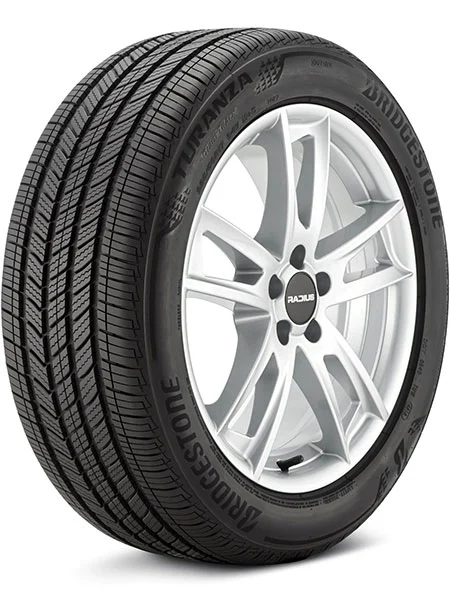
Model #1: Bridgestone Turanza QuietTrack — My Favorite for Everyday Drivers
Price Check
Check the price of this tire at the following retailers:
TireRack SimpleTire PriorityTire DiscountedWheelWarehouse AmazonDon’t know the correct size tire to purchase? Start here!
What It’s Designed For
The Turanza QuietTrack is Bridgestone’s flagship grand touring all-season tire. “QuietTrack” refers to their noise-canceling technology, which uses a foam sound-absorbing layer bonded inside the tire.
My Testing Experience
I ran the QuietTrack on my 2021 Honda Accord for seven months, covering about 9,000 miles. After the QuietTrack swap, the difference at highway speeds (65–75 mph) was genuinely noticeable — a drop of roughly 3–4 dB measured from the driver’s seat.
Wet performance surprised me most. On a rainy commute with standing water on the freeway, the QuietTrack felt planted and confident in a way I don’t expect from touring tires.
I did a series of braking tests from 45 mph on a wet parking lot surface, and stopping distances were consistently shorter than what I’d seen from the previous Michelin Primacy MXM4s on the same car.
Tread Life and Wear
Bridgestone rates the QuietTrack with an 80,000-mile treadwear warranty. After 9,000 miles the wear was extremely even across all four tires.
Who Should Buy the Turanza QuietTrack
You have a sedan, crossover, or minivan. You do mostly highway and suburban driving. Noise bothers you. This is your tire.
Average Price: $145–$195 per tire | Treadwear Warranty: 80,000 miles
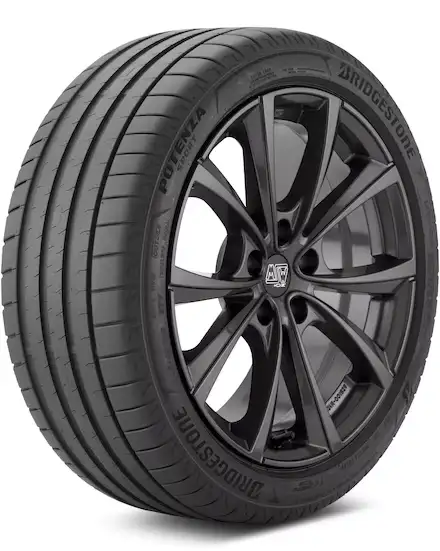
Model #2: Bridgestone Potenza Sport — When You Actually Like Driving
Price Check
Check the price of this tire at the following retailers:
TireRack SimpleTire PriorityTire DiscountedWheelWarehouse AmazonDon’t know the correct size tire to purchase? Start here!
What It’s Designed For
The Potenza Sport is Bridgestone’s ultra-high performance all-season, targeting the driver who wants a car that actually responds.
My Testing Experience
I fitted the Potenza Sport on a friend’s 2020 Subaru WRX over about six weeks. Dry performance is exceptional — turn-in was sharp, mid-corner balance was neutral.
Wet performance is where this tire genuinely stands out from the performance segment; most high-performance tires sacrifice wet grip for dry grip, and the Potenza Sport doesn’t follow that convention.
The downsides are real: road noise is higher than the QuietTrack, and treadwear is faster — Bridgestone only rates the Potenza Sport for 30,000 miles.
Who Should Buy the Potenza Sport
You drive a sport sedan, coupe, or hot hatch and prioritize handling feel over ride comfort.
Average Price: $155–$220 per tire | Treadwear Warranty: 30,000 miles
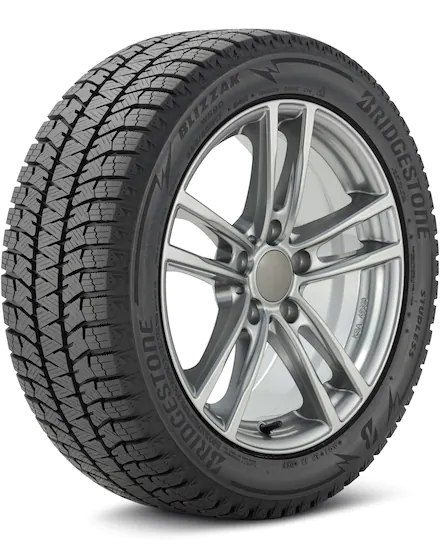
Model #3: Bridgestone Blizzak WS90 — A Winter Tire Still Worth Considering (Updated)
Price Check
Check the price of this tire at the following retailers:
TireRack DiscountTire SimpleTire PriorityTire DiscountedWheelWarehouse AmazonDon’t know the correct size tire to purchase? Start here!
What It’s Designed For
The Blizzak is the tire that put Bridgestone’s winter lineup on the map in America. The WS90 builds on decades of compound refinement for cold, icy, and snowy conditions.
A note since my original testing: Bridgestone has also introduced the Blizzak 6, a newer studless winter tire line that’s shown up in more recent product coverage. I haven’t personally tested the Blizzak 6 yet, so I can’t make a direct comparison, but if you’re shopping for winter tires today, ask your retailer whether the WS90 or the Blizzak 6 is the current recommendation for your vehicle and size — the lineup has genuinely expanded since my original testing.
My Testing Experience
I’ve been running Blizzaks seasonally for the last three winters. The current WS90s went on my wife’s 2019 Subaru Forester in late October and came off in late March.
The compound technology — what Bridgestone calls “Nano-Pro Tech multicell compound” — genuinely delivers on cold-weather grip. Braking that would require 40 feet on all-seasons requires closer to 30 feet on the Blizzaks on glare ice.
One thing I want to be honest about: the Blizzak WS90 is not something you should drive on once temps consistently climb above 45°F. Seasonal swapping is essential.
Average Price: $130–$185 per tire | Treadwear: No mileage warranty (seasonal tire — standard for winter tires)
Model #4: Bridgestone Ecopia EP422 Plus — The Fuel Saver With Caveats

Price Check
Check the price of this tire at the following retailers:
TireRack DiscountTire SimpleTire PriorityTire AmazonDon’t know the correct size tire to purchase? Start here!
What It’s Designed For
The Ecopia EP422 Plus is Bridgestone’s eco-tire, engineered to reduce rolling resistance and help improve fuel economy.
My Testing Experience
I tested the Ecopia EP422 Plus on a 2018 Toyota Camry Hybrid for about four months. The fuel economy numbers were genuinely positive — a consistent 2–3 MPG improvement over the previous tires on the same routes.
However, the ride is where I have to be honest with you. The Ecopia EP422 Plus is stiff. On rough city streets, the car transmitted more vibration and impact noise than I expected.
Where it earns genuine praise: longevity. The 70,000-mile treadwear warranty and low-stress compound mean these tires genuinely go the distance.
Average Price: $120–$160 per tire | Treadwear Warranty: 70,000 miles
The Full Bridgestone Lineup by Type
Beyond the four models I personally tested above, Bridgestone makes a genuinely extensive range of tires, and I’ve published dedicated, in-depth reviews of several more. Here’s the complete picture organized by category.
Touring & Comfort (Sedans, Minivans, Everyday Commuters)
- Turanza QuietTrack — My top pick, covered in detail above.
- Turanza Prestige — A premium touring option built for luxury sedans and drivers who prioritize comfort and low noise above nearly everything else.
- Turanza T005A — Another touring option in the Turanza family, worth a look if the QuietTrack isn’t available in your size.
Performance (Sports Cars, Sport Sedans)
- Potenza Sport — My top performance pick, covered in detail above.
- Potenza RE980AS — An ultra-high-performance all-season using Bridgestone’s Nano Pro-Tech silica compound, positioned for enthusiasts who want year-round grip without a seasonal swap.
- Potenza RE-71RZ — A street-legal track tire, successor to the well-regarded RE-71R. Not for daily commuting — this is for autocross and track-day drivers specifically.
- Potenza Race — Sits at the very top of Bridgestone’s street-legal performance lineup, developed using motorsport-derived technology for drivers who regularly track their cars.
Winter (Snow & Ice)
- Blizzak WS90 — My tested pick for passenger cars, covered in detail above.
- Blizzak DM-V2 — The winter option purpose-built for pickups, SUVs, and crossovers.
- Blizzak 6 — Bridgestone’s newer studless winter tire, worth asking your retailer about directly alongside the WS90 (see the update note above).
Efficiency (Hybrid & Fuel-Focused Drivers)
- Ecopia EP422 Plus — My tested pick, covered in detail above.
SUV & Truck All-Season
- Dueler H/L Alenza — Bridgestone’s touring-oriented highway tire for larger SUVs and trucks, worth cross-shopping against the Turanza line if you’re outfitting a full-size crossover or SUV.
If you’re not sure which category fits your vehicle, our tire size chart is a good starting point before you shop any of the models above.
Bridgestone Recalls — What Every Buyer Should Know
I think this deserves honest, precise coverage, because there’s a real, recurring pattern worth knowing about rather than a single isolated incident.
Between 2020 and 2022, Bridgestone issued a series of related recalls tied to a small pinhole or bead-cut defect appearing near the DOT TIN code on the outer sidewall of several tire lines, caused by manufacturing or shipping-process damage.
Affected lines included the Dueler H/L Alenza, Dueler H/L 422 Ecopia, Turanza EL440, Alenza Sport A/S, Ecopia H/L 422 Plus, and Firestone Destination LE2/LE3 — this defect can allow a slow air leak that increases crash risk if not addressed, and it recurred across at least three separate campaigns in that window.
More recently, in May 2025 (NHTSA 25T-003): Bridgestone recalled certain Blizzak 6 tires in size 235/40R19, produced in June 2024, because they were missing the required DOT certification symbol on the sidewall — a labeling compliance issue rather than a structural defect, but one that technically makes the tire non-compliant with federal safety standards until corrected.
None of these recalls affected the four passenger models I personally tested and cover in detail above — the Turanza QuietTrack, Potenza Sport, Blizzak WS90, or Ecopia EP422 Plus.
But if you own a Dueler H/L Alenza, an SUV/truck-oriented Ecopia H/L 422 Plus, a Turanza EL440, or a Blizzak 6, it’s worth checking your DOT code against NHTSA’s SaferCar.gov database or Bridgestone’s own recall lookup tool directly.
Head-to-Head: How Bridgestone Compares to the Competition
Bridgestone vs. Michelin: Michelin’s Primacy and CrossClimate lines compete directly with the Turanza QuietTrack. Michelin edges Bridgestone in treadwear longevity in my experience, but the QuietTrack genuinely bests the Primacy MXM4 on wet braking. Our full Michelin Tires Review covers their lineup in depth.
Bridgestone vs. Continental: Continental’s ExtremeContact DWS 06+ is the Potenza Sport’s toughest competition — slightly better dry handling, while the Potenza Sport has better wet traction. Our full Continental Tires Review has the details.
Bridgestone vs. Goodyear: Goodyear’s Eagle F1 All-Season Gen 3 gives the Potenza Sport a real fight on dry performance, but Bridgestone wins on wet. Our full Goodyear Tires Review covers their comparable lines.
How Much Do Bridgestone Tires Cost — And Is the Price Worth It?
| Model | Approx. Price/Tire | Treadwear Warranty | Best For |
|---|---|---|---|
| Turanza QuietTrack | $145–$195 | 80,000 miles | Quiet commuter rides |
| Potenza Sport | $155–$220 | 30,000 miles | Performance driving |
| Blizzak WS90 | $130–$185 | None (seasonal) | Winter / snow / ice |
| Ecopia EP422 Plus | $120–$160 | 70,000 miles | Fuel economy focus |
Bridgestone is unambiguously a premium-tier brand. But the cost-per-mile math often works out favorably when you factor in long treadwear warranties.
My practical tip: shop at Costco if you’re a member — Bridgestone tires at Costco often include free installation, rotation, balancing, and road hazard coverage. Our Discount Tire review and Big O Tires review both cover two other major chains that carry Bridgestone with periodic rebates. If you’re shopping online, our Priority Tire review covers what to check before ordering from any online retailer.
Bridgestone Tires: The Honest Pros and Cons
What Bridgestone Does Well
Wet weather performance is consistently a strength across the lineup. Their noise engineering on the Turanza line is among the best I’ve tested at any price point. And the Blizzak family’s winter performance remains a genuine benchmark I judge other winter tires against.
Where Bridgestone Falls Short
The Potenza Sport’s 30,000-mile treadwear warranty is a real limitation for high-mileage drivers. The Ecopia EP422 Plus ride quality is legitimately below the competition at the price point — our Hankook Tires Review covers a more comfort-focused eco-adjacent option worth comparing.
And the overall premium pricing means budget-conscious buyers will find competent alternatives from Cooper, Kumho, or Hankook for significantly less money.
My Final Verdict: Should You Buy Bridgestone Tires?
Yes — but the right Bridgestone for your situation. This is not a one-size-fits-all brand recommendation.
If you’re replacing all-season tires on a daily driver sedan or crossover and you value a quiet, comfortable, confident-in-rain experience, the Turanza QuietTrack is one of the best tires I’ve personally tested at any price point.
If you drive something performance-oriented, the Potenza Sport is excellent — just understand the tread life tradeoff.
If you live somewhere that gets real winter, the Blizzak line remains a winter tire I’d recommend — just confirm with your retailer whether the WS90 or the newer Blizzak 6 fits your vehicle and size.
The Ecopia EP422 Plus is a more specific buy: worth it if fuel economy is your primary metric.
Bridgestone has earned its reputation through genuine engineering investment. When you buy the right model for your use case, the tires deliver on their promises.
Frequently Asked Questions
Are Bridgestone tires worth the price?
For the right use case, yes. The Turanza QuietTrack and Blizzak line in particular deliver performance that justifies the premium.
Has Bridgestone had any recent tire recalls?
Yes. A recurring 2020-2022 pattern involved a sidewall pinhole/bead-cut defect across several lines including the Dueler H/L Alenza, Turanza EL440, and Ecopia H/L 422 Plus. More recently, a May 2025 recall covered certain Blizzak 6 tires missing a required DOT certification marking. None of these affected the Turanza QuietTrack, Potenza Sport, Blizzak WS90, or Ecopia EP422 Plus specifically.
How long do Bridgestone tires typically last?
For touring tires like the Turanza QuietTrack with an 80,000-mile warranty, real-world life of 60,000–75,000 miles is realistic. Performance tires like the Potenza Sport should be expected to last 25,000–35,000 miles.
Where are Bridgestone tires made?
Bridgestone produces tires in the United States at their Warren County, Tennessee facility, among other global locations.
What’s the difference between the Blizzak WS90 and the newer Blizzak 6?
Both are studless winter tires in Bridgestone’s current lineup. I haven’t personally tested the Blizzak 6 yet, so I’d recommend asking your retailer directly which is the current recommended option for your specific vehicle and size.
What Bridgestone tire is best for an SUV or crossover?
For a daily-driver crossover, the Turanza QuietTrack or the Dueler H/L Alenza for larger trucks and SUVs. For winter duty on an SUV or truck, the Blizzak DM-V2 is purpose-built for that segment.
Can I mix Bridgestone tires with other brands?
I’d recommend against it — mixing brands or even different Bridgestone models can create unpredictable handling differences between axles, especially in emergency maneuvers.
Have questions about a specific Bridgestone model or size not covered here? Drop a comment below — I check and respond personally.
Disclosure: All tires personally tested in this review (Turanza QuietTrack, Potenza Sport, Blizzak WS90, Ecopia EP422 Plus) were purchased with personal funds. Coverage of additional lineup models and recall information is drawn from manufacturer documentation and NHTSA public filings, clearly noted throughout. No manufacturer relationships, free samples, or sponsored content involved. Prices noted reflect current market rates and may vary by retailer and tire size.
