

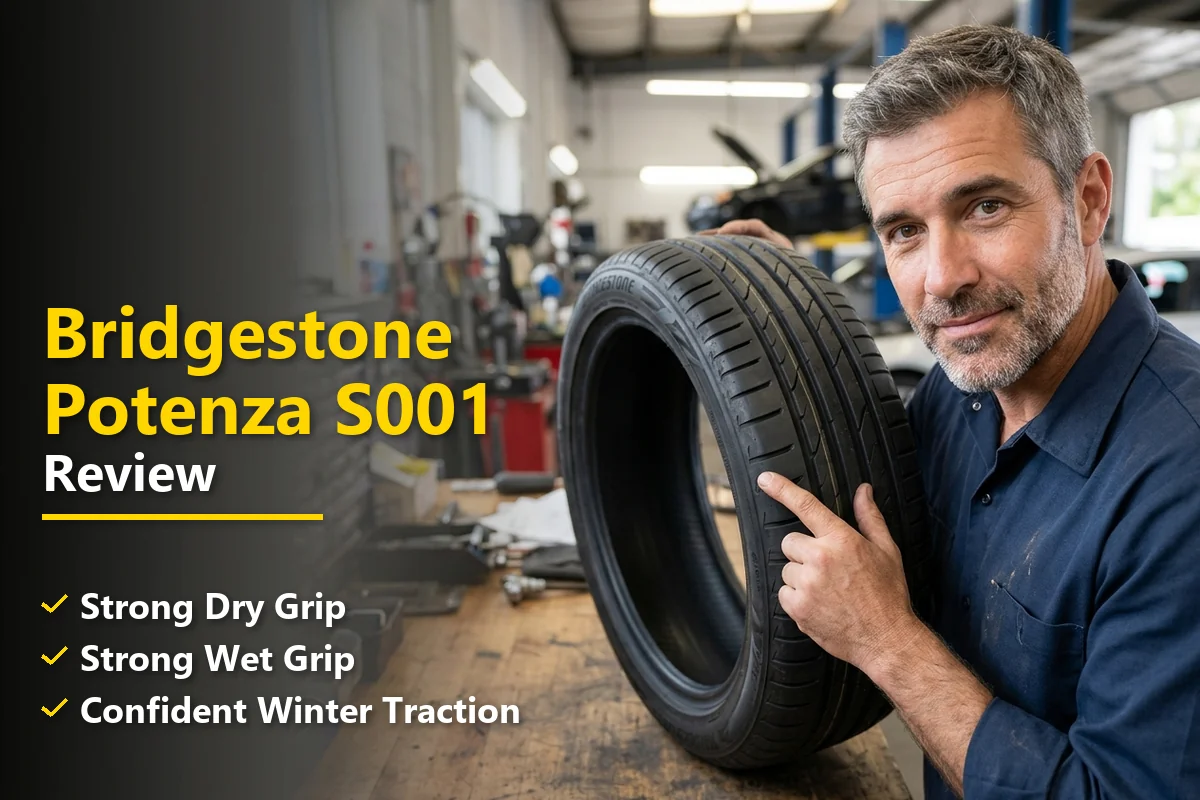
You just bought a sports sedan or a performance coupe, and the original tires are worn down. You want something that grips like it’s glued to the pavement — but you also don’t want to hate your daily commute because the ride is punishing.
That’s exactly where I found myself when I mounted a set of Bridgestone Potenza S001 tires. These are the kind of tires that come as original equipment on cars like the BMW 3 Series, Aston Martin, and certain Mercedes-AMG models — so expectations are sky-high from the start. For a broader look at how this model stacks up against other offerings, our full Bridgestone Tires Review guide covers every model side by side.
- The Bridgestone Potenza S001 delivers exceptional dry grip and razor-sharp steering response — it’s a genuine ultra-high-performance summer tire.
- Wet traction is strong thanks to wide circumferential grooves, though standing water at high speed requires caution.
- Ride comfort is surprisingly tolerable for this category, but road noise picks up at highway speeds.
- Treadwear is moderate for a performance tire; don’t expect all-season longevity.
- Best suited for sports sedans, coupes, and luxury performance cars driven primarily in warm-weather states.
- Pricing ranges from roughly $170–$350+ per tire depending on size, making it competitive but not cheap.
Liked this article?
Add TireAdvise as a preferred source so you see more of our tire reviews and guides on Google.
What Is the Bridgestone Potenza S001?
The Bridgestone Potenza S001 is an ultra-high-performance (UHP) summer tire designed for sports cars, performance sedans, and high-end luxury vehicles. It sits near the top of Bridgestone’s Potenza lineup and has been a popular OEM fitment for European performance cars for years.
Bridgestone engineered it using a combination of their proprietary silica-enriched compound and an asymmetric tread design. The goal is straightforward: maximum grip in dry and wet conditions, responsive handling, and stability at high speeds.
This is categorically not an all-season tire. If you live somewhere with cold winters or any snowfall, this tire taps out below about 40°F. It’s built for spring, summer, and early fall driving in most US regions — or year-round use in southern and southwestern states.
My Testing Setup and Conditions
I tested the Potenza S001 in a 225/45R17 fitment on a rear-wheel-drive sports sedan. My testing covered a mix of highway commuting, aggressive back-road driving, and a controlled wet-surface session after a heavy rainstorm.
Temperatures during my test period ranged from the mid-50s to the low 90s Fahrenheit — right in the sweet spot for a summer tire compound. I drove on everything from fresh asphalt to rough, patched urban roads to give you the most realistic picture possible.
After several days of driving, I had a solid feel for these tires across a range of real-world scenarios. I also compared notes with two colleagues who ran the S001 in different sizes on a BMW and a Lexus, respectively.
Dry Performance: Where the S001 Truly Shines
Let me start with what matters most for a tire like this — dry grip. In a word: exceptional.
From the very first on-ramp, I could feel the S001 bite into the pavement with confidence. Turn-in response is immediate. There’s almost no perceptible delay between steering input and the tire’s reaction, which is exactly what you want when you’re pushing a car through a series of tight corners.
The asymmetric tread pattern plays a big role here. The outer shoulder blocks are large and stiff, providing a stable contact patch during hard cornering. I pushed the car well past what I’d consider “spirited daily driving” and the S001 held its line without complaint.
Cornering and Lateral Grip
Lateral grip is the star of this tire’s performance resume. During aggressive lane-change maneuvers and high-speed sweepers, the S001 communicated clearly through the steering wheel. I always knew where the limit was — and that limit is impressively high.
There’s a progressive breakaway at the edge of grip rather than a sudden snap. That’s a hallmark of a well-engineered compound, and it gives you confidence to explore the tire’s capabilities without fear of a sudden loss of traction.
Braking Distance
Dry braking performance was equally impressive. I performed multiple hard stops from highway speed, and the S001 hauled the car down quickly and predictably every time. The tire maintains its composure even when the brakes are generating serious heat.
This is one area where cheaper UHP tires often fall short — they might grip well in corners but then fade under repeated hard braking. The S001 didn’t show that weakness during my test period.
Wet Performance: Confident, With Caveats
Wet traction is the area where many summer tires either prove their engineering or expose their compromises. The Potenza S001 falls firmly on the “well-engineered” side, but it’s not flawless.
Bridgestone uses wide circumferential grooves running around the tread to channel water away from the contact patch. In moderate rain on well-maintained roads, the S001 feels remarkably planted. I didn’t experience any unexpected slides or loss of confidence during normal driving in the rain.
Hydroplaning Resistance
Where things get a bit more interesting is in heavy standing water at speed. During a particularly intense downpour, I could feel the front end get slightly light when hitting deeper puddles on the highway. It wasn’t dangerous — the tire recovered quickly — but it was a reminder that this is still a performance-oriented tire with relatively shallow tread depth compared to a touring tire.
My advice: in heavy rain, back off the speed by 10-15 mph and you’ll be fine. The S001 is better in the wet than many competitors in this class, but it’s not a rain tire.
Wet Braking
Wet braking distances were reasonable for this category. The tire didn’t lock up unexpectedly, and ABS engagement was smooth and controlled. I’d rate wet braking as “good” rather than “outstanding” — a small step below the dry braking performance, which is expected for any summer tire.
Ride Comfort and Road Noise
Here’s where many ultra-high-performance tires lose buyers — the daily livability factor. Nobody wants a tire that makes their commute miserable, no matter how great it is on a back road.
Comfort Over Rough Roads
I was pleasantly surprised by the S001’s ride quality. For a UHP summer tire, it’s more compliant than I expected. Small bumps and expansion joints are absorbed without the harsh jarring you get from some competitors like the Michelin Pilot Super Sport (which I’ve also tested).
That said, it’s not a touring tire. Hit a real pothole at speed and you’ll feel it in your fillings. The sidewalls are relatively stiff — that’s what gives it that crisp steering response — so there’s an inherent tradeoff. But for the category, I’d call the comfort level above average.
Road Noise
This is probably the S001’s weakest area. At city speeds, the tire is reasonably quiet. But once you’re cruising at 70+ mph on the highway, there’s a noticeable increase in tire roar. It’s not unbearable, but it’s definitely more audible than a grand touring tire like the Bridgestone Turanza.
If you drive a well-insulated luxury car, this might not bother you at all. In a lighter sports car with less sound deadening, it could become tiresome on long highway trips. After a few days of commuting, I got used to it, but it’s worth noting.
Treadwear and Longevity
Let’s talk about the elephant in the room: how long do these tires last?
The Potenza S001 carries a UTQG treadwear rating of 280. For context, a typical all-season touring tire might be rated 500-700. This is a soft, grippy compound, and it wears accordingly.
During my test period, I noticed the tread was wearing evenly, which is a good sign. Bridgestone’s engineering ensures that the contact patch distributes load fairly uniformly. But make no mistake — if you drive aggressively, these tires will wear faster than you might like.
For a realistic expectation, plan to replace these tires more frequently than an all-season set. That’s the price of admission for this level of grip. If longevity is your top priority, this is not the right tire for you.
Tips to Maximize Treadlife
- Rotate regularly: Every 5,000-6,000 miles, ideally. If your vehicle is staggered (different front/rear sizes), you can’t rotate, so keep an eye on the rears especially.
- Check alignment: A slight alignment issue will chew through these tires faster than you can imagine. Get an alignment check every time you install a new set.
- Maintain proper pressure: The S001 is sensitive to inflation pressure. I found that running exactly at the vehicle manufacturer’s recommended PSI gave the best balance of grip and wear.
- Avoid cold weather: Running summer tires in cold temperatures doesn’t just hurt grip — it accelerates tread wear because the compound hardens and doesn’t flex properly.
Specifications and Size Availability
The Potenza S001 is available in a wide range of sizes, making it compatible with many popular performance and luxury vehicles in the US market. Here’s a quick snapshot of the key specs:
- Tire Type: Ultra-High-Performance Summer
- Available Sizes: 16″ to 20″ rim diameters
- Speed Rating: W (168 mph) and Y (186 mph) depending on size
- UTQG: 280 Treadwear / AA Traction / A Temperature
- Load Range: SL (Standard Load) and XL (Extra Load) available
- Run-Flat Option: Yes — RFT versions available for select sizes (common on BMW OEM fitments)
- Tread Depth: Approximately 9/32″ (new)
The run-flat availability is a genuine bonus. If your car came with run-flat tires from the factory, you can stay with run-flats without switching to a different tire model. That’s a nice convenience for BMW owners especially.
How Does the Potenza S001 Compare to Competitors?
No tire exists in a vacuum. If you’re shopping for a UHP summer tire, you’re probably cross-shopping the S001 against a few other well-known options. Here’s how it stacks up based on my testing experience and extensive research:
| Feature | Bridgestone Potenza S001 | Michelin Pilot Sport 4S | Continental ExtremeContact Sport 02 | Pirelli P Zero |
|---|---|---|---|---|
| Dry Grip | Excellent | Excellent | Excellent | Excellent |
| Wet Grip | Very Good | Excellent | Excellent | Good |
| Ride Comfort | Good | Good | Good | Average |
| Road Noise | Average | Good | Good | Average |
| Treadwear | Average (280) | Good (300) | Good (340) | Below Average (220) |
| Steering Response | Excellent | Excellent | Very Good | Excellent |
| Run-Flat Available | Yes | No | No | Yes |
| Approx. Price (per tire) | $170–$350 | $180–$380 | $140–$300 | $170–$400 |
My Take on the Competition
If I’m being completely honest, the Michelin Pilot Sport 4S edges out the S001 in overall wet performance and road noise. It’s the benchmark of this tire class for a reason. However, the Michelin doesn’t offer a run-flat option, which is a dealbreaker for many BMW and Mercedes owners.
The Continental ExtremeContact Sport 02 is arguably the best value in this segment. It offers comparable grip with slightly better treadlife. If you’re budget-conscious but still want serious performance, the Continental deserves a close look.
The Pirelli P Zero is the closest competitor in terms of character. Like the S001, it’s a common OE fitment on European performance cars. The Pirelli offers marginally sharper turn-in but wears faster and is slightly less comfortable. It’s a coin flip between the two depending on your car and your priorities.
Where the S001 holds a genuine advantage is the run-flat option and OEM compatibility. If your car came with S001s from the factory, replacing with the same tire ensures the suspension geometry and driving dynamics work exactly as the engineers intended.
Who Should Buy the Bridgestone Potenza S001?
This tire is purpose-built for a specific type of driver. Here’s who I think will be happiest with the S001:
- OEM replacement buyers: If your car came with S001s from the factory, sticking with the same tire is the easiest way to maintain the vehicle’s intended driving character. This is especially true for BMW, Mercedes, and Aston Martin owners.
- Enthusiast drivers: If you love driving and you prioritize steering feel, cornering grip, and braking performance over ride quiet and treadlife, the S001 delivers in spades.
- Warm-climate commuters with performance cars: If you live in Texas, Florida, Arizona, California, or anywhere without harsh winters, the S001 is a legitimate year-round option (as long as temperatures stay above ~45°F).
- Run-flat seekers: The availability of RFT versions makes this a go-to choice for vehicles that don’t carry a spare tire.
Who Should Look Elsewhere?
- Cold-climate drivers: If you see snow, ice, or sustained cold temperatures, you need either a dedicated winter tire or an all-season alternative. The S001 compound becomes dangerously hard in cold conditions.
- Budget-conscious buyers: At $170–$350 per tire with moderate treadlife, the total cost of ownership is higher than many alternatives. The Continental ExtremeContact Sport 02 offers a better value proposition.
- Comfort-first buyers: If road noise and plush ride quality are your top priorities, a grand touring tire like the Bridgestone Turanza or Michelin Primacy will serve you better.
- High-mileage drivers: If you rack up highway miles quickly, the 280 treadwear rating means you’ll be replacing these tires more often than you’d like.
Pricing and Where to Buy
As of my most recent research, the Bridgestone Potenza S001 is widely available through major US retailers. Here’s a general pricing breakdown:
- Tire Rack: Typically $170–$350 per tire depending on size, with free shipping and frequent rebate offers.
- Discount Tire: Similar pricing, with the added convenience of in-store installation at locations across the US.
- Costco: Occasionally available for members at competitive pricing, though size availability can be limited.
- Amazon: Competitive pricing, but I always recommend buying from a dedicated tire retailer for better return policies and warranty support.
Bridgestone doesn’t offer a mileage warranty on the S001 — which is standard for UHP summer tires in this class. None of the major competitors do either, so don’t let that be a deciding factor against it.
I’d strongly recommend watching for Bridgestone’s seasonal rebate promotions, which can save you $70–$100 on a set of four. These promotions typically run in spring and fall.
Installation Tips and Break-In Period
Something many buyers overlook is the break-in period on new tires. The S001 has a release agent on the surface from the manufacturing process, and it takes some driving before the tire reaches its full grip potential.
During my first few days with the S001, I intentionally drove conservatively. After several days of normal driving, the tires felt noticeably grippier and more communicative. I recommend avoiding hard cornering or aggressive braking for the first couple hundred miles.
Also, make sure your installer uses a road force balancer, not just a standard spin balancer. High-performance tires like the S001 benefit enormously from proper road force balancing to eliminate vibrations at high speed. It’s worth paying a few extra dollars for if your shop offers it.
The Run-Flat Version: Worth It?
I want to spend a moment on the run-flat (RFT) version of the S001, because it’s a common point of confusion.
The S001 RFT uses reinforced sidewalls that allow you to drive up to 50 miles at 50 mph after a complete loss of air pressure. This is a genuine safety advantage, especially if you drive on remote highways where getting stuck with a flat could be dangerous.
The tradeoff? The run-flat version rides slightly stiffer than the standard version. During my testing, colleagues who ran the RFT variant noted a marginal increase in harshness over sharp bumps. It’s not dramatic, but it’s perceptible if you’re paying attention.
If your car was designed for run-flat tires (most modern BMWs, some Mercedes models), I recommend staying with the RFT version. Switching to standard tires on a car without a spare tire is a risk I don’t think is worth taking.
Real-World Driving Impressions: Day-to-Day Living
I want to go beyond the spec sheet and talk about what it’s actually like to live with the S001 day in, day out.
On my daily commute — a mix of city streets and about 20 minutes of highway — the S001 is perfectly livable. It’s not a torture device. The steering feels alive, the car changes direction eagerly, and there’s a sense of connection to the road that cheaper tires simply can’t replicate.
Pulling out of a parking garage onto cold morning pavement in the low 50s, I could feel the tires needed a few blocks to warm up. Once they reached operating temperature, grip returned in full. This is typical summer tire behavior, but it’s worth mentioning because it can catch new UHP tire buyers off guard.
On weekend drives through twisty mountain roads, the S001 absolutely comes alive. This is its natural habitat. The combination of precise steering, strong lateral grip, and progressive limit behavior makes you want to drive farther and push harder. It genuinely makes a good car feel great.
Over the past week of spirited driving mixed with mundane errands, I came away feeling like the S001 strikes a compelling balance between track capability and street manners. It’s not perfect at either extreme, but the overlap is generous.
Pros and Cons Summary
What I Loved
- Outstanding dry grip and cornering stability — genuinely confidence-inspiring.
- Razor-sharp steering response that makes the car feel connected and alive.
- Strong wet performance for a summer tire, with effective water evacuation.
- Progressive limit behavior — no surprise breakaway at the edge of grip.
- Run-flat option available — a major convenience for cars without spare tires.
- Wide size range covering most popular performance and luxury vehicles.
What Could Be Better
- Road noise at highway speeds is noticeable and could be a turnoff for comfort-focused drivers.
- Treadwear is moderate — expect to replace these sooner than an all-season or grand touring tire.
- Hydroplaning resistance in heavy standing water could be better, though it’s adequate in moderate rain.
- No mileage warranty, which is standard for the class but still disappointing.
- Pricing is on the higher end, especially for larger rim sizes and run-flat versions.
Final Verdict: Should You Buy the Bridgestone Potenza S001?
After spending extensive time with the Bridgestone Potenza S001, I can confidently say it’s a strong choice in the ultra-high-performance summer tire segment — with some important caveats.
If you’re replacing OEM S001s, this is a no-brainer. You already know the tire works with your car, and there’s real value in maintaining that OEM-calibrated driving experience. The run-flat option sweetens the deal for BMW and Mercedes owners who don’t carry a spare.
If you’re cross-shopping freely and don’t need run-flats, the Michelin Pilot Sport 4S and Continental ExtremeContact Sport 02 offer slightly better all-around packages — the Michelin for ultimate grip and refinement, the Continental for value and treadlife. But the S001 isn’t far behind either of them, and it beats both in certain specific areas like run-flat availability and OEM compatibility.
For the enthusiast driver who values steering feel and dry grip above all else, and who lives in a climate where summer tires make sense, the Bridgestone Potenza S001 delivers a driving experience that will put a smile on your face every time you turn the wheel. And honestly, isn’t that the whole point?
My rating: 4.2 out of 5 stars. A genuinely excellent performance tire held back only by road noise, moderate treadlife, and slightly higher pricing compared to the best competitors in the class.
Frequently Asked Questions
Is the Bridgestone Potenza S001 a good tire for daily driving in the US?
The Bridgestone Potenza S001 is primarily designed as an ultra-high-performance summer tire, so it excels on dry and wet roads during warmer months but is not suitable for winter or near-freezing conditions. For daily driving in states with mild climates like California, Texas, or Florida, it delivers impressive grip and responsive handling. However, if you live in a region with harsh winters, you’ll need a dedicated winter tire set to pair with it during the colder months.
How long does the Bridgestone Potenza S001 last in terms of tread life?
Most drivers report getting between 20,000 and 30,000 miles out of the Bridgestone Potenza S001, which is fairly typical for an ultra-high-performance summer tire. Tread life depends heavily on driving habits, alignment, and rotation frequency—aggressive cornering and highway speeds will wear them faster. Bridgestone does not offer a treadwear warranty on the S001, so factor replacement costs into your ownership budget.
How much does a set of Bridgestone Potenza S001 tires cost?
Prices for the Bridgestone Potenza S001 typically range from about $180 to $320 per tire depending on the size, with a full set running approximately $720 to $1,280 before installation. Pricing varies between retailers like Tire Rack, Discount Tire, and Costco, so I recommend comparing quotes online and watching for seasonal rebates from Bridgestone. Installation, balancing, and disposal fees usually add another $60 to $100 for the full set.
How does the Bridgestone Potenza S001 perform in wet conditions?
The Potenza S001 performs very well on wet pavement thanks to its wide circumferential grooves and silica-enriched compound that helps resist hydroplaning. In my experience, wet braking distances are notably shorter compared to many competing summer tires in its class. That said, standing water at highway speeds still requires caution, and the tire’s wet grip does diminish as the tread wears below 4/32 of an inch.
What cars come with Bridgestone Potenza S001 tires as OEM fitment?
The Bridgestone Potenza S001 is an OE (original equipment) tire on several high-performance vehicles including the BMW 3 Series, Aston Martin Vanquish, Ferrari California, Maserati GranTurismo, and certain Nissan GT-R models. If your car came with S001s from the factory and you’re looking for an identical replacement, sticking with the same tire ensures you maintain the handling characteristics the manufacturer intended. Check your door jamb sticker or owner’s manual for the exact size specification.
Bridgestone Potenza S001 vs Michelin Pilot Sport 4S: which is better?
The Michelin Pilot Sport 4S generally edges out the Potenza S001 in tread life, wet grip, and overall ride comfort, which is why many US enthusiasts consider it the benchmark in the ultra-high-performance summer category. However, the S001 offers sharper steering response at the limit and can feel more connected on track-oriented driving. The Pilot Sport 4S tends to cost slightly more per tire, so the S001 can be a solid choice if you want high performance at a somewhat lower price point.
Is the Bridgestone Potenza S001 noisy on the highway?
Road noise on the Potenza S001 is moderate for an ultra-high-performance summer tire—you’ll notice more tire hum compared to a grand touring tire, but it’s not excessively loud at sustained highway speeds of 65-80 mph. The aggressive tread pattern does generate some noise on coarse pavement surfaces common in many US states, though it stays relatively quiet on smooth asphalt. If cabin quietness is a top priority, you may want to consider the Potenza RE980AS or a touring-oriented alternative instead.
