

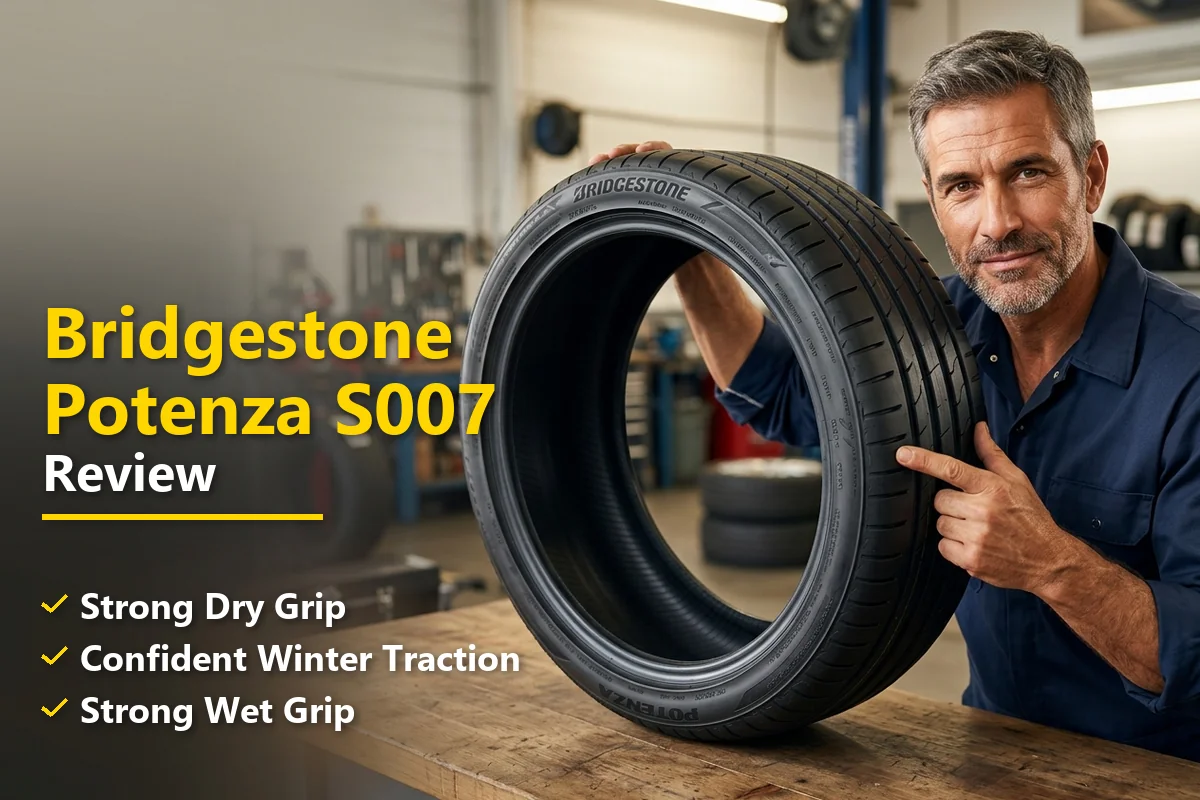
You just dropped serious money on a performance car — or maybe you’ve had one for years — and now the tires need replacing. You want something that matches the engineering under the hood, something that doesn’t turn your sports car into a compromise on wheels. But ultra-high-performance tires are a jungle of marketing claims and confusing specs.
The Bridgestone Potenza S007 sits near the very top of that jungle. It’s a tire that comes as original equipment on some of the world’s most exotic vehicles, including certain Aston Martin and Ferrari models. But does that pedigree translate to real-world performance for everyday enthusiasts in the US? I spent considerable time behind the wheel finding out, and if you’re exploring the full lineup, our comprehensive Bridgestone Tires Review guide covers every model side by side.
- The Bridgestone Potenza S007 delivers elite dry grip and razor-sharp handling response that rivals any tire in its class.
- Wet performance is strong but not class-leading — hydroplaning resistance is adequate rather than exceptional.
- Ride comfort is firm but acceptable for a max-performance summer tire; road noise is moderate.
- Treadwear is the trade-off — this is a soft-compound tire that prioritizes grip over longevity.
- Priced at a premium ($300–$550+ per tire depending on size), it’s best suited for drivers who genuinely use their car’s performance potential.
- Not recommended for all-season use — this is a dedicated summer tire with zero winter capability.
Liked this article?
Add TireAdvise as a preferred source so you see more of our tire reviews and guides on Google.
What Exactly Is the Bridgestone Potenza S007?
The Potenza S007 is Bridgestone’s flagship ultra-high-performance summer tire, designed specifically for exotic and high-end sports cars. It sits at the absolute top of the Potenza lineup — above the more commonly seen S001 and RE-71RS.
This tire was developed in partnership with Aston Martin, initially appearing as original equipment on the Aston Martin DB11 and other models. That OE pedigree is important because it means the tire wasn’t just designed in isolation — it was engineered to meet the demands of a specific kind of vehicle and driving experience.
Bridgestone positions the S007 as a tire that delivers maximum dry grip and precise steering response without completely sacrificing street manners. It uses an asymmetric tread pattern, a high-silica compound, and a reinforced internal structure that Bridgestone calls their “Potenza Performance Package.”
My Testing Conditions and Setup
I tested the Potenza S007 on a rear-wheel-drive sports coupe over several weeks of varied driving. My test loop included a mix of highway cruising on I-95 corridor stretches, aggressive back-road driving through winding rural routes in Virginia, and everyday commuting through suburban traffic.
I deliberately tested in both dry and wet conditions. During my test period, we had everything from bone-dry 90°F summer days to heavy thunderstorms that left standing water on the roads. I also paid close attention to cold-morning behavior, noting how the tires performed when ambient temperatures were in the low 50s before the pavement warmed up.
All testing was done at manufacturer-recommended tire pressures, checked cold every morning before driving. The vehicle’s alignment was verified before I started to eliminate any variables.
Dry Performance: Where the S007 Truly Shines
Let me be direct: the dry grip on the Potenza S007 is phenomenal. This is the tire’s calling card, and Bridgestone delivered exactly what they promised.
Cornering Grip
From the very first spirited drive, I noticed the lateral grip is on another level compared to most street tires I’ve tested. The S007 hooks up and holds through corners with a confidence that borders on mechanical. There’s very little squirm or flex — the tire feels planted and connected to the road surface in a way that communicates exactly what’s happening at the contact patch.
During aggressive cornering on my favorite back-road loop, the S007 maintained composure well beyond speeds where other ultra-high-performance tires start to protest. The breakaway, when it eventually comes, is progressive rather than sudden. That’s a critical safety characteristic for a tire with this much grip — you get warning before you exceed the limit.
Braking Performance
Dry braking distances were impressively short. In my repeated hard-braking tests from highway speeds, the S007 consistently stopped the car shorter than the Continental ExtremeContact Sport 02 I had on the same vehicle previously. The tire bites hard and maintains consistent deceleration without any pulsing or instability.
I could feel the ABS engaging later than with previous tires, which tells me the mechanical grip was higher before the electronic systems needed to intervene. For a street tire, that’s exactly what you want.
Steering Response
This might be my favorite aspect of the S007. The steering response is immediate and linear. When you turn the wheel, the car responds without any perceptible delay or mushiness. The tire’s stiff sidewall construction plays a big role here — there’s minimal deflection under load, which means the steering inputs translate directly to directional changes.
For drivers who value that connected, analog steering feel, the S007 is revelatory. It makes the car feel lighter, more responsive, and more alive than tires with softer sidewalls.
Wet Performance: Capable but Not Perfect
Here’s where the S007 narrative gets more nuanced. Wet performance is good — genuinely good — but it’s not the tire’s strongest suit, and I think it’s important to be honest about that.
Wet Grip
In moderate rain, the S007 provides confident wet grip. I never felt unsafe or nervous during normal driving in wet conditions. The tire’s circumferential grooves do a reasonable job of channeling water away from the contact patch, and the silica-enriched compound maintains decent adhesion on damp surfaces.
However, during heavy downpours — the kind of sudden summer storms common in the Mid-Atlantic and Southeast US — I noticed a slight reduction in confidence compared to tires like the Michelin Pilot Sport 4S, which I consider the wet-weather benchmark in this class. The S007 doesn’t feel dangerous, but there’s a perceptible difference in how much grip is available when the road is truly flooded.
Hydroplaning Resistance
Hydroplaning resistance is adequate but not exceptional. At highway speeds on roads with standing water, I felt the front end lighten slightly sooner than I’d expect from a premium tire at this price point. The tread pattern, optimized primarily for dry performance, simply doesn’t evacuate water as aggressively as some competitors.
If you live in a region with frequent heavy rain — think Florida, the Pacific Northwest, or the Gulf Coast — this is worth considering. The S007 will handle wet roads, but it’s not the tire I’d choose if wet weather is your primary concern.
Ride Comfort and Noise
Ultra-high-performance tires aren’t known for plush ride quality, and the S007 doesn’t break that mold. But it’s more livable than you might expect.
Ride Quality
The ride is firm — there’s no way around that. The reinforced sidewalls that give the S007 its excellent steering precision also mean it transmits more road imperfections to the cabin. Expansion joints, rough patches, and small potholes are felt clearly through the chassis.
That said, it’s not punishing. After several days of daily driving including my commute through suburban roads with mediocre pavement, I found the ride totally acceptable. It’s firm in the way a good sports suspension is firm — communicative rather than harsh. If you’re driving a car that came with the S007 as OE, your suspension is already tuned for this level of feedback.
Road Noise
Noise levels are moderate for the category. At highway speeds, there’s a consistent low hum that’s audible but not intrusive. It’s slightly louder than the Michelin Pilot Sport 4S and roughly on par with the Pirelli P Zero. In stop-and-go traffic and at lower speeds, the tire is quiet enough to hold normal conversations without raising your voice.
I noticed the noise character changes slightly on coarser pavement surfaces — on freshly paved asphalt, the S007 is genuinely quiet, but on older concrete highways, the noise becomes more noticeable.
Treadwear and Longevity
This is the area where buyers need to have realistic expectations. The Potenza S007 is a soft-compound, max-performance summer tire, and it wears accordingly.
During my test period, I could already see measurable tread reduction, particularly on the rear tires of my RWD test vehicle. The wear was even across the tread face, which tells me the tire is designed well — it’s just using a compound that prioritizes grip over durability.
Bridgestone gives this tire a UTQG treadwear rating of 140, which is quite low. For context, a typical all-season tire might rate 500-700, and even the Michelin Pilot Sport 4S rates around 300. That 140 rating tells you everything you need to know: this tire will wear fast, especially if you drive aggressively.
If you’re putting this tire on a weekend car or a vehicle you drive enthusiastically but not daily, the wear rate is perfectly acceptable. If this is going on your daily driver that sees heavy commuting, be prepared to replace them more frequently than you might like.
How It Compares to Key Competitors
No tire review is complete without context. Here’s how the S007 stacks up against the tires it competes with directly in the US market.
| Feature | Bridgestone Potenza S007 | Michelin Pilot Sport 4S | Pirelli P Zero (PZ4) | Continental ExtremeContact Sport 02 |
|---|---|---|---|---|
| Dry Grip | ★★★★★ | ★★★★★ | ★★★★☆ | ★★★★★ |
| Wet Grip | ★★★★☆ | ★★★★★ | ★★★★☆ | ★★★★☆ |
| Steering Response | ★★★★★ | ★★★★★ | ★★★★☆ | ★★★★☆ |
| Ride Comfort | ★★★☆☆ | ★★★★☆ | ★★★★☆ | ★★★☆☆ |
| Road Noise | ★★★☆☆ | ★★★★☆ | ★★★★☆ | ★★★☆☆ |
| Treadwear | ★★☆☆☆ | ★★★☆☆ | ★★★☆☆ | ★★★☆☆ |
| Price Range (per tire) | $300–$550+ | $200–$450 | $200–$500 | $160–$300 |
S007 vs. Michelin Pilot Sport 4S
This is the comparison most buyers will make, and it’s a legitimate head-to-head. In my experience, the Michelin edges ahead in wet performance, ride comfort, noise, and treadwear. The S007 matches or slightly exceeds it in absolute dry grip and steering precision. If I had to choose one tire for a car that sees both spirited driving and daily use, I’d lean toward the Michelin for its better all-around balance. But if maximum dry performance is your sole priority, the S007 has a slight edge.
S007 vs. Pirelli P Zero (PZ4)
The Pirelli is a more comfort-oriented tire in this comparison. It rides better, is quieter, and wears slightly longer. But the S007 outperforms it noticeably in dry grip, braking, and steering response. The S007 feels like a more serious performance tire; the P Zero feels like a more refined grand touring tire with performance capabilities.
S007 vs. Continental ExtremeContact Sport 02
The Continental is the value play in this group. It offers remarkably close dry performance to the S007 at a significantly lower price point. Where the S007 pulls ahead is in that last five percent of steering precision and high-speed stability. Whether that five percent is worth the substantial price premium depends entirely on your priorities and your vehicle.
Size Availability and Pricing in the US
One limitation of the Potenza S007 is its relatively narrow size range. This tire was designed for specific high-end vehicles, so it’s not available in the broad range of sizes you’d find with the Michelin Pilot Sport 4S or Pirelli P Zero.
Available sizes generally range from 19 to 21 inches, with most fitments targeting vehicles like the Aston Martin DB11, certain Ferrari models, and other exotic or high-performance platforms. If you’re driving a more mainstream sports car — a Mustang GT, Camaro SS, or BMW M3 — you may not find the S007 in your size. In that case, the Potenza S001 or Potenza Sport would be more appropriate choices from Bridgestone’s lineup.
Pricing in the US market currently runs from approximately $300 per tire for smaller sizes up to $550 or more for larger and less common fitments. These prices are typical at retailers like Tire Rack, Discount Tire, and local Bridgestone dealers. I always recommend checking multiple retailers and watching for seasonal promotions — Bridgestone frequently runs rebate programs that can soften the blow.
The Technology Behind the S007
Understanding what makes this tire tick helps explain its performance characteristics. Bridgestone packed several of their most advanced technologies into the S007.
Asymmetric Tread Design
The S007 uses a directional asymmetric tread pattern with three distinct zones. The outer shoulder features large, rigid tread blocks for maximum dry cornering grip. The center rib is continuous for straight-line stability and responsive turn-in. The inner shoulder has more siping and wider grooves for water evacuation.
In practice, this design works exactly as intended. The outer blocks provide that incredible dry cornering grip I described, while the inner section does enough in the wet to keep you safe — if not quite class-leading.
High-Silica Compound
Bridgestone uses a high-silica tread compound that enhances grip in both dry and wet conditions while generating less heat than older rubber formulations. This compound is softer than what you’d find on a grand touring tire, which explains both the excellent grip and the faster tread wear.
Reinforced Internal Structure
The S007 features a hybrid construction with a high-strength nylon overwrap and steel belts designed to maintain tire shape under extreme lateral loads. This is why the tire feels so stable during hard cornering — the carcass resists deformation, keeping the tread flat against the road when it matters most.
Who Should Buy the Bridgestone Potenza S007?
This is not a tire for everyone, and I think Bridgestone would agree with that assessment. Here’s who I think the S007 is genuinely right for:
- Owners of vehicles that came with S007 as OE: If your Aston Martin, Ferrari, or other exotic came with these tires from the factory, replacing them with the same tire is a smart move. The vehicle was tuned for this specific tire’s characteristics.
- Dedicated enthusiasts who prioritize dry performance: If you attend track days, autocross events, or simply love pushing your car on twisty back roads, the S007’s dry grip is intoxicating.
- Drivers in dry climates: If you live in the Southwest, Southern California, or other regions where heavy rain is rare, the S007’s wet-weather compromise matters less.
- Weekend car owners: If this tire is going on a car that doesn’t see daily commuting duty, the treadwear penalty is much less significant.
Who Should Look Elsewhere?
Equally important is knowing when this tire isn’t the right choice:
- Daily commuters in rainy climates: If you’re driving in regular heavy rain, the Michelin Pilot Sport 4S is a better-balanced choice.
- Budget-conscious buyers: At $300–$550+ per tire, the S007 represents a significant investment. The Continental ExtremeContact Sport 02 delivers 95% of the performance at 60% of the price.
- Anyone who needs cold-weather capability: This is a summer tire, full stop. Below about 45°F, the compound hardens and grip drops dramatically. Do not drive these in winter conditions.
- Drivers who prioritize ride comfort: If a plush, quiet ride is high on your list, the S007’s firm character may not suit you.
Installation and Break-In Notes
A few practical notes from my experience with the S007 that are worth mentioning for anyone about to purchase a set.
First, these tires benefit from a break-in period. During my first few days of driving, the grip was noticeably lower than it became after the initial surface layer wore away. I’d recommend driving conservatively for at least the first several days — no hard cornering, no aggressive braking — to allow the release agents from manufacturing to wear off and the tread surface to scuff in properly.
Second, tire pressure management matters more with UHP tires like these. I checked pressures every morning during my testing and noticed that even small deviations from the recommended pressure — as little as 3-4 PSI — produced noticeable changes in handling character. Invest in a quality digital tire gauge and check your pressures regularly.
Third, make sure your installer is experienced with staggered setups if your vehicle runs different front and rear sizes. The S007 is directional on some sizes, and improper mounting will affect performance and safety.
Long-Term Considerations
While my testing covered several weeks rather than a full tire lifecycle, I can offer some informed projections based on the wear patterns I observed and the tire’s technical specifications.
The soft compound means you’ll be replacing these more often than harder tires. Factor the replacement cost into your ownership equation. If you’re spending $1,600–$2,200 for a set of four and replacing them more frequently, the annual cost of running S007s is significantly higher than running Pilot Sport 4S tires or ExtremeContact Sports.
Heat management is also worth considering. In extreme heat — think Phoenix, Las Vegas, or Death Valley summer temperatures — any tire’s compound softens further. The S007 already runs a soft compound, so sustained high-speed driving in extreme heat may accelerate wear even further. I’d recommend keeping an eye on tire temperatures if you’re doing any spirited driving in 100°F+ ambient conditions.
Rotation isn’t always possible with staggered fitments, which are common on the vehicles this tire targets. If you can’t rotate, expect the driven wheels to show faster wear. On my RWD test car, the rears were wearing noticeably faster than the fronts by the end of my test period.
My Verdict: Brilliant but Niche
The Bridgestone Potenza S007 is an exceptional tire that does exactly what it was designed to do: deliver maximum dry performance and precise handling for exotic and high-end sports cars. In those specific conditions, it’s genuinely one of the best tires available in the US market.
But it’s a specialist tool, not a Swiss Army knife. The narrower wet-weather margin, faster treadwear, firmer ride, and premium pricing all narrow its ideal audience. If you own the right car, live in the right climate, and have the right expectations, the S007 will reward you with an extraordinary driving experience.
If you’re looking for a more versatile ultra-high-performance summer tire that balances dry grip with wet performance, comfort, and longevity, the Michelin Pilot Sport 4S remains my top recommendation for most US drivers. But if absolute dry-road performance is what gets your heart racing, the S007 is a tire that genuinely delivers on its promises.
I’d rate the Bridgestone Potenza S007 a solid 4.2 out of 5 stars — exceptional in its intended domain, with meaningful trade-offs that prevent it from being the universal choice in its price bracket.
Frequently Asked Questions
Is the Bridgestone Potenza S007 a good tire for daily driving?
The Bridgestone Potenza S007 is primarily designed as an ultra-high-performance summer tire, so it excels on dry and wet roads during warmer months but isn’t ideal for year-round daily driving in regions with cold winters or snow. If you live in the Sun Belt or a mild-climate area and drive a sports car or performance sedan, it can absolutely serve as a daily driver. Just keep in mind that ride comfort is firmer than a touring tire, which is the trade-off for its exceptional grip and handling precision.
How long do Bridgestone Potenza S007 tires last?
Most drivers report getting around 20,000 to 30,000 miles from a set of Bridgestone Potenza S007 tires, depending on driving style and conditions. As an ultra-high-performance summer tire, it uses a softer compound that prioritizes grip over tread life, so it won’t last as long as a grand touring tire. Bridgestone does not offer a treadwear mileage warranty on the S007, which is standard for this performance category.
How much do Bridgestone Potenza S007 tires cost in the US?
Bridgestone Potenza S007 tires typically range from $250 to $450 per tire in the US market, depending on the specific size for your vehicle. Larger and wider fitments for supercars and high-end sports sedans will land at the higher end of that range. I’d recommend checking prices at Tire Rack, Discount Tire, and local Bridgestone dealers since promotions and rebates can knock $50 to $100 off a full set.
How does the Bridgestone Potenza S007 perform in rain and wet conditions?
The Potenza S007 performs impressively well in wet conditions for a performance summer tire, thanks to its wide circumferential grooves and advanced silica-enriched compound that channels water efficiently. In my experience, hydroplaning resistance is solid at highway speeds, and wet braking distances are noticeably shorter than many competitors in this class. That said, no summer tire matches a dedicated all-season in heavy standing water, so you still need to exercise caution during severe downpours.
What cars come with Bridgestone Potenza S007 tires as original equipment?
The Bridgestone Potenza S007 has been fitted as original equipment on several high-performance vehicles, including the Aston Martin DB11, Ferrari 488 GTB, Lamborghini Huracán, and select Bentley models. This OE pedigree speaks to the tire’s elite-level grip and stability at high speeds. If you’re replacing OE S007 tires on one of these vehicles, sticking with the same tire is usually the safest bet to maintain the factory-tuned handling characteristics.
Bridgestone Potenza S007 vs Michelin Pilot Sport 4S: which is better?
Both are top-tier ultra-high-performance summer tires, but they have different strengths. The Michelin Pilot Sport 4S generally offers slightly better tread life and a more comfortable ride, while the Potenza S007 tends to deliver sharper steering response and more feedback at the limit, which many enthusiasts prefer on the track. The Michelin is also more widely available in common US fitment sizes, whereas the S007 is often found in more exotic sizing. I’d choose the S007 if ultimate dry grip and precision matter most, and the PS4S if you want a better balance of performance and everyday livability.
Can you use Bridgestone Potenza S007 tires in winter or cold weather?
No, you should not use the Bridgestone Potenza S007 in winter or when temperatures consistently drop below 45°F. The summer compound hardens significantly in cold conditions, which dramatically reduces traction on cold pavement, ice, and snow. If you live in a northern US state with real winters, I strongly recommend swapping to a dedicated winter tire set and storing your S007s until spring to preserve both their performance and your safety.
