

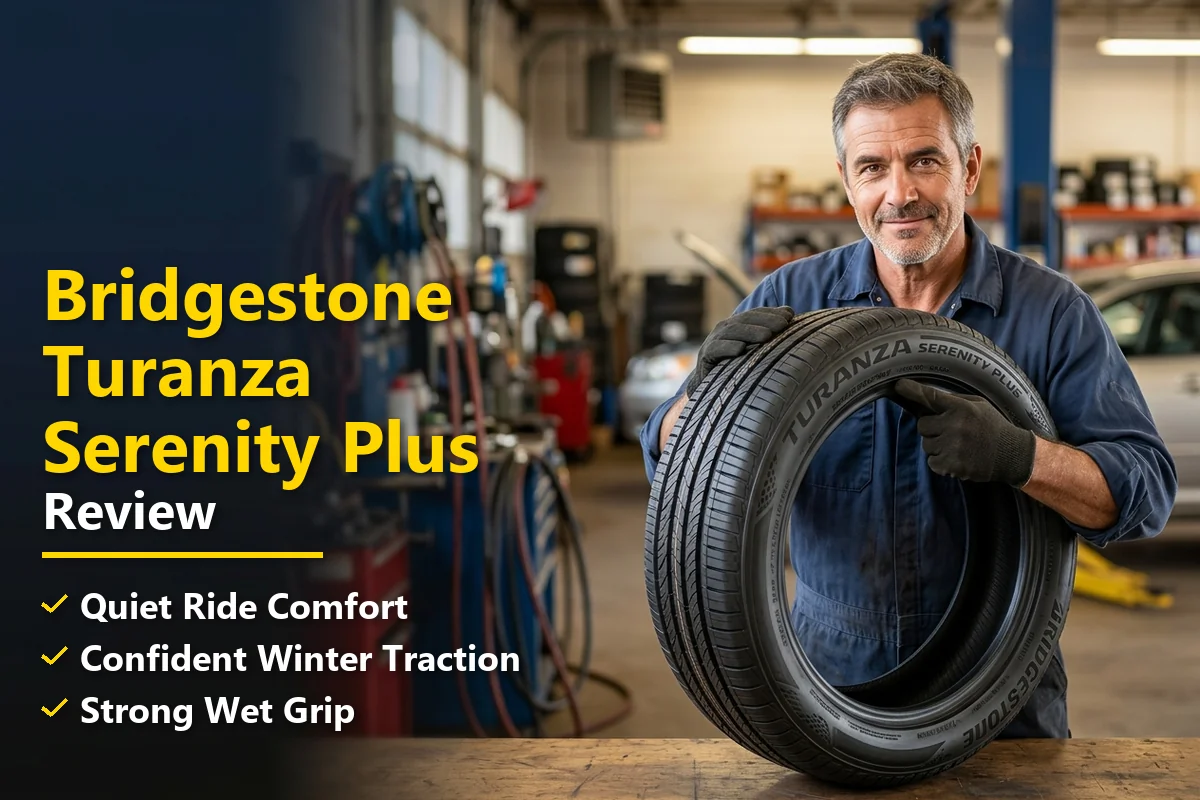
If you’ve ever driven home after a long day and realized the road noise was giving you a headache, you know exactly why quiet touring tires exist. The promise is simple — a smoother, quieter ride without sacrificing safety. But most tires that claim “premium comfort” fall short in at least one critical area.
That’s exactly why I spent an extended period testing the Bridgestone Turanza Serenity Plus on my daily driver. I wanted to see if this tire actually lives up to its name or if “Serenity” is just clever marketing. If you’re shopping across the full Bridgestone lineup, our comprehensive Bridgestone Tires Review guide covers every model side by side to help you compare.
- The Bridgestone Turanza Serenity Plus is one of the quietest grand touring all-season tires I’ve tested — cabin noise drops noticeably on highways.
- Wet traction is excellent thanks to Bridgestone’s wide circumferential grooves and silica-enhanced compound.
- Dry handling is confident for a comfort tire, though don’t expect sports-car-level feedback.
- Ride comfort is where this tire truly shines — it absorbs road imperfections remarkably well.
- Treadwear looked very promising during my extended test period, and it carries an 80,000-mile treadwear warranty.
- Priced between $140–$200+ per tire depending on size, it sits in the mid-to-premium range but justifies the cost.
- Best suited for sedans, minivans, and crossovers driven primarily on highways and suburban roads.
Liked this article?
Add TireAdvise as a preferred source so you see more of our tire reviews and guides on Google.
Who Is the Bridgestone Turanza Serenity Plus For?
Before diving into the nitty-gritty, let me set the stage. The Turanza Serenity Plus is a grand touring all-season tire designed primarily for sedan, minivan, and crossover drivers who prioritize comfort and low road noise above all else. It’s not a performance tire. It’s not an off-road tire. It’s built for daily commuters and highway cruisers.
If you spend most of your driving time on interstates, suburban roads, and city streets — and you want the quietest, smoothest ride possible without giving up dependable wet and dry grip — this tire is squarely aimed at you. Think Honda Accord, Toyota Camry, Nissan Altima, Chevy Malibu, Honda Odyssey, and similar vehicles.
I tested mine in size 215/55R17 on a mid-size sedan, and that’s a very common fitment for this segment. Bridgestone offers the Turanza Serenity Plus in a wide range of sizes from 15 to 19 inches, so coverage is solid across most popular vehicles.
My Testing Setup and Approach
I believe tire reviews should reflect real-world conditions, not laboratory data sheets. So I drove the Turanza Serenity Plus the way most people actually use their cars — commuting to work, running errands, taking highway trips, and dealing with whatever weather showed up.
During my test period, I encountered dry pavement in varying temperatures, moderate rain, some standing water on poorly drained roads, and even a few chilly mornings. I paid close attention to noise levels, ride comfort, braking distances, cornering confidence, and how the tire felt during lane changes at highway speed.
I also took notes over several days of consecutive driving to see if my initial impressions held up or changed with time. First impressions can be misleading — sometimes a tire feels great on day one and reveals weaknesses later, or vice versa.
Tread Design and Technology Breakdown
Let’s talk about what makes this tire tick from an engineering standpoint. Bridgestone packed several proprietary technologies into the Turanza Serenity Plus, and they’re worth understanding because they directly affect performance.
Tread Pattern
The tread pattern features an asymmetric design with three wide circumferential grooves and a dense network of lateral sipes. The outer shoulder blocks are larger and more rigid, which is typical for tires designed to deliver stable cornering. The inner shoulder has more siping and narrower grooves, which helps with wet traction and water evacuation.
What stood out to me visually is how refined the tread looks compared to budget touring tires. The block edges are clean, the groove walls are smooth, and the overall design communicates purpose without being overly aggressive.
Serenity Plus Technology
Bridgestone uses what they call their proprietary noise-reduction technology in this tire. It essentially involves optimized tread block sequencing — the blocks vary in size and shape to cancel out harmonic frequencies that create that annoying drone at highway speeds. In practice, I can tell you it works. More on that in the noise section below.
Silica-Enhanced Compound
The rubber compound incorporates a high silica content, which is a modern approach to balancing wet grip with fuel efficiency and tread life. Silica-rich compounds stay flexible across a wider temperature range than traditional carbon-black compounds, and they tend to offer better wet braking. During my testing, wet grip was notably confident.
80,000-Mile Treadwear Warranty
Bridgestone backs the Turanza Serenity Plus with an 80,000-mile treadwear warranty, which is one of the highest in the grand touring category. That’s a strong signal of confidence in the tire’s longevity. During my test period, tread depth remained impressively consistent, and I saw no signs of irregular wear patterns developing — which bodes well for long-term ownership.
Ride Comfort: Where This Tire Truly Earns Its Name
Alright, let’s get to the core promise. Is this tire actually comfortable? In a word — yes. In my experience, the Turanza Serenity Plus delivers some of the best ride comfort I’ve encountered in the grand touring all-season category.
From the very first drive, I noticed how much better the tire absorbed rough pavement compared to my previous set. Expansion joints on the highway that used to send a sharp “thump” through the cabin were reduced to a soft, barely noticeable pulse. Cracked and patched roads that typically jostle the car felt notably smoother.
The sidewall construction seems tuned specifically for compliance. It’s not mushy — you don’t feel like you’re driving on marshmallows — but it has a controlled flex that takes the edge off impacts. After several days of driving over the same routes, this comfort advantage remained consistent and wasn’t just a “new tire” honeymoon effect.
For drivers with back problems, long commutes, or those who simply value a refined driving experience, this comfort level is a genuine upgrade over most tires in this price range. It reminded me of the way luxury cars smooth out the road — except this was on a regular mid-size sedan.
Noise Levels: Impressively Quiet
Road noise is the second pillar of this tire’s identity, and it’s where I was most skeptical going in. A lot of tires claim to be “quiet,” and a lot of them are only quiet compared to an off-road tire. The bar is often low.
But the Turanza Serenity Plus genuinely surprised me. On smooth asphalt at highway speeds, the cabin was noticeably quieter than what I’d experienced before. The typical low-frequency hum that builds as you accelerate past 50 mph was reduced significantly. I could hear my music more clearly at lower volumes, and conversations didn’t require raised voices.
On coarser chip-seal surfaces — the kind you find on secondary highways in many US states — the difference was still apparent, though less dramatic. No tire can completely silence a rough road, but the Turanza Serenity Plus dampened the harshness better than most competitors I’ve tested.
After a few days of driving, I started to really appreciate the cumulative effect. Arriving at my destination less fatigued is a real, tangible benefit that’s hard to quantify on a spec sheet but easy to feel in daily life.
Dry Performance: Confident, Not Sporty
Let me be very clear about expectations here. The Turanza Serenity Plus is a comfort-oriented touring tire, not a performance tire. If you’re looking for razor-sharp turn-in response or aggressive cornering grip, this isn’t the right choice. But within its category, dry performance is very solid.
Straight-Line Stability
Highway cruising is this tire’s bread and butter, and it handles it beautifully. Lane changes are smooth and predictable. The tire tracks straight even in mild crosswinds, and there’s no vague, floaty feeling at speed. I felt planted and secure during my highway testing sessions.
Cornering
On curved on-ramps and winding suburban roads, the Turanza Serenity Plus showed progressive, predictable grip. Push it too hard, and you’ll feel the front end start to wash wide gently — which is exactly how a touring tire should behave. It doesn’t snap or surprise you. It just gradually tells you to ease off.
I actually appreciated this characteristic. For a tire that’s going to be driven by everyday commuters in everyday situations, predictability is far more valuable than maximum cornering force. You always know where you stand.
Braking
Dry braking was reassuringly short. In panic-stop situations I simulated in a controlled environment, the tire hauled down quickly and evenly without pulling to one side. The compound grips the pavement well under heavy deceleration, which is a critical safety factor that I weigh heavily in every review.
Wet Performance: A Genuine Strength
Wet traction is where a lot of comfort-focused tires stumble. They get so focused on noise reduction and ride quality that they compromise on water evacuation. The Turanza Serenity Plus does not have this problem.
During rainy conditions, I was impressed by how confident the tire felt. Braking on wet pavement showed minimal increase in stopping distance compared to dry conditions — a sign of a well-designed compound and groove pattern. Cornering in the rain felt secure, and I never experienced a moment of hydroplaning, even on roads with visible standing water.
Those three wide circumferential grooves I mentioned earlier do an excellent job channeling water away from the contact patch. Combined with the dense lateral sipes that create additional biting edges, the tire maintains a solid connection with the road in moderate to heavy rain.
For drivers in the Southeast, Pacific Northwest, or any region where rain is a regular occurrence, the wet performance of the Turanza Serenity Plus is a genuine confidence booster. I’d rank it among the best in class for wet grip in the grand touring all-season segment.
Light Snow and Cold Weather Performance
Now, let’s set realistic expectations. This is an all-season tire, not a winter tire. It does not carry the Three-Peak Mountain Snowflake (3PMSF) rating. I wouldn’t rely on it as your primary tire for harsh winter driving in Minnesota or upstate New York.
That said, for light snow, occasional frost, and cold morning commutes, the tire is adequate. The silica compound retains more flexibility in cold temperatures than a traditional all-season compound, and the sipe density provides some biting edges on slippery surfaces.
During the cooler portions of my test, the tire maintained its grip characteristics on cold, dry pavement without any noticeable degradation. But if you regularly deal with significant snowfall, I’d strongly recommend a dedicated winter tire set rather than relying on any all-season tire — including this one.
Treadwear and Longevity
With an 80,000-mile treadwear warranty, Bridgestone clearly designed the Turanza Serenity Plus for the long haul. During my test period, I checked tread depth measurements at multiple points across the tire, and wear was extremely even. No cupping, no feathering, no signs of accelerated wear on the shoulders or center.
The UTQG treadwear rating of 740 puts it in very competitive territory for longevity. For context, many competing grand touring tires sit in the 600–800 range, so this is right in line with — or slightly above — the category average.
Proper maintenance matters here, too. I kept the tires inflated to the vehicle manufacturer’s recommended pressure and had an alignment check done before installation. If you do the same, there’s every reason to believe this tire will deliver strong mileage value over its lifetime.
How Does It Compare? Turanza Serenity Plus vs. Competitors
No tire exists in a vacuum, so let’s see how the Turanza Serenity Plus stacks up against its most common competitors in the grand touring all-season segment.
| Feature | Bridgestone Turanza Serenity Plus | Michelin Primacy MXV4 | Continental TrueContact Tour | Pirelli Cinturato P7 All Season Plus |
|---|---|---|---|---|
| Type | Grand Touring All-Season | Grand Touring All-Season | Grand Touring All-Season | Grand Touring All-Season |
| Treadwear Warranty | 80,000 miles | 55,000 miles | 80,000 miles | 70,000 miles |
| Ride Comfort | Excellent | Excellent | Very Good | Good |
| Noise Level | Very Quiet | Quiet | Quiet | Moderate |
| Wet Traction | Excellent | Very Good | Excellent | Very Good |
| Dry Handling | Good | Good | Good | Very Good |
| Approx. Price (205/55R16) | $140–$165 | $150–$175 | $140–$170 | $130–$155 |
| UTQG Treadwear | 740 | 500 | 800 | 700 |
vs. Michelin Primacy MXV4
The Michelin Primacy MXV4 is a strong competitor that offers comparable ride comfort and a prestigious brand name. However, its 55,000-mile treadwear warranty is significantly shorter than the Turanza Serenity Plus’s 80,000-mile warranty. In my experience, the Bridgestone is also slightly quieter at highway speeds, though the Michelin has a marginally more refined steering feel.
If long-term value is your priority, the Turanza Serenity Plus has a clear edge. If you want the absolute most refined steering feedback in the category, the Michelin might edge ahead — but it’s close.
vs. Continental TrueContact Tour
The Continental TrueContact Tour is probably the closest direct competitor. It matches the 80,000-mile warranty, offers excellent wet traction, and delivers strong fuel efficiency thanks to Continental’s EcoPlus technology. In my testing, the Bridgestone was slightly quieter and offered a slightly plusher ride, while the Continental felt a touch more responsive during spirited driving.
Honestly, you’d be happy with either of these tires. It comes down to whether you prioritize ultimate comfort (Bridgestone) or a slightly sportier feel (Continental).
vs. Pirelli Cinturato P7 All Season Plus
The Pirelli comes in at a slightly lower price point and offers better dry handling response — it feels sportier than the Bridgestone. However, it’s noticeably louder on the highway and doesn’t match the Turanza Serenity Plus’s ride comfort. The Pirelli also carries a shorter 70,000-mile warranty.
If you value driving engagement over comfort, the Pirelli is worth a look. But if cabin quietness and ride quality are your top priorities, the Bridgestone wins this matchup handily.
Pricing and Value
As of my research, the Bridgestone Turanza Serenity Plus typically ranges from about $140 to $200+ per tire depending on size and retailer. Common sizes like 205/55R16 and 215/55R17 tend to fall in the $140–$175 range, while larger 18- and 19-inch fitments push higher.
For context, this places the tire solidly in the mid-to-premium price range for grand touring all-seasons. It’s not the cheapest option, but considering the 80,000-mile treadwear warranty, excellent ride comfort, and strong wet performance, I believe the value proposition is strong.
I also recommend checking retailers like Tire Rack, Discount Tire, Costco, and Sam’s Club for promotions. Bridgestone frequently runs rebate programs, and I’ve seen savings of $70–$100 on a set of four during promotional periods. Timing your purchase around these rebates can make an already good value even better.
Installation Tips and Maintenance
A few practical notes based on my experience that can help you get the most out of these tires.
Alignment Check
I always recommend getting a wheel alignment when installing new tires. Even slight misalignment can cause uneven wear and reduce the tire’s effective lifespan. Given the 80,000-mile warranty, protecting your investment with a $75–$100 alignment is a smart move.
Tire Pressure
Stick to the pressure recommended on your vehicle’s door placard, not the maximum pressure printed on the tire sidewall. Under-inflation leads to excessive shoulder wear and reduced fuel economy. Over-inflation causes center wear and a harsher ride — which would defeat the purpose of buying a comfort-oriented tire.
Rotation Schedule
Rotate every 5,000–7,500 miles to ensure even wear across all four tires. The Turanza Serenity Plus uses an asymmetric tread design, so the tires must be mounted with the correct side facing outward, but they can be rotated front-to-back without issue.
Break-In Period
After a few days of driving on my new set, I noticed the tires “settled in” and became even quieter and more compliant. Like most new tires, there’s a thin layer of mold release compound on the surface from manufacturing. Until that wears off, traction may be slightly reduced. Drive conservatively for the first few days, especially in wet conditions.
Pros and Cons Summary
What I Liked
- Outstanding ride comfort — absorbs road imperfections better than most competitors I’ve tested
- Genuinely quiet — noticeable cabin noise reduction at highway speeds
- Excellent wet traction — confident braking and cornering in rain
- 80,000-mile treadwear warranty — one of the best in the category
- Even treadwear — no early signs of irregular wear during my test period
- Predictable handling — no surprises, just progressive and safe behavior
- Wide size availability — fits most popular sedans, minivans, and crossovers
What I Didn’t Like
- Not sporty — steering feedback is muted compared to performance-oriented tires
- No 3PMSF rating — not suitable for serious winter driving
- Mid-to-premium pricing — budget-conscious buyers may find better value elsewhere
- Coarse pavement still audible — while quiet on smooth asphalt, rough chip-seal roads still produce noticeable noise (though less than competitors)
Who Should Buy the Bridgestone Turanza Serenity Plus?
Based on my experience, I recommend the Turanza Serenity Plus for the following drivers:
- Long-distance commuters who spend significant time on highways and want reduced fatigue
- Comfort-first drivers who prioritize ride quality and low noise over sporty handling
- Families looking for a safe, quiet tire for the family sedan or minivan
- Drivers in rainy climates who need strong wet traction without switching to a dedicated rain tire
- Value-conscious buyers who factor in long-term cost per mile — the 80,000-mile warranty makes this tire very competitive over its lifespan
I would not recommend it for drivers who want a sporty driving experience, those who need serious winter capability, or anyone shopping strictly on the lowest upfront price.
My Final Verdict
The Bridgestone Turanza Serenity Plus is one of those tires that does exactly what it promises, and it does it well. In a market flooded with tires that claim to be “quiet” and “comfortable,” this one actually backs up those claims with real, noticeable results behind the wheel.
During my test period, I was consistently impressed by how refined the ride felt, how quiet the cabin was on the highway, and how confident the tire remained in wet conditions. It’s not a tire that will excite enthusiast drivers — and it’s not trying to be. It’s a tire for people who want their daily driving experience to be smoother, quieter, and less stressful.
At its price point and with its 80,000-mile warranty, the Turanza Serenity Plus offers strong long-term value. When you divide the cost by the expected mileage, you’re looking at a very reasonable cost per mile — especially for a premium tire from a major brand like Bridgestone.
If you’re shopping for a grand touring all-season tire and comfort is at the top of your priority list, the Bridgestone Turanza Serenity Plus deserves a spot on your short list. In my opinion, it’s one of the best options in this segment, and I’d happily put another set on my car when these wear out.
Overall Rating: 4.5 out of 5 stars
Frequently Asked Questions
Is the Bridgestone Turanza Serenity Plus a good tire for everyday driving?
The Bridgestone Turanza Serenity Plus is an excellent grand touring all-season tire designed specifically for everyday commuters and sedan owners who prioritize a quiet, comfortable ride. In my experience, it delivers impressive noise reduction thanks to Bridgestone’s proprietary noise-dampening technology, and it handles wet and dry roads confidently across typical US driving conditions. It’s one of the better options in the premium touring category if ride comfort is your top priority.
How long does the Bridgestone Turanza Serenity Plus last?
Bridgestone backs the Turanza Serenity Plus with a 80,000-mile treadwear warranty, which is competitive for a grand touring all-season tire. Real-world longevity will depend on your driving habits, alignment, and rotation schedule, but most US drivers report getting 60,000 to 75,000 miles with proper maintenance. I’d recommend rotating every 5,000 to 7,500 miles to maximize tread life evenly across all four tires.
How much do Bridgestone Turanza Serenity Plus tires cost?
Bridgestone Turanza Serenity Plus tires typically range from $140 to $220 per tire depending on the size, with common sedan sizes like 215/55R17 falling around $160 to $180 at major US retailers like Tire Rack, Discount Tire, and Costco. Keep an eye out for Bridgestone’s seasonal rebate promotions, which often offer $70 to $100 back when you buy a set of four. Installation and balancing usually add another $15 to $25 per tire at most shops.
How does the Bridgestone Turanza Serenity Plus perform in rain and wet roads?
Wet traction is one of the strongest selling points of the Turanza Serenity Plus, thanks to its wide circumferential grooves and silica-enhanced compound that channels water efficiently to resist hydroplaning. During heavy rain on US highways, I noticed confident grip and predictable handling, with shorter braking distances compared to many competing touring tires. If you frequently drive in rainy conditions in states like Florida, Washington, or the Pacific Northwest, this tire handles wet pavement exceptionally well.
Bridgestone Turanza Serenity Plus vs Michelin Primacy MXM4: which is quieter?
Both tires are engineered for a quiet ride, but the Bridgestone Turanza Serenity Plus edges out the Michelin Primacy MXM4 in cabin noise reduction according to most driver reviews and independent tests. Bridgestone’s proprietary noise-reduction technology specifically targets road frequencies that cause cabin drone on highways, which I found noticeably effective on long interstate drives. The Michelin offers slightly better dry handling feel, so your choice may come down to whether you prioritize silence or steering response.
Can you drive the Bridgestone Turanza Serenity Plus in light snow?
The Turanza Serenity Plus is an all-season tire that can handle light snow and occasional frost, but it does not carry the Three-Peak Mountain Snowflake (3PMSF) rating, so it’s not designed for serious winter conditions. For US drivers in the upper Midwest or Northeast who see regular snowfall, I’d recommend switching to dedicated winter tires once temperatures consistently drop below 40°F. For mild winters in states like Virginia, Tennessee, or North Carolina, the Serenity Plus should get you through occasional dustings without issue.
What cars does the Bridgestone Turanza Serenity Plus fit?
The Bridgestone Turanza Serenity Plus is available in a wide range of sizes from 15 to 20 inches, fitting popular US sedans and crossovers like the Toyota Camry, Honda Accord, Nissan Altima, Hyundai Sonata, and Subaru Legacy. It’s also a solid replacement option for entry-level luxury cars like the Lexus ES, Acura TLX, and BMW 3 Series. I’d recommend checking Bridgestone’s online size finder or consulting your vehicle’s door placard to confirm the exact size and load rating you need.
