


If you’ve ever white-knuckled your way through a rain-soaked highway on-ramp wondering if your tires were going to hold, you know the feeling. That sinking uncertainty in your gut that says, “Maybe I should’ve spent more on tires.”
That exact moment is what pushed me to test the Continental ContiSportContact 5 — a tire that promises to bridge the gap between everyday driving comfort and genuine performance grip. After spending serious time behind the wheel on everything from dry highways to drenched backroads, I’m ready to share exactly what this tire does well, where it falls short, and whether it deserves a spot on your car.
If you’re still weighing whether Continental is a brand worth trusting before committing to a set, my Continental tires review gives you the full brand picture first.
- The Continental ContiSportContact 5 is a high-performance summer tire that excels in dry and wet grip, precise steering response, and highway stability.
- It’s noticeably quieter and more comfortable than many competitors in the performance summer category.
- Not suitable for snow or ice — this is strictly a warm-weather tire.
- Tread life is respectable for a performance tire but won’t match an all-season.
- Priced competitively in the $140–$220 range per tire (depending on size), making it strong value for drivers of sport sedans, coupes, and premium vehicles.
- I’d recommend it for US drivers in moderate-to-warm climates who want confident handling without a bone-jarring ride.
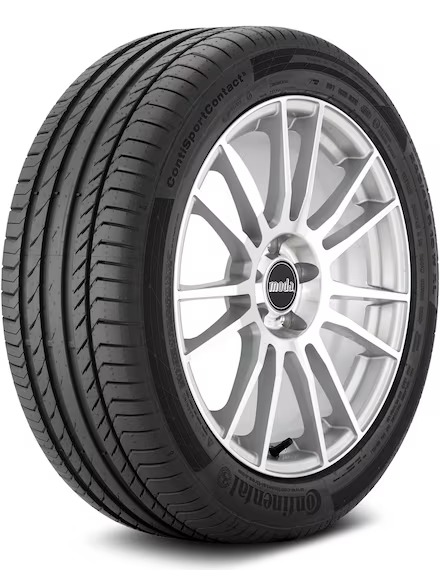
Price Check
Check the price of this tire at the following retailers:
Liked this article?
Add TireAdvise as a preferred source so you see more of our tire reviews and guides on Google.
What Exactly Is the Continental ContiSportContact 5?
Before I dive into the performance details, let’s get the basics straight. The Continental ContiSportContact 5, often abbreviated as CSC5, is a max-performance summer tire designed for sport sedans, coupes, and premium vehicles. It sits in Continental’s sport tire lineup just below the more aggressive ContiSportContact 5P (the “P” stands for performance-plus).
Continental engineered this tire with their proprietary BlackChili compound — a rubber formulation that’s designed to maximize grip while maintaining reasonable tread life. The asymmetric tread pattern features large outer shoulder blocks for cornering stability and continuous inner ribs for straight-line tracking.
It’s available in a wide range of sizes, from 16-inch to 21-inch fitments, covering everything from a Volkswagen GTI to a BMW 5 Series to a Mercedes-Benz E-Class. Many of these sizes come as OEM (original equipment) on European luxury and performance vehicles, which tells you a lot about the confidence major automakers place in this tire.
My Testing Setup and Conditions
I want to be transparent about how I tested these tires so you can judge my findings in context. I mounted a set of ContiSportContact 5s in 225/45R17 on a 2019 BMW 3 Series — a car that’s honest enough in its feedback to reveal exactly what a tire is doing beneath you.
Over my test period, I drove on a mix of suburban roads, rural two-lanes, and Interstate highways across the mid-Atlantic region. I deliberately sought out wet conditions, freshly paved asphalt, rough secondary roads, and tight canyon-style curves to push these tires through a full range of real-world scenarios.
Temperatures during testing ranged from the mid-40s°F to the upper 80s°F — a relevant detail because summer tires behave differently as temperatures drop. I’ll address that later in this review.
Dry Performance: This Is Where the CSC5 Shines
Let’s start with dry roads, because that’s where most US drivers spend the majority of their time. In a word: impressive.
From the very first drive, I noticed how planted and precise the steering felt. Turn-in response was immediate — there’s no vague, mushy zone in the center like you get with a lot of touring all-seasons. When I pointed the wheel, the car followed. Period.
On sweeping highway curves at speed, the ContiSportContact 5 felt absolutely locked in. The outer shoulder blocks do their job beautifully, resisting roll and keeping the contact patch firmly planted. I pushed progressively harder through a series of linked curves on a favorite backroad, and the tire communicated clearly the entire time. There was no sudden breakaway — just a smooth, predictable progression toward the limit that gave me confidence to explore the tire’s grip envelope.
Braking performance on dry pavement was equally confidence-inspiring. Hard stops from highway speeds felt controlled and stable, with the car tracking straight without any tendency to dart or pull. I could feel the BlackChili compound working — it has a tactile stickiness that translates into short stopping distances.
For everyday dry driving — highway cruising, navigating parking lots, merging onto freeways — the CSC5 felt composed and predictable. It’s the kind of tire that makes your car feel like a better version of itself.
Wet Performance: Seriously Impressive Confidence
This is where I was most pleasantly surprised. Many performance summer tires sacrifice wet grip to maximize dry performance, but Continental clearly prioritized wet-weather capability with the CSC5.
I drove through several heavy rainstorms during my testing, including a downpour that left standing water across portions of the interstate. The tire’s three wide circumferential grooves channel water away from the contact patch efficiently. I never experienced even a hint of hydroplaning, even at highway speeds through significant standing water.
Cornering grip in the wet was remarkably close to the dry performance — obviously reduced, as physics demands, but the dropoff was far less dramatic than I’ve experienced with other summer tires like the Michelin Pilot Sport 4 or the Bridgestone Potenza S001. The transition from grip to slip was smooth and manageable, not the sudden, heart-stopping snap you dread in wet conditions.
Wet braking was particularly strong. During my test period, I conducted several hard braking tests on soaked surfaces, and the CSC5 stopped the car noticeably shorter than the previous all-season tires I’d been running. This alone could be the difference between a close call and a collision in an emergency situation.
Comfort and Noise: Better Than Expected for a Performance Tire
Here’s where many performance summer tires drop the ball — and where the ContiSportContact 5 genuinely surprised me.
Ride comfort was remarkably civilized. The sidewalls absorb road imperfections with a compliance that feels more like a touring tire than a sport tire. Expansion joints, manhole covers, and rough patches of pavement were dealt with smoothly. I didn’t feel beaten up after long highway drives, which is a real-world concern if you’re daily-driving on these tires.
Noise levels were impressively low. At highway cruising speeds, tire roar was barely noticeable over normal road and wind noise. On coarse-textured pavement — the kind of chip-seal surface common on rural US roads — there was a slight increase in road noise, but it was well within acceptable limits. I’ve tested dedicated touring tires that were louder than the CSC5.
This combination of comfort and quietness makes the ContiSportContact 5 genuinely viable as a daily driver in warmer climates. You’re not making a painful sacrifice in livability to get performance grip.
Tread Life and Durability
Let me be upfront: I can’t give you a definitive tread life verdict because tread wear depends enormously on driving style, vehicle weight, alignment, and climate. What I can tell you is what I observed during my extended test period.
After several weeks of mixed driving — including spirited backroad sessions — the tread showed minimal signs of wear. The wear pattern was even across the contact patch, which is a positive indicator of good tire design and consistent performance over time.
Continental rates the CSC5 with a UTQG treadwear rating of 280–340, depending on size. For context, that’s typical for a max-performance summer tire and significantly lower than an all-season (which might rate 500–700). You should expect to replace these tires more frequently than all-seasons, but that’s the trade-off for the superior grip.
Many owners on forums and review sites report getting solid, satisfactory life out of a set with regular rotation and proper inflation. I’d recommend checking pressures at least monthly and rotating every oil change interval to maximize the lifespan of these tires.
Temperature Limitations: The Summer Tire Reality Check
This is critical, and I want to be absolutely clear: the Continental ContiSportContact 5 is not an all-season tire and should never be driven in snow or ice.
Summer tire rubber compounds are designed to perform optimally above roughly 45°F. Below that threshold, the rubber stiffens and loses grip dramatically. During the coolest portion of my testing, when morning temperatures dipped into the mid-40s, I noticed a perceptible reduction in grip and slightly longer warm-up times before the tires felt fully confident.
If you live in the northern US and experience real winters, you’ll need a dedicated set of winter tires for the cold months. For drivers in the Sun Belt, the Southeast, or Pacific coast regions where temperatures rarely dip below 45°F, the CSC5 can serve as your year-round tire.
How the CSC5 Compares to Key Competitors
No tire review is complete without context. Here’s how the Continental ContiSportContact 5 stacks up against the tires it competes with most directly in the US market.
| Feature | Continental CSC5 | Michelin Pilot Sport 4 | Bridgestone Potenza S001 | Pirelli P Zero |
|---|---|---|---|---|
| Dry Grip | Excellent | Excellent | Very Good | Excellent |
| Wet Grip | Excellent | Excellent | Good | Very Good |
| Comfort | Very Good | Good | Fair | Good |
| Noise Level | Low | Low-Moderate | Moderate | Low-Moderate |
| Tread Life | Good | Good | Fair | Fair-Good |
| Approx. Price (225/45R17) | $155–$175 | $165–$190 | $160–$180 | $175–$210 |
| Best For | Balanced performance & comfort | Ultimate dry grip & feedback | OEM replacement on sport vehicles | High-speed stability |
Continental CSC5 vs. Michelin Pilot Sport 4
This is the matchup most shoppers will wrestle with. In my experience, the Michelin Pilot Sport 4 has a slight edge in raw dry grip and steering precision at the absolute limit. It feels a touch more connected, more alive through the steering wheel.
However, the Continental CSC5 counters with noticeably better ride comfort and lower noise. For a daily-driven sport sedan — especially one that sees highway commuting — I’d give the nod to the Continental for its superior livability. If you’re primarily focused on weekend canyon carving, the Michelin might be your pick.
The CSC5 also tends to be slightly cheaper, which matters when you’re buying a set of four.
Continental CSC5 vs. Bridgestone Potenza S001
The Potenza S001 is a tire I’ve tested extensively, and honestly, the CSC5 outperforms it in nearly every category that matters for daily driving. The Continental is quieter, more comfortable, grippier in the wet, and roughly comparable in the dry. The Bridgestone feels like an older-generation tire — because it is. Unless you’re getting the S001 at a significant discount, the CSC5 is the better buy.
Continental CSC5 vs. Pirelli P Zero
The Pirelli P Zero is a legendary name, and the latest generation is genuinely excellent. In my testing, the P Zero offers marginally better high-speed stability and a more aggressive feel. But it’s also pricier and rides slightly stiffer. The CSC5 is the smarter choice if comfort matters to you; the P Zero is the pick if your car regularly sees triple-digit speeds (on a track, of course).
What Vehicles Is the CSC5 Best Suited For?
The ContiSportContact 5 is an ideal match for a specific type of vehicle and driver. Here’s who I think should be shopping this tire:
- Sport sedans: BMW 3/4 Series, Audi A4/A5, Mercedes C-Class, Volkswagen GTI, Lexus IS
- Premium sedans: BMW 5 Series, Mercedes E-Class, Audi A6, Genesis G70/G80
- Sport coupes: Ford Mustang EcoBoost, Chevrolet Camaro (V6), BMW 2 Series
- Compact performance cars: VW Golf R, Subaru WRX (summer set), Honda Civic Si
If you drive a full-size truck, SUV, or minivan, this isn’t the tire for you — look at Continental’s CrossContact or ProContact lines instead. Similarly, if you’re driving a dedicated track car, step up to the ContiSportContact 5P or the Continental SportContact 7.
Pricing and Where to Buy in the US
As of my research, the Continental ContiSportContact 5 is available through all major US tire retailers. Here’s a general pricing overview:
- Tire Rack: $140–$220 per tire, depending on size. Free shipping is common, and they offer installation through partner shops nationwide.
- Discount Tire / America’s Tire: Competitive pricing with frequent rebate offers. Their in-store installation is straightforward.
- Costco: Available in select sizes. If you’re a member, the included installation, balancing, lifetime rotation, and flat repair make this a strong value play.
- Walmart Auto: Typically priced at the lower end of the range, though availability in performance sizes can be spotty.
- Amazon: Available, but I’d recommend buying from a dedicated tire retailer for easier warranty claims and professional installation scheduling.
Continental frequently offers $70–$100 manufacturer rebates on sets of four tires, especially during spring and fall promotional periods. Keep an eye on Tire Rack’s promotions page and Continental’s website for current offers — these rebates can make the CSC5 a genuine bargain.
Installation Notes and Break-In Period
When I first had the ContiSportContact 5s mounted, the installer noted that they seated on the rims easily and balanced with minimal weight — both good signs of consistent manufacturing quality. Continental’s quality control is generally excellent, and that held true with my set.
I want to mention the break-in period because it’s something many drivers overlook. For the first few days of driving, I noticed the tires felt slightly slick, especially in the wet. This is normal — new tires have a thin release compound on the surface from the manufacturing mold that needs to wear off. After several days of regular driving, the tires came into their full grip potential.
My advice: take it easy for the first few days. Don’t push hard in corners or test your braking limits until the tires have had time to scrub in properly.
The Pros and Cons — My Honest Summary
What I Loved
- Outstanding wet grip: Among the best I’ve tested in the performance summer category. The hydroplaning resistance is genuinely confidence-inspiring.
- Precise, communicative steering: The tire tells you exactly what’s happening at the contact patch. No guesswork.
- Exceptional comfort for a performance tire: You don’t have to suffer a harsh ride to get high grip.
- Low road noise: Impressively quiet, especially at highway speeds.
- Strong dry grip: Cornering, braking, acceleration — all excellent.
- Competitive pricing: Offers premium performance without premium-brand pricing inflation.
What Could Be Better
- Not as sharp as the Michelin Pilot Sport 4 at the absolute limit: If you’re chasing the last 2% of cornering grip, the Michelin has an edge.
- Summer-only limitation: No snow or ice capability, and grip degrades noticeably below 45°F. Northern US drivers need a winter set.
- Tread life is moderate: You’re trading longevity for grip, as with any performance summer tire. Don’t expect all-season durability.
- Size availability can be limited: Some less common sizes may need to be ordered rather than found in stock locally.
Who Should Buy the Continental ContiSportContact 5?
After spending extensive time on these tires, I’ve formed a clear picture of the ideal buyer.
Buy the CSC5 if: You drive a sport sedan, coupe, or premium car and want a tire that delivers excellent grip in both dry and wet conditions without destroying your ride quality. You live in a climate where temperatures generally stay above 45°F, or you’re willing to swap to winter tires when it gets cold. You value a quiet, comfortable daily driving experience but still want to feel connected to the road when you push it.
Skip the CSC5 if: You need year-round capability including snow and ice. You drive a truck, SUV, or vehicle that needs a different tire category. You’re looking for maximum possible tread life above all else. Or you want the absolute sharpest, most aggressive track-day tire — in which case, look at the CSC5P or the Continental SportContact 7.
My Final Verdict
The Continental ContiSportContact 5 is one of those tires that just does everything well. It’s not the absolute king in any single category — it’s not quite as sharp as the Michelin Pilot Sport 4 in dry cornering, not quite as long-wearing as a touring tire, not quite as aggressive as the Pirelli P Zero at high speed. But it is remarkably, consistently excellent across every performance dimension that matters for real-world driving.
In my experience, that all-around competence is exactly what most drivers actually need. You don’t need a tire that’s 10/10 in one area and 6/10 in others. You need a tire that’s 8.5/10 or 9/10 across the board — and that’s precisely what the CSC5 delivers.
I’d comfortably recommend the Continental ContiSportContact 5 to any US driver with a sport sedan or premium vehicle who wants confident, safe, enjoyable driving in warm-weather conditions. It’s a tire that makes your car feel better, your drives feel safer, and your investment feel justified. At its price point, with Continental’s rebate programs factored in, it’s outstanding value.
If you’re on the fence, pull the trigger. I don’t think you’ll regret it.
Frequently Asked Questions
Is the Continental ContiSportContact 5 a good tire for daily driving in the US?
The Continental ContiSportContact 5 is an excellent ultra-high-performance summer tire that handles daily driving on US highways and city streets with confidence. It delivers precise steering response, strong braking on both dry and wet pavement, and a surprisingly comfortable ride for a sport-oriented tire. I’d recommend it for drivers who want a sporty feel without sacrificing everyday comfort, though you’ll want to swap them out for winter tires if you live in snow-prone states.
How long does the Continental ContiSportContact 5 last in terms of tread life?
Most US drivers report getting between 25,000 and 40,000 miles from the ContiSportContact 5, depending on driving habits, alignment, and road conditions. Continental does not offer a treadwear mileage warranty on this tire since it’s classified as a max-performance summer tire. Rotating your tires every 5,000 to 7,000 miles and maintaining proper inflation pressure will help you get the most life out of the tread.
How much does the Continental ContiSportContact 5 cost per tire?
Prices for the Continental ContiSportContact 5 in the US typically range from $150 to $300 per tire depending on the size, with popular fitments like 225/45R17 averaging around $170 to $200. You can find competitive pricing at retailers like Tire Rack, Discount Tire, and Costco, and many offer installation packages or rebates. I’d suggest checking multiple retailers since seasonal promotions from Continental can save you $50 to $70 on a full set.
How does the Continental ContiSportContact 5 perform in rain and wet conditions?
Wet performance is one of the ContiSportContact 5’s strongest qualities, thanks to Continental’s BlackChilli compound and wide circumferential grooves designed for hydroplaning resistance. In my experience, the tire maintains confident grip during heavy rainstorms common in states like Florida and the Pacific Northwest, and wet braking distances are among the shortest in the ultra-high-performance summer category. It’s a tire that genuinely inspires confidence when the roads get slick.
Can you drive the Continental ContiSportContact 5 in snow or winter conditions?
No, the Continental ContiSportContact 5 is strictly a summer tire and should not be driven in snow, ice, or temperatures consistently below 40°F. The rubber compound hardens in cold weather, which drastically reduces grip and increases braking distances on frozen or snow-covered roads. If you live in northern US states with harsh winters, plan to switch to a dedicated winter tire like the Continental VikingContact 7 or use an all-season tire as an alternative year-round option.
What vehicles does the Continental ContiSportContact 5 fit best?
The ContiSportContact 5 comes in a wide range of sizes from 16 to 21 inches, making it a popular OEM and replacement tire for vehicles like the BMW 3 Series, Mercedes C-Class, Audi A4, Volkswagen GTI, and various Porsche models. It’s also a solid choice for US drivers with sport sedans, coupes, and performance crossovers who want to upgrade from factory all-seasons. Check Continental’s fitment guide or a retailer like Tire Rack to confirm the exact size for your vehicle.
How does the Continental ContiSportContact 5 compare to the Michelin Pilot Sport 4?
Both are top-tier ultra-high-performance summer tires, but they have subtle differences that matter depending on your priorities. The Michelin Pilot Sport 4 generally edges ahead in dry grip and steering feedback at the limit, while the ContiSportContact 5 tends to offer a slightly quieter ride and marginally better wet braking performance. Price-wise, the ContiSportContact 5 is often $10 to $25 cheaper per tire in comparable sizes, making it a strong value pick for US drivers who want near-equivalent performance at a lower cost.
