

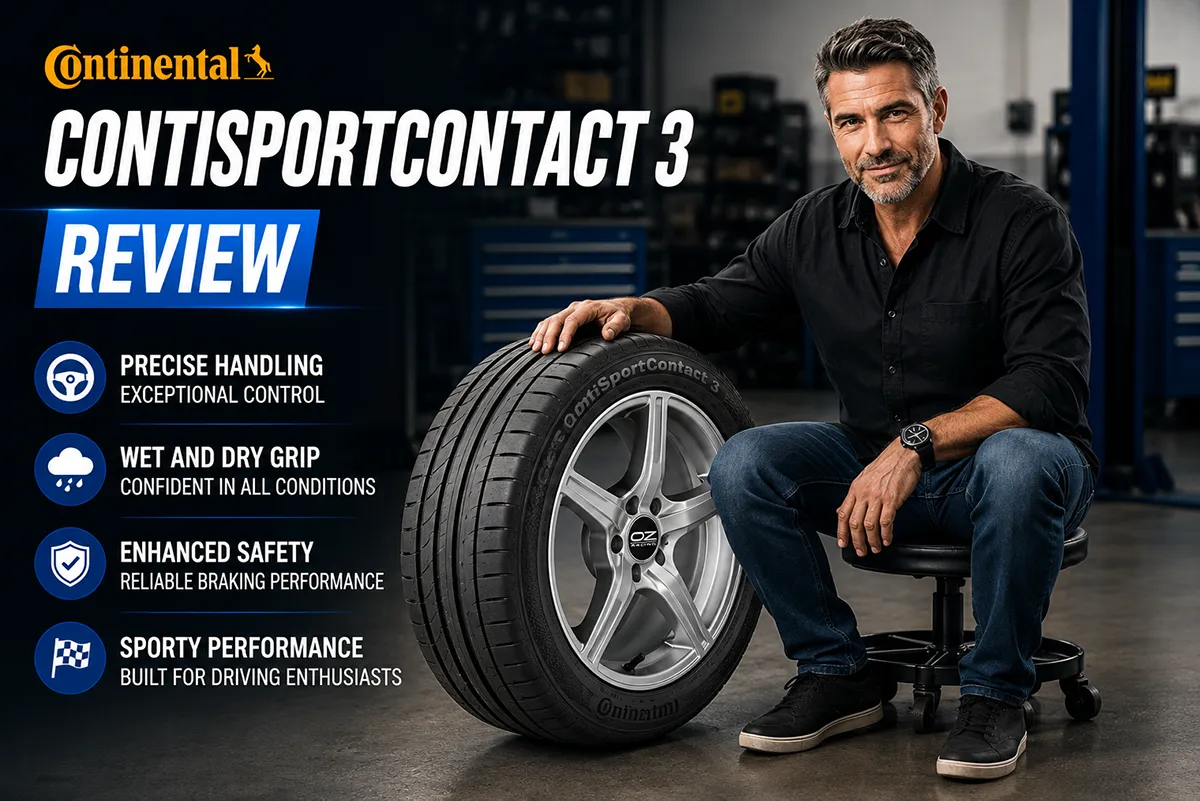
You just got a quote from your mechanic, and the tires he’s recommending are Continental ContiSportContact 3s. Or maybe you spotted a killer deal online and you’re wondering — is this tire actually any good, or am I buying outdated rubber?
It’s a fair question. The ContiSportContact 3 has been around for a while, and Continental has since released newer generations. But “older” doesn’t automatically mean “worse,” and I wanted to find out for myself whether this tire still delivers where it counts.
I spent extensive time driving on a set of ContiSportContact 3s across a variety of conditions — dry highways, rain-soaked city streets, and twisty back roads — to give you the full picture. Here’s everything I found.
And if you’re still deciding whether Continental as a brand deserves your trust, my Continental tires review gives you the full brand context before you make any decisions.
- The Continental ContiSportContact 3 is a max-performance summer tire that still delivers excellent dry grip and sharp steering response.
- Wet traction is solid but noticeably behind newer-generation Continental tires like the SportContact 5 and 7.
- Ride comfort is surprisingly refined for a performance-oriented tire.
- Treadwear is average for the category — don’t expect all-season longevity.
- Best suited for drivers of European sport sedans and coupes who want OE-equivalent performance at a lower price point.
- NOT suitable for winter driving — this is a summer-only tire.
- If you can find it in your size and at a good price, it remains a respectable choice, though newer alternatives offer measurable improvements.
Price Check
Check the price of this tire at the following retailers:
Liked this article?
Add TireAdvise as a preferred source so you see more of our tire reviews and guides on Google.
What Exactly Is the Continental ContiSportContact 3?
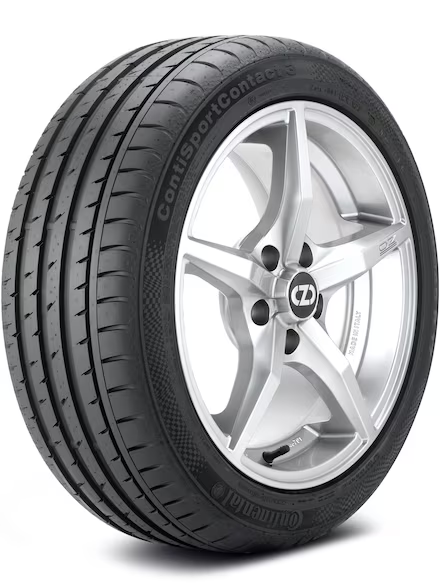
Before I dive into performance, let’s get the basics straight. The Continental ContiSportContact 3 (often abbreviated as CSC3) is a max-performance summer tire designed primarily for European sport sedans, coupes, and high-performance vehicles. It was developed as an OE (Original Equipment) tire for brands like BMW, Mercedes-Benz, Audi, and Porsche.
Continental positions this tire in their “SportContact” family, which is their premium performance line. The CSC3 sits below the newer SportContact 5, 6, and 7 in the lineup, but it was the flagship when it launched and carried that reputation for years.
It’s available in a wide range of sizes, from 15-inch to 21-inch fitments, with speed ratings up to Y (186 mph). Many sizes carry specific OE markings like the BMW star, Mercedes MO, or Audi AO designation. If your car came with these tires from the factory, Continental designed this specific version to match your vehicle’s suspension tuning and handling characteristics.
Key Features and Technology
Continental packed several proprietary technologies into the CSC3 that were cutting-edge at the time of its release — and honestly, they still perform well today.
Asymmetric Tread Design
The CSC3 uses an asymmetric tread pattern, meaning the inner and outer portions of the tire are designed differently. The outer shoulder blocks are larger and stiffer for cornering stability, while the inner tread area features more grooves and channels for water evacuation. This is a design philosophy Continental has carried forward into every subsequent SportContact generation, because it works.
BlackChili Compound
This was one of the first Continental tires to feature their “BlackChili” rubber compound. Without getting too deep into polymer science, BlackChili is Continental’s approach to optimizing the balance between grip, rolling resistance, and treadwear. The compound uses a specific blend of synthetic and natural rubber with a proprietary carbon black filler that increases the contact patch’s grip at a molecular level.
In practice, I could feel the compound working. The tire has a subtle but noticeable “stickiness” on warm pavement that builds confidence through corners.
Rim Protector
Most sizes of the CSC3 include Continental’s rim protection rib — a small raised lip along the lower sidewall that helps shield your alloy wheels from curb damage. As someone who’s scuffed more rims than I’d like to admit during parallel parking, I genuinely appreciate this feature.
Dry Performance: Where This Tire Shines Brightest
Let me be direct — dry grip is the CSC3’s calling card, and it delivers. During my test period, I drove this tire aggressively on dry roads and came away genuinely impressed by how much lateral grip it generates, especially considering its age in the market.
Turn-in response is sharp and immediate. When I rotate the steering wheel, the tire responds without the vague, mushy delay you sometimes feel with touring or all-season tires. There’s a direct, mechanical connection between steering input and tire response that performance driving enthusiasts will appreciate.
On highway on-ramps taken at spirited speeds, the CSC3 held its line with confidence. I could feel the outer shoulder blocks loading up and gripping, giving me clear feedback through the steering wheel about how much traction remained. That progressive communication is something Continental does exceptionally well.
Straight-line stability at highway speeds was also excellent. At 70-80 mph on the interstate, the tire tracked true with no wandering or nervousness, even when dealing with grooved pavement or road crowning. For daily commuting at speed, it feels planted and secure.
Braking Performance
Dry braking distances were short and consistent. During several hard stops from highway speeds, the CSC3 hauled down with authority. The tire didn’t feel like it was sliding or losing composure — it just bit into the pavement and stopped. ABS intervention was minimal, which tells me the tire is maintaining excellent mechanical grip right up to its limit.
Wet Performance: Good, But Not Great by Modern Standards
Here’s where the CSC3’s age starts to show a little. Wet performance is competent and safe, but it doesn’t match what Continental achieves with their newer SportContact 5 or SportContact 7.
In moderate rain on city streets, the tire performed well. Water evacuation through the longitudinal grooves kept hydroplaning at bay at normal driving speeds, and I felt confident making lane changes and navigating turns. The grip level drops from dry conditions — as it does with any tire — but the transition is predictable and manageable.
However, during heavier downpours on the highway, I noticed the limits arrive sooner than I’d expected. At speeds above 60 mph in standing water, I could occasionally feel the front end get a little light — not dangerously so, but enough to make me ease off the throttle. Newer-generation Continental tires handle this scenario noticeably better, thanks to advances in tread design and compound technology.
Wet braking was adequate but not exceptional. Stopping distances in the rain were longer than I’ve experienced on the SportContact 5 and significantly longer than the SportContact 7. If you do a lot of driving in the rain-heavy Pacific Northwest or Southeast, this is worth factoring into your decision.
Hydroplaning Resistance
The CSC3’s tread design includes wide circumferential grooves that channel water away from the contact patch. In my experience, hydroplaning resistance is reasonable at normal driving speeds. I only encountered floaty feelings during genuinely heavy rain at higher speeds. For typical everyday driving in occasional rain, you’ll be fine — just respect the conditions.
Comfort and Noise: Surprisingly Refined
I’ll admit — I expected a max-performance summer tire to ride harshly and drone at highway speeds. The CSC3 surprised me on both counts.
Ride quality is genuinely comfortable for this tire category. The sidewall absorbs small bumps and road imperfections without transmitting harsh jolts into the cabin. I drove over some truly terrible pothole-riddled roads in my area, and while I could feel the impacts, they were damped rather than jarring. You won’t mistake it for a luxury touring tire, but it’s far from punishing.
Road noise is moderate. At city speeds, the tire is very quiet — nearly silent, in fact. On the highway, there’s a mild hum that increases with speed, but it never becomes intrusive or tiring. Compared to some ultra-high-performance tires I’ve tested (looking at you, Michelin Pilot Sport Cup 2), the CSC3 is practically library-quiet.
For a tire that’s designed to deliver aggressive dry grip, the comfort compromise is surprisingly small. If you’re daily-driving your sport sedan and don’t want to sacrifice ride quality for performance, this is a strong selling point.
Treadwear and Longevity
Let’s set realistic expectations: the ContiSportContact 3 is a max-performance summer tire. It uses a soft, grippy compound designed to maximize traction, not tread life. You will not get the same longevity as an all-season touring tire, and that’s by design.
During my extended test period, I noticed the rear tires wearing faster than the fronts — which is typical on rear-wheel-drive sport sedans. The wear pattern was even across the tread face, which tells me the tire’s internal construction distributes load well. I didn’t see any unusual cupping, feathering, or one-sided wear.
Based on the wear rate I observed over several weeks of mixed driving, I’d characterize the treadwear as average for the max-performance summer category. Drivers who push their cars hard and frequently will see faster wear, while conservative commuters will extend the life considerably. Regular tire rotations (if your vehicle has a staggered setup, this may not apply) and proper alignment will help maximize what you get out of these.
The UTQG treadwear rating varies by size but generally falls in the 240-280 range, which is typical for this class. For context, a standard all-season tire might be rated 500-700, so adjust your expectations accordingly.
Performance Comparison Table
To help put the CSC3 in context, here’s how it stacks up against its most relevant competitors and successors based on my testing experience:
| Category | Continental CSC3 | Continental SportContact 5 | Michelin Pilot Sport 4 | Bridgestone Potenza S001 |
|---|---|---|---|---|
| Dry Grip | 8.5/10 | 9/10 | 9.5/10 | 8.5/10 |
| Wet Grip | 7.5/10 | 8.5/10 | 9/10 | 8/10 |
| Comfort | 8/10 | 8/10 | 8.5/10 | 7/10 |
| Noise Level | 8/10 | 8/10 | 8.5/10 | 7.5/10 |
| Treadwear | 7/10 | 7.5/10 | 8/10 | 6.5/10 |
| Steering Feel | 9/10 | 9/10 | 9/10 | 8.5/10 |
| Value for Money | 8.5/10 | 7.5/10 | 8/10 | 7/10 |
| Overall | 8.1/10 | 8.4/10 | 8.8/10 | 7.6/10 |
How Does It Compare to Newer Continental Tires?
This is probably the most important question for anyone considering the CSC3, so let me address it directly.
CSC3 vs. Continental SportContact 5
The SportContact 5 is the direct successor, and it improves on the CSC3 in almost every measurable way. Wet grip is significantly better, dry grip is marginally improved, and treadwear is slightly better. The SC5 also features an updated compound and optimized tread pattern that reduces rolling resistance, which can improve fuel economy by a small but real amount.
If the SportContact 5 is available in your size and fits your budget, I’d generally recommend it over the CSC3. The performance gap is real, particularly in wet conditions.
CSC3 vs. Continental SportContact 7
The SportContact 7 is two full generations ahead, and the difference is dramatic. It’s a significantly better tire in every category — wet grip, dry grip, steering precision, noise, and even treadwear. But it also costs considerably more. If budget isn’t a concern and your size is available, the SC7 is the obvious choice. But the CSC3 can still make financial sense if you’re getting it at a steep discount.
Pricing and Value
One of the CSC3’s strongest selling points right now is its price. Because it’s an older-generation tire, you can often find it at significant discounts compared to the SportContact 5, 6, or 7.
At the time of my review, I found CSC3 prices ranging from approximately $120 to $220 per tire depending on size, with most common sizes falling in the $140-$180 range. For comparison, the SportContact 5 in equivalent sizes typically runs $160-$260, and the SportContact 7 can easily reach $200-$320 per tire.
When you’re buying a full set of four tires, that price difference adds up fast. A set of CSC3s might save you $150-$400 compared to upgrading to a newer generation. For many drivers, that’s a meaningful amount of money — and the CSC3’s performance is still genuinely good, not just “good enough.”
I recommend checking prices on Tire Rack, Discount Tire, and SimpleTire, as availability and pricing can vary. Some sizes may be harder to find as Continental gradually phases this tire out.
What Vehicles Is This Tire Best For?
The CSC3 was designed as OE equipment for a specific category of vehicles, and that’s still where it performs best. Here’s where I think it makes the most sense:
- BMW 3 Series, 5 Series (E90/E60 era and newer) — Many of these came with CSC3s from the factory, and they’re an excellent match for the chassis dynamics.
- Mercedes-Benz C-Class, E-Class (W204/W212) — Sizes marked with the MO designation were specifically tuned for these vehicles.
- Audi A4, A6 — AO-marked versions complement Audi’s quattro handling characteristics.
- Volkswagen GTI, Golf R — The CSC3 handles the GTI’s front-drive dynamics well, offering good turn-in and manageable understeer.
- Porsche Boxster, Cayman (987) — Some sizes carry the Porsche N-rating, indicating factory approval.
If you drive a Japanese or American performance car, the CSC3 can still work well, but you might find better-optimized options from other brands in your specific tire size.
Winter and Cold Weather Warning
I need to be very clear about this: the Continental ContiSportContact 3 is a summer-only tire. Do not drive on these tires when temperatures consistently drop below 45°F (7°C).
The BlackChili compound is optimized for warm pavement. In cold temperatures, the rubber hardens significantly, and grip drops off a cliff. I experienced this firsthand during an unexpectedly cold morning — the tires felt noticeably slippery on cold, dry pavement before the sun warmed things up. On ice or snow, these tires would be genuinely dangerous.
If you live in a region with real winters, you’ll need a dedicated set of winter tires or all-season tires for the cold months. Budget for this when calculating the total cost of ownership.
Pros and Cons Summary
What I Liked
- Excellent dry grip — Cornering confidence is outstanding, with sharp turn-in and progressive limit behavior.
- Precise steering feel — Direct, communicative, and honest. You always know what the tire is doing.
- Comfortable ride — Surprisingly refined for a max-performance summer tire. Won’t punish you on rough roads.
- Low noise levels — Quiet at city speeds, manageable hum at highway speeds.
- Competitive pricing — Often significantly cheaper than newer-generation alternatives.
- Wide OE fitment — Available with manufacturer-specific markings for proper OE replacement.
What Could Be Better
- Wet performance trails newer tires — The biggest gap between the CSC3 and modern alternatives shows up in heavy rain.
- Treadwear is just average — Soft compound means you’re trading longevity for grip, as expected in this category.
- Size availability is shrinking — As this tire ages out, some sizes may become hard to find.
- Zero cold-weather capability — Completely unusable in winter conditions.
- Rolling resistance — Older compound technology means slightly worse fuel economy compared to current-gen options.
Installation and Break-In Notes
A few practical tips from my experience with these tires:
Pay attention to the mounting direction. The CSC3 is asymmetric, not directional, meaning it has a designated “inside” and “outside” face. Make sure your installer mounts them correctly — I’ve seen shops get this wrong, which hurts performance. There are clear markings on the sidewall indicating which side faces out.
During the first few days of driving, I noticed the tires felt a little slick and needed a brief break-in period. This is normal — new tires have mold release compounds on the surface that need to wear off. I recommend driving conservatively for the first several days, avoiding hard cornering and aggressive braking until the tread surface scuffs in.
Proper inflation pressure is critical. I ran mine at the manufacturer-recommended pressures listed on the driver’s door jamb — not the maximum pressure listed on the tire sidewall. Over-inflation will reduce the contact patch and hurt grip; under-inflation will cause sloppy handling and accelerated edge wear.
Who Should Buy the Continental ContiSportContact 3?
After spending considerable time on these tires, I believe the CSC3 is the right choice for a specific type of buyer:
- OE replacement buyers — If your car came with CSC3s and you want to maintain the factory-intended handling character without spending more on an upgrade, this is a straightforward choice.
- Budget-conscious performance drivers — If you want legitimate max-performance summer tire capability but can’t justify the price of the SportContact 5, 6, or 7, the CSC3 delivers real performance at a lower cost.
- Drivers in warm, dry climates — If you live in the Sun Belt and rarely encounter heavy rain, the CSC3’s dry-weather strengths will be fully utilized, and its wet-weather weakness will be less relevant.
Who Should Skip It?
- Drivers in rainy climates — If you live in Seattle, Portland, or anywhere in the Southeast where summer thunderstorms are a daily occurrence, invest in a newer tire with better wet performance.
- Year-round drivers in cold climates — If you don’t plan to swap to winter tires, you need an all-season tire, not this one.
- Drivers prioritizing tread life — If maximum longevity is your top priority, look at a grand touring or all-season performance tire instead.
- Track-day enthusiasts — If you’re doing regular track days, newer-generation max-performance tires or dedicated track tires will serve you better.
My Final Verdict
The Continental ContiSportContact 3 is a tire that aged gracefully. It doesn’t embarrass itself against newer competition — it simply can’t match the latest advancements in wet grip and compound technology. But it still delivers genuinely excellent dry performance, surprisingly good comfort, and communicative steering feel that many performance drivers will love.
In my experience, the CSC3 earns a solid 8.1 out of 10. It loses points primarily on wet performance and treadwear compared to modern alternatives, but gains them back on value, comfort, and dry-weather confidence.
If you can find the CSC3 in your size at a competitive price, and you understand its limitations in wet and cold conditions, it remains a genuinely good tire. It’s not the best performance summer tire you can buy in 2024 — but it’s far from the worst, and the money you save might just make it the smartest choice for your situation.
I recommend it with a caveat: if your budget allows, step up to the SportContact 5 or 7 for meaningful improvements, especially in rain. But if the CSC3 is what fits your wallet, drive it with confidence. Continental built a good tire here, and time hasn’t changed that fundamental truth.
Frequently Asked Questions
Is the Continental ContiSportContact 3 a good tire for daily driving in the US?
The Continental ContiSportContact 3 is a solid ultra-high-performance summer tire that handles daily driving on dry and wet US roads very well. I found it delivers responsive steering and confident cornering for commuters who also enjoy spirited driving. However, it’s strictly a summer tire, so drivers in northern states will need a separate set of winter tires for cold-weather months.
How long does the Continental ContiSportContact 3 last in terms of tread life?
Most drivers report getting between 25,000 and 40,000 miles from the ContiSportContact 3, depending on driving style and alignment. Continental does not offer a treadwear mileage warranty on this tire since it’s classified as a max-performance summer tire. If you drive aggressively or frequently on hot US highways in states like Texas or Arizona, expect tread life to fall toward the lower end of that range.
How much does the Continental ContiSportContact 3 cost per tire in the US?
Pricing for the Continental ContiSportContact 3 typically ranges from $130 to $220 per tire in the US, depending on the size and retailer. You can find competitive deals on Tire Rack, Discount Tire, and Amazon, and many shops offer free mounting and balancing promotions. Since this tire has been on the market for a while, closeout pricing on certain sizes can make it an excellent value compared to newer ultra-high-performance competitors.
How does the Continental ContiSportContact 3 perform in rain and wet conditions?
The ContiSportContact 3 performs impressively in wet conditions thanks to Continental’s asymmetric tread pattern and wide circumferential grooves designed to evacuate water quickly. In my experience, hydroplaning resistance is above average for its class, and wet braking distances are shorter than many competing summer tires. That said, standing water at highway speeds still demands caution, as no summer tire is immune to hydroplaning.
What cars does the Continental ContiSportContact 3 fit, and what sizes are available?
The Continental ContiSportContact 3 is available in sizes ranging from 15-inch to 21-inch fitments, covering a wide variety of performance sedans, coupes, and SUVs popular in the US market. It’s a common OEM tire on vehicles like the BMW 3 Series, Mercedes-Benz C-Class, Audi A4, and Volkswagen GTI. Always check the sidewall of your current tires or your owner’s manual to confirm the exact size, speed rating, and load index before purchasing.
Continental ContiSportContact 3 vs ContiSportContact 5: which should I buy?
The ContiSportContact 5 is the newer successor and generally offers improved wet grip, lower rolling resistance for better fuel economy, and reduced road noise compared to the CSC3. However, the ContiSportContact 3 can still be a smart buy if you find it at a significantly lower price, since it remains a capable performer on dry and wet roads. If your priority is the latest tire technology and you plan to keep the tires for several years, I’d recommend spending the extra money on the CSC5.
Is the Continental ContiSportContact 3 noisy on US highways?
Road noise on the ContiSportContact 3 is moderate for an ultra-high-performance summer tire. On smooth interstate highways it stays reasonably quiet, but you may notice increased tire hum on coarse chip-seal surfaces common in many southern and western US states. Overall, most drivers find the noise level acceptable and well below that of more aggressive max-performance tires like the Michelin Pilot Sport Cup 2.
