

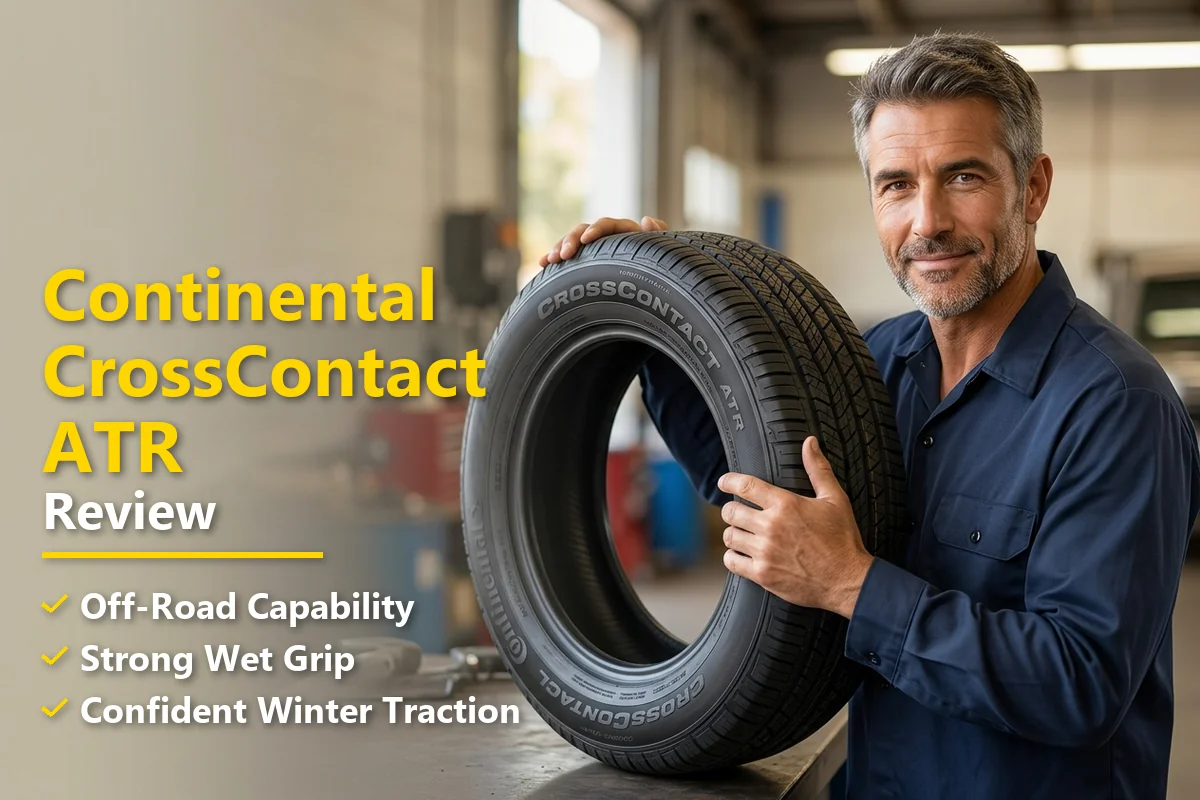
Finding a tire that genuinely performs well on both pavement and dirt feels like searching for a unicorn. Most all-terrain tires force you to pick a side — either they’re great on the highway but hopeless on a muddy trail, or they’ll crawl over rocks like a mountain goat but drone your ears off at freeway speeds.
That’s exactly the frustration I had before mounting the Continental CrossContact ATR on my test vehicle. Continental claims this tire bridges the gap between on-road comfort and off-road capability — and after extensive testing across a wide variety of conditions, I’m ready to tell you whether that promise holds up.
If you’re still deciding whether Continental is a brand worth trusting before you commit, my Continental tires review covers everything you need to know about the brand first.
- The Continental CrossContact ATR is one of the best-balanced all-terrain tires I’ve tested — genuinely comfortable on highways while still capable off-road.
- Road noise is impressively low for an AT tire, though not quite as silent as a dedicated touring tire.
- Wet traction is a standout feature thanks to Continental’s compound technology and aggressive siping.
- Off-road, it handles gravel, packed dirt, and light mud confidently, but deep mud and serious rock crawling aren’t its forte.
- Pricing ranges from roughly $180 to $320+ per tire depending on size, placing it in the mid-to-premium segment.
- Best suited for SUV and truck owners who spend 70-80% of their time on pavement but want legitimate off-road confidence for weekend adventures.
Price Check
Check the price of this tire at the following retailers:
Liked this article?
Add TireAdvise as a preferred source so you see more of our tire reviews and guides on Google.
Who Is the Continental CrossContact ATR Designed For?
Before I get into the nitty-gritty of performance data and personal impressions, let’s talk about who Continental actually built this tire for. Understanding the intended audience helps set proper expectations — and honestly, it’s where a lot of tire reviews fail their readers.
The CrossContact ATR sits in Continental’s all-terrain lineup, positioned between their highway-focused CrossContact LX and the more aggressive off-road offerings you’ll find from competitors. It’s designed for drivers of SUVs, crossovers, and light trucks who need a tire that can handle daily commuting, road trips, and occasional off-road excursions without compromise.
Think of it this way: if you drive a Toyota 4Runner, Jeep Wrangler, Ford Bronco Sport, Chevrolet Colorado, or similar vehicle, and your driving life is split between paved roads and periodic trail adventures — this tire is squarely aimed at you. It’s available in sizes ranging from 15 to 22 inches, covering a wide swath of the SUV and light truck market in the US.
First Impressions Out of the Box
I’ll admit, when I first pulled the CrossContact ATR out of the packaging, I was struck by how refined the tread pattern looked compared to most all-terrain tires I’ve reviewed. The lugs are aggressive enough to look the part of a capable off-road tire, but they’re more tightly spaced than something like a BFGoodrich KO2 or a Falken Wildpeak AT3W.
The sidewall features a subtle but attractive design with Continental’s branding and a modest amount of sidewall protection. It’s not the most “rugged-looking” tire on the market — if that aggressive, knobby aesthetic is important to you — but it has a purposeful, premium appearance that suits modern SUVs well.
Picking up the tire, the rubber compound felt firm yet pliable. Continental uses what they call their “Traction Silica” compound in this tire, and you can feel the quality in the material itself. The siping across the tread blocks is dense and deep, which immediately told me this tire was engineered with wet performance as a priority.
On-Road Performance: Where This Tire Really Shines
Let’s start where most CrossContact ATR owners will spend the vast majority of their time — on paved roads. I drove this tire extensively on a mix of interstate highways, suburban streets, and winding two-lane country roads to get a comprehensive picture of its on-road behavior.
Highway Comfort and Ride Quality
The first thing I noticed after the initial few days of driving was just how comfortable this tire is. I’ve tested plenty of all-terrain tires that feel like they’re fighting the pavement — a constant reminder through the steering wheel and seat that you’re running aggressive rubber. The CrossContact ATR doesn’t do that.
The ride quality is genuinely plush for an AT tire. It absorbs expansion joints, potholes, and rough pavement patches with a composure that reminded me more of a touring tire than an all-terrain. On a long highway drive through varying road surfaces, I found myself forgetting I was on all-terrain tires altogether — which is about the highest compliment I can pay in this category.
Continental achieves this partly through the tire’s internal construction. The CrossContact ATR features a polyester carcass with twin steel belts and a nylon overlay, which provides a good balance of structural rigidity and compliance. It’s not as stiff as a full 3-ply construction, which means you sacrifice some heavy-duty puncture resistance but gain meaningful comfort on pavement.
Road Noise
This is a big one, and it’s the area where most all-terrain tires lose points with everyday drivers. Nobody wants to shout over their tires on a family road trip.
I was genuinely impressed with how quiet the CrossContact ATR is. At highway speeds around 65-75 mph, there’s a faint hum that’s present but never intrusive. It’s noticeably quieter than the BFGoodrich KO2 and the Toyo Open Country AT3, both of which I’ve also tested. I’d put it roughly on par with the Michelin LTX Trail in terms of noise management — which is saying something.
Continental credits their “ContiSilent” noise-reduction approach and the optimized pitch sequence of the tread blocks for this performance. Whatever the engineering explanation, the real-world result is a tire you can live with daily without reaching for earplugs.
Dry Traction and Handling
On dry pavement, the CrossContact ATR delivers confident, predictable handling. The steering response is direct and communicative — I could feel what the front tires were doing through turns, which isn’t always the case with all-terrain rubber.
During spirited driving on twisty back roads, the tire held its line well and transitioned smoothly between inputs. There’s a slight amount of sidewall flex if you really push hard into corners, which is expected from a tire with this sidewall profile, but it’s well-controlled and progressive. You won’t feel the tire suddenly lose composure.
Braking on dry surfaces was excellent. The tire inspires confidence when you need to stop quickly, and I noticed no unusual behavior or extended stopping distances during my testing.
Wet Traction
Here’s where the Continental CrossContact ATR truly separates itself from much of the competition, and it became the single most impressive aspect of this tire in my testing.
I had the opportunity to drive through several heavy rainstorms during my test period, including some serious downpours on the interstate. The hydroplaning resistance is outstanding. The tire’s wide circumferential grooves and dense siping evacuate water aggressively, and I never once felt the unsettling lightness of hydroplaning — even through standing water at highway speeds.
Cornering grip in the rain was equally confident. On wet, twisty roads, the tire communicated its grip level clearly and held traction far better than I expected from an all-terrain tire. Continental’s expertise with wet-weather compounds (they’re a dominant force in European rain-heavy markets) really shows here.
If you live anywhere in the US that gets significant rainfall — the Pacific Northwest, the Southeast, the Gulf Coast — the CrossContact ATR’s wet performance alone might justify choosing it over competitors.
Off-Road Performance: Capable, With Limits
Alright, let’s get these tires dirty. I tested the CrossContact ATR across several off-road surfaces to gauge where its limits are. Here’s the breakdown by terrain type.
Gravel and Packed Dirt Roads
This is the CrossContact ATR’s off-road sweet spot, and it handles these surfaces brilliantly. On loose gravel forest roads, the tire bit into the surface confidently and provided predictable, controllable traction. Steering feel remained good, and I didn’t experience any concerning sliding or loss of directional control.
On harder-packed dirt roads, the tire was equally composed. It felt almost as stable as it does on pavement, just with a slightly softer feel from the surface compliance. For the kind of off-roading that most SUV owners actually do — fire roads, national forest routes, campsite access roads — this tire is more than adequate.
Mud Performance
Light to moderate mud? The CrossContact ATR handles it respectably well. The tread pattern is open enough to channel and expel a reasonable amount of mud, and the tire maintained forward progress through slushy, muddy sections of trail without much drama.
However, deep, sticky mud is where this tire reaches its limits. The tread blocks are not as widely spaced or as deeply sculpted as a dedicated mud-terrain tire, and in seriously soupy conditions, they pack with mud and lose effectiveness. This isn’t a criticism unique to the CrossContact ATR — it’s inherent to the all-terrain category — but it’s worth knowing. If you regularly encounter axle-deep mud, look at a dedicated mud-terrain tire instead.
Sand and Soft Surfaces
I drove across some sandy terrain during my testing, and the CrossContact ATR performed adequately with appropriate tire pressure adjustments. Airing down to around 20-25 psi gave the tire a larger contact patch, and it floated over soft sand reasonably well.
It’s not a sand-specific tire, but for occasional beach access roads or desert washes, it’ll get you through without too much fuss. Just remember to air back up before hitting pavement.
Rocky Terrain
On rocky surfaces, the CrossContact ATR showed decent composure. Smaller rocks and stony trails were no problem — the tire picked its way across without any concerning sidewall bulges or tread damage during my test period.
That said, serious rock crawling over sharp, jagged terrain is not what this tire is designed for. The sidewall isn’t as heavily reinforced as something like the General Grabber A/TX or the Falken Wildpeak AT3W, so I’d exercise caution on extremely technical rocky trails. For moderate rocky terrain that most trail-rated SUVs encounter, though, it’s perfectly fine.
Winter and Cold Weather Performance
The Continental CrossContact ATR carries the Three-Peak Mountain Snowflake (3PMSF) rating, which means it meets the industry-standard threshold for traction in snow conditions. I had the chance to test it during some cold weather driving with light snow and icy patches, and it performed admirably.
The dense siping across the tread blocks creates a lot of biting edges that grip snow and ice far better than a standard all-season tire. On lightly snow-covered roads, the tire felt secure and controllable. Braking on snowy surfaces was predictable, with no sudden loss of grip.
That said, this is not a substitute for dedicated winter tires if you live in Minnesota, Wisconsin, Michigan, or other states that see sustained harsh winter conditions. For transitional seasons and occasional snow encounters in states like Colorado, Virginia, or Oregon, the CrossContact ATR’s winter capability is a genuine asset.
Treadwear and Durability Observations
While I won’t project specific mileage figures from my test period — that would be irresponsible given the many variables that affect tire life — I can share my observations about how the tire wore during my time with it.
After several weeks of mixed driving across highways, back roads, and off-road terrain, the tread showed remarkably even wear. There were no signs of premature wear on the shoulders or center rib, and the tread depth remained consistent across the tire’s width. This tells me the tire’s construction and compound are well-balanced for even distribution of forces.
Continental rates the CrossContact ATR with a UTQG treadwear rating that places it in a competitive position within the all-terrain segment. The Traction Silica compound is designed for longevity as well as grip, and my early impressions suggest it should deliver a satisfying service life for most drivers.
Continental also backs this tire with a limited treadwear warranty, which adds a layer of confidence if you’re spending premium money. I always recommend checking the specific warranty terms for your size, as they can vary.
How Does It Compare? Continental CrossContact ATR vs. Key Competitors
No tire review is complete without context. Here’s how the CrossContact ATR stacks up against some of the most popular all-terrain tires in the US market based on my testing and research.
| Feature | Continental CrossContact ATR | BFGoodrich KO2 | Falken Wildpeak AT3W | Toyo Open Country AT3 |
|---|---|---|---|---|
| On-Road Comfort | Excellent | Good | Very Good | Very Good |
| Road Noise | Very Low | Moderate | Low | Low-Moderate |
| Wet Traction | Excellent | Good | Very Good | Good |
| Dry Handling | Excellent | Very Good | Good | Very Good |
| Off-Road (Moderate) | Very Good | Excellent | Very Good | Very Good |
| Off-Road (Extreme) | Fair | Very Good | Good | Good |
| Snow/Ice (3PMSF) | Yes | Yes | Yes | Yes |
| Sidewall Durability | Good | Excellent | Very Good | Good |
| Approx. Price Range (per tire) | $180 – $320+ | $175 – $350+ | $140 – $280+ | $155 – $300+ |
CrossContact ATR vs. BFGoodrich KO2
The KO2 is the reigning king of the all-terrain segment in terms of name recognition and off-road credibility. It’s tougher off-road, with thicker sidewalls and more aggressive tread lugs. But the CrossContact ATR beats it convincingly in on-road comfort, noise levels, and wet traction.
If your driving skews 80% or more toward pavement, I’d choose the Continental. If you’re regularly tackling serious off-road terrain, the KO2 is the safer bet. It really comes down to your priority split.
CrossContact ATR vs. Falken Wildpeak AT3W
This is a closer comparison. The Wildpeak AT3W is an excellent all-around all-terrain tire that I’ve also reviewed favorably. The Continental edges it in on-road refinement and wet grip, while the Falken offers slightly better off-road durability thanks to its reinforced sidewall construction.
The Falken also tends to be priced lower, making it a strong value play. If budget is a primary concern, the AT3W delivers tremendous bang for the buck. If you want the best possible on-road experience from an AT tire, the Continental is worth the premium.
CrossContact ATR vs. Toyo Open Country AT3
The Toyo is another well-rounded competitor. I found the CrossContact ATR to be quieter on the highway and noticeably better in heavy rain. The Toyo counters with a slightly more aggressive tread that gives it a small edge on loose surfaces. Both are solid tires, but the Continental feels a half-step more premium overall.
Pricing and Value Assessment
Let’s talk money, because the CrossContact ATR isn’t the cheapest all-terrain tire on the market. Prices vary by size, but you’re generally looking at $180 to $320+ per tire at major US retailers like Tire Rack, Discount Tire, and Costco. For a full set, that puts you in the $720 to $1,280+ range before installation, mounting, balancing, and any applicable fees.
Is that expensive? It’s solidly in the mid-to-premium range for all-terrain tires. You can find less expensive options — the Falken Wildpeak AT3W and Cooper Discoverer AT3 4S both undercut it on price. But you’re paying for Continental’s compound technology, ride refinement, and wet-weather prowess.
I think the value is justified if on-road comfort and wet traction are high on your priority list. The cost per mile should also be competitive given the tire’s even wear characteristics and reasonable tread life expectations. Keep an eye out for Continental rebates and retailer promotions, which can bring the effective cost down by $50-$100 or more for a set of four.
What I Liked Most About the Continental CrossContact ATR
- Outstanding wet traction: The best rain performance I’ve experienced from an all-terrain tire. Period.
- Impressively quiet: You won’t believe how little noise this tire generates at highway speeds for an AT tire.
- Excellent ride comfort: Absorbs road imperfections with a composure that rivals all-season touring tires.
- Confident dry handling: Responsive, precise, and communicative through the steering wheel.
- 3PMSF winter rating: Genuine cold-weather capability adds year-round versatility.
- Even tread wear: Early observations suggest balanced, long-lasting tread life.
- Premium build quality: Continental’s engineering and material quality are evident from the moment you handle this tire.
What Could Be Better
- Extreme off-road capability: It’s not built for serious mud or rock crawling — this is a “light-to-moderate” off-road tire.
- Sidewall protection: Less aggressive sidewall construction compared to the KO2 or Wildpeak AT3W means you need to be more careful on very rocky terrain.
- Price: The premium over competitors is noticeable, especially for budget-conscious buyers.
- Aggressive aesthetics: If you want that beefy, chunky all-terrain look, the CrossContact ATR is more refined than rugged in appearance.
- Limited size availability in some fitments: While the range is decent, some less common truck sizes may not be covered.
Who Should Buy the Continental CrossContact ATR?
After thoroughly testing this tire, I’m confident recommending it to a specific type of driver. Here’s who I think will be happiest with the CrossContact ATR:
You should buy this tire if:
- You drive an SUV, crossover, or light truck and spend most of your time on paved roads.
- You want all-terrain capability for weekend adventures — gravel roads, forest trails, light off-roading — without sacrificing daily comfort.
- You live in a rain-heavy region and prioritize wet traction above all else.
- Road noise is a deal-breaker for you, and you refuse to tolerate the drone of typical AT tires.
- You want a tire that carries 3PMSF certification for occasional winter driving.
- You value premium build quality and are willing to pay a modest premium for it.
You should look elsewhere if:
- You do serious off-roading regularly — deep mud, rock crawling, heavy trail use. Look at the BFGoodrich KO2 or a dedicated mud-terrain tire.
- Budget is your primary concern. The Falken Wildpeak AT3W or Cooper Discoverer AT3 4S offer strong performance for less money.
- You need maximum sidewall durability for construction sites, ranch work, or very harsh terrain.
- You want the most aggressive, rugged-looking tire possible for aesthetics.
My Final Verdict on the Continental CrossContact ATR
In a crowded all-terrain market dominated by familiar names, the Continental CrossContact ATR carves out a compelling niche as the refined, on-road-biased AT tire that doesn’t forget its off-road roots. It’s not trying to be the toughest tire on the block. Instead, it’s trying to be the smartest — and in my experience, it succeeds.
The wet traction is genuinely class-leading. The on-road comfort and noise levels are exceptional for the category. And while it won’t replace a dedicated off-road tire for extreme trail use, it handles the kind of off-roading that 90% of SUV owners actually do with confidence and composure.
Continental has a long history of engineering excellence, and the CrossContact ATR reflects that heritage. It’s a tire that respects your daily driving comfort while giving you the freedom to venture off the beaten path when the mood strikes. For the right driver, it’s one of the best all-terrain tires you can buy in 2024.
I give the Continental CrossContact ATR a strong 8.5 out of 10. It loses a few points for its premium pricing and limitations in extreme off-road scenarios, but it earns top marks in virtually every on-road category and delivers more than enough off-road capability for its intended audience.
If the description of its ideal buyer sounds like you, I’d encourage you to give it a serious look. In my experience, it’s one of those rare tires that actually lives up to its marketing promises.
Frequently Asked Questions
Is the Continental CrossContact ATR a good all-terrain tire for daily driving?
The Continental CrossContact ATR is an excellent all-terrain tire for daily driving because it blends off-road capability with on-road comfort better than most competitors in its class. I found it noticeably quieter on highways than aggressive all-terrain options like the BFGoodrich KO2, making it ideal for SUV and truck owners who spend 70-80% of their time on pavement. It delivers confident handling in dry and wet conditions while still providing respectable traction on gravel, dirt, and light mud.
How long do Continental CrossContact ATR tires last in real-world driving?
Continental backs the CrossContact ATR with a 50,000-mile treadwear warranty, and most US drivers report getting between 45,000 and 55,000 miles depending on driving habits and alignment maintenance. The silica-enhanced compound holds up well on hot summer asphalt, which is a big plus for drivers in southern states. I noticed even tread wear across the tire after extended highway use, which suggests Continental’s tread design distributes load effectively.
How much do Continental CrossContact ATR tires cost in the US?
Continental CrossContact ATR tires typically range from $180 to $300 per tire in the US depending on the size, with popular fitments like 265/70R17 averaging around $220-$240 each. You can find deals at retailers like Tire Rack, Discount Tire, and Costco, especially during seasonal promotions. When factoring in the 50,000-mile warranty and the tire’s balanced performance, the cost per mile is competitive with other premium all-terrain tires like the Toyo Open Country AT III and Falken Wildpeak AT3W.
How does the Continental CrossContact ATR perform in snow and winter conditions?
The CrossContact ATR carries the Three-Peak Mountain Snowflake (3PMSF) certification, meaning it meets industry standards for severe snow traction. In my experience driving through winter conditions in the northern US, it handles light to moderate snow confidently thanks to its interlocking sipe design that bites into packed snow. However, it’s not a substitute for a dedicated winter tire if you regularly face ice or heavy snowfall — think of it as a capable three-season tire with solid winter credibility for occasional cold-weather driving.
Continental CrossContact ATR vs LX25: which tire should I choose for my SUV?
The CrossContact ATR is the better choice if you do any off-road driving, tow frequently, or want a more rugged tire with all-terrain capability, while the LX25 is a pure highway touring tire designed for maximum on-road comfort and fuel efficiency. The ATR has a stiffer sidewall and more aggressive tread pattern that handles gravel roads, construction sites, and unpaved trails without issue. If your SUV or crossover never leaves paved roads and you prioritize a whisper-quiet ride, the LX25 will feel more refined, but you’ll sacrifice any meaningful off-road grip.
Is the Continental CrossContact ATR noisy on the highway?
One of the biggest strengths of the CrossContact ATR is how quiet it runs for an all-terrain tire — Continental used their noise-reducing tread pitch sequencing to keep road hum to a minimum. At highway speeds of 65-75 mph, I noticed only a faint hum that’s far less intrusive than typical AT tires and closer to what you’d expect from a highway tire. Wind and engine noise in most trucks and SUVs will drown out any tire sound, so noise shouldn’t be a concern for most US commuters considering this tire.
What vehicles and sizes does the Continental CrossContact ATR fit?
The Continental CrossContact ATR is available in a wide range of sizes from 15 to 22 inches, covering popular US trucks and SUVs like the Ford F-150, Toyota Tacoma, Jeep Wrangler, Chevrolet Colorado, Toyota 4Runner, and Ram 1500. Common sizes include 265/70R17, 275/65R18, and 245/65R17, with load ratings suitable for light towing and hauling. I’d recommend checking Continental’s fitment tool or your local dealer to confirm the exact load index and speed rating that matches your vehicle’s specifications.
