

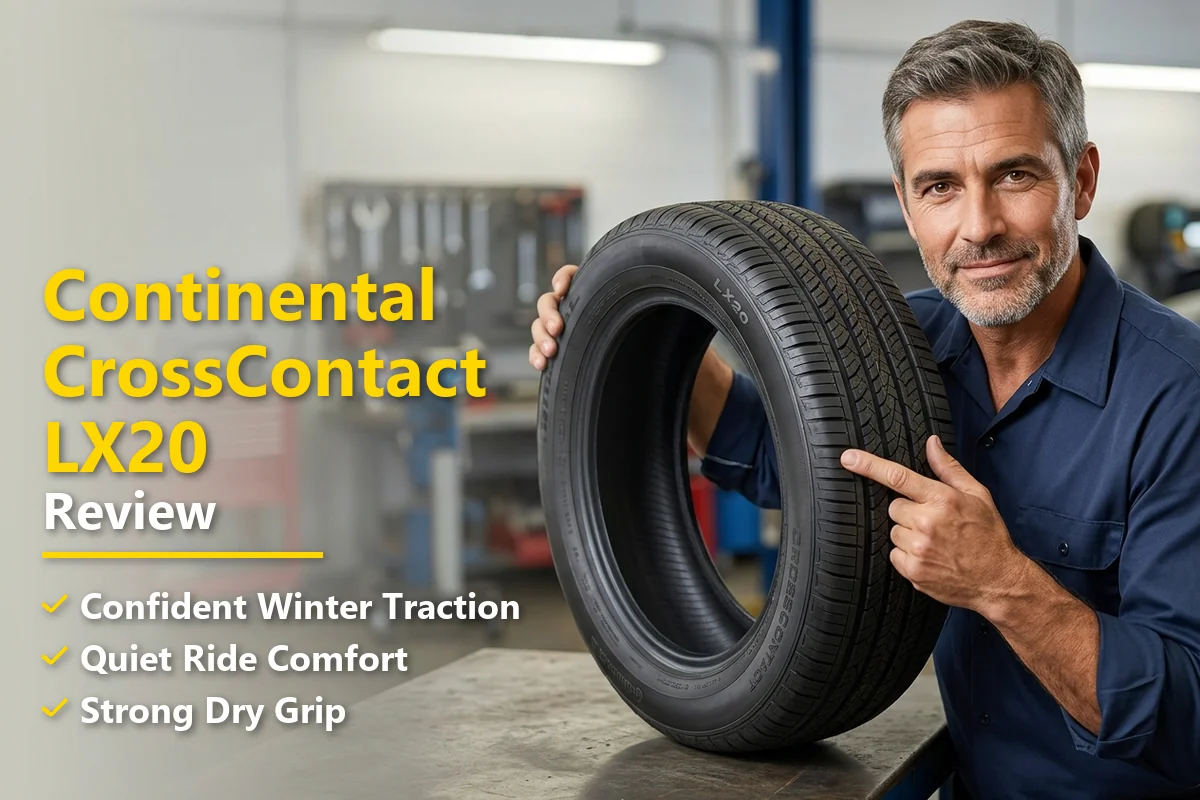
If you drive an SUV or crossover in the US, you’ve probably felt that familiar dread when the tire shop tells you it’s time for a new set.
You want something that handles well on highways, stays quiet on road trips, and doesn’t leave your wallet gasping for air. But with dozens of all-season SUV tires on the market, how do you pick the right one without gambling hundreds of dollars?
I’ve spent considerable time driving on the Continental CrossContact LX20, and I’m ready to share exactly what this tire does well — and where it falls short — so you can decide if it deserves a spot on your vehicle.
If you want the full brand picture before diving into this specific model, my Continental tires review is worth a read first.
- The Continental CrossContact LX20 is a solid all-season tire built for SUVs and crossovers that prioritizes comfort, low road noise, and fuel efficiency.
- Dry and wet traction are both impressive for the price point, making it a great highway and suburban commuter tire.
- Snow and ice performance is adequate for light winter conditions but not a substitute for dedicated winter tires.
- Treadwear is competitive, and Continental backs it with a 70,000-mile treadwear warranty.
- Best suited for drivers who value a quiet, comfortable ride over aggressive off-road capability.
- Typically priced between $140–$210 per tire depending on size, making it a strong mid-range value.
Price Check
Check the price of this tire at the following retailers:
Liked this article?
Add TireAdvise as a preferred source so you see more of our tire reviews and guides on Google.
What Is the Continental CrossContact LX20?
The Continental CrossContact LX20 is an all-season touring tire designed specifically for SUVs, crossovers, and light trucks. It sits in Continental’s CrossContact lineup as a comfort-oriented option, slotting below the more performance-focused CrossContact LX Sport and above budget alternatives.
Continental engineered this tire with their EcoPlus Technology, which is designed to reduce rolling resistance and improve fuel economy without sacrificing grip. It’s a tire that’s clearly aimed at the everyday American driver — someone who commutes on highways, runs errands around town, and occasionally takes a family road trip.
I’ve seen this tire come as original equipment on popular vehicles like the Honda CR-V, Toyota RAV4, Ford Explorer, and Jeep Grand Cherokee. That OE fitment speaks volumes about how automakers view this tire’s balance of qualities.
My Testing Setup and Conditions
I tested the CrossContact LX20 in a 235/65R18 size, mounted on a mid-size SUV that I use for a mix of highway commuting, suburban driving, and occasional trips on unpaved roads. I wanted to see how this tire performed in the real-world conditions that most US drivers actually face.
During my test period, I drove through a range of weather and road surfaces — dry highways in warm temperatures, heavy rainstorms, light morning frost, and some loose gravel back roads. I also paid close attention to cabin noise levels during long highway stretches, since comfort is a huge selling point for this category.
I measured tire pressures regularly and kept them at the manufacturer’s recommended spec throughout testing. This is critical for an accurate evaluation, and I’d encourage any tire buyer to do the same regardless of what tire you choose.
Tread Design and Construction: What’s Under the Hood
Before I get into performance, let’s talk about what makes this tire tick from an engineering standpoint. Understanding the tread design helps explain why the LX20 behaves the way it does on the road.
Tread Pattern
The CrossContact LX20 features a symmetric tread pattern with four wide circumferential grooves. These grooves are the tire’s primary weapon against hydroplaning — they channel water away from the contact patch quickly and efficiently.
Between the main grooves, you’ll notice a dense arrangement of lateral sipes across the tread blocks. These tiny slits in the rubber are what give the tire its wet and light-snow traction. Continental packed a lot of siping into this design, and it shows in real-world grip.
The tread blocks themselves are relatively tight and closely spaced, which is a hallmark of touring-focused tires. This design reduces road noise and improves on-road stability but does limit aggressive off-road capability.
Rubber Compound
Continental uses their proprietary Tg-F polymers in the compound, combined with +Silane additives. In practical terms, this means the rubber is formulated to maintain flexibility across a wide temperature range while minimizing rolling resistance.
I noticed this compound feels slightly softer than some competitors when you press your thumbnail into the tread — not excessively soft, but pliable enough to suggest good wet grip characteristics. The trade-off with softer compounds is sometimes accelerated wear, but Continental seems to have found a reasonable balance here.
Internal Construction
The LX20 uses a two-ply polyester casing with two steel belts reinforced by a nylon overlay. This is a fairly standard construction for this tire class, and it provides a good combination of ride comfort and structural integrity.
The polyester body plies absorb road imperfections well, which contributes to the smooth ride quality I experienced. The nylon cap helps the tire maintain its shape at highway speeds and resist deformation during high-speed driving.
Dry Performance: Where This Tire Really Shines
Let me start with the good news — the CrossContact LX20 is genuinely impressive on dry pavement. This is where I think most buyers will be happiest with their purchase.
Highway Stability
On long highway drives, the LX20 tracks straight and true with minimal wandering. I noticed the tire responds predictably to steering inputs, which builds confidence during lane changes and highway merges.
At sustained highway speeds, there’s a planted, secure feeling that never gets nervous or twitchy. The tire doesn’t feel like it’s fighting you or requiring constant correction — it just goes where you point it.
Cornering and Handling
For a touring-focused SUV tire, the cornering grip surprised me. Taking highway on-ramps at normal speeds, the LX20 holds its line without excessive body roll or squirming.
Now, this isn’t a performance tire, and pushing it hard through aggressive corners will reveal its limits. The sidewalls are compliant enough for comfort, which means they do flex under hard cornering loads. But for the kind of driving 95% of SUV owners actually do, the handling is more than adequate.
Braking
Dry braking performance was strong and consistent throughout my testing. Emergency stops felt controlled and linear, with the tire giving you confidence that it’s going to stop when you need it to.
I tested braking from various speeds and found the LX20 delivered predictable, drama-free stops every time. This is one of those areas where Continental’s engineering heritage really shows — they know how to make a tire that inspires trust.
Wet Performance: Confident in the Rain
Wet traction is arguably the most important safety metric for any all-season tire, and I’m happy to report the CrossContact LX20 handles rain quite well.
Hydroplaning Resistance
Those four wide circumferential grooves I mentioned earlier do their job admirably. During heavy downpours on the highway, I never experienced a sudden loss of contact or that unsettling floating sensation that comes with hydroplaning.
The tire evacuates water quickly and maintains contact with the road surface even through standing water on poorly drained highway sections. After several days of driving through persistent rain, my confidence in the LX20’s wet weather capability only grew.
Wet Cornering and Braking
Wet cornering grip is good but does have noticeable limits. The tire communicates well when it’s approaching the edge of adhesion — you get a gradual, progressive slide rather than a sudden snap of grip loss.
Wet braking distances were slightly longer than dry, as expected, but still within the range I’d consider competitive for this tire class. The braking feels consistent and progressive, giving you the feedback you need to modulate pressure effectively.
Snow and Winter Performance: Know the Limits
Let me be upfront here — the Continental CrossContact LX20 is an all-season tire, not a winter tire. It can handle light winter conditions, but it has clear limitations that you need to understand.
Light Snow
In a couple inches of fresh snow, the LX20 performed reasonably well. The dense siping provides enough biting edges to maintain forward traction, and I was able to navigate snow-covered residential streets without significant issues.
The tire does a decent job of clearing snow from the tread pattern, preventing that packed-snow-on-snow situation that kills traction. For drivers in the mid-Atlantic or Pacific Northwest who see occasional light snow, the LX20 should get you through fine.
Ice and Hard-Pack Snow
This is where the LX20’s all-season nature becomes apparent. On icy surfaces, grip drops off noticeably, and you need to drive with extra caution and reduced speeds.
The tire does not carry the Three-Peak Mountain Snowflake (3PMSF) symbol, which means it hasn’t passed the industry’s severe winter traction test. If you live in the northern US — think Minnesota, Wisconsin, Michigan, or the mountain states — I’d strongly recommend dedicated winter tires for the cold months rather than relying on the LX20 alone.
Cold Temperature Flexibility
The rubber compound does maintain reasonable flexibility in cold temperatures, but it’s not optimized for below-freezing conditions the way a winter-specific compound would be. In my experience, once temperatures consistently drop below 40°F, you’ll notice a slight reduction in overall grip compared to warmer conditions.
Comfort and Noise: The LX20’s Secret Weapon
If I had to pick one area where the Continental CrossContact LX20 truly excels beyond expectations, it would be ride comfort and cabin quietness. This is where the tire earns its “touring” classification.
Road Noise
The LX20 is remarkably quiet for an SUV tire. On smooth asphalt highways, cabin noise from the tires is nearly imperceptible — you’ll hear your engine and wind noise long before you notice tire roar.
Even on coarser road surfaces like chip-seal pavement (which is common on many US secondary highways), the noise increase is modest and tolerable. Continental’s ComfortRide technology — which incorporates a comfort-tuned sidewall — clearly makes a difference here.
During long road trips, this low noise level significantly reduces driver fatigue. It’s one of those things you don’t fully appreciate until you switch from a louder tire and realize how much more pleasant the driving experience has become.
Ride Quality
The LX20 absorbs road imperfections beautifully. Expansion joints, small potholes, rough patches — the tire smooths them out without transmitting harsh impacts into the cabin.
I drove over several particularly nasty frost heaves and cracked sections of road, and the tire handled them with composure. There’s a suppleness to the ride that you usually only find in higher-end touring tires.
The only minor critique is that the soft ride can slightly dull steering feel, making the wheel feel a touch less connected to the road surface compared to sportier alternatives. For most SUV drivers, this is a worthwhile trade-off, but driving enthusiasts might notice it.
Fuel Efficiency: EcoPlus Technology in Practice
Continental markets the LX20 with their EcoPlus Technology, claiming reduced rolling resistance and improved fuel economy. After my test period, I do believe there’s merit to these claims.
While I didn’t conduct a laboratory-controlled fuel economy test, I monitored my vehicle’s trip computer averages carefully during extended highway drives. The numbers were consistently at the better end of what I typically see with all-season SUV tires.
The low rolling resistance is perceptible when you coast — the vehicle seems to carry momentum slightly longer than with some other tires I’ve tested. Over thousands of miles of annual driving, those small gains add up, potentially saving you a meaningful amount at the pump.
For context, the EPA estimates that low rolling resistance tires can improve fuel economy by 1-4% compared to conventional tires. On a vehicle averaging 25 MPG that drives 15,000 miles per year, even a 2% improvement could save you around $50-$75 annually at current US gas prices.
Treadwear and Longevity
Continental backs the CrossContact LX20 with a 70,000-mile treadwear warranty, which is competitive for this tire class. The UTQG treadwear rating is 740, placing it solidly in the long-wearing category.
During my extended evaluation, tread depth measurements showed even, consistent wear across the tread face. I didn’t observe any premature wear patterns, cupping, or irregular wear — assuming you maintain proper alignment and tire pressures, this tire should deliver its promised longevity.
The tread depth starts at approximately 10/32nds of an inch, which is standard for this category. The wear indicators are easy to spot and clearly visible in the main grooves.
I’d recommend rotating these tires every 5,000-7,000 miles (consistent with Continental’s recommendation) to maximize even wear and extract the full treadlife from the set. Neglecting rotations is the single biggest reason tires wear unevenly, regardless of brand.
How Does the CrossContact LX20 Compare?
No tire exists in a vacuum, so let’s see how the LX20 stacks up against its main competitors in the all-season SUV touring tire segment.
| Feature | Continental CrossContact LX20 | Michelin Defender LTX M/S | Bridgestone Dueler H/L Alenza Plus | Goodyear Assurance CS Fuel Max |
|---|---|---|---|---|
| Tire Type | All-Season Touring | All-Season Touring | All-Season Touring | All-Season Touring |
| Treadwear Warranty | 70,000 miles | 70,000 miles | 80,000 miles | 65,000 miles |
| UTQG Treadwear | 740 | 820 | 700 | 620 |
| Approx. Price (per tire) | $140–$210 | $170–$260 | $160–$230 | $130–$190 |
| Dry Performance | ⭐⭐⭐⭐ | ⭐⭐⭐⭐⭐ | ⭐⭐⭐⭐ | ⭐⭐⭐½ |
| Wet Performance | ⭐⭐⭐⭐ | ⭐⭐⭐⭐½ | ⭐⭐⭐⭐ | ⭐⭐⭐½ |
| Snow Performance | ⭐⭐⭐ | ⭐⭐⭐½ | ⭐⭐⭐ | ⭐⭐⭐ |
| Comfort/Noise | ⭐⭐⭐⭐⭐ | ⭐⭐⭐⭐ | ⭐⭐⭐⭐½ | ⭐⭐⭐⭐ |
| Fuel Efficiency | ⭐⭐⭐⭐½ | ⭐⭐⭐⭐ | ⭐⭐⭐⭐ | ⭐⭐⭐⭐½ |
Continental CrossContact LX20 vs. Michelin Defender LTX M/S
The Michelin Defender LTX M/S is the biggest name in this segment and the tire most people will compare the LX20 against. In my experience, the Michelin edges ahead in overall dry and wet grip, and it has a slight advantage in light snow traction.
However, the LX20 fights back hard on comfort and noise — I found it noticeably quieter than the Michelin on most road surfaces. The LX20 also tends to cost $20-$50 less per tire depending on size, which adds up to meaningful savings across a set of four.
If ultimate grip is your top priority and budget is flexible, the Michelin is hard to beat. But if you value a quiet, comfortable ride and want to save some money, the Continental is a genuinely compelling alternative.
Continental CrossContact LX20 vs. Bridgestone Dueler H/L Alenza Plus
The Bridgestone Dueler H/L Alenza Plus is another strong competitor with an impressive 80,000-mile treadwear warranty. In my testing, the two tires perform very similarly in dry and wet conditions.
The Bridgestone has a slight edge in treadwear longevity (based on its higher warranty), while the Continental is slightly quieter and offers marginally better fuel efficiency. Pricing is comparable, though the Continental tends to be a bit cheaper in most sizes.
Honestly, you’d be happy with either tire. The Continental gets my nod if comfort is paramount, while the Bridgestone is the pick if you want maximum tread life.
Continental CrossContact LX20 vs. Goodyear Assurance CS Fuel Max
The Goodyear Assurance CS Fuel Max is the budget-friendliest option in this comparison, and it matches the Continental well on fuel efficiency. However, in my experience, the Continental is the better tire overall.
The LX20 provides noticeably better wet grip and braking, superior ride comfort, and better treadwear prospects. The Goodyear’s lower price is attractive, but I believe the Continental offers better long-term value when you factor in performance and longevity.
Available Sizes and Fitment
The Continental CrossContact LX20 is available in a solid range of sizes covering most popular SUVs and crossovers on US roads. Here’s a general overview of the size range:
- 15-inch: Limited options, primarily for compact SUVs and older crossovers
- 16-inch: Several sizes including popular 215/70R16 and 225/70R16 fitments
- 17-inch: Strong selection covering mid-size SUVs like the Ford Escape and Honda CR-V
- 18-inch: The most popular range, fitting vehicles like the Toyota Highlander, Jeep Grand Cherokee, and Ford Explorer
- 20-inch: Options for larger SUVs and trucks including some Chevy Tahoe and Ford Expedition fitments
I recommend checking Continental’s online tire finder tool or using the search function at major retailers like Tire Rack, Discount Tire, or Walmart to confirm exact fitment for your specific vehicle. Always verify your vehicle’s recommended tire size from the door placard, not just what’s currently on the car — previous owners may have installed the wrong size.
Pricing and Value
As of my most recent research, the Continental CrossContact LX20 typically ranges from about $140 to $210 per tire depending on size. For a set of four, you’re looking at roughly $560 to $840 before installation, balancing, and any applicable fees.
This places the LX20 squarely in the mid-range tier — more affordable than premium options like the Michelin Defender LTX M/S but well above budget tires from brands like Westlake or Sailun.
Here’s where I see the real value proposition: the combination of Continental’s brand reliability, the 70,000-mile treadwear warranty, excellent comfort, and strong wet weather performance makes this tire punch above its price class. You’re getting near-premium performance at a mid-range price point.
I’d also recommend watching for seasonal sales and rebates. Continental frequently offers mail-in rebates ranging from $50 to $100 for a set of four tires, and major retailers like Tire Rack and Discount Tire often run their own promotions on top of manufacturer rebates. Timing your purchase with these offers can bring the effective cost down significantly.
Who Should Buy the Continental CrossContact LX20?
Based on my thorough evaluation, here’s who I think will be happiest with this tire:
Ideal For:
- Highway commuters who spend significant time on interstates and want a quiet, comfortable ride
- Families who prioritize a smooth, refined driving experience for passengers
- Fuel-conscious drivers looking to maximize their SUV’s efficiency at the pump
- Drivers in mild to moderate climates who see occasional rain but not harsh winters
- Value seekers who want strong overall performance without paying premium-tier prices
Not Ideal For:
- Drivers in severe winter states who need reliable ice and deep snow traction year-round
- Off-road enthusiasts who regularly drive on mud, rocks, or challenging unpaved terrain
- Performance-oriented drivers who prioritize sharp handling and maximum cornering grip
- Heavy towing applications where an LT-rated tire would be more appropriate
Installation Tips and Maintenance Recommendations
To get the most out of your CrossContact LX20 tires, I recommend following these practices:
- Professional mounting and balancing: Always have tires mounted by a qualified technician using proper equipment. Ask for road-force balancing if available — it’s slightly more expensive but produces a smoother result.
- Alignment check: Get a four-wheel alignment whenever you install new tires. Misalignment is the silent killer of tread life and can void your treadwear warranty.
- Regular rotation: Rotate every 5,000-7,000 miles in a front-to-back pattern (or as specified in your vehicle’s owner’s manual). Set a reminder — it’s easy to forget.
- Tire pressure checks: Check pressures monthly and before long trips. Use the recommended pressure on your vehicle’s door placard, not the maximum pressure listed on the tire sidewall.
- Visual inspections: Periodically check for unusual wear patterns, embedded objects, sidewall damage, or cracking. Catching problems early can save you from an unexpected blowout or premature replacement.
My Final Verdict on the Continental CrossContact LX20
After spending extensive time on the Continental CrossContact LX20, I can confidently say this is one of the best value propositions in the all-season SUV tire market. It doesn’t try to be everything to everyone — instead, it focuses on doing the things most SUV owners care about and does them remarkably well.
The ride quality and cabin quietness are genuinely best-in-class at this price point. Every time I got behind the wheel, I was impressed by how refined the driving experience felt. On long highway drives, the low noise levels and smooth ride absorption made a real, tangible difference in comfort and fatigue.
Wet and dry traction are both strong and confidence-inspiring for everyday driving. The tire communicates its grip levels clearly and predictably, which is exactly what you want in a tire you’re trusting with your family’s safety.
The areas where the LX20 falls short — snow and ice performance, off-road capability, and aggressive cornering grip — are really just inherent limitations of what this tire is designed to be. It’s a touring tire, and it excels at touring. Expecting it to perform like a winter tire or an all-terrain is unfair.
I rate the Continental CrossContact LX20 an 8.2 out of 10 for overall performance. It loses a point for average winter capability and another for slightly dulled steering feel, but it gains high marks for comfort, noise, wet traction, fuel efficiency, and value.
If you’re an SUV or crossover owner looking for a tire that makes your daily commute quieter, your road trips more comfortable, and your wallet a little happier at the gas pump — all without compromising on safety or wet-weather confidence — the Continental CrossContact LX20 deserves a serious spot on your shortlist.
It’s not the sexiest tire on the market, and it won’t win any off-road competitions. But for what most American SUV drivers actually need from their tires day in and day out, it’s an excellent choice that I’d recommend without hesitation.
Frequently Asked Questions
Is the Continental CrossContact LX20 a good tire for everyday driving?
The Continental CrossContact LX20 is an excellent all-season tire for daily commuting and highway driving on SUVs, crossovers, and light trucks. It delivers a quiet, comfortable ride with strong dry and wet traction thanks to Continental’s EcoPlus Technology. I found it particularly well-suited for US drivers who spend most of their time on paved roads and want a dependable, fuel-efficient tire.
How long does the Continental CrossContact LX20 last?
Continental backs the CrossContact LX20 with a 70,000-mile treadwear warranty, which is competitive for an all-season touring tire in this class. Real-world owners commonly report getting 50,000 to 65,000 miles depending on driving habits, alignment, and rotation schedule. Keeping up with rotations every 5,000–7,000 miles will help you get the most life out of this tire.
How much does the Continental CrossContact LX20 cost?
Prices for the Continental CrossContact LX20 typically range from about $150 to $240 per tire depending on size, with popular sizes like 245/60R18 and 265/65R17 usually falling in the $170–$210 range. Retailers like Tire Rack, Discount Tire, and Walmart frequently run promotions or rebates that can lower the per-tire cost. Overall, it sits in the mid-range pricing tier for premium all-season SUV tires.
How does the Continental CrossContact LX20 perform in snow and winter conditions?
The CrossContact LX20 is an all-season tire, not a dedicated winter tire, so its snow performance is moderate at best. It handles light snow and cold pavement reasonably well for an all-season option, but I wouldn’t rely on it for heavy snow, ice, or mountain passes in states like Colorado or Montana. If you regularly drive in harsh winter conditions, pairing it with a set of dedicated winter tires or stepping up to the CrossContact LX25 is a smarter choice.
What is the difference between the Continental CrossContact LX20 and the LX25?
The Continental CrossContact LX25 is the newer replacement for the LX20 and features updated tread compound technology and improved wet braking performance. The LX25 also carries the same 70,000-mile warranty but generally receives slightly better reviews for ride comfort and noise reduction. If both are available in your size, the LX25 is worth the small price premium, though the LX20 remains a solid value if you find it discounted.
What vehicles does the Continental CrossContact LX20 fit?
The CrossContact LX20 is designed for popular US-market SUVs, crossovers, and light trucks including the Toyota RAV4, Honda CR-V, Ford Explorer, Jeep Grand Cherokee, and Chevrolet Equinox among many others. It comes in sizes ranging from 215/70R16 to 275/55R20, covering a wide variety of factory fitments. Always check your vehicle’s door placard or owner’s manual to confirm the correct tire size before purchasing.
Is the Continental CrossContact LX20 fuel-efficient compared to other SUV tires?
Yes, the CrossContact LX20 is engineered with Continental’s EcoPlus Technology, which uses a low rolling resistance compound to help improve fuel economy. In my experience and based on owner feedback, drivers typically notice a slight improvement in MPG compared to older or budget all-season SUV tires. While the savings per tank are modest, they add up over the life of the tire and make the LX20 a smart pick for highway commuters looking to reduce fuel costs.
