

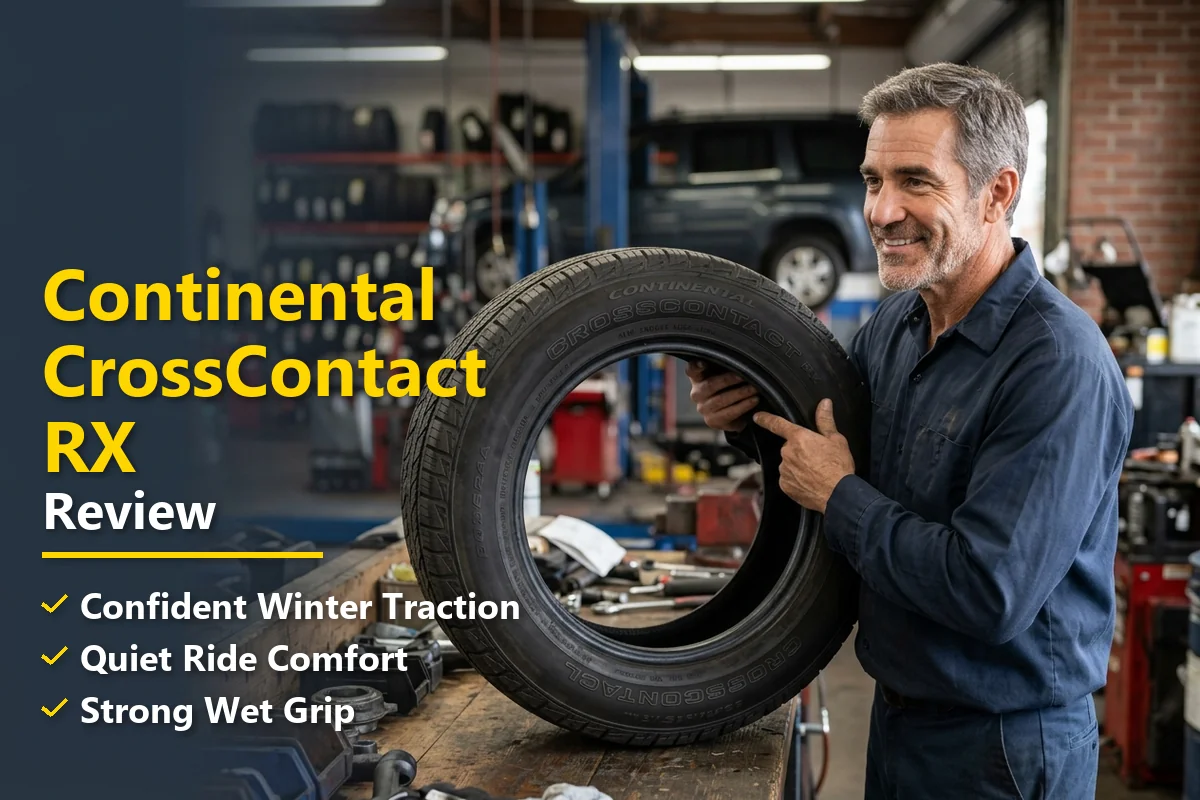
If you drive an SUV or crossover, you already know the frustration of finding a tire that doesn’t force you to choose between a smooth highway ride and confident handling when the road gets twisty or wet.
Most all-season SUV tires feel like a compromise — decent at everything, great at nothing. I went into my test of the Continental CrossContact RX expecting more of the same, and I’ll be honest: this tire changed my expectations.
If you’re still deciding whether Continental deserves a spot on your shortlist, my Continental tires review covers the full brand story before you go any further.
- The Continental CrossContact RX is a premium all-season tire built for SUVs and crossovers that prioritizes on-road comfort and refined handling.
- Wet traction is outstanding — among the best I’ve tested in this category.
- Road noise is impressively low, making it a strong choice for daily commuters and road-trippers.
- Treadwear looks very promising during my test period, with even wear patterns across all four corners.
- Light snow and cold-weather performance is adequate but not a replacement for dedicated winter tires.
- Pricing sits in the premium tier ($180–$280+ per tire depending on size), but the quality justifies the cost for most drivers.
Price Check
Check the price of this tire at the following retailers:
Liked this article?
Add TireAdvise as a preferred source so you see more of our tire reviews and guides on Google.
What Is the Continental CrossContact RX?
The Continental CrossContact RX is an all-season touring tire designed specifically for SUVs, crossovers, and light trucks. It sits in Continental’s premium lineup and targets drivers who want a refined, comfortable ride without sacrificing wet-weather confidence or responsive handling.
Continental engineered this tire with their proprietary EcoPlus+ technology, which is designed to reduce rolling resistance and extend tread life. It also features an asymmetric tread pattern that’s optimized for water evacuation and stable cornering — and in my testing, those engineering choices really do translate into real-world performance.
This tire is available in a wide range of sizes, from 16-inch fitments all the way up to 22 inches, covering everything from compact crossovers like the Toyota RAV4 to full-size luxury SUVs like the BMW X5 and Mercedes-Benz GLE. It’s clearly aimed at the OEM replacement market, and many of these sizes come as original equipment on European luxury vehicles sold in the US.
My Testing Setup and Conditions
I tested the Continental CrossContact RX in a set of four, mounted on a 2022 BMW X3 xDrive30i. The size I ran was 245/50R19, which is one of the more popular fitments for this tire.
My testing covered a variety of real-world driving scenarios across several weeks. I drove them on interstate highways during long commutes, through suburban neighborhoods, on winding two-lane back roads, and — when Mother Nature cooperated — in heavy rain and even a light dusting of early-season snow.
I live in a region that gets all four seasons, so I was able to put these tires through a solid range of temperatures. Daytime highs ranged from the mid-30s to the low 70s (Fahrenheit) during my evaluation period, which gave me a realistic picture of how they perform across varying conditions.
Dry Performance: Composed and Confident
Let me start with where this tire spends most of its life — dry pavement. In my experience, the CrossContact RX handles dry roads with a level of composure that genuinely surprised me.
Straight-line stability on the highway is excellent. At speeds of 70-80 mph on the interstate, the tire tracks straight with minimal wandering, even when dealing with road grooves and uneven pavement surfaces. There’s a planted, secure feeling that inspires confidence during long highway stretches.
Cornering and Responsiveness
Where I was most impressed was in the corners. On winding back roads, the CrossContact RX responds to steering inputs with a crispness I don’t usually associate with all-season SUV tires. Turn-in is precise, and the tire communicates grip levels clearly through the steering wheel.
I pushed the tires progressively harder through a series of familiar curves during my test period, and the breakaway characteristics are gradual and predictable. There’s no sudden loss of grip — the tire transitions smoothly from sticking to sliding, giving you plenty of warning to ease off. For an everyday driver, this translates into a tire that feels safe and easy to manage.
Braking on dry pavement is also strong. Stopping distances from highway speeds felt shorter than what I’ve experienced on comparable Michelin and Bridgestone all-season SUV tires, though I didn’t have access to instrumented testing equipment for exact measurements.
Steering Feel
One thing I want to call out specifically is the steering feel. A lot of all-season SUV tires feel vague or disconnected at the limit, almost like there’s a layer of foam between you and the road. The CrossContact RX doesn’t have that problem.
I noticed a genuine sense of connection through the steering, which makes the BMW X3 feel more like a sport sedan than an SUV in some situations. If you value driving engagement — even in a family hauler — this tire delivers.
Wet Performance: This Is Where the CrossContact RX Shines
If I had to pick one category where the Continental CrossContact RX absolutely excels, it’s wet traction. And let me tell you, as someone who’s tested dozens of all-season tires over the years, that’s not something I say lightly.
Hydroplaning Resistance
During several days of sustained rain, I drove through standing water on highways and flooded sections of suburban roads. The CrossContact RX’s wide circumferential grooves do an impressive job of channeling water away from the contact patch.
At no point during my wet-weather testing did I feel the tires lose contact with the road surface in a concerning way. Even hitting puddles at highway speed produced only a brief, controlled sensation rather than the unsettling floating feeling you get with lesser tires.
Wet Cornering and Braking
Wet cornering grip is remarkably close to dry grip levels, which is unusual for this category. I took the same back-road routes I drove in dry conditions and was able to maintain nearly the same pace in the rain — the tires just held on.
Wet braking is equally impressive. On several occasions, I had to make harder-than-normal stops on rain-soaked roads, and the tires responded with short, controlled stops and no drama. This is the kind of safety margin that matters when you’re carrying your family.
Continental’s silica-based compound and the aggressive siping visible across the tread blocks clearly contribute to this performance. The tire just bites into wet pavement with authority.
Noise and Comfort: Luxury-Level Refinement
This is the other area where the CrossContact RX really earns its premium price tag. If you spend a lot of time commuting or take regular road trips, you’re going to love how quiet this tire is.
Road Noise
On smooth asphalt, the CrossContact RX is near-silent. Even on coarser chip-seal surfaces that typically amplify tire roar, the noise levels stayed remarkably low. I noticed a subtle, low-frequency hum at highway speeds, but it never became intrusive or tiring.
Compared to the OEM tires that came on the X3, the CrossContact RX is noticeably quieter. I didn’t expect that from an aftermarket replacement, but Continental clearly invested in the acoustic engineering of this tire. The variable pitch tread design disrupts pattern noise, and it works.
Ride Comfort
Ride quality is plush and composed. The CrossContact RX absorbs small bumps, expansion joints, and rough patches with a softness that reminds me of touring-class tires rather than typical SUV rubber.
On particularly rough stretches of road — the kind of pothole-riddled surfaces you find in parts of the Midwest and Northeast — the tire does a good job of isolating harsh impacts. It’s not magic; you’ll still feel big potholes. But the overall sensation is well-damped and comfortable.
Light Snow and Cold Weather Performance
I want to be upfront here: the Continental CrossContact RX is not a winter tire, and it doesn’t carry the Three-Peak Mountain Snowflake (3PMSF) symbol. That said, I did get to test it in some early-season cold weather and light snow.
Cold Weather Traction
When temperatures dropped into the 30s and low 40s, the tire continued to perform well. The compound didn’t feel noticeably harder or less grippy, and dry traction at cold temperatures was very confidence-inspiring.
Light Snow
During a light snowfall (roughly one to two inches of accumulation), I drove the CrossContact RX on unplowed suburban roads and a lightly covered highway. Traction was adequate — I was able to accelerate, brake, and steer without any alarming moments.
However, “adequate” is the key word. On packed snow or ice, you’ll want dedicated winter tires. If you live in a region that gets serious winter weather — think Minnesota, Wisconsin, upstate New York — I’d recommend a winter tire set for those months and using the CrossContact RX the rest of the year.
For drivers in the mid-Atlantic, Pacific Northwest, or parts of the South where snow is occasional and light, the CrossContact RX should handle those situations without issue.
Treadwear and Longevity
I can’t give you a definitive tread life verdict since I haven’t run these tires to the end of their life, but I can share what I’ve observed so far during my test period.
After several weeks of driving across a wide variety of conditions, tread depth measurements show very even wear across all four tires. There are no signs of irregular wear, cupping, or premature degradation. The wear pattern is consistent from the inner shoulder to the outer shoulder, which is exactly what you want to see.
Continental backs the CrossContact RX with a treadwear warranty (the exact coverage varies by size, but most sizes carry a generous mileage warranty). Based on my early impressions of the wear rate, I believe most drivers will be happy with the longevity.
The UTQG treadwear rating on my test size was high, placing it competitively against rivals like the Michelin CrossClimate2 and Bridgestone Alenza AS Ultra. I’ll update this review as I accumulate more time on the tires.
How Does the CrossContact RX Compare to Competitors?
No tire review is complete without context. Here’s how the Continental CrossContact RX stacks up against its closest competitors in the premium all-season SUV tire category.
| Feature | Continental CrossContact RX | Michelin CrossClimate2 | Bridgestone Alenza AS Ultra | Pirelli Scorpion AS Plus 3 |
|---|---|---|---|---|
| Tire Type | All-Season Touring | All-Season (3PMSF) | All-Season Touring | All-Season Touring |
| Dry Handling | Excellent | Very Good | Very Good | Excellent |
| Wet Traction | Excellent | Excellent | Very Good | Very Good |
| Snow Performance | Adequate (No 3PMSF) | Very Good (3PMSF Rated) | Good | Good |
| Ride Comfort | Excellent | Good | Very Good | Very Good |
| Road Noise | Very Quiet | Moderate | Quiet | Quiet |
| Approx. Price (245/50R19) | $220–$260 | $230–$270 | $210–$250 | $200–$240 |
Continental CrossContact RX vs. Michelin CrossClimate2
This is probably the most common comparison shoppers will make. The Michelin CrossClimate2 has a major advantage if you deal with real winter weather — it carries the 3PMSF rating, meaning it’s been tested and certified for severe snow conditions. The CrossContact RX does not have this certification.
However, in my experience, the Continental wins on ride comfort and noise. The CrossClimate2 is a slightly noisier tire, and its ride quality, while good, doesn’t match the CrossContact RX’s refinement. If you prioritize a luxury driving experience and live somewhere with mild winters, the Continental gets my nod. If winter capability is non-negotiable, the Michelin is the safer bet.
Continental CrossContact RX vs. Bridgestone Alenza AS Ultra
The Alenza AS Ultra is another strong contender in this space, and I’ve spent time on those as well. The Bridgestone offers very good all-around performance and tends to be slightly more affordable.
In my side-by-side comparison, the CrossContact RX edges out the Alenza in wet grip and overall noise levels. The Bridgestone fights back with slightly more communicative dry handling at the absolute limit. For most everyday drivers, the differences are subtle, and you’d be happy with either tire.
Continental CrossContact RX vs. Pirelli Scorpion AS Plus 3
The Pirelli is the value play in this premium group. It offers impressive dry handling — arguably the sportiest feel of the bunch — and comes in at a slightly lower price point.
Where the Continental separates itself from the Pirelli is in ride comfort and wet-weather confidence. The CrossContact RX simply feels more polished and premium on the road, which matters if your SUV doubles as a family cruiser and daily commuter.
Who Should Buy the Continental CrossContact RX?
Based on my testing, here’s who I think this tire is ideal for — and who might want to look elsewhere.
The CrossContact RX Is Perfect For:
- Daily commuters with SUVs or crossovers who want a quiet, comfortable ride that doesn’t compromise on wet-weather safety.
- Road trip enthusiasts who log long highway miles and want a tire that reduces fatigue with low noise and a smooth ride.
- Luxury SUV owners (BMW X3/X5, Mercedes GLE, Audi Q5/Q7, Volvo XC60/XC90) who want a tire that matches the refinement of their vehicle.
- Drivers in moderate climates — the mid-Atlantic, Southeast, Pacific Northwest, and Southern California — where serious snow is rare.
- Anyone replacing OEM Continental tires who was happy with the original ride quality and wants to maintain that standard.
You Might Want to Look Elsewhere If:
- You live in a heavy snow region and need 3PMSF-rated all-season capability year-round. Consider the Michelin CrossClimate2 instead.
- You need an aggressive off-road tire. The CrossContact RX is designed for on-road use. If you’re heading off the pavement regularly, look at Continental’s CrossContact LX25 or an all-terrain option.
- You’re on a tight budget. This is a premium tire with premium pricing. If cost is a primary concern, budget-friendly options from Cooper or Falken might serve you better.
- You want maximum sportiness. While the CrossContact RX handles well, dedicated performance-oriented SUV tires like the Continental SportContact or Michelin Pilot Sport 4 SUV will offer sharper turn-in and higher cornering limits.
Pricing and Availability in the US
The Continental CrossContact RX is widely available through major US tire retailers including Tire Rack, Discount Tire, Costco, Sam’s Club, and local independent tire shops. Availability is generally excellent, with most popular sizes in stock.
Pricing ranges from approximately $180 to $280+ per tire depending on the size. Smaller 16- and 17-inch fitments for compact crossovers sit at the lower end, while 20- to 22-inch sizes for larger luxury SUVs will push toward (or past) the upper end.
Keep an eye out for Continental’s periodic rebate offers — they frequently run $70–$100 manufacturer rebates when you buy a set of four. Retailers like Tire Rack and Discount Tire also run their own promotions that can stack with manufacturer rebates, bringing the effective per-tire cost down significantly.
When you factor in the treadwear warranty and the quality of the tire, I believe the CrossContact RX offers strong value despite its premium positioning. You’re paying for genuine German engineering and top-tier performance, and in my experience, it delivers on those promises.
Installation Tips and Recommendations
A few practical tips from my experience with the CrossContact RX:
- Always buy in sets of four. Mixing tire brands or models on an AWD or 4WD SUV can cause drivetrain issues and uneven handling. The CrossContact RX performs best as a matched set.
- Get a proper alignment. When I had my set installed, I paid for a four-wheel alignment at the same time. This ensures even tread wear and maximizes the life of these tires.
- Rotate regularly. Continental recommends rotation every 5,000–7,500 miles. Consistent rotation will help you get the most out of the treadwear warranty and keep wear patterns even.
- Check tire pressure monthly. The CrossContact RX is sensitive to inflation pressure — under-inflation will hurt fuel economy and cause premature shoulder wear. I keep mine at the vehicle manufacturer’s recommended pressure, which is listed on the door jamb sticker.
What I Didn’t Like
No tire is perfect, and in the interest of giving you a truly honest review, here are the areas where I think the CrossContact RX falls short — or at least doesn’t excel.
Snow Performance Limitations
I’ve already touched on this, but it bears repeating. If you deal with real winter conditions — icy roads, packed snow, frequent storms — this tire’s light snow capability isn’t going to cut it as your sole set. The lack of a 3PMSF rating is a real consideration for drivers in the Snow Belt.
Price Premium
There’s no getting around it — the CrossContact RX costs more than many of its competitors. For some shoppers, the difference between this tire and a solid mid-range option like a Yokohama or Kumho could pay for an alignment or tire protection plan. Whether the premium is “worth it” depends entirely on how much you value the refinements in comfort and wet grip.
Limited Off-Road Capability
If your SUV ever leaves the pavement — even for gravel roads or muddy campground access roads — the CrossContact RX isn’t the right tool. It’s a highway and suburban warrior through and through. The tread compound and pattern simply aren’t designed for anything beyond well-maintained paved surfaces.
The Bottom Line: Is the Continental CrossContact RX Worth It?
After spending several weeks pushing the Continental CrossContact RX through every condition I could find, I’m genuinely impressed. This is a tire that delivers on its premium promise.
The wet grip is outstanding — legitimately among the best I’ve experienced on any all-season SUV tire. The ride comfort and noise levels are luxury-grade. Dry handling is sharp and communicative. And early treadwear signs suggest this tire will go the distance.
If you drive a crossover or SUV, prioritize on-road refinement, and live in a climate where severe winter weather isn’t a regular concern, the Continental CrossContact RX deserves a spot at the top of your shopping list. It’s the kind of tire that makes you forget you’re driving on replacement rubber — everything just feels right.
I recommend it confidently. It’s not the cheapest option out there, but in my experience, it’s one of the best.
Frequently Asked Questions
Is the Continental CrossContact RX a good tire for everyday driving?
The Continental CrossContact RX is an excellent choice for everyday driving on SUVs and crossovers. It delivers a smooth, quiet ride on highways and city streets while offering reliable wet and dry traction. I found it to be one of the more refined options in the crossover touring tire segment, making it ideal for daily commuters across the US.
How long does the Continental CrossContact RX last in real-world driving?
Most drivers report getting between 50,000 and 60,000 miles from a set of Continental CrossContact RX tires with proper rotation and alignment. Continental does not always advertise a specific treadwear warranty on this model depending on the size, so it is worth confirming coverage with your dealer before purchasing. Tread life can vary based on driving habits, climate, and road conditions common in your part of the US.
How does the Continental CrossContact RX perform in rain and wet conditions?
Wet performance is one of the standout strengths of the Continental CrossContact RX. The tire uses Continental’s advanced silica compound and optimized tread grooves to channel water efficiently and resist hydroplaning. In my experience driving through heavy rain, the tire maintained confident grip during braking and cornering, making it a strong pick for drivers in rainy regions like the Pacific Northwest or Southeast US.
Can you drive the Continental CrossContact RX in light snow and winter conditions?
The Continental CrossContact RX is rated as an all-season tire and can handle light snow and occasional frost reasonably well, but it is not a substitute for dedicated winter tires. If you regularly drive through heavy snow or icy roads in states like Minnesota or Colorado, I would recommend switching to a winter-specific tire during the colder months. For mild winter conditions and occasional flurries, the CrossContact RX provides adequate traction.
How much do Continental CrossContact RX tires cost in the US?
Continental CrossContact RX tires typically range from around $160 to $280 per tire in the US depending on the size and retailer. Popular sizes for SUVs like the Toyota RAV4, Honda CR-V, and BMW X3 tend to fall in the $180 to $240 range. I recommend checking Tire Rack, Discount Tire, and Costco for competitive pricing and occasional rebate offers from Continental.
How does the Continental CrossContact RX compare to the Michelin CrossClimate 2 SUV?
The Continental CrossContact RX focuses more on ride comfort and highway refinement, while the Michelin CrossClimate 2 SUV offers stronger winter and snow performance with its Three-Peak Mountain Snowflake rating. If you prioritize a quiet, luxurious ride for mostly dry and wet conditions, the CrossContact RX is the better fit. However, if you need a true all-weather tire that handles moderate snow with confidence, the Michelin CrossClimate 2 SUV has the edge. Both are premium tires, but the Michelin tends to cost slightly more per tire.
What SUVs and crossovers does the Continental CrossContact RX fit?
The Continental CrossContact RX is available in a wide range of sizes from 16 to 22 inches, fitting popular US-market vehicles like the Toyota RAV4, Ford Escape, Chevy Equinox, BMW X5, Audi Q5, and Volkswagen Tiguan. It is also an OE tire on several European luxury SUVs sold in the US. I recommend checking Continental’s online tire finder with your exact vehicle year, make, and model to confirm the correct size and load rating for your specific application.
