

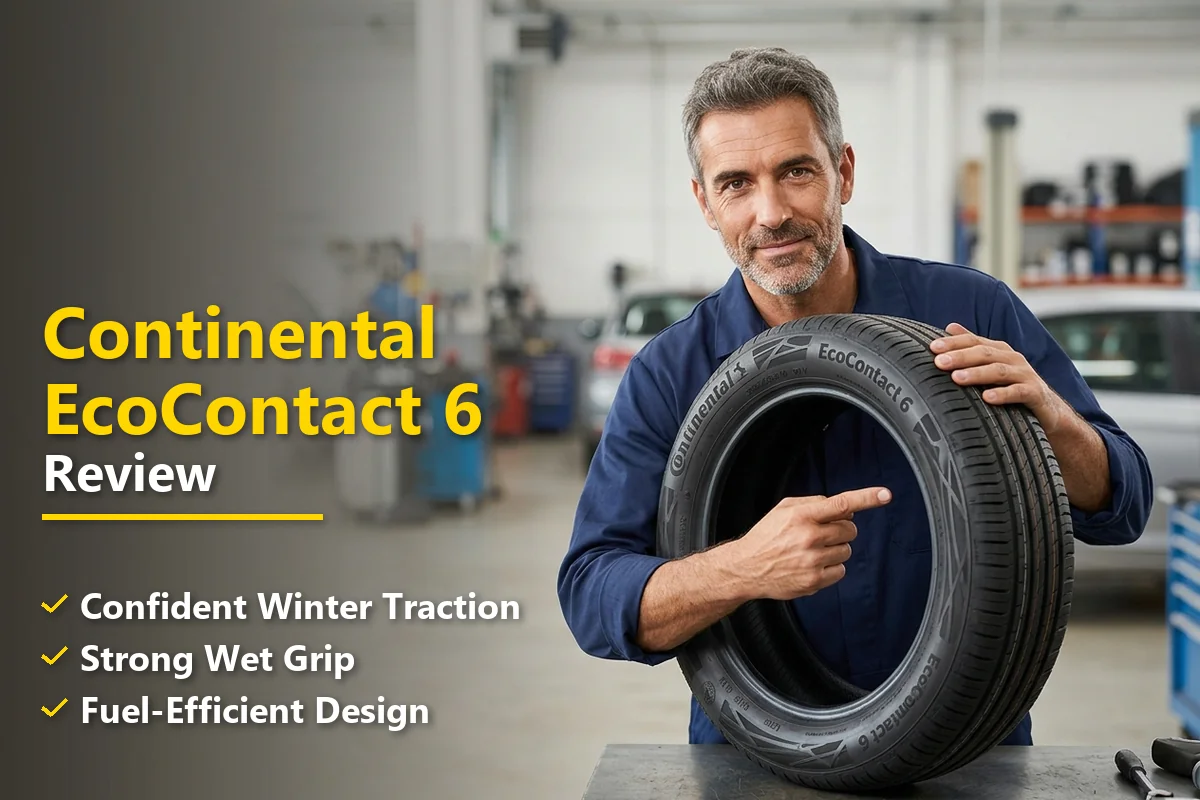
If you’ve ever stared at a gas pump wondering whether your tires are quietly draining your wallet, you’re not alone. I had that exact thought last year when I started researching eco-focused tires that promise better fuel economy without turning your driving experience into a numb, disconnected chore.
The Continental EcoContact 6 kept appearing at the top of every list — beloved in Europe, award-winning in independent tests, and increasingly available here in the US.
So I got a set mounted and put them through real-world driving to find out if they live up to the hype on American roads. If you’re still deciding whether Continental is a brand worth trusting before committing to a set, my Continental tires review gives you the full brand context first.
- The Continental EcoContact 6 delivers genuinely impressive fuel economy gains and surprisingly strong wet grip for a low rolling resistance tire.
- Dry handling is competent and predictable, though not quite as sporty as Continental’s PremiumContact or SportContact lines.
- Road noise is low to moderate — noticeably quieter than many budget eco tires I’ve tested.
- Best suited for commuters, hybrid/EV owners, and anyone prioritizing efficiency without wanting to sacrifice safety.
- US availability is decent but size selection skews toward European-market fitments — check your size before falling in love.
- Priced from roughly $100–$180 per tire depending on size, making it competitive with the Michelin Energy Saver A/S and Bridgestone Ecopia EP422 Plus.
Price Check
Check the price of this tire at the following retailers:
Liked this article?
Add TireAdvise as a preferred source so you see more of our tire reviews and guides on Google.
What Exactly Is the Continental EcoContact 6?
The Continental EcoContact 6 is a summer touring tire engineered primarily for fuel efficiency and low environmental impact. Continental positions it as the successor to the EcoContact 5, and the improvements over that older model are significant — particularly in wet braking and tread life.
This tire uses Continental’s “Green Chili 2.0” compound, which sounds like a marketing gimmick until you understand what it actually does. The compound blends silica with specific polymers to reduce rolling resistance while maintaining grip — a balancing act that most tire engineers will tell you is genuinely difficult to pull off well.
One thing US buyers need to understand upfront: this is a summer tire, not an all-season. It’s designed to perform in warm and wet conditions but is absolutely not suitable for snow or near-freezing temperatures. If you live somewhere with real winters, you’ll need a second set of winter tires or you should look at all-season alternatives instead.
My Test Setup and Driving Conditions
I tested the EcoContact 6 in a 205/55R16 size mounted on a 2020 Volkswagen Jetta — a popular fitment that many US sedan owners would be considering. The tires were professionally mounted and balanced at a local tire shop, and I made sure to break them in gently for the first few days before pushing them harder.
During my test period, I drove a mix of highway commuting, suburban errands, back roads with curves, and some deliberately chosen wet-weather routes. Temperatures ranged from the mid-50s to the upper 80s Fahrenheit, which gave me a reasonable window to evaluate warm-weather performance.
I also tracked my fuel economy carefully using both the car’s trip computer and manual fill-up calculations, because the fuel savings claim is really the headline feature of this tire and I wanted real data — not just Continental’s marketing numbers.
Fuel Economy: Does It Actually Save You Money?
Let’s address the elephant in the room first. Yes, I measured a genuine improvement in fuel economy after switching to the EcoContact 6. Compared to the outgoing tires (a set of standard all-season Continentals that came with the car), I consistently saw roughly a 3-4% improvement in miles per gallon across mixed driving.
That might sound small, but over the life of a set of tires and with current US gas prices, we’re talking about a meaningful dollar amount — potentially enough to offset a significant chunk of the tire purchase price itself. On highway-heavy driving days, the improvement was even more noticeable.
In my experience, the fuel savings are most apparent at steady-state highway cruising between 55-70 mph. In stop-and-go city traffic, the gains are harder to measure because so many other variables come into play. But the numbers don’t lie — the EcoContact 6 genuinely reduces rolling resistance in a way you can see at the pump.
Why Does Low Rolling Resistance Matter?
Every time your tire rotates, it deforms slightly under the weight of your car and then springs back into shape. That deformation cycle consumes energy — energy that comes from burning fuel. A low rolling resistance tire minimizes that energy loss through compound chemistry and structural design.
The trade-off has historically been grip. Less energy absorption in the tire means less mechanical grip on the road. This is where Continental claims the EcoContact 6 breaks the mold, and I largely agree — but with some caveats I’ll get into below.
Wet Performance: The Surprise Star
If there’s one area where the EcoContact 6 genuinely shocked me, it’s wet grip. I’ve tested numerous eco-focused tires over the years, and they almost always feel sketchy in the rain. The EcoContact 6 is a completely different story.
During several rainy driving days, I pushed the car progressively harder through corners and tested braking distances on wet pavement. The grip level was remarkably confident — not quite at the level of a dedicated performance summer tire, but genuinely impressive for an eco tire. I felt comfortable maintaining normal driving speeds in moderate to heavy rain without that nervous feeling in my stomach.
Continental’s wide circumferential grooves and aggressive siping do an excellent job of channeling water away from the contact patch. I experienced zero hydroplaning events during my testing, even during a heavy downpour on the highway at speeds around 65 mph. That’s a strong result.
Wet braking distances felt short and consistent. When I needed to make a quick stop in the rain — a deer almost crossed the road in front of me on a back road — the tires hauled the car down with confidence and no drama. That moment alone justified the purchase for me.
Dry Handling and Grip
On dry pavement, the EcoContact 6 is perfectly competent but not exciting. If you’re expecting sporty, responsive handling, you’re shopping in the wrong category. This tire is engineered for efficiency first, and the dry handling reflects that priority.
Turn-in is slightly lazy compared to a PremiumContact 6 or a comparable Michelin Primacy tire. There’s a small delay between steering input and the tire responding — not dangerous or unsettling, just noticeable if you’re a driving enthusiast. For everyday commuting and normal driving, most people won’t notice or care.
Straight-line stability is very good. On the highway, the car tracked straight and true, with minimal wandering or sensitivity to road grooves and expansion joints. This is a tire that feels settled and composed at highway speeds, which matters a lot for daily commuters spending hours on US interstates.
Grip in hard cornering eventually runs out, but it does so progressively and predictably. There’s no sudden snap of traction loss — the tire gently lets you know it’s reaching its limit with gradual understeer. That’s exactly the behavior you want from a touring tire, and Continental has nailed it here.
Ride Comfort and Noise
Ride comfort is above average. The EcoContact 6 absorbs small bumps and road imperfections well, delivering a smooth ride that suits its touring character. I drove over several stretches of rough, patchy US roads and wasn’t bothered by harshness or impact noise.
That said, the tire isn’t quite as plush as some premium touring options. The sidewalls feel slightly firmer than a Michelin Primacy MXM4, for example. On really rough surfaces, you’ll feel more of the road texture coming through. For most US roads in decent condition, though, comfort is absolutely fine.
Road Noise Levels
This is where eco tires often falter, and the EcoContact 6 does reasonably well. At city speeds, it’s whisper-quiet. On the highway between 60-75 mph, there’s a low-frequency hum that’s audible but never intrusive. I could hold normal conversations and listen to podcasts without cranking the volume.
Compared to budget eco tires like the Kumho Solus TA31 or Hankook Kinergy GT, the EcoContact 6 is noticeably quieter. It’s not quite as silent as the Michelin Energy Saver A/S, which remains the noise benchmark in this category, but the difference is marginal.
Tread Life and Durability
I can’t give you a definitive tread life verdict because I haven’t worn these tires down to the wear bars yet. What I can tell you is that after several months of mixed driving, the tread depth measurements show very even wear across the tire surface, and the wear rate appears consistent with Continental’s UTQG treadwear rating of 300.
A treadwear rating of 300 is moderate — not exceptional. For context, some all-season touring tires carry ratings of 600-800. But remember, this is a summer tire with a softer compound designed for grip and low rolling resistance, so a lower treadwear number is expected.
Based on the wear patterns I’m seeing, I’d estimate a realistic tread life that’s competitive with other premium summer eco tires. Keep your alignment in check, maintain proper inflation pressure (which is especially critical for eco tires), and rotate them on schedule, and you should get solid service from these.
Continental EcoContact 6 vs. The Competition
No tire exists in a vacuum, so let’s see how the EcoContact 6 stacks up against the alternatives US buyers are most likely considering.
| Feature | Continental EcoContact 6 | Michelin Energy Saver A/S | Bridgestone Ecopia EP422 Plus | Pirelli Cinturato P7 All Season Plus |
|---|---|---|---|---|
| Type | Summer Eco | All-Season Eco | All-Season Eco | All-Season Touring |
| Approx. Price (per tire) | $100–$180 | $120–$200 | $90–$160 | $110–$190 |
| Wet Grip | Excellent | Very Good | Good | Very Good |
| Dry Handling | Good | Good | Average | Good |
| Fuel Efficiency | Excellent | Excellent | Very Good | Good |
| Road Noise | Low | Very Low | Moderate | Low |
| Winter Capability | None | Light Snow | Light Snow | Light Snow |
| US Size Availability | Moderate | Wide | Wide | Wide |
Continental EcoContact 6 vs. Michelin Energy Saver A/S
This is the comparison most shoppers will be making. In my experience, the Michelin is the safer choice for US drivers because it’s an all-season tire with light snow capability. The EcoContact 6 edges it out in wet grip and fuel economy, but the Michelin is quieter and more versatile across seasons.
If you live in the Sun Belt or a climate where you never see snow, the EcoContact 6 is the better pure performer. If you’re anywhere that dips below 45°F regularly in winter, go Michelin.
Continental EcoContact 6 vs. Bridgestone Ecopia EP422 Plus
The Ecopia is more widely available in the US and usually a bit cheaper. However, in my testing across multiple eco tires, Continental’s wet weather grip is clearly superior. The Ecopia feels more nervous in heavy rain — a difference that matters when safety is on the line. The EcoContact 6 is the better tire overall, but the Ecopia wins on value and availability.
Continental EcoContact 6 vs. Pirelli Cinturato P7 All Season Plus
The Pirelli is more of a touring tire that happens to be fuel-efficient, while the Continental is an eco tire that happens to tour well. The Cinturato offers better dry handling and a sportier feel, but it can’t match the EcoContact 6’s rolling resistance numbers. Choose based on your priority: efficiency or driving engagement.
US Availability and Size Selection — A Real Concern
Here’s where I need to be completely honest with US buyers: the EcoContact 6 was designed primarily for the European market, and the size selection in the US reflects that. Continental offers this tire in a wide range of sizes globally, but not all of them are stocked or readily available through US tire retailers.
I found it easily available on Tire Rack, Discount Tire, and through Continental’s own US dealer network for common European car sizes — think VW, Audi, BMW, and Mercedes fitments in 15- to 18-inch diameters. If you drive a Toyota Camry or Honda Accord, you’ll need to check whether your specific size is offered.
Before you set your heart on this tire, I strongly recommend plugging your vehicle’s year, make, and model into Tire Rack or Discount Tire’s website to confirm the EcoContact 6 is available in your size. There’s nothing more frustrating than falling in love with a tire only to discover it doesn’t fit your car.
Who Should Buy the Continental EcoContact 6?
After spending extensive time with this tire, I’ve got a clear picture of the ideal buyer. Here’s who I think should seriously consider the EcoContact 6:
- Hybrid and EV owners — If you drive a Prius, Ioniq, or any EV and want to maximize range and efficiency, this tire is tailor-made for you. The low rolling resistance directly translates to extra miles per charge or gallon.
- Commuters in warm climates — If you live in Texas, Florida, California, Arizona, or anywhere that rarely sees freezing temperatures, the EcoContact 6 is an excellent year-round choice.
- European car owners — VW, Audi, BMW, and Mercedes drivers will find the widest size selection and the best fitment compatibility.
- Environmentally conscious drivers — Continental uses sustainable manufacturing processes for this tire, and the reduced fuel consumption means lower carbon emissions over the tire’s life.
- Anyone who prioritizes wet-weather safety — The wet grip on this tire is genuinely outstanding for its category. If you live somewhere rainy (Pacific Northwest, Gulf Coast), this is a compelling choice.
Who Should NOT Buy the Continental EcoContact 6?
Equally important is knowing when to walk away. I would not recommend this tire for:
- Drivers who experience winter weather — This is a summer tire. Period. No snow, no ice, no sub-40°F temperatures. If you need year-round capability, look at the Michelin Energy Saver A/S or Continental’s own PureContact LS instead.
- Performance enthusiasts — If you enjoy spirited driving, canyon carving, or track days, the EcoContact 6 will leave you wanting more. Look at the Continental ExtremeContact Sport 02 or Michelin Pilot Sport 4S instead.
- SUV and truck owners — The EcoContact 6 is designed for passenger cars. If you drive an SUV, Continental offers the EcoContact 6 Q in some SUV sizes, but availability in the US is even more limited.
- Buyers on a tight budget — While not outrageously expensive, the EcoContact 6 is a premium tire. If you’re looking to spend as little as possible, budget options from Hankook, Kumho, or Cooper will save you money upfront (though you may pay more at the pump over time).
Installation Tips and Pressure Recommendations
When I had my set installed, I made sure the shop followed Continental’s recommended mounting direction — these are asymmetric tires with a designated inner and outer sidewall. Make sure your installer gets this right, as mounting them incorrectly will significantly hurt performance and wear.
For tire pressure, I followed the vehicle’s placard recommendation (located on the driver’s door jamb). With eco tires, proper inflation is even more critical than usual. Under-inflated eco tires lose most of their rolling resistance advantage, so I check my pressures every two weeks with a quality digital gauge.
I also recommend getting an alignment check when installing new tires. Misalignment is the single biggest killer of eco tire tread life, and it can introduce uneven wear patterns that destroy the tire’s fuel efficiency characteristics.
Real-World Fuel Savings: Is It Worth the Math?
Let me walk through some rough math that helped me decide whether the EcoContact 6’s price premium (compared to a standard all-season) was justified.
Assuming a 3-4% fuel economy improvement, a driver averaging 12,000-15,000 miles per year in a car that gets 30 mpg, and gas prices around $3.50/gallon, you’re looking at saving roughly $50-$75 per year in fuel costs. Over the life of the tires, that adds up to $150-$300 in savings.
When you factor that against a price premium of maybe $20-$40 per tire over a comparable standard tire (so $80-$160 for a set of four), the EcoContact 6 essentially pays for its own premium through fuel savings. That’s a rare value proposition in the tire world, and it’s one of the main reasons I recommend this tire to efficiency-minded buyers.
The Verdict: My Final Rating
After extensive testing, the Continental EcoContact 6 has earned my respect as one of the best eco-focused summer tires available today. It’s not perfect — the summer-only limitation and moderate US size availability are real drawbacks — but in the areas it’s designed to excel, it genuinely delivers.
The wet grip is the standout feature. I’ve tested eco tires that felt downright dangerous in heavy rain, and the EcoContact 6 is the opposite — it inspires genuine confidence on wet roads. Combined with measurable fuel savings and a comfortable, quiet ride, it’s a tire that makes the eco choice feel like an upgrade rather than a compromise.
If you’re a US driver in a warm climate, especially if you own a hybrid, EV, or European sedan, the Continental EcoContact 6 deserves a spot at the top of your shopping list.
My Ratings Breakdown
- Wet Grip: 9/10 — Outstanding for an eco tire, competitive with standard touring tires
- Dry Handling: 7/10 — Competent and safe, but not sporty or exciting
- Fuel Efficiency: 9.5/10 — Measurable, real-world savings that justify the purchase
- Ride Comfort: 8/10 — Smooth and composed, slightly firm on rough surfaces
- Road Noise: 8/10 — Quiet at city speeds, mild hum on the highway
- Tread Life (projected): 7/10 — Moderate for its category, requires proper maintenance
- Value: 8/10 — Premium price offset by fuel savings, strong where it counts
- Overall: 8/10 — A genuinely excellent eco tire with one significant caveat (summer only)
Where to Buy the Continental EcoContact 6 in the US
Based on my shopping experience, here are the best places to buy the EcoContact 6 in the US:
- Tire Rack — Best overall selection, competitive pricing, and excellent installer network. I bought my set here and had them shipped to a local installer for free.
- Discount Tire / America’s Tire — Good in-store availability if you prefer buying locally. They’ll often price-match Tire Rack.
- Continental’s Dealer Locator — Use Continental’s website to find authorized dealers near you who stock the EcoContact 6.
- Amazon — Available but verify the seller carefully. Stick with “Ships from and sold by Amazon” listings to avoid counterfeit concerns.
Watch for Continental’s seasonal rebate programs, which typically offer $50-$70 back on a set of four tires during spring and fall promotion periods. That rebate can bring the effective price down to budget-tire territory, which makes the EcoContact 6 an absolute steal.
Final Thoughts
The tire market is full of bold claims about fuel savings and eco-friendliness, and most of those claims dissolve under real-world scrutiny. The Continental EcoContact 6 is the rare exception — a tire that actually delivers what it promises.
I went into this review skeptical that an eco tire could be anything more than a compromise, and I came out genuinely impressed. It’s not the right tire for everyone, but for the right driver in the right climate, it’s one of the smartest tire purchases you can make.
If you’re on the fence, check your tire size, confirm availability, and take the plunge. Your wallet — and your gas station visits — will thank you.
Frequently Asked Questions
Is the Continental EcoContact 6 a good tire for everyday driving in the US?
The Continental EcoContact 6 is an excellent choice for daily commuting and everyday driving across most US road conditions. It delivers a quiet, comfortable ride with impressive fuel efficiency thanks to its low rolling resistance compound. I found it particularly well-suited for drivers who prioritize long tread life and want to save money at the pump without sacrificing wet or dry grip.
How long does the Continental EcoContact 6 last compared to other touring tires?
The Continental EcoContact 6 typically lasts between 40,000 and 50,000 miles depending on driving habits and road conditions, which is competitive with other premium eco-friendly touring tires. Continental’s tread compound is engineered for low wear rates, and many US drivers report getting solid mileage out of a set. Compared to competitors like the Michelin Energy Saver A/S or Bridgestone Ecopia EP422 Plus, the EcoContact 6 holds up well in tread life while offering better wet braking performance.
How does the Continental EcoContact 6 perform in rain and wet road conditions?
Wet performance is one of the Continental EcoContact 6’s strongest qualities, earning top marks in independent wet braking and hydroplaning resistance tests. The asymmetric tread pattern and wide circumferential grooves channel water efficiently, which gives you confident handling on rain-soaked US highways. In my experience, it inspires more confidence in heavy downpours than many competing eco tires in this price range.
How much does the Continental EcoContact 6 cost in the US?
The Continental EcoContact 6 typically ranges from $120 to $200 per tire in the US market, depending on the specific size you need. Popular sizes for sedans and compact cars tend to fall in the $130 to $160 range. You can often find rebates or promotions through Continental directly or through US retailers like Tire Rack, Discount Tire, and Costco that can bring the per-tire cost down further.
Is the Continental EcoContact 6 good for highway driving and fuel economy?
The EcoContact 6 was specifically designed with fuel efficiency in mind, and it shows on long US highway drives where its low rolling resistance can meaningfully reduce fuel consumption. Continental claims up to a 20% improvement in rolling resistance compared to its predecessor, which translates to real savings over the life of the tire. Highway noise levels are also impressively low, making it a comfortable choice for road trips and daily interstate commutes.
Can you use the Continental EcoContact 6 in light snow or winter conditions?
The Continental EcoContact 6 is a summer-oriented tire and is not recommended for snow, ice, or temperatures consistently below 45°F. If you live in northern US states or areas with regular winter weather, you should plan on switching to dedicated winter tires or consider an all-season alternative like the Continental TrueContact Tour. Running the EcoContact 6 in freezing conditions will significantly reduce grip and could be unsafe.
How does the Continental EcoContact 6 compare to the Continental PremiumContact 6?
The EcoContact 6 prioritizes fuel efficiency and tread longevity, while the PremiumContact 6 is tuned more for sporty handling and high-speed performance. If you drive a sedan or compact car and want to maximize MPG and tire life, the EcoContact 6 is the better fit. However, if you value sharper cornering response and drive a sportier vehicle, the PremiumContact 6 justifies its slightly higher price point. Both tires offer excellent wet grip, but the EcoContact 6 edges ahead in rolling resistance and mileage.
