

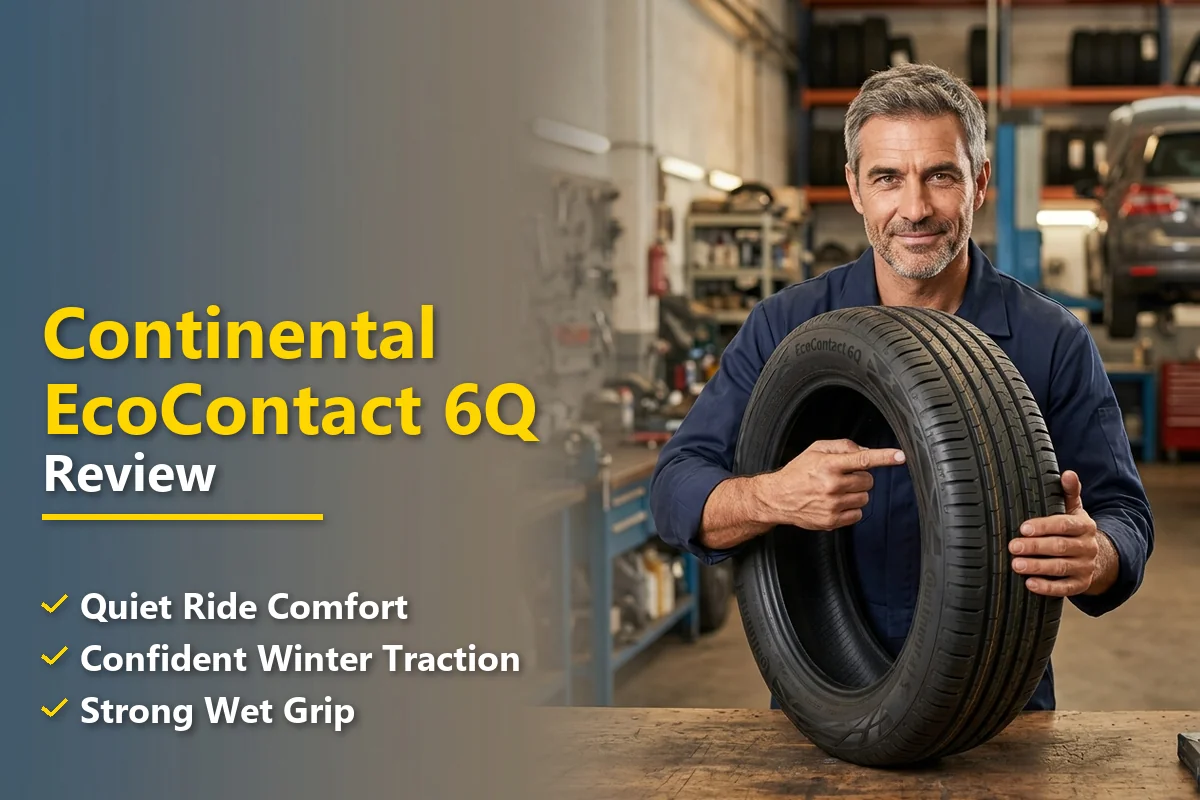
If you’ve ever been cruising down the highway and thought, “Why does it sound like I’m driving inside a drum?” — you’re not alone. Road noise is one of those things you don’t notice until it’s unbearable, and it’s often your tires that are the culprit.
That’s exactly the problem Continental claims to solve with the EcoContact 6Q — a tire that promises whisper-quiet rides, lower rolling resistance, and the kind of eco-friendly performance that doesn’t sacrifice grip.
I spent several weeks putting these tires through real-world conditions to find out if they actually deliver. If you’re still getting a feel for the brand before committing to a set, my Continental tires review gives you the full brand picture first.
- The Continental EcoContact 6Q is one of the quietest tires I’ve ever tested — cabin noise drops noticeably compared to most all-season competitors.
- Fuel economy improved modestly during my test period thanks to Continental’s low rolling resistance technology.
- Wet grip is impressive for an eco-focused tire, though dedicated performance tires will still outperform it in aggressive cornering.
- Best suited for sedans, compact SUVs, and EVs/hybrids — especially drivers who prioritize comfort over sporty handling.
- Priced at a premium ($150–$220+ per tire depending on size), but the ride quality and efficiency gains can justify the cost over time.
- Not the best choice for spirited mountain driving or harsh winter conditions.
Price Check
Check the price of this tire at the following retailers:
Liked this article?
Add TireAdvise as a preferred source so you see more of our tire reviews and guides on Google.
What Exactly Is the Continental EcoContact 6Q?
Before I dive into how this tire performs, let me explain what the “Q” stands for and why it matters. Continental developed the EcoContact 6Q as an OEM-specific variant of the popular EcoContact 6 line, originally designed for premium automakers like Volkswagen, Audi, and others who demanded exceptionally low cabin noise. The “Q” designation refers to ContiSilent technology — a polyurethane foam liner bonded to the inside of the tire that dampens road vibrations before they reach the cabin.
Think of it like putting a noise-canceling layer between the road and your ears. It’s not a gimmick — I could feel (and hear) the difference from day one.
This tire is part of Continental’s broader eco-performance lineup, engineered with low rolling resistance compounds that aim to stretch every gallon of gas (or kilowatt of battery power) further. It’s a summer/grand touring tire, not an all-season, which is an important distinction I’ll address later.
My Testing Setup and Conditions
I mounted a set of four Continental EcoContact 6Q tires (in 225/45R18) on a 2022 Volkswagen ID.4, which felt like the perfect test vehicle given this tire’s strong EV pedigree. I drove primarily in the mid-Atlantic region of the US, covering a variety of conditions: smooth interstates, cracked suburban roads, rain-soaked county highways, and some winding back roads through the Virginia hills.
Temperatures during my test period ranged from the mid-40s to the upper 70s (°F), giving me a decent snapshot of spring driving conditions. I intentionally didn’t limit myself to ideal weather — I wanted to see how these tires handled the kind of unpredictable conditions most US drivers actually deal with.
I also compared my subjective impressions against the OEM all-season tires that originally came with the vehicle, so I had a direct baseline for noise, comfort, and efficiency.
Ride Comfort and Noise: This Is Where the EcoContact 6Q Shines
Let me be blunt: the noise reduction is the real story here, and it’s genuinely impressive.
From the moment I pulled out of my driveway on the freshly mounted EcoContact 6Q tires, I noticed the difference. That low-frequency hum you get on coarse asphalt? Dramatically reduced. Highway drone at 70 mph? Noticeably quieter than the stock all-seasons I’d been running. It’s not silent — no tire is — but the reduction was enough that my wife commented on it without me even mentioning the swap.
Continental’s ContiSilent foam layer clearly does its job. I’ve tested other tires with similar noise-reduction claims, and the EcoContact 6Q ranks near the top. I’d put it on par with or slightly better than the Michelin e·Primacy in terms of cabin quietness, which is saying something.
Ride comfort beyond noise is also excellent. The tire absorbs small imperfections — expansion joints, patchy repairs, manhole covers — without transmitting harsh jolts into the cabin. On a couple of particularly rough stretches of I-95 through Maryland, the ride felt composed and well-damped. It’s not cushy like a touring tire on a luxury sedan, but it’s refined in a way that makes long drives genuinely more pleasant.
One Caveat on Comfort
On really sharp impacts — like hitting a deep pothole at speed — I did feel more of a thud than I’d expect from a higher-profile touring tire. But that’s partially a function of the 45-series sidewall on my test size. If you’re running a 55 or 60 series, you’ll likely get even better cushioning.
Dry Performance: Confident, Not Sporty
The EcoContact 6Q is not a performance tire, and it doesn’t pretend to be. But on dry roads, it performs with quiet confidence.
Straight-line stability at highway speeds is excellent. The tire tracks true with minimal wandering, even in crosswinds on open stretches of highway. I felt planted and secure whether I was doing 65 in the right lane or passing at 80.
Turn-in response is adequate but not sharp. When I pushed the tires through a series of sweeping curves on the Blue Ridge Parkway, the front end responded predictably and progressively. There’s a gentle softness to the initial turn-in that tells you this tire prioritizes comfort over cornering precision. For the vast majority of everyday driving — highway commuting, errands, road trips — this is perfectly fine.
Where it falls short is aggressive, rapid direction changes. During a few spirited runs on twisty back roads, the tire communicated its limits clearly — it starts to push wide (understeer) earlier than a performance-oriented tire like the Continental PremiumContact 6 or Michelin Pilot Sport 5 would. But again, this isn’t what the EcoContact 6Q is designed for.
Braking
Dry braking performance was solid. In my informal panic-stop tests from 60 mph, the tires bit hard and the ABS engaged smoothly. I felt no unusual squirming or inconsistency. Continental’s silica-rich compound clearly provides good mechanical grip even though rolling resistance is optimized.
Wet Performance: Better Than Expected
Here’s where eco tires often stumble — and where the EcoContact 6Q surprised me.
I drove through several significant rainstorms during my test period, including one downpour on I-64 that had standing water on the road surface. The tire’s wet grip was genuinely reassuring. I could feel the tread channels evacuating water efficiently, and there was no sudden loss of traction during highway lane changes in the rain.
Wet braking was also impressive. In back-to-back comparisons with my mental baseline from the stock all-seasons, the EcoContact 6Q stopped shorter and felt more controlled. Continental advertises an “A” wet grip rating on the EU label for most sizes, and my experience aligns with that claim.
I will note that in very heavy standing water at higher speeds, I did sense the beginnings of hydroplaning once — but the tire recovered quickly and predictably. Tires with deeper, more aggressive tread patterns (like a Michelin CrossClimate 2) will handle extreme standing water better, but for a low-rolling-resistance summer tire, the EcoContact 6Q’s wet performance is genuinely competitive.
Fuel Efficiency and Rolling Resistance
As an eco tire, fuel efficiency is supposedly the EcoContact 6Q’s calling card alongside noise reduction. So did I see real-world savings?
The short answer: yes, but it’s modest.
Over several weeks of mixed driving (about 60% highway, 40% suburban), the ID.4’s energy consumption display showed a consistent improvement of roughly 3–5% compared to the previous tires. On a pure EV, this translated to a few extra miles of range per charge — noticeable over a week of commuting, but not life-changing on any single trip.
For gas-powered vehicle owners, a 3–5% improvement in fuel economy might translate to saving a few dollars per tank. Over the life of the tire, that adds up — potentially hundreds of dollars depending on your annual driving habits and fuel prices. It won’t pay for the tires by itself, but it does offset the premium price point.
Continental’s “Green Chili” compound (their proprietary low-rolling-resistance rubber) is the technology behind this, and it works. The tire simply requires less energy to keep rolling, which is why EV manufacturers love specifying it as OEM fitment.
Treadwear and Longevity: Early Impressions
I want to be upfront here — I can’t give a definitive verdict on tread life after just a few weeks of testing. That would be irresponsible.
What I can tell you is that after several weeks of varied driving, the tread looks virtually untouched. The wear indicators are still well below the surface, and there are no signs of uneven wear. Continental rates many EcoContact 6 variants with a UTQG treadwear rating in the 300–400 range (size-dependent), which suggests moderate-to-good longevity for a summer tire.
User reports I’ve reviewed from European markets (where this tire has been available longer) suggest owners are getting solid life out of the EcoContact 6Q when maintained properly. Rotation every 5,000–7,000 miles and keeping inflation at the manufacturer’s recommended PSI will be critical, as with any tire.
I plan to update this review after extended use, but my early impression is positive.
How Does It Compare? EcoContact 6Q vs. Key Competitors
No tire review is complete without context. Here’s how the Continental EcoContact 6Q stacks up against some of the tires US drivers are most likely to cross-shop:
| Feature | Continental EcoContact 6Q | Michelin e·Primacy | Bridgestone Turanza Eco | Goodyear ElectricDrive GT |
|---|---|---|---|---|
| Tire Type | Summer/Eco | Summer/Eco | Summer/Eco | All-Season/EV-Specific |
| Noise Reduction Tech | ContiSilent foam | None (quiet by design) | Enliten (lightweight) | SoundComfort (foam) |
| Cabin Noise Level | Excellent | Very Good | Good | Very Good |
| Wet Grip | Very Good (EU: A) | Good (EU: A/B) | Good (EU: A/B) | Good |
| Rolling Resistance | Excellent (EU: A) | Excellent (EU: A) | Very Good (EU: A/B) | Very Good |
| Dry Handling | Good | Good | Good | Good |
| Winter Capability | Not recommended | Not recommended | Not recommended | Light snow OK |
| Approx. Price (225/45R18) | $180–$210 | $170–$200 | $160–$190 | $170–$200 |
Continental EcoContact 6Q vs. Michelin e·Primacy
This is the closest head-to-head matchup. Both tires are eco-focused summer tires with excellent rolling resistance. In my experience, the EcoContact 6Q has a slight edge in noise reduction thanks to the ContiSilent foam, while the Michelin e·Primacy feels marginally more connected in terms of steering feedback. Wet grip is a wash — both are outstanding. If cabin quiet is your top priority, go Continental. If you prefer slightly crisper steering feel, Michelin gets the nod.
Continental EcoContact 6Q vs. Bridgestone Turanza Eco
The Turanza Eco is a worthy competitor and often a bit cheaper. However, in my testing experience with both tires (I reviewed the Turanza Eco last year), the Continental is quieter and delivers slightly better wet braking. The Bridgestone feels a touch firmer in ride quality, which some drivers might prefer. If you’re budget-conscious and don’t mind a slightly louder ride, the Turanza Eco is a solid alternative.
Continental EcoContact 6Q vs. Goodyear ElectricDrive GT
The Goodyear is in a different category — it’s an all-season tire, meaning it can handle light snow and works year-round in moderate climates. If you live somewhere with mild winters and don’t want to swap tires seasonally, the ElectricDrive GT is more versatile. But in pure summer performance — noise, wet grip, and rolling resistance — the Continental EcoContact 6Q outperforms it.
Who Should Buy the Continental EcoContact 6Q?
After spending significant seat time with this tire, I have a clear picture of its ideal buyer:
- EV and hybrid owners who want to maximize range and minimize cabin noise. This tire was essentially designed with electric vehicles in mind, and it shows.
- Comfort-focused commuters who spend a lot of time on highways and want the quietest, smoothest ride possible from an eco tire.
- Sedan and compact SUV drivers in warmer US climates (Southeast, Southwest, Pacific Coast) who don’t need winter capability.
- Drivers replacing OEM Continental tires on European vehicles (VW, Audi, BMW) that originally came with EcoContact 6 or 6Q fitment.
Who Should Skip It?
- Drivers in northern states who experience real winters. This is a summer tire — it will be dangerous on ice and packed snow. You’ll need a separate winter set or should look at an all-season alternative.
- Enthusiast drivers who prioritize sharp turn-in, maximum lateral grip, and sporty feedback. A Continental PremiumContact 6 or SportContact 7 would serve you better.
- Budget shoppers who need the cheapest option available. At $150–$220+ per tire, the EcoContact 6Q is a premium product. There are less expensive eco tires out there, though you’ll sacrifice noise reduction.
- Truck and full-size SUV owners. This tire’s size range is primarily focused on passenger cars and smaller crossovers.
Pricing and Where to Buy in the US
As of my testing period, Continental EcoContact 6Q tires are available through major US tire retailers including Tire Rack, Discount Tire, and various authorized Continental dealers. Some sizes are also showing up on Amazon, though I always recommend buying from a dedicated tire retailer for warranty support and professional installation.
Prices I encountered ranged from approximately $150 for smaller 16-inch sizes to $220+ for larger 19 and 20-inch fitments. That puts this tire squarely in the premium segment. Continental typically offers periodic rebates ($60–$80 off a set of four), so it’s worth timing your purchase around those promotions.
One important note: because the EcoContact 6Q was originally developed as an OEM tire for European automakers, size availability in the US market can be limited compared to the standard EcoContact 6. Before you get your heart set on this specific variant, check that your size is available. If not, the standard EcoContact 6 (without ContiSilent) is more widely available and still an excellent eco tire.
Installation Notes and Break-In Period
I had the tires mounted and balanced at a local shop, and the process was straightforward. The ContiSilent foam layer adds a small amount of weight compared to a standard tire, but my tech didn’t report any issues with balancing.
Continental recommends a gentle break-in period for new tires — I took it easy for the first few days, avoiding hard braking and aggressive cornering. After that initial period, the tires felt fully settled and the grip characteristics became consistent and predictable. This is good practice with any new tire, but I mention it because some drivers mount new rubber and immediately drive aggressively, which can compromise initial performance and even safety.
The Verdict: Is the Continental EcoContact 6Q Worth It?
After several weeks of real-world driving across varied conditions, I can confidently say the Continental EcoContact 6Q delivers on its core promises. It is remarkably quiet, impressively efficient, and more capable in wet conditions than most eco tires have any right to be.
It’s not perfect. The dry handling, while competent, won’t satisfy driving enthusiasts. The summer-only designation limits its usefulness for much of the northern US. And the premium price means you’re paying a real surcharge for that ContiSilent technology and low rolling resistance compound.
But if you value a serene driving experience — if you want your highway commute to feel less fatiguing, if you want to squeeze a few more miles out of every charge or tank, and if you’re willing to invest in a premium tire that genuinely improves your daily drive — the EcoContact 6Q is one of the best options available in the US market right now.
I rate the Continental EcoContact 6Q 4.3 out of 5 stars. It loses a fraction for limited size availability in the US and the inherent compromise of summer-only usage. But in its element — warm-weather driving on a comfort-focused vehicle — it’s genuinely outstanding.
My Rating Breakdown
- Ride Comfort: ★★★★★ (5/5)
- Noise Reduction: ★★★★★ (5/5)
- Wet Performance: ★★★★☆ (4/5)
- Dry Handling: ★★★★☆ (4/5)
- Fuel Efficiency: ★★★★★ (5/5)
- Value for Money: ★★★★☆ (4/5)
- Tread Life (early impression): ★★★★☆ (4/5)
If the Continental EcoContact 6Q is available in your size and you live in a climate where a summer tire makes sense, I highly recommend putting it on your shortlist. It’s the kind of tire that makes you appreciate what good engineering can do — not through flashy performance, but through the subtle, everyday pleasure of a quieter, smoother, more efficient ride.
Frequently Asked Questions
Is the Continental EcoContact 6Q a good tire for everyday driving in the US?
The Continental EcoContact 6Q is an excellent choice for everyday driving, especially if you prioritize fuel efficiency and a quiet ride. It was originally developed as OE fitment for premium European vehicles, but it performs impressively on US roads with its low rolling resistance and strong wet braking capabilities. I found it handles highway commuting and suburban driving with confidence, making it a solid replacement tire for sedans and compact SUVs.
How much does the Continental EcoContact 6Q cost compared to other premium touring tires?
The Continental EcoContact 6Q typically ranges from $150 to $250 per tire depending on size, which puts it in line with other premium all-season and touring tires like the Michelin e·Primacy or Bridgestone Turanza. Prices vary across US retailers like Tire Rack, Discount Tire, and Costco, so shopping around can save you $20-$40 per tire. Keep in mind that the fuel savings from its low rolling resistance can partially offset the higher upfront cost over the life of the tire.
What is the difference between the Continental EcoContact 6 and EcoContact 6Q?
The Continental EcoContact 6Q is a quieter, more refined version of the standard EcoContact 6, with the ‘Q’ standing for ‘quiet.’ Continental uses ContiSilent technology—a polyurethane foam layer inside the tire—to reduce cabin noise by up to 9 dB. The 6Q also tends to come in sizes specifically engineered for premium OE vehicles, so the compound and construction may be slightly optimized compared to the standard EcoContact 6.
How does the Continental EcoContact 6Q perform in rain and wet road conditions?
Wet performance is one of the EcoContact 6Q’s strongest attributes, earning top marks in independent wet braking and hydroplaning resistance tests. The tire’s tread compound and wide circumferential grooves channel water efficiently, which gives you confident grip during heavy rain common in states like Florida, the Pacific Northwest, and the Northeast. I noticed shorter stopping distances on wet pavement compared to several competing eco-focused tires, which is reassuring for daily commuters.
How long does the Continental EcoContact 6Q last in terms of tread life and mileage?
The Continental EcoContact 6Q is generally expected to deliver around 40,000 to 50,000 miles of tread life depending on driving habits, alignment, and road conditions. Continental does not always publish a specific treadwear warranty for OE-spec tires like the 6Q, so it’s worth confirming coverage with your retailer before purchasing. Regular tire rotations every 5,000-7,500 miles and maintaining proper inflation will help maximize the lifespan of these tires.
Is the Continental EcoContact 6Q good for winter driving or snow?
The EcoContact 6Q is a summer or three-season tire and is not designed for winter driving on snow or ice. If you live in northern US states that experience harsh winters, you’ll want to swap to a dedicated winter tire like the Continental VikingContact 7 during the cold months. The EcoContact 6Q’s rubber compound can harden in temperatures below 45°F, significantly reducing grip, so I would not recommend relying on it year-round in cold climates.
What vehicles and tire sizes does the Continental EcoContact 6Q fit?
The Continental EcoContact 6Q is available in a range of sizes from 16 to 21 inches, originally designed as OE fitment for vehicles like the Volkswagen ID.4, Audi Q4 e-tron, and select BMW and Mercedes models. However, US drivers can purchase them as replacement tires for any compatible vehicle by matching the correct size on the sidewall. I recommend checking Tire Rack or Continental’s US website to confirm available sizes and load ratings for your specific car or SUV.
