

If you’ve ever white-knuckled your way through a rain-soaked highway on-ramp because your tires felt like they were skating on glass, you know how much the right rubber matters.
I’ve been there — and that exact experience is what pushed me to start taking tire selection a lot more seriously years ago.
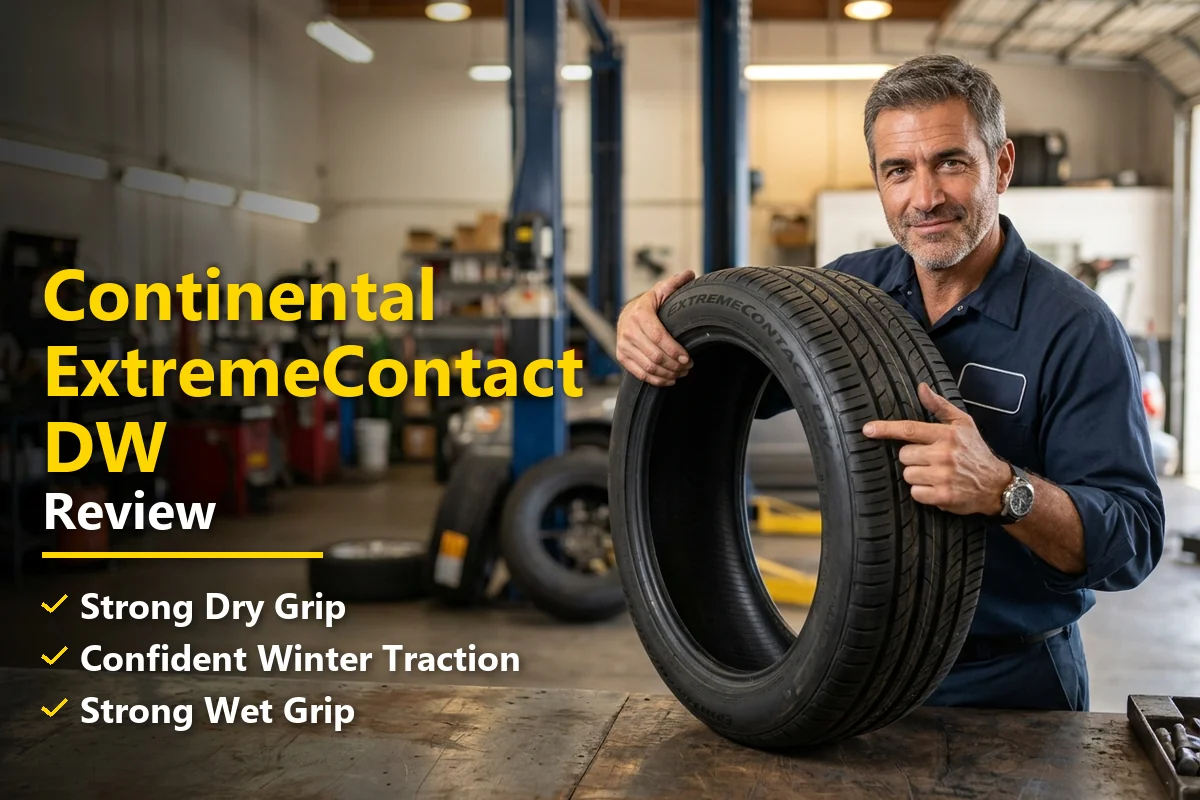
The Continental ExtremeContact DW is one of those tires that keeps popping up in forums, enthusiast groups, and recommendation lists whenever someone asks for an ultra-high-performance all-season option.
So I decided to put a set on my car, drive them hard, and report back with an honest, no-fluff review. If you’re still sizing up Continental as a brand before committing to a set, my Continental tires review gives you the full brand breakdown first.
- The Continental ExtremeContact DW delivers excellent dry and wet grip for an ultra-high-performance all-season tire.
- Steering response is sharp and confidence-inspiring, especially through sweeping highway curves.
- Road noise is impressively low for a performance tire — great for daily commuting.
- Wet traction is a standout feature; hydroplaning resistance is among the best I’ve tested in this category.
- Treadlife is decent for a UHP all-season but won’t match a grand-touring tire.
- Best suited for sport sedans, coupes, and performance-oriented daily drivers in mild-to-moderate climates.
- Not a winter tire — don’t expect miracles in snow or ice.
Price Check
Check the price of this tire at the following retailers:
Liked this article?
Add TireAdvise as a preferred source so you see more of our tire reviews and guides on Google.
What Is the Continental ExtremeContact DW?
Before I get into my hands-on experience, let me set the stage. The Continental ExtremeContact DW (which stands for “Dry” and “Wet”) is an ultra-high-performance all-season tire designed for drivers who want sporty handling without giving up everyday livability.
Continental positioned this tire as a bridge between pure summer performance rubber and standard all-season tires. It’s aimed at sport sedans, sporty coupes, and performance-oriented vehicles that are driven year-round — but primarily in regions that don’t see heavy snowfall.
It’s worth noting that Continental has since released the ExtremeContact DWS 06 Plus, which adds the “S” for snow and is the newer successor. However, the original ExtremeContact DW remains available in many sizes and is still a relevant option, especially at discounted prices. This review focuses strictly on the ExtremeContact DW.
Key Specifications at a Glance
| Feature | Details |
|---|---|
| Tire Type | Ultra-High Performance All-Season |
| Tread Compound | Silica-enhanced compound for wet/dry grip |
| Speed Rating | W (up to 168 mph) in most sizes |
| UTQG Rating | 340 AA A (varies by size) |
| Available Sizes | 16″ to 20″ rim diameters |
| Treadwear Warranty | None (common for UHP all-seasons) |
| Price Range (approx.) | $120 – $220 per tire depending on size |
My Test Setup and Driving Conditions
I mounted a set of the Continental ExtremeContact DW in 225/45R17 on a mid-size sport sedan — the kind of car this tire was clearly designed for. I made sure to get a fresh alignment before installation so I could evaluate the tires on their own merits without any suspension variables skewing the results.
My testing covered a range of real-world scenarios: daily commuting on suburban roads, extended highway drives, spirited runs on twisty back roads, and plenty of wet-weather driving. I also drove through a couple of unexpected downpours that gave me an honest look at how these tires handle standing water at highway speeds.
I live in a part of the US where summers are hot and humid, springs are rainy, and winters are mild — making this a near-ideal climate for an ultra-high-performance all-season tire. I did not test these in snow or ice, and I’ll explain why that matters later.
Dry Performance: Where This Tire Truly Shines
Let me start with the good stuff, because the Continental ExtremeContact DW earns its “D” designation with confidence. From the very first drive, I noticed the steering feel was noticeably sharper and more communicative than the all-season tires I’d been running previously.
On dry pavement, these tires feel planted and composed. Turn-in response is quick without being twitchy, and there’s a reassuring sense of grip through sweeping highway curves and tighter back-road corners alike. I pushed the tires progressively harder over my test period, and the breakaway characteristics were gradual and predictable — exactly what you want in a performance tire you’re using every day.
The asymmetric tread pattern clearly plays a role here. The outboard shoulder blocks are large and stiff, providing a solid contact patch during cornering. During hard lane changes and emergency-style maneuvers, the tire held its line without feeling mushy or vague.
Braking on Dry Roads
Dry braking performance was excellent. I performed several hard stops from highway speeds, and the tires consistently delivered short, confidence-inspiring stopping distances. There was no unusual chirping or skipping during ABS-engaged stops, which tells me the contact patch is doing its job evenly.
Compared to the standard all-season tires I replaced, the improvement in dry braking alone was worth the upgrade. It’s one of those differences you can feel immediately, even if you’re not a track-day enthusiast.
Wet Performance: The Real Story Behind the “W”
If dry grip is where the ExtremeContact DW shines, wet performance is where it genuinely impressed me. I’ve tested a fair number of UHP all-season tires, and this one ranks near the top in terms of wet traction confidence.
Continental’s wide circumferential grooves and dense siping network do a remarkable job of channeling water away from the contact patch. During heavy rain on the highway, I felt none of the unsettling “float” that lesser tires produce. The steering stayed communicative, and grip levels remained high enough that I could maintain normal highway speeds without that creeping anxiety.
Hydroplaning Resistance
I specifically drove through sections of road with standing water during rainstorms to test hydroplaning resistance. The results were genuinely impressive. Even at speeds above 60 mph, the tires carved through puddles without any loss of directional control or sudden grip reduction.
This is a huge deal for everyday drivers. Most of us don’t have the luxury of staying home when it rains, and having a tire that can handle wet conditions with this level of composure is a genuine safety advantage.
Wet Cornering and Braking
Wet cornering grip was strong — not summer-tire strong, but substantially better than what I’ve experienced on most touring all-seasons. I could carry more speed through wet curves with greater confidence, and the tire provided clear feedback before it reached its limits.
Wet braking was similarly encouraging. Stopping distances increased compared to dry conditions (as expected with any tire), but the difference was smaller than I anticipated. The silica-enhanced compound seems to maintain good grip even on cold, wet pavement.
Ride Comfort and Road Noise
Here’s where a lot of ultra-high-performance tires stumble — and where the ExtremeContact DW pleasantly surprised me. Many UHP tires sacrifice comfort for grip, leaving you with a harsh, noisy ride that gets old fast on a daily commuter.
The ExtremeContact DW, however, manages a solid compromise. The ride quality isn’t luxury-car smooth, but it absorbs small road imperfections without transmitting harsh jolts through the cabin. Expansion joints and rough patches are noticeable but not punishing.
Noise Levels
Road noise was one of the standout surprises for me. At highway speeds, the ExtremeContact DW is remarkably quiet for a performance tire. There’s a low-frequency hum that’s barely perceptible over the radio or a normal conversation.
On coarse chip-seal road surfaces, there’s a bit more tire noise — but that’s true of virtually every tire I’ve ever tested. On standard asphalt and concrete, the cabin stays impressively hushed. If you’re coming from a set of aggressive summer tires, you’ll likely notice a significant drop in noise.
I’ll be honest: I didn’t expect this level of refinement from a tire with “Extreme” in its name. Continental clearly engineered the tread pattern and compound to minimize noise generation without sacrificing performance, and they nailed it.
Treadwear and Longevity
Treadlife is always the tricky topic with ultra-high-performance all-season tires. The softer compounds that deliver outstanding grip inevitably wear faster than the harder compounds found in grand-touring tires. That’s just physics.
After several months of regular driving — including spirited back-road sessions and daily commuting — I checked the tread depth at multiple points across the tire. The wear was even and consistent, with no signs of cupping, feathering, or uneven shoulder wear. That tells me the tire’s construction and my alignment were both doing their jobs.
The UTQG treadwear rating of 340 puts the ExtremeContact DW in the middle of the UHP all-season pack. For context, a typical touring all-season might rate in the 500-700 range, while aggressive summer tires can rate below 300. So your expectations should be calibrated accordingly.
One important note: Continental does not offer a treadwear warranty on the ExtremeContact DW. This is common for UHP all-season tires, but it’s worth knowing before you buy. If guaranteed mileage is a priority for you, this might not be the right category of tire.
Tips to Maximize Treadlife
- Rotate regularly: I recommend rotating every oil change or at the interval specified in your owner’s manual.
- Check alignment: Even minor alignment issues can dramatically accelerate wear on performance tires.
- Maintain proper inflation: Check pressures at least monthly. Under-inflation kills tread edges; over-inflation wears the center.
- Avoid aggressive driving habits: Hard launches, heavy braking, and aggressive cornering all accelerate wear. Drive them hard when it matters, but ease up during routine commuting.
Light Snow and Cold Weather: Know the Limits
I want to be very direct about this: the Continental ExtremeContact DW is not a snow tire, and it doesn’t pretend to be. The “DW” stands for Dry and Wet — there’s no “S” here. If you live in an area that sees regular snow and ice, you should either look at the newer DWS 06 Plus or invest in a dedicated winter tire set.
That said, the tire can handle a light frost or an unexpected dusting of snow well enough to get you home safely. I drove on some cold mornings where temperatures dipped into the mid-30s (Fahrenheit), and the tire maintained reasonable grip on dry, cold pavement. But I wouldn’t push it beyond that.
The compound in UHP all-season tires stiffens as temperatures drop below about 40°F, which reduces grip progressively. For drivers in the Sun Belt, the Gulf Coast, or the Pacific Southwest, this is barely a concern. For drivers in the Midwest or Northeast, this is a critical limitation.
How Does It Compare? Continental ExtremeContact DW vs. Competitors
No tire review is complete without context. Here’s how the ExtremeContact DW stacks up against some of the most popular tires in its category that I’ve also had experience with.
| Category | Continental ExtremeContact DW | Michelin Pilot Sport A/S 3+ | BFGoodrich g-Force COMP-2 A/S |
|---|---|---|---|
| Dry Grip | ★★★★☆ | ★★★★★ | ★★★★☆ |
| Wet Grip | ★★★★★ | ★★★★☆ | ★★★★☆ |
| Ride Comfort | ★★★★☆ | ★★★★☆ | ★★★☆☆ |
| Road Noise | ★★★★☆ | ★★★★★ | ★★★☆☆ |
| Treadlife | ★★★☆☆ | ★★★★☆ | ★★★☆☆ |
| Light Snow | ★★☆☆☆ | ★★★☆☆ | ★★★☆☆ |
| Value for Money | ★★★★★ | ★★★☆☆ | ★★★★☆ |
| Approx. Price (225/45R17) | $140 – $160 | $170 – $200 | $130 – $150 |
Continental ExtremeContact DW vs. Michelin Pilot Sport A/S 3+
The Michelin is the gold standard in this category, and frankly, it edges out the Continental in dry grip and overall refinement. The Pilot Sport A/S 3+ has a slightly more connected, telepathic steering feel and offers better light-snow capability.
However, the Continental fights back hard on wet grip — I’d actually give it a slight edge in heavy rain scenarios — and it costs significantly less. If you’re on a budget and wet-weather performance is a priority, the ExtremeContact DW is a compelling alternative to the Michelin.
Continental ExtremeContact DW vs. BFGoodrich g-Force COMP-2 A/S
The BFG is a solid performer that’s often compared to the Continental. In my experience, the g-Force COMP-2 A/S is slightly more aggressive in its handling character — it feels sportier and more eager to rotate — but it’s also noisier and has a harsher ride.
The Continental strikes a better balance between performance and daily livability. If you’re using this as a true daily driver and value comfort alongside grip, I’d lean toward the ExtremeContact DW. If you want the most connected driving feel on a budget, the BFG is worth considering.
Continental ExtremeContact DW vs. ExtremeContact DWS 06 Plus
This is the most common question I get. The DWS 06 Plus is Continental’s newer tire that adds winter capability (the “S” in DWS). It uses an updated compound and tread design that provides meaningful improvement in light snow and cold-weather traction.
If you can find the ExtremeContact DW at a meaningful discount and you live in a warm climate, it’s still an excellent buy. But if you need any cold-weather versatility at all — even occasional cold snaps below freezing — the DWS 06 Plus is the smarter choice. The newer tire also tends to have slightly better treadlife in my experience.
Who Should Buy the Continental ExtremeContact DW?
After spending extensive time with this tire, I have a clear picture of who it’s best suited for — and who should look elsewhere.
This Tire Is Perfect For:
- Enthusiast drivers in warm climates who want year-round performance without swapping to winter tires.
- Daily commuters with sport sedans or coupes who value sharp handling without a punishing ride.
- Drivers in rainy regions (Pacific Northwest, Gulf Coast, Southeast) who need outstanding wet-weather traction.
- Budget-conscious buyers looking for UHP all-season performance at a lower price point than premium options like the Michelin Pilot Sport A/S series.
- Anyone upgrading from standard all-season tires who wants a noticeable improvement in grip and handling response.
This Tire Is NOT For:
- Drivers in snowy climates — look at the DWS 06 Plus or a dedicated winter tire instead.
- Anyone prioritizing maximum treadlife — a grand-touring all-season like the Continental TrueContact Tour would be a better fit.
- Truck, SUV, or crossover owners — this tire is designed for passenger cars and doesn’t come in SUV-specific sizes.
- Track-day enthusiasts — while spirited driving is fine, a dedicated summer performance tire will outperform this on a circuit.
Installation and Pricing Tips
I purchased my set online and had them shipped to a local installer — a process that’s become incredibly simple in the US market. Retailers like Tire Rack, Discount Tire Direct, and Simple Tire all carry the ExtremeContact DW, and most offer free shipping to a local installer.
At the time of my purchase, I paid around $150 per tire for the 225/45R17 size, which included no additional fees beyond the tire itself. Installation, balancing, valve stems, and disposal fees at my local shop came to about $25 per tire. So my all-in cost for four mounted and balanced tires was roughly $700.
Ways to Save
- Check for manufacturer rebates: Continental frequently runs mail-in rebate promotions, especially in spring and fall. I’ve seen rebates as high as $70 for a set of four.
- Compare online retailers: Prices can vary by $10-20 per tire between retailers. Spend five minutes comparing before you click “buy.”
- Ask about closeout pricing: Since the DWS 06 Plus is the newer model, some retailers discount remaining DW inventory to clear stock. This can represent significant savings.
- Bundle with installation: Some online retailers partner with local shops and include installation in a package deal.
The Technology Inside the ExtremeContact DW
Continental is one of those manufacturers that invests heavily in tire technology, and the ExtremeContact DW benefits from several proprietary features that are worth understanding.
Asymmetric Tread Design
The tire uses an asymmetric tread pattern, meaning the inner and outer halves of the tire have different designs optimized for different functions. The outer shoulder has large, rigid tread blocks for maximum cornering grip. The inner portion has more sipes and grooves for water evacuation and wet traction.
This is a proven design philosophy used across the performance tire industry, and Continental executes it well here.
Silica-Enhanced Compound
The tread compound incorporates high amounts of silica, which improves grip on wet and cold surfaces compared to traditional carbon-black compounds. This is a big reason why the tire’s wet performance is so strong — the silica helps the rubber maintain flexibility and adhesion even when the road surface is slippery.
SportPlus Technology
Continental’s SportPlus Technology package includes design elements focused on high-speed stability, responsive handling, and precise steering feedback. While marketing names can sometimes be more sizzle than steak, I genuinely felt the benefits in real-world driving — particularly the way the tire responds to quick steering inputs without delay.
What I Didn’t Love
No tire is perfect, and I want to be transparent about the areas where the ExtremeContact DW falls short — or at least falls behind the best-in-class competitors.
No winter capability: I know I’ve mentioned this already, but it’s worth emphasizing. In an era where many UHP all-season tires offer at least some cold-weather competence, the ExtremeContact DW’s complete lack of winter capability feels like a limitation. Continental addressed this with the DWS 06 Plus, but if you’re buying the DW specifically, you need to understand this tradeoff.
No treadwear warranty: While this is standard for the category, it’s still a negative for value-conscious buyers. You’re essentially taking on the full risk of premature wear, even though Continental has a solid reputation for consistent treadlife.
Dry grip, while very good, isn’t class-leading: The Michelin Pilot Sport A/S 3+ and its successor, the A/S 4, both offer a slightly higher level of dry grip and steering precision. If you’re chasing the absolute best dry-road performance in an all-season format, Michelin still holds the crown — but you’ll pay for it.
Aging product line: The ExtremeContact DW has been on the market for a while, and tire technology doesn’t stand still. Newer competitors have incorporated more advanced compounds, optimized tread designs, and improved noise-reduction features. The DW is still a good tire, but it’s no longer cutting-edge.
My Final Verdict on the Continental ExtremeContact DW
After spending considerable time with the Continental ExtremeContact DW across a wide range of driving conditions, I can confidently say it’s a strong performer that earns its reputation — especially in wet conditions. The combination of excellent rain traction, sharp dry handling, low road noise, and reasonable comfort makes it a compelling daily driver tire for anyone with a sport sedan or performance-oriented car.
Is it the best UHP all-season tire on the market right now? No — the Michelin Pilot Sport A/S 4 and Continental’s own DWS 06 Plus have surpassed it in several key areas. But the ExtremeContact DW remains a smart buy, particularly if you find it at a discount or if you live in a warm climate where its lack of winter capability isn’t a factor.
I’d give the Continental ExtremeContact DW a solid 4 out of 5 stars. It does what it promises — delivers extreme contact in dry and wet conditions — and it does it at a price that undercuts many competitors. For a tire shopper looking to upgrade from basic all-seasons without breaking the bank, this is one I recommend with confidence.
Quick Rating Breakdown
- Dry Performance: 8.5/10
- Wet Performance: 9/10
- Ride Comfort: 7.5/10
- Road Noise: 8/10
- Treadlife: 7/10
- Winter/Snow: 3/10
- Value: 8.5/10
- Overall: 8/10
If wet-weather confidence is high on your priority list and you’re shopping in the $130-$180 per tire range, put the Continental ExtremeContact DW on your short list. You won’t regret it.
Frequently Asked Questions
How does the Continental ExtremeContact DW perform in wet and dry conditions?
The Continental ExtremeContact DW delivers excellent grip in both wet and dry conditions thanks to its asymmetric tread design and high-silica compound. In my experience, wet traction is one of its strongest points — hydroplaning resistance is noticeably better than many competitors in this ultra-high-performance all-season category. Dry cornering feel is responsive and confidence-inspiring, especially on highways and winding roads common across the US.
Is the Continental ExtremeContact DW a good tire for daily driving?
Yes, the ExtremeContact DW is a solid choice for daily drivers who want sporty performance without sacrificing everyday comfort. Road noise is well-controlled at highway speeds, and the ride quality is surprisingly smooth for an ultra-high-performance tire. If you commute on US interstates or city streets, this tire strikes a great balance between fun handling and practical livability.
How long does the Continental ExtremeContact DW last in terms of treadlife?
Most drivers report getting between 30,000 and 45,000 miles from the Continental ExtremeContact DW, depending on driving habits and alignment. Continental does not offer a treadwear warranty on this tire, which is typical for the ultra-high-performance category. I’d recommend regular tire rotations every 5,000–7,000 miles to maximize tread life, especially if you drive aggressively or in hot US climates like Texas or Arizona.
How much does the Continental ExtremeContact DW cost per tire?
The Continental ExtremeContact DW typically ranges from about $120 to $220 per tire depending on the size, with common fitments for sedans and sports cars falling in the $140–$180 range. Prices vary by retailer, so I recommend checking Tire Rack, Discount Tire, and local shops for the best deal. Installation and balancing usually add $15–$25 per tire at most US tire shops.
How does the Continental ExtremeContact DW compare to the ExtremeContact DWS 06 Plus?
The ExtremeContact DW is the summer-focused sibling, while the DWS 06 Plus is a true all-season tire that adds light snow capability — the ‘S’ literally stands for snow. If you live in a region with mild winters like the Southeast or California, the DW is the sportier option with better warm-weather grip. For drivers in the Midwest or Northeast who face occasional snow, the DWS 06 Plus is the safer year-round choice.
Can you use the Continental ExtremeContact DW in winter or snow?
No, the Continental ExtremeContact DW is not designed for winter driving and should not be used in snow or near-freezing temperatures. Its summer compound hardens significantly in cold weather, which drastically reduces traction and braking performance. If you live in a US region that sees snow or sustained temperatures below 40°F, you should either switch to dedicated winter tires or consider the all-season ExtremeContact DWS 06 Plus instead.
What vehicles are the Continental ExtremeContact DW best suited for?
The ExtremeContact DW is available in a wide range of sizes that fit popular US sports cars and performance sedans like the Ford Mustang, BMW 3 Series, Honda Civic Si, Subaru WRX, and Chevrolet Camaro. It’s ideal for drivers who want a performance-oriented summer tire without going full track-day aggressive. If your car came with factory performance tires and you want a capable replacement at a reasonable price, the ExtremeContact DW is worth serious consideration.
