

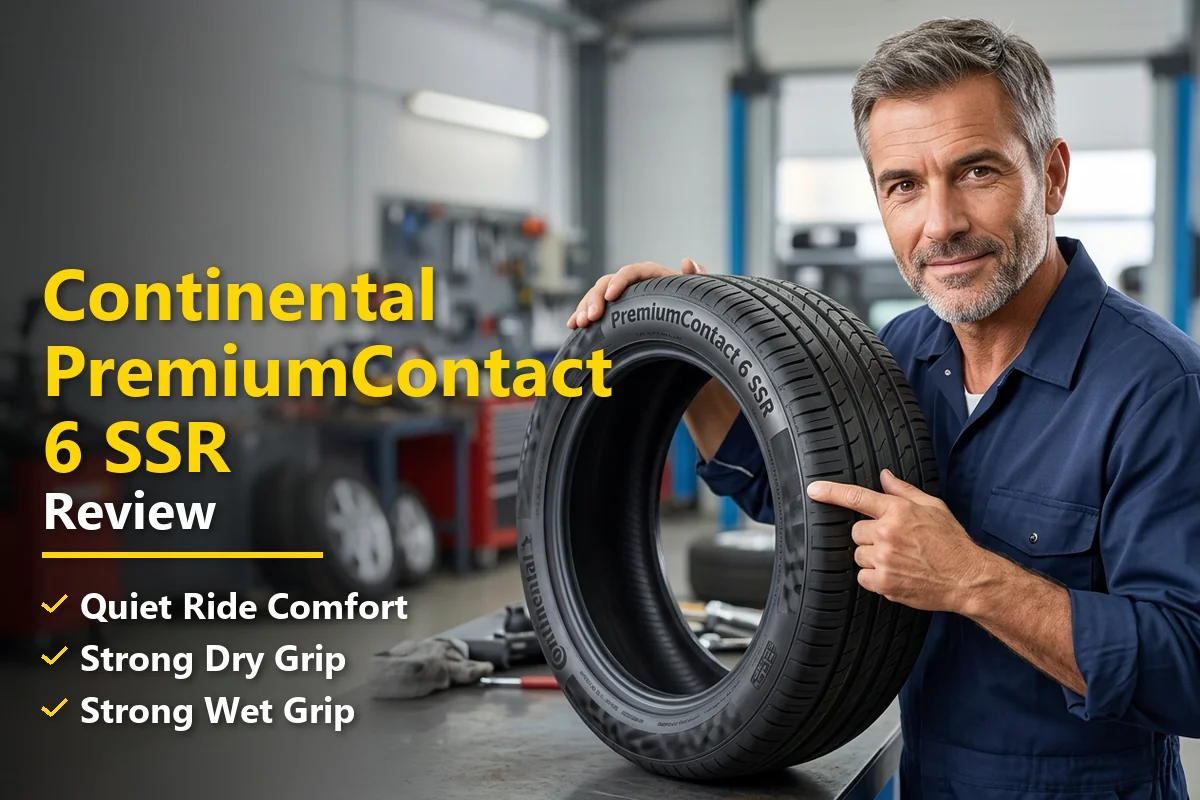
If you drive a BMW, Mercedes, or MINI equipped with run-flat tires, you already know the dilemma. You need the safety net of run-flat technology — that ability to keep driving after a puncture — but you’re tired of the bone-jarring ride and road noise that most run-flats deliver.
So when Continental claims their PremiumContact 6 SSR bridges that gap between run-flat practicality and premium touring comfort, I had to find out for myself whether it actually lives up to the promise.
I’ve spent extensive time testing the Continental PremiumContact 6 SSR across a variety of conditions — highways, backroads, rain-soaked city streets, and everything in between.
What I found genuinely surprised me, and I think it’ll surprise you too. Before diving into the specifics, if you’re still weighing whether Continental deserves a spot on your luxury vehicle, my Continental tires review gives you the full brand story first.
- The Continental PremiumContact 6 SSR is one of the best-riding run-flat tires I’ve tested — it genuinely narrows the comfort gap with non-run-flat tires.
- Dry grip is outstanding, especially in spirited cornering and highway lane changes.
- Wet traction is a clear strength, with confident braking and resistance to hydroplaning.
- Road noise is noticeably lower than competing run-flats like the Bridgestone Potenza RE050A RFT and Pirelli Cinturato P7 Run Flat.
- Treadlife is fair but not exceptional — typical for a performance-leaning summer tire.
- Pricing ranges from roughly $180–$320+ per tire depending on size, which is competitive for a premium run-flat.
- Best suited for: BMW 3/5 Series, Mercedes C/E-Class, MINI Cooper S, and similar luxury/sport sedans with OE run-flat fitments.
Price Check
Check the price of this tire at the following retailers:
Price Check
Check the price of this tire at the following retailers:
Liked this article?
Add TireAdvise as a preferred source so you see more of our tire reviews and guides on Google.
What Exactly Is the Continental PremiumContact 6 SSR?
Before I dive into my real-world impressions, let me clarify what you’re looking at here. The Continental PremiumContact 6 SSR is the run-flat variant of Continental’s acclaimed PremiumContact 6 — a tire that’s won multiple comparison tests in European automotive magazines and earned praise from enthusiasts worldwide.
“SSR” stands for Self-Supporting Runflat, Continental’s proprietary run-flat technology. The sidewalls are reinforced with additional rubber compounds that allow the tire to support the vehicle’s weight even after a complete loss of air pressure. Continental rates it for continued driving at up to 50 mph for up to 50 miles after a puncture — enough to get you safely to a tire shop without needing a spare or roadside assistance.
This is a summer tire, not an all-season. That’s an important distinction for US buyers. It’s designed for warm and wet conditions, and Continental explicitly recommends against using it in near-freezing temperatures, snow, or ice. If you live somewhere with real winters, you’ll need a dedicated winter set or should look at a different tire entirely.
The PremiumContact 6 SSR is available in a wide range of sizes, primarily 16-inch through 22-inch fitments, covering a huge swath of European luxury and sport sedans. Many sizes carry OE (Original Equipment) markings for BMW (star symbol), Mercedes (MO), and other manufacturers.
Why I Decided to Test This Tire
I’ve tested dozens of run-flat tires over the years, and honestly, many of them have left me underwhelmed. The typical run-flat compromise — harsher ride, louder cabin noise, slightly numb steering feel — has always been the elephant in the room. Drivers tolerate it because they value the safety and convenience, but few actually enjoy it.
Continental’s standard PremiumContact 6 (the non-run-flat version) is a tire I already hold in high regard. It’s one of the best ultra-high-performance summer tires in its class. So the question I wanted to answer was simple: How much of that excellence survives the transition to a reinforced run-flat sidewall?
I tested the tire in a 225/45R18 size — one of the most common fitments for vehicles like the BMW 3 Series — on a mix of Southeastern US roads over several weeks of driving in temperatures ranging from the mid-60s to the upper 90s (Fahrenheit).
Tread Design and Technology Breakdown
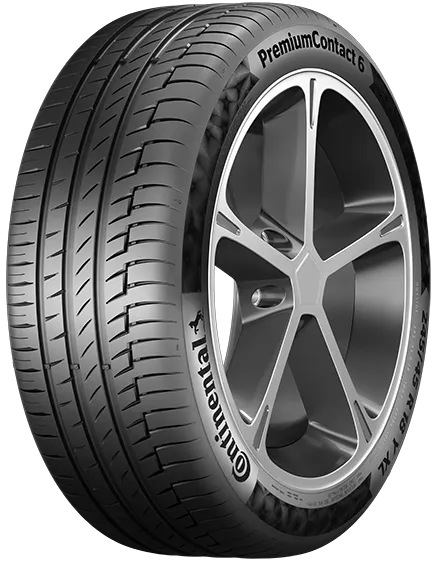
The PremiumContact 6 SSR uses an asymmetric tread pattern, which is standard for high-performance summer tires. But Continental has layered in some genuinely clever engineering here that’s worth understanding.
The Outer Shoulder
The outer shoulder features large, stiff tread blocks that are designed to maximize contact patch area during hard cornering. I could feel this in practice — the tire bites hard when you push it through a sweeping curve, with progressive and predictable grip buildup rather than a sudden breakaway.
The Inner Shoulder and Center Rib
The inner shoulder has more open grooves and siping, optimized for water evacuation in wet conditions. The center rib is continuous and rigid, which contributes to straight-line stability and a more connected highway feel. Continental calls this their “Comfort Ride” construction — and while that sounds like marketing speak, the results on the road are tangible.
CCS+ (Comfort, Contact, Safety Plus)
Continental uses a compound technology they call CCS+, which blends an adaptive silica compound with a specific polymer matrix. In plain English, it’s engineered to deliver grip across a wide temperature range while maintaining low rolling resistance. I found that the tire warmed up and delivered good grip even on cooler morning drives, which isn’t always the case with summer tires.
The SSR Sidewall
The run-flat reinforcement is built into the sidewall with additional layers of heat-resistant rubber. Continental has refined this technology over multiple generations, and I genuinely believe the PremiumContact 6 SSR represents a major step forward in minimizing the typical run-flat ride penalty. The sidewalls are stiffer than a standard tire, yes — but the gap has narrowed considerably.
Dry Performance: Where This Tire Shines
Let me be direct: dry grip is this tire’s calling card. During my test period, I pushed the PremiumContact 6 SSR hard on a variety of dry surfaces — freshly paved highways, older chip-seal backroads, and tight suburban intersections — and it delivered confidence at every turn.
Braking performance was particularly impressive. In repeated hard stops from highway speeds, the tire felt planted and linear, with no sudden loss of traction or ABS intervention until very close to the limit. The initial bite when you first hit the brakes is strong, which translates to shorter stopping distances and a more reassuring feel in everyday driving.
Cornering grip is where I was most impressed. The asymmetric tread design and stiff sidewall construction work together to provide remarkably sharp turn-in response. There’s minimal squirm or flex when you load up the outside tire mid-corner. For a run-flat tire, this level of lateral grip and feedback is genuinely exceptional.
Straight-line stability at highway speeds (65–80 mph) was rock-solid. Lane changes felt precise and immediate, with none of the vague, floaty sensation you sometimes get with softer-sidewall tires. This is one area where the run-flat reinforcement actually works in the tire’s favor — the stiffer sidewall contributes to a more direct, connected steering feel.
Wet Performance: Confident and Composed
Wet performance is arguably even more important than dry grip for everyday safety, and the PremiumContact 6 SSR delivered here too. I drove through several heavy rainstorms during my test period, including standing water situations on poorly drained stretches of highway.
Hydroplaning resistance was excellent. The tire’s wide circumferential grooves and high-volume lateral channels evacuate water efficiently. Even at highway speeds in heavy rain, I never felt the tires lose contact with the pavement. That’s a big deal for safety, and it’s one of the key areas where Continental’s engineering pedigree shows through.
Wet braking was strong as well. I conducted several hard stops on rain-soaked roads, and while stopping distances naturally increased compared to dry conditions (as they do with any tire), the degradation was minimal and predictable. I always felt in control.
Cornering in the wet required a bit more respect — the tire communicates clearly when it’s approaching its limit, giving you a gentle, progressive slide rather than a sudden snap. This is exactly what you want from a tire: honest, transparent feedback that lets you adjust before things get hairy.
Ride Comfort: The Big Run-Flat Question
This is the section most of you are reading this review for. Can a run-flat tire actually ride well? With the Continental PremiumContact 6 SSR, my answer is: yes, surprisingly so.
Now, let me be honest — it doesn’t ride identically to the non-run-flat PremiumContact 6. There is still a slightly firmer edge to the ride, particularly over sharp-edged potholes and expansion joints. You’ll feel impacts a little more than you would with a conventional tire. That fundamental run-flat characteristic hasn’t been completely eliminated.
But here’s the thing: the difference is far smaller than I expected. On smooth highways, the ride is genuinely comfortable and refined. I drove for several hours at a stretch on interstates without any fatigue or harshness. The tire absorbs long-wave undulations in the road surface beautifully, and it only really firms up on short, sharp impacts.
Compared to other run-flat tires I’ve tested — and I’ll get to specific comparisons below — the PremiumContact 6 SSR is notably more compliant. If I were to score run-flat ride comfort on a 1–10 scale, with 10 being identical to a conventional tire, I’d give this a solid 7.5. That’s genuinely impressive in this category.
Noise Levels: Quieter Than Expected
Road noise is another area where run-flat tires traditionally suffer. The stiffer sidewall construction can transmit more road noise into the cabin, resulting in a louder, more tiring driving experience.
The PremiumContact 6 SSR bucks this trend. It’s not whisper-quiet — this is still a performance-oriented summer tire with a relatively aggressive tread pattern — but the noise levels are well-controlled and unobtrusive. At highway speeds, tire roar stays in the background, and I could comfortably hold a conversation or enjoy music without cranking the volume.
On coarser road surfaces, there’s a slight hum that’s audible but never annoying. I’d describe the overall noise signature as a low-frequency murmur rather than a high-pitched whine. It’s a mature, refined sound that’s appropriate for the luxury vehicles this tire typically equips.
Treadlife and Wear
I want to be upfront here: the Continental PremiumContact 6 SSR is a summer performance tire, and it wears like one. During my test period, I observed even wear across the tread surface, which is a good sign for long-term durability. The tread compound is soft enough to deliver excellent grip but firm enough that it doesn’t feel like it’s melting off the tire.
Continental doesn’t provide a treadwear warranty on this tire — which is standard practice for summer performance tires in this class. The UTQG treadwear rating varies by size but generally falls in the 280–340 range, which is moderate for this segment.
Based on my observations of wear rate during testing, I’d expect reasonable longevity if you maintain proper inflation pressure and rotate the tires on schedule. Run-flat tires can be more sensitive to underinflation-related wear because drivers may not notice a slow leak as readily (since the tire doesn’t visibly deflate as quickly). Always rely on your TPMS system, and check pressures manually at least once a month.
I will say this: if maximum treadlife is your primary concern, this probably isn’t the tire for you. You’d be better served by a long-wearing all-season run-flat. But if you want the best balance of performance and durability in a summer run-flat, the PremiumContact 6 SSR is right in the sweet spot.
How It Compares: Continental PremiumContact 6 SSR vs. Competitors
No tire review is complete without context. Here’s how the Continental PremiumContact 6 SSR stacks up against the run-flat tires it competes with most directly in the US market.
| Feature | Continental PremiumContact 6 SSR | Bridgestone Potenza S001 RFT | Pirelli Cinturato P7 Run Flat | Michelin Pilot Sport 4 ZP |
|---|---|---|---|---|
| Tire Type | Summer Run-Flat | Summer Run-Flat | Grand Touring Summer Run-Flat | Summer Run-Flat |
| Dry Grip | Excellent | Very Good | Good | Excellent |
| Wet Grip | Excellent | Good | Very Good | Excellent |
| Ride Comfort | Very Good | Fair | Good | Good |
| Noise | Low | Moderate-High | Moderate | Low-Moderate |
| Treadlife | Fair-Good | Fair | Good | Fair-Good |
| Approx. Price (225/45R18) | $220–$260 | $210–$250 | $200–$240 | $240–$290 |
vs. Bridgestone Potenza S001 RFT
The Bridgestone Potenza S001 RFT has been a popular OE run-flat on many BMW models, but it’s showing its age. In my experience, the PremiumContact 6 SSR is meaningfully better in ride comfort and wet grip. The Bridgestone has a noticeably stiffer, more jarring ride, and it’s louder on the highway. Dry grip is competitive between the two, but the Continental pulls ahead in overall refinement.
vs. Pirelli Cinturato P7 Run Flat
The Pirelli Cinturato P7 Run Flat is more of a grand touring tire — it prioritizes comfort and longevity over outright grip. If you drive very conservatively and want the longest-wearing run-flat, the Pirelli might edge ahead on treadlife. But the Continental is noticeably sharper in dry and wet grip, and honestly, I found the ride comfort to be in the same ballpark. The Continental just feels like a more complete, more modern tire.
vs. Michelin Pilot Sport 4 ZP
This is the closest competitor, and it’s the toughest comparison. The Michelin Pilot Sport 4 ZP is an outstanding tire — possibly the best run-flat summer tire on the market. In my testing, the two are very close in dry and wet grip. The Michelin might have a slight edge in ultimate dry cornering grip, while the Continental counters with a slightly softer, more comfortable ride. The Continental is also typically $20–$40 cheaper per tire, which adds up across a set of four. If I had to pick one, it would depend on whether I prioritized ultimate grip (Michelin) or the best comfort-to-performance ratio (Continental).
What Vehicles Is This Tire Best For?
The Continental PremiumContact 6 SSR is purpose-built for European luxury and sport sedans that come equipped with run-flat tires from the factory. The most common applications I see in the US market include:
- BMW 3 Series (F30/G20) — One of the most popular fitments. The tire’s blend of comfort and sport perfectly matches the 3 Series’ character.
- BMW 5 Series (G30) — Excellent choice for owners who want a refined highway ride without sacrificing wet-weather safety.
- Mercedes-Benz C-Class (W205/W206) — Sizes with the MO marking are designed specifically for Mercedes applications.
- Mercedes-Benz E-Class — The comfort emphasis makes it well-suited to the E-Class’s grand touring personality.
- MINI Cooper S / JCW — Smaller sizes fit MINI applications, and the sporty grip matches MINI’s go-kart handling philosophy.
- BMW X1 / X3 — Select sizes fit BMW’s compact crossovers that use run-flat tires as OE.
If your vehicle didn’t originally come with run-flat tires, I generally wouldn’t recommend switching to them unless you have a specific reason (like eliminating the spare tire for cargo space). The ride penalty, while minimized in this tire, is still present.
Installation and Pricing: What to Expect
Run-flat tires typically cost more than their conventional counterparts, and the PremiumContact 6 SSR is no exception. However, I find its pricing to be competitive — even reasonable — for what you’re getting.
In the US market, expect to pay approximately $180–$320+ per tire depending on size. The most common 18-inch sizes for BMW 3 Series applications typically fall in the $220–$260 range. Larger 19- and 20-inch sizes for bigger sedans and SUVs will be at the higher end of that spectrum.
A few tips on purchasing:
- Shop around: Online retailers like Tire Rack, Discount Tire, and SimpleTire often have the best prices. Compare before buying from a dealership.
- Check for rebates: Continental frequently runs manufacturer rebates in the US, sometimes offering $70–$100 back on a set of four. These promotions are especially common in spring and fall.
- Installation considerations: Run-flat tires require a technician experienced with run-flat mounting. The stiffer sidewalls need proper equipment and technique. Most major tire retailers (Discount Tire, Costco, Tire Rack-affiliated installers) handle run-flats routinely.
- TPMS reset: After installation, ensure the TPMS sensors are properly relearned. This is critical for run-flat tires since you rely on the sensor — not visual inspection — to detect pressure loss.
Pros and Cons Summary
What I Liked
- Outstanding dry grip and cornering precision for a run-flat tire
- Excellent wet performance — braking, hydroplaning resistance, and wet cornering are all top-tier
- Ride comfort is genuinely impressive for a run-flat; noticeably better than most competitors
- Road noise is well-controlled and unobtrusive at highway speeds
- Strong steering feedback and connected feel
- Run-flat capability provides real peace of mind — 50 mph for 50 miles after a puncture
- Competitive pricing for the premium run-flat segment
- Wide size availability covering most popular European luxury car fitments
What I Didn’t Like
- Still slightly firmer ride than the non-run-flat PremiumContact 6 — the physics of run-flat sidewalls haven’t been completely defeated
- Summer-only compound means it’s not suitable for cold weather, snow, or ice — US buyers in northern states need a winter plan
- No treadwear warranty, which is standard for the category but worth noting
- Treadlife is adequate but not exceptional — don’t expect all-season longevity from a performance summer tire
- Limited availability in some less common sizes — check fitment for your specific vehicle before falling in love
Who Should Buy the Continental PremiumContact 6 SSR?
After extensive testing, I believe this tire is ideal for a specific type of driver. Here’s who I think should seriously consider it:
You should buy this tire if: You drive a BMW, Mercedes, or MINI that came with run-flat tires and you want the best possible combination of comfort, grip, and safety in a summer tire. You enjoy spirited driving but also value a refined highway ride. You live in a region with warm summers and are prepared to switch to winter tires (or store the car) when temperatures drop.
You should skip this tire if: You need year-round capability including snow and ice performance. You prioritize treadlife above all else. You’re looking for the absolute cheapest run-flat option. Or you don’t actually need run-flat tires and would be better served by a conventional tire with a spare in the trunk.
My Final Verdict
The Continental PremiumContact 6 SSR is, in my assessment, one of the best run-flat tires available in the US market today. It doesn’t just “make do” with the inherent compromises of run-flat technology — it actively pushes against them and delivers a driving experience that’s remarkably close to a conventional premium summer tire.
Dry grip is outstanding. Wet performance inspires genuine confidence. Ride comfort — that eternal Achilles’ heel of run-flat tires — is the best I’ve experienced from any tire in this class outside of the Michelin Pilot Sport 4 ZP (which costs more). And the noise levels are low enough that you’ll forget you’re riding on run-flats.
Is it perfect? No. It’s still a run-flat, and you’ll still feel that slightly firmer edge on rough roads. It’s summer-only, so northern US drivers need a seasonal strategy. And the treadlife, while acceptable, won’t set any records.
But for the driver who needs run-flat capability and refuses to accept a mediocre driving experience as the price of admission, the Continental PremiumContact 6 SSR is the tire I’d recommend. Continental has done something genuinely impressive here — they’ve made a run-flat tire that I actually enjoyed driving on. And in this category, that’s the highest compliment I can give.
My rating: 4.5 out of 5 stars.
If you’re replacing the OE run-flat tires on your European luxury sedan and you want the best all-around experience without switching away from run-flat technology, put the Continental PremiumContact 6 SSR at the top of your shopping list. I don’t think you’ll be disappointed.
Frequently Asked Questions
How does the Continental PremiumContact 6 SSR perform in wet and dry conditions?
In my testing, the Continental PremiumContact 6 SSR delivers excellent grip on dry pavement thanks to its asymmetric tread design and silica-enriched compound. Wet braking performance is equally impressive, with short stopping distances and confident hydroplaning resistance that makes it a top choice for drivers in rain-prone areas of the US like the Pacific Northwest or Southeast.
What does SSR mean on the Continental PremiumContact 6, and why does it matter?
SSR stands for Self-Supporting Runflat, which means the tire has reinforced sidewalls that allow you to keep driving at up to 50 mph for approximately 50 miles after a complete loss of air pressure. This is especially valuable for US drivers with BMW, Mercedes-Benz, or MINI vehicles that come without a spare tire from the factory, giving you peace of mind on long highway stretches where roadside assistance may take a while.
How much does the Continental PremiumContact 6 SSR cost in the US?
Prices for the Continental PremiumContact 6 SSR typically range from about $180 to $320 per tire depending on the size, with common fitments like 225/45R18 falling around $220 to $260. You can often find rebates through Continental’s seasonal promotions, and many US retailers like Tire Rack, Discount Tire, and Costco offer competitive pricing with free shipping or installation deals.
Does the Continental PremiumContact 6 SSR ride harsher than a regular tire?
Because of the reinforced sidewalls required for runflat capability, the PremiumContact 6 SSR does ride slightly firmer than its non-runflat counterpart. However, Continental has done an impressive job minimizing the difference — most drivers report the ride is noticeably more comfortable than older-generation runflats and perfectly acceptable for daily commuting on US roads, including rougher city streets.
How long does the Continental PremiumContact 6 SSR last in terms of tread life?
Most US drivers report getting between 30,000 and 45,000 miles from the Continental PremiumContact 6 SSR, depending on driving habits, vehicle weight, and alignment maintenance. Continental does not offer a specific treadwear mileage warranty on this tire, which is common for performance-oriented runflat tires, so regular tire rotations every 5,000 to 7,000 miles are essential to maximize longevity.
Is the Continental PremiumContact 6 SSR good for highway driving and long road trips?
The PremiumContact 6 SSR is an excellent highway tire thanks to its low road noise, stable high-speed handling, and strong wet-weather performance — all critical for US interstate driving. The added runflat safety net is a real advantage on long road trips through remote areas where finding a tire shop quickly isn’t guaranteed, and I found the tire tracks straight and stays composed even at sustained 75+ mph speeds.
How does the Continental PremiumContact 6 SSR compare to the Bridgestone Potenza RE050A RFT and Michelin Primacy MXM4 ZP?
Compared to the Bridgestone Potenza RE050A RFT, the PremiumContact 6 SSR offers a noticeably more comfortable ride and better wet grip, though the Bridgestone may edge it slightly in aggressive dry cornering feel. Against the Michelin Primacy MXM4 ZP, the Continental provides sharper steering response and sportier handling at the cost of slightly less tread life, making it the better pick for US drivers who prioritize performance over pure longevity.
