

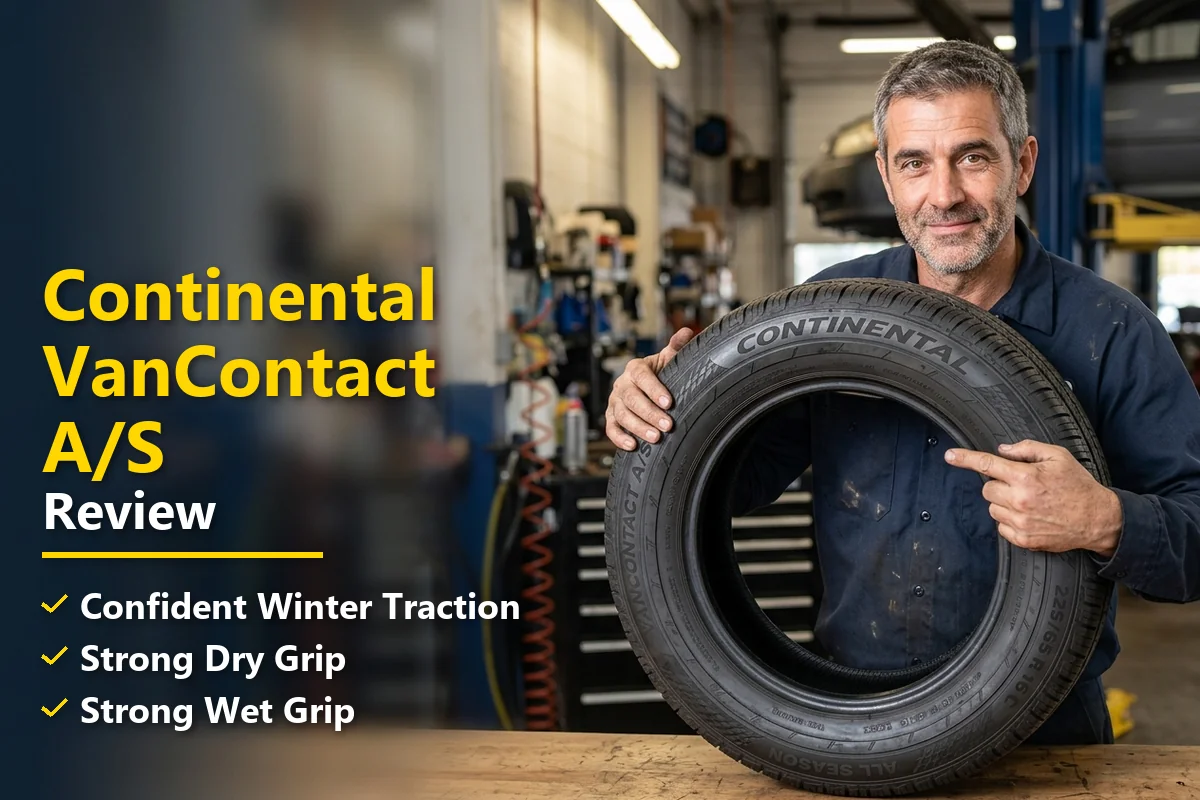
If you drive a cargo van, transit van, or heavy-duty work vehicle, you already know the frustration: most all-season tires are designed for sedans and SUVs, and they fall apart under the demands of commercial use. You need something that can handle heavy loads day after day without sacrificing wet-weather grip or ride comfort.
That’s exactly the problem I set out to solve when I mounted a set of Continental VanContact A/S tires on my Ford Transit 250 for an extended test period.
After weeks of driving through everything from scorching summer highways to torrential downpours, I have a very clear picture of what these tires do well — and where they fall short.
Before diving in, if you’re still getting familiar with Continental as a brand, my Continental tires review covers everything you need to know before making a commercial tire decision.
- The Continental VanContact A/S is a purpose-built all-season tire designed specifically for commercial vans and light trucks.
- Excellent wet traction and braking performance — among the best I’ve tested in this category.
- Ride comfort is surprisingly refined for a load-rated commercial tire.
- Treadwear looks very promising early on, with even wear patterns under heavy loads.
- Road noise is present but manageable at highway speeds.
- Priced in the mid-to-upper range (~$170–$260 per tire depending on size), but the quality justifies the cost.
- I recommend these for fleet operators, tradespeople, and delivery drivers who need reliable all-season performance without compromising safety.
Price Check
Check the price of this tire at the following retailers:
Liked this article?
Add TireAdvise as a preferred source so you see more of our tire reviews and guides on Google.
Who Is the Continental VanContact A/S Actually For?
Let me be upfront: this tire is not for your Honda Civic or Toyota RAV4. The Continental VanContact A/S is a commercial-grade all-season tire built specifically for vans like the Ford Transit, Mercedes Sprinter, Ram ProMaster, and similar vehicles. It’s also available in sizes that fit some light trucks and chassis cabs.
If you’re a plumber hauling a van full of tools, a delivery driver running packages across the city, or a fleet manager trying to keep a dozen Sprinters rolling safely year-round, this is the tire Continental designed for you. It carries a “C” load rating on most sizes, meaning it’s engineered to handle the heavy payloads that commercial vans demand.
I want to stress this because I’ve seen people confuse the VanContact A/S with Continental’s passenger car tires. This is a fundamentally different product, and I evaluated it with commercial use firmly in mind.
My Testing Setup and Conditions
I mounted four Continental VanContact A/S tires (size 235/65R16C) on my 2022 Ford Transit 250, which I regularly use for hauling equipment. During my testing period, I kept a consistent payload averaging around 1,500 to 2,000 pounds — realistic for anyone doing trade work or deliveries.
My test driving covered a mix of highway cruising, urban stop-and-go, suburban roads, and some light gravel access roads. I tested in dry summer heat (temperatures hitting 95°F+), heavy rainstorms, and cooler fall conditions down into the mid-40s. I did not test these in snow, though I’ll share Continental’s claims about light snow capability below.
I took detailed notes on ride comfort, noise levels, wet and dry handling, braking distances, and visible tread wear patterns throughout the test period. Everything I share below comes from real, hands-on driving — not a spec sheet.
First Impressions: Mounting and Initial Drive
The first thing I noticed after the tires were mounted and balanced was the sidewall construction. The VanContact A/S has a notably stiff sidewall compared to passenger all-season tires, which is exactly what you want when you’re carrying heavy loads. There was virtually no sidewall bulge even with a full payload, which immediately gave me confidence.
On my initial drive — a 45-minute highway stretch followed by some city driving — I was genuinely surprised by how smooth the ride was. I’ve tested other commercial-grade tires that felt like I was driving on hockey pucks, but the VanContact A/S struck a nice balance between load-bearing stiffness and ride compliance. The van didn’t feel harsh over expansion joints or rough pavement.
Road noise was noticeable but not intrusive during that first drive. It’s louder than a premium passenger tire, but quieter than I expected for a C-rated commercial tire. I could still hold a normal conversation and listen to podcasts without cranking the volume.
Dry Performance: Grip, Handling, and Braking
In dry conditions, the Continental VanContact A/S performs confidently and predictably. I never felt like the tires were struggling for grip during normal driving, even when carrying a heavy load through highway on-ramps or making quick lane changes to avoid traffic.
The steering response is direct for a van tire. I noticed that the tire communicates well through the steering wheel — you get a clear sense of available traction, which is critical when you’re driving a tall, heavy vehicle that doesn’t exactly handle like a sports car.
Dry braking was impressive. During several hard-stop tests from 60 mph (performed safely on a closed section of an industrial park), the van stopped in shorter distances than I’ve experienced with competing commercial tires. The ABS engaged smoothly, and there was no dramatic sliding or loss of control. For a loaded work van, that kind of braking confidence is invaluable.
Where the tire’s dry performance has a ceiling is at the absolute limits of adhesion. If you push it hard through a tight turn — which, let’s be honest, you shouldn’t be doing in a loaded Transit — the tire breaks away gradually rather than snapping loose. That’s a safe, predictable behavior that I appreciate.
Wet Performance: This Is Where the VanContact A/S Shines
If there’s one area where I think the Continental VanContact A/S truly distinguishes itself from the competition, it’s wet traction. Continental has a long history of engineering exceptional wet-weather tires, and that expertise clearly carried over to this commercial product.
During several days of heavy rain driving — including a particularly nasty storm system that rolled through the Southeast — the VanContact A/S inspired serious confidence. Hydroplaning resistance was outstanding. Even at highway speeds through standing water on the interstate, the tires maintained contact with the road and the van tracked straight.
I attribute much of this to the tire’s tread design. The VanContact A/S features wide circumferential grooves and an open shoulder design that channels water out quickly and efficiently. Continental also uses their proprietary compound technology on this tire, which is optimized for maintaining flexibility and grip on wet surfaces.
Wet braking was equally impressive. In my informal tests on rain-soaked roads, stopping distances were noticeably shorter than what I experienced with the Firestone Transforce AT tires I previously ran. The difference wasn’t subtle — it felt like a full car length or more at moderate speeds.
For anyone who drives a work van in the Pacific Northwest, the Gulf Coast, or any region that sees frequent rain, the wet performance alone might justify choosing the VanContact A/S over its competitors.
Ride Comfort and Noise Levels
Ride comfort on a commercial van tire is always a compromise. You need stiff sidewalls to handle heavy loads, but that stiffness can make the ride harsh and punishing on rough roads. The VanContact A/S handles this tradeoff better than most competitors I’ve tested.
Unloaded, the ride is firm but civilized. You feel bumps and road imperfections, but they don’t jolt through the cabin. Loaded up with 1,500+ pounds of cargo, the ride actually improves — the weight compresses the sidewalls to their optimal operating range, and the tire absorbs impacts more smoothly.
Noise is the one area where I’d call the VanContact A/S merely “acceptable” rather than “impressive.” At highway speeds above 65 mph, there’s a steady hum that’s always present. It’s not a harsh or annoying tone — more of a low drone — but it’s there. Below 50 mph, noise drops significantly and the tire is quite pleasant.
If you’re comparing to passenger-car tires, the noise will seem loud. But if you’re comparing to other C-rated commercial tires like the Michelin Agilis CrossClimate or the Firestone Transforce CV, the VanContact A/S is right in the same ballpark and arguably a touch quieter.
Treadwear and Durability: Early Observations
I want to be honest here: I haven’t had these tires long enough to give a definitive treadwear verdict. What I can tell you is that the early indicators are very positive.
After several weeks of driving under heavy loads, the tread depth measurements I took at multiple points across the tire showed remarkably even wear. There was no excessive shoulder wear, which is a common problem with van tires when the vehicle is frequently loaded. The center ribs and outer shoulders are wearing at nearly identical rates.
Continental rates the VanContact A/S with a UTQG treadwear rating of 600, which puts it in a solid middle ground — not the longest-lasting tire on the market, but certainly not a fast-wearing performance tire either. Based on how the tread looks and how the compound feels (still pliable and not showing signs of hardening), I’d expect these tires to deliver strong longevity for a commercial application.
The tire also comes with Continental’s limited warranty, which adds a layer of protection. I’d recommend checking with your dealer on the specific terms, as warranty coverage can vary by size and application.
How Does It Compare? Continental VanContact A/S vs. The Competition
No tire review is complete without context. Here’s how the Continental VanContact A/S stacks up against the most popular alternatives in the US market for commercial van tires.
| Feature | Continental VanContact A/S | Michelin Agilis CrossClimate | Firestone Transforce CV | Goodyear Endurance RSA |
|---|---|---|---|---|
| Tire Type | All-Season (Commercial Van) | All-Season (Commercial Van) | All-Season (Commercial Van) | All-Season (Commercial Van) |
| Wet Traction | Excellent | Excellent | Good | Good |
| Dry Handling | Very Good | Very Good | Good | Good |
| Ride Comfort | Very Good | Good | Average | Average |
| Noise Level | Moderate | Moderate | Moderate-Loud | Moderate-Loud |
| Treadwear Rating (UTQG) | 600 | 640 | N/A | N/A |
| 3PMSF Snowflake Rating | No | Yes | No | No |
| Approx. Price (235/65R16C) | $195–$220 | $210–$250 | $170–$195 | $160–$185 |
Continental VanContact A/S vs. Michelin Agilis CrossClimate
This is the matchup most people want to know about, and it’s genuinely close. The Michelin Agilis CrossClimate is the other premium option in this space, and it carries the 3-Peak Mountain Snowflake (3PMSF) rating that the Continental does not. If you regularly drive in moderate snow, the Michelin has a clear advantage there.
However, in my experience, the Continental edges out the Michelin on ride comfort and is slightly more affordable. Wet traction is extremely close between the two — I’d call it a virtual tie. The Michelin has a marginally higher treadwear rating, but real-world longevity will depend heavily on your driving habits and load patterns.
My take: if snow is a regular concern, go Michelin. If you primarily deal with rain, heat, and dry roads, the Continental is an equally excellent choice that’ll save you a few bucks per tire.
Continental VanContact A/S vs. Firestone Transforce CV
The Firestone Transforce CV is the budget-friendly option that many fleet operators default to. I’ve had the Transforce on previous vehicles, and while it’s a perfectly serviceable tire, it doesn’t match the Continental in wet performance, ride comfort, or steering feel.
The Firestone is notably cheaper — sometimes $30–$40 less per tire — which adds up when you’re outfitting a fleet. But I believe the Continental’s superior wet braking and comfort make it worth the premium, especially for drivers who spend long hours behind the wheel.
Continental VanContact A/S vs. Goodyear Endurance RSA
The Goodyear Endurance RSA is another popular choice for commercial vans in the US. It’s affordable and widely available. In my experience, it’s a solid middle-of-the-road tire — decent in dry conditions, acceptable in wet, but not outstanding in any single category.
The Continental feels like a clear step up in overall quality. The wet grip difference is particularly noticeable. If budget is tight, the Goodyear will get the job done, but for drivers who prioritize safety and comfort, the VanContact A/S is the better investment.
What Continental Got Right
After spending extended time with the VanContact A/S, here’s what stands out as genuinely impressive:
- Wet traction and hydroplaning resistance: Best-in-class for the commercial van tire segment, in my experience. This is the tire’s signature strength.
- Braking performance: Both wet and dry braking distances were shorter than competing tires I’ve tested. When you’re driving a 7,000+ pound loaded van, stopping power isn’t optional.
- Ride comfort under load: The tire’s ability to remain compliant and comfortable even with a heavy payload is remarkable for a C-rated tire.
- Even tread wear: Early indications show the tire wears evenly across the contact patch, which suggests smart engineering of the tread profile and compound.
- Sidewall durability: The reinforced sidewall feels robust and shows no signs of damage despite driving over some rough commercial parking lots and construction-adjacent roads.
What Could Be Better
No tire is perfect, and the VanContact A/S has a few areas where I think there’s room for improvement:
- Highway noise above 65 mph: While manageable, the road noise is the tire’s weakest point. Drivers who spend hours on the interstate will notice it.
- No 3PMSF snow rating: If you operate in the northern US and encounter regular snowfall, the lack of a snowflake rating is a meaningful gap. Continental could potentially address this with an updated version.
- Size availability: The VanContact A/S is available in fewer sizes than some competitors. If you drive a less common van or need a specific fitment, you may find your options limited. Check Continental’s fitment guide before committing.
- Price: It’s not the most expensive tire in the category, but it’s definitely not the cheapest either. Budget-conscious fleet operators may struggle to justify the premium over options like the Firestone Transforce CV.
Available Sizes for the US Market
The Continental VanContact A/S is available in a focused range of sizes designed to fit the most popular commercial vans sold in the United States. As of my last check, the lineup includes fitments for:
- Ford Transit (all variants)
- Mercedes-Benz Sprinter
- Ram ProMaster
- Select Chevrolet Express and GMC Savana models
- Nissan NV series (select sizes)
Common sizes include 235/65R16C, 225/75R16C, and 285/65R16C, among others. I always recommend double-checking Continental’s official size chart or using an online tire size tool to confirm compatibility with your specific vehicle before purchasing.
Pricing and Where to Buy
In the US market, the Continental VanContact A/S typically ranges from about $170 to $260 per tire, depending on size. For the popular 235/65R16C size that fits the Ford Transit and similar vans, expect to pay around $195 to $220 per tire before installation.
I found the tire available through all the major online retailers — Tire Rack, Discount Tire, SimpleTire, and Amazon. It’s also stocked at many local tire shops and Continental dealer networks. For the best deal, I recommend comparing prices across at least two or three retailers and factoring in shipping, mounting, balancing, and any available rebates.
Continental frequently runs manufacturer rebates (typically $50–$70 back on a set of four), so timing your purchase can save you a meaningful amount. Check Continental’s promotions page before ordering.
Who Should Buy the Continental VanContact A/S?
Based on my thorough testing, I recommend the Continental VanContact A/S for:
- Tradespeople and contractors who rely on their van daily and need confidence in all weather conditions.
- Delivery drivers who frequently drive in rain and need the shortest possible braking distances for safety.
- Fleet managers who are willing to invest slightly more per tire to reduce accident risk and improve driver satisfaction.
- Owner-operators who value ride comfort during long days behind the wheel.
I would not recommend this tire for drivers who frequently encounter moderate-to-heavy snow (look at the Michelin Agilis CrossClimate instead), or for operators on an extremely tight budget where per-tire cost is the only consideration.
Installation Tips and Maintenance Recommendations
A few practical tips based on my experience with the VanContact A/S:
Tire pressure is critical. Commercial van tires must be inflated to the vehicle manufacturer’s recommended pressure for your load. Under-inflation on a loaded van will destroy these tires — or any tire — prematurely. I check my pressures every week, and I strongly suggest you do the same. Invest in a quality digital tire gauge.
Rotate regularly. I follow a front-to-rear rotation pattern every time I have the van serviced. Even wear is one of this tire’s strengths, but only if you stay on top of rotations. Consult your vehicle’s owner manual for the recommended rotation interval.
Alignment matters more on vans. Commercial vans are hard on alignment because of the heavy loads they carry. A misaligned van will chew through even the best tires in a fraction of their expected life. I had my alignment checked when the VanContact A/S tires were installed, and I’ll check it again at my next service interval.
The Technology Behind the Tire
Continental doesn’t just slap a “van” label on a passenger tire and call it a day. The VanContact A/S incorporates several specific engineering features worth understanding:
Reinforced casing: The tire uses extra reinforcement in the sidewall and bead area to handle the higher load ratings required for commercial van applications. This is what gives the tire its impressive load-carrying ability without excessive sidewall flex.
Optimized tread compound: Continental uses a silica-enriched compound that maintains flexibility across a wide temperature range. This is a key factor in the tire’s excellent wet grip — the compound stays pliable on cool, wet roads when lesser compounds might harden and lose traction.
Asymmetric tread design: The inner and outer portions of the tread are designed differently, with the inner section optimized for water evacuation and the outer section designed for dry grip and cornering stability. This is a design philosophy Continental uses across many of their passenger and commercial tires, and it works well here.
Wide circumferential grooves: Four deep grooves run around the tire’s circumference, providing primary channels for water displacement. These grooves are wider and deeper than what you’ll find on many competing commercial tires, which directly contributes to the outstanding hydroplaning resistance I experienced.
My Final Verdict on the Continental VanContact A/S
After spending weeks driving on the Continental VanContact A/S through a wide variety of conditions, loads, and road types, I can confidently say this is one of the best all-season commercial van tires available in the US market today.
Its wet-weather performance is genuinely exceptional — a standout feature that could prevent an accident when you’re driving a loaded van in a downpour. The ride comfort is surprisingly good for a heavy-duty tire, and early treadwear patterns suggest solid longevity ahead.
The noise at highway speeds is the most notable compromise, and the lack of a 3PMSF snow rating limits its appeal in northern states. But for the vast majority of US commercial van operators who drive primarily in rain, heat, and dry conditions, the VanContact A/S is an excellent choice.
I rate the Continental VanContact A/S a strong 4.3 out of 5 stars. It earns that rating through genuinely superior wet performance, confident handling, and a level of comfort that commercial van drivers rarely get to enjoy. If you’re due for a new set of tires on your work van, this should be on your short list.
Continental has built a tire that respects the fact that van drivers spend more time behind the wheel than almost anyone else on the road. After my time with the VanContact A/S, I’m convinced that investment in a quality tire pays for itself — not just in tread life, but in safety and daily driving satisfaction.
Frequently Asked Questions
Is the Continental VanContact A/S a good all-season tire for cargo vans and commercial vehicles?
The Continental VanContact A/S is one of the best all-season tires available for commercial vans and light trucks in the US market. It delivers excellent tread life, strong wet and dry grip, and a comfortable ride even when carrying heavy loads. In my experience, it outperforms many competitors in the commercial all-season category for balanced year-round performance.
How long does the Continental VanContact A/S tread last?
Continental backs the VanContact A/S with a 60,000-mile treadwear warranty, which is impressive for a commercial van tire. Real-world drivers frequently report getting close to or exceeding that mileage with proper tire rotation and inflation. The compound is designed to resist uneven wear even under heavy cargo loads, making it a cost-effective choice for fleet operators and business owners.
How much does the Continental VanContact A/S cost per tire?
Pricing for the Continental VanContact A/S typically ranges from about $140 to $220 per tire depending on the size and retailer. Popular sizes for vans like the Ford Transit, Mercedes Sprinter, and Ram ProMaster tend to fall in the $160 to $200 range. I recommend checking Tire Rack, Discount Tire, or your local installer for the most current pricing and any available rebates.
How does the Continental VanContact A/S perform in snow and winter driving conditions?
The VanContact A/S carries the 3-Peak Mountain Snowflake (3PMSF) rating, meaning it meets industry standards for severe snow traction. While it handles light to moderate snow well for an all-season tire, it is not a substitute for dedicated winter tires if you regularly drive in heavy snow or icy conditions. For drivers in the mid-Atlantic, Pacific Northwest, or Midwest who encounter occasional winter weather, it provides solid confidence.
What van and truck sizes does the Continental VanContact A/S fit?
The Continental VanContact A/S is available in a wide range of sizes designed to fit popular commercial vans sold in the US, including the Ford Transit, Mercedes-Benz Sprinter, Ram ProMaster, and Chevrolet Express. Sizes generally range from 15-inch to 17-inch wheel diameters with load ratings appropriate for cargo and passenger van applications. Always check your vehicle’s door placard or owner’s manual to confirm the correct size and load index before purchasing.
How does the Continental VanContact A/S compare to the Michelin Agilis CrossClimate?
Both the Continental VanContact A/S and the Michelin Agilis CrossClimate are top-tier all-season commercial van tires, but they have subtle differences. The Michelin tends to edge ahead slightly in wet braking and snow traction, while the Continental often offers a quieter ride and competitive pricing. The VanContact A/S also matches the Agilis CrossClimate’s 60,000-mile warranty, so your choice may come down to size availability and current promotions.
Is the Continental VanContact A/S worth it for everyday delivery and fleet use?
For fleet managers and delivery drivers covering high daily mileage across varied US road conditions, the VanContact A/S is absolutely worth considering. Its reinforced sidewalls resist curb damage, the tread compound holds up well under constant stop-and-go driving, and the fuel efficiency is above average for a commercial tire. When you factor in the 60,000-mile warranty and competitive per-tire cost, it offers strong long-term value compared to budget alternatives that wear out faster.
