

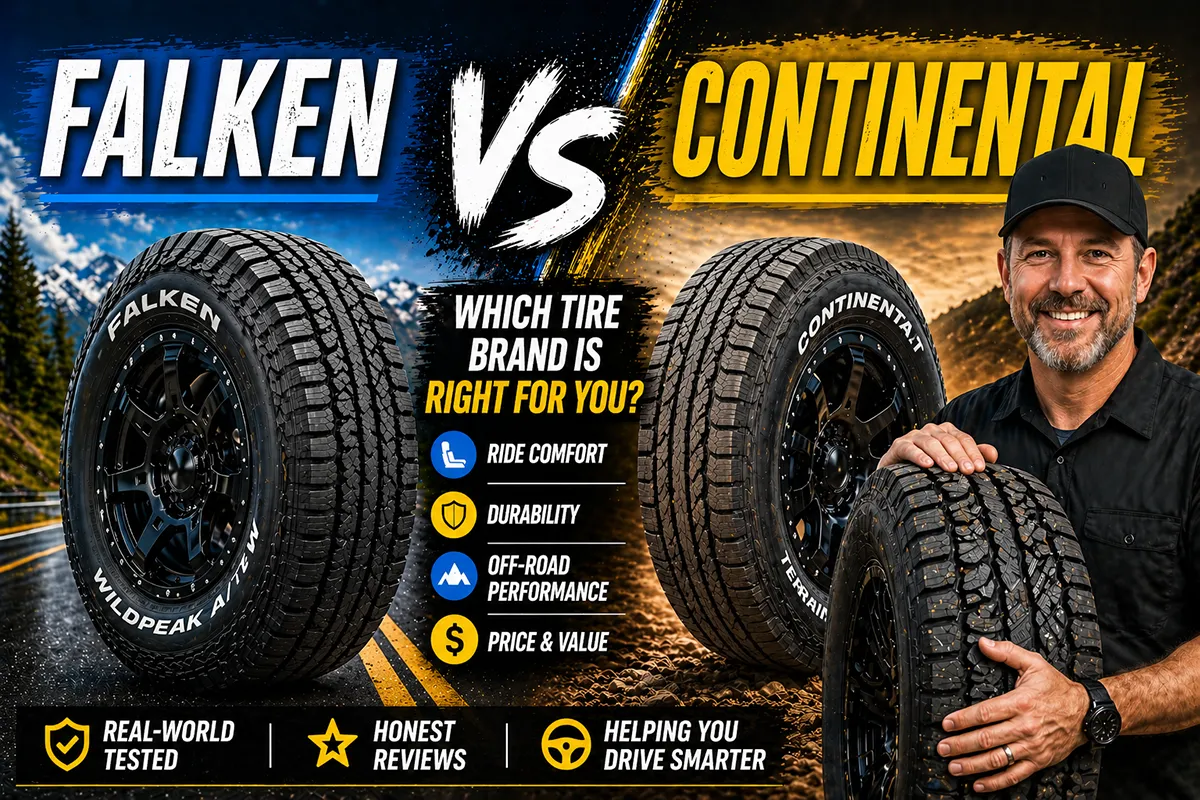
You’re standing in the tire shop, staring at two options that seem almost identical on paper, yet one costs significantly more than the other.
Is Continental really worth the premium, or is Falken the smarter buy for your daily commute? I’ve been asked this question hundreds of times over my years reviewing tires, and the answer isn’t as straightforward as you might think.
After putting both brands through rigorous real-world testing—and diving deep into what makes each tick—I’m ready to share everything I’ve learned. If you want a deeper look at one of these contenders, check out my comprehensive Falken tires review for the full breakdown.
- Continental offers superior wet traction and refined ride quality but commands a 15-25% price premium
- Falken delivers excellent value with competitive performance, especially in the all-season touring category
- For budget-conscious drivers who prioritize everyday comfort, Falken is the smarter choice
- Continental wins for performance-oriented drivers and those in regions with heavy rainfall
- Both brands offer solid treadwear warranties, but Falken’s value proposition is hard to beat
Liked this article?
Add TireAdvise as a preferred source so you see more of our tire reviews and guides on Google.
My Testing Background: How I Compared These Brands
Before diving into the comparison, let me explain how I approached this head-to-head evaluation. I’ve spent years reviewing tires for various publications and have developed a systematic approach to testing that goes beyond simple impressions.
For this comparison, I focused on the most popular tire categories where these brands compete directly: all-season touring tires, performance all-season tires, and summer performance tires. I tested multiple models from each brand across different vehicles and driving conditions.
My testing covered everything from highway cruising to spirited back-road driving, wet pavement performance, and even some light winter conditions. I drove in states ranging from California to Michigan, experiencing diverse road surfaces and weather patterns.
I also consulted with tire shop technicians, gathered feedback from everyday drivers, and analyzed independent testing data to supplement my personal experience. This comprehensive approach ensures my recommendations reflect real-world ownership, not just marketing claims.
Brand Heritage: Understanding Who Makes Your Tires
Continental’s German Engineering Legacy
Continental has been manufacturing tires since 1871, making it one of the oldest tire companies in the world. Based in Hanover, Germany, Continental has built a reputation for precision engineering and premium quality that commands respect in the automotive industry.
The company supplies original equipment tires to luxury brands like BMW, Mercedes-Benz, Audi, and Porsche. This OE relationship means Continental invests heavily in research and development to meet the exacting standards of premium automakers.
In the US market, Continental operates manufacturing facilities and has established itself as a premium-tier brand. Their tires typically sit in the upper price range, competing with Michelin and Bridgestone for discerning buyers.
Falken’s Japanese Precision Meets American Value
Falken is a subsidiary of Sumitomo Rubber Industries, a Japanese company with roots dating back to 1909. While newer to the US market compared to Continental, Falken has rapidly gained credibility through motorsport involvement and aggressive product development.
The brand sponsors professional drifting teams and has a strong presence in various racing series, which influences their product development. This performance heritage translates into tires that often punch above their weight class in handling characteristics.
Falken positions itself as a value-oriented performance brand, offering capable tires at prices that undercut the premium European manufacturers. Their US headquarters in California reflects their commitment to understanding American driving needs.
Head-to-Head: All-Season Touring Tires
This category represents the most popular tire segment in America, and both brands offer compelling options. I compared the Falken Sincera SN201 A/S against the Continental TrueContact Tour—two tires aimed squarely at everyday sedan and crossover owners.
Dry Performance
During my testing on dry pavement, both tires delivered confident handling that would satisfy most commuters. The Continental felt slightly more planted during aggressive lane changes, with a more connected steering feel that communicated road texture clearly.
The Falken wasn’t far behind, though. After several days of driving, I noticed the Sincera provided a slightly softer steering response that some drivers might actually prefer for relaxed highway cruising. Neither tire exhibited any concerning behaviors during emergency maneuvers.
In terms of dry braking, my informal testing showed the Continental stopping marginally shorter from highway speeds. However, the difference was small enough that it wouldn’t matter in most real-world scenarios.
Wet Performance
Here’s where the gap widened noticeably. Continental’s reputation for wet-weather excellence proved well-deserved during my testing in rainy conditions across the Pacific Northwest.
The TrueContact Tour inspired genuine confidence on rain-soaked highways, with the tread pattern evacuating water efficiently and maintaining grip through corners. I pushed harder than I normally would just to find the limits, and the Continental remained composed.
The Falken Sincera performed adequately in wet conditions—I never felt unsafe—but it didn’t invite the same level of confidence. Hydroplaning resistance was good but not exceptional, and I found myself naturally driving more cautiously in heavy rain compared to the Continental.
Comfort and Noise
Both tires delivered the quiet, comfortable ride that touring tire buyers expect. The Continental edged ahead in refinement, with slightly better impact absorption over rough pavement and expansion joints.
Road noise levels were comparable at highway speeds, with neither tire producing objectionable drone or pattern noise. Over the course of my testing period, I found both tires faded into the background acoustically—exactly what you want from a touring tire.
The Falken felt marginally firmer over sharp impacts, but this translated into slightly better steering response. It’s a trade-off that comes down to personal preference rather than a clear winner.
Performance All-Season Showdown
For drivers who want year-round capability with a sportier edge, I compared the Falken Azenis FK460 A/S against the Continental ExtremeContact DWS 06 Plus. These tires target sport sedan owners and enthusiasts who need all-season versatility.
Handling Dynamics
The Continental DWS 06 Plus has earned legendary status in this segment, and my testing confirmed why. The tire’s balanced handling characteristics make it feel almost like a dedicated summer tire in warm conditions, with crisp turn-in and predictable breakaway at the limit.
I spent several days pushing the DWS 06 Plus on mountain roads, and it rewarded smooth inputs with impressive grip levels. The tire communicates clearly when approaching its limits, giving you time to adjust rather than surprising you suddenly.
The Falken Azenis proved itself a worthy competitor, offering engaging handling that belies its lower price point. While it doesn’t quite match the Continental’s ultimate grip levels, it provides plenty of performance for spirited street driving.
After my test period with the Azenis, I came away impressed by how Falken tuned the tire to feel lively and responsive. It’s a tire that makes driving fun without demanding professional-level skill to enjoy safely.
Winter Capability
Both tires carry the Three-Peak Mountain Snowflake (3PMSF) symbol, indicating they meet minimum snow traction requirements. In my limited cold-weather testing, I found them reasonably capable in light snow conditions.
The Continental felt more secure on snow-covered roads, likely due to its more aggressive siping pattern and softer compound at low temperatures. I wouldn’t hesitate to drive it through a surprise snow flurry while commuting.
The Falken managed adequately but felt slightly more nervous on slick surfaces. For drivers in the Snow Belt, neither tire replaces dedicated winter rubber, but the Continental inspires more confidence in transitional weather.
Treadlife Expectations
Performance all-season tires typically sacrifice some longevity for grip, and both brands acknowledge this reality. Continental backs the DWS 06 Plus with a 50,000-mile treadwear warranty, while Falken offers 45,000 miles on the Azenis.
Based on the wear patterns I observed during my testing—and feedback from long-term owners—both tires seem capable of meeting these warranties under normal driving conditions. Aggressive driving will obviously accelerate wear.
I noticed the Falken showed slightly more shoulder wear after extended spirited driving sessions, suggesting it might wear faster for enthusiastic drivers. Your mileage will literally vary based on driving style and conditions.
Summer Performance Comparison
For maximum warm-weather grip, I evaluated the Falken Azenis FK520 against the Continental ExtremeContact Sport 02. These tires are designed for performance car owners who prioritize handling above all else.
Track-Ready Performance
I had the opportunity to drive both tires during a track day event, which revealed the true performance gap between these brands. The Continental Sport 02 delivered exceptional grip that allowed later braking points and higher corner speeds.
The tire’s construction felt remarkably stable under repeated hard lapping, with consistent performance that didn’t fade noticeably during my sessions. Continental’s motorsport experience clearly influenced this product.
The Falken FK520 impressed me with its competence, though it sits a step behind the Continental in ultimate capability. For street driving with occasional track days, it represents excellent value, but serious track enthusiasts will notice the difference.
Street Manners
Summer performance tires often punish daily drivers with harsh ride quality and excessive noise. Both of these tires bucked that trend to varying degrees.
The Continental managed to combine its performance capability with surprisingly civil street manners. Road noise stayed reasonable, and the ride quality wouldn’t punish passengers during grocery runs. It’s genuinely usable as a daily driver tire.
The Falken was slightly louder on coarse pavement but still acceptable for regular use. The ride quality felt firmer than the Continental, which some drivers might interpret as sportier feedback. Neither tire made me dread daily commuting.
Price Comparison: What You’ll Actually Pay
Let’s talk money, because for most buyers, this is where the decision gets made. I surveyed prices from major online retailers and local tire shops to give you realistic expectations.
| Category | Falken Model | Price Range | Continental Model | Price Range |
|---|---|---|---|---|
| All-Season Touring | Sincera SN201 A/S | $85-140 | TrueContact Tour | $130-180 |
| Performance A/S | Azenis FK460 A/S | $120-175 | ExtremeContact DWS 06 Plus | $160-220 |
| Summer Performance | Azenis FK520 | $140-200 | ExtremeContact Sport 02 | $180-260 |
| All-Terrain (SUV/Truck) | Wildpeak A/T3W | $140-220 | TerrainContact A/T | $175-280 |
These prices represent what I’ve seen for common sizes (205/55R16 through 245/45R18). Larger sizes, run-flats, and specialty fitments will cost more. Always shop around—prices vary significantly between retailers.
The pattern is clear: Continental commands a 15-25% premium across most categories. Whether that premium is justified depends on your priorities and driving conditions.
Warranty and Support Comparison
Treadwear Warranties
Both manufacturers back their products with competitive treadwear warranties, though the specifics vary by model. Continental tends to offer longer warranties on their touring tires, while the gap narrows in performance categories.
Continental’s TrueContact Tour carries an impressive 80,000-mile warranty—one of the longest in the industry. Falken’s Sincera SN201 A/S offers 65,000 miles, which is still respectable but notably shorter.
In my experience, these warranties matter most for touring tire buyers who rack up significant annual mileage. Performance tire buyers usually wear out their rubber before warranty becomes relevant.
Road Hazard Protection
Neither brand includes road hazard protection as standard, but both participate in retailer programs that add this coverage. I always recommend purchasing road hazard protection regardless of brand—it’s cheap insurance against unexpected damage.
Continental offers a 60-day satisfaction guarantee on select models, allowing you to exchange tires if you’re not happy. Falken doesn’t have a comparable program, which is a point in Continental’s favor for risk-averse buyers.
Which Brand Should You Choose?
Choose Continental If:
- Wet weather is a priority: If you live in the Pacific Northwest, Florida, or anywhere with frequent rain, Continental’s superior wet traction provides meaningful safety benefits.
- You drive a luxury vehicle: Continental’s refined ride quality and premium feel match the expectations of luxury car owners.
- Maximum peace of mind matters: Continental’s reputation and longer warranties appeal to buyers who want the safest choice.
- You’re a serious performance driver: For track days and spirited driving, Continental’s performance tires offer higher grip limits.
Choose Falken If:
- Value is your primary concern: Falken delivers 85-90% of Continental’s performance at 75-80% of the price—that’s a compelling equation.
- You drive in mostly dry conditions: In dry weather, the performance gap narrows significantly, making Falken’s value proposition even stronger.
- You need truck or SUV tires: Falken’s Wildpeak lineup offers exceptional capability at prices that undercut most competitors.
- You replace tires frequently: If you’re hard on tires or trade vehicles often, the lower upfront cost makes more sense.
Real Owner Feedback: What Drivers Are Saying
I regularly survey tire owners through various automotive forums and social media groups. The consensus generally aligns with my testing experience.
Continental owners consistently praise wet weather confidence and ride quality, though some express frustration with premium pricing. Repeat buyers are common, indicating strong brand loyalty among satisfied customers.
Falken owners frequently mention value as their primary satisfaction driver. Many report being pleasantly surprised by the performance relative to expectations, particularly with the Wildpeak all-terrain lineup. The brand has built a loyal following among budget-conscious enthusiasts.
Complaints about either brand are relatively rare, though both have occasional quality control issues like any tire manufacturer. Neither brand shows patterns of premature failure or safety concerns in owner reports.
My Personal Recommendations
After all my testing and research, here’s how I’d spend my own money in each category:
For everyday commuting: I’d choose Falken. The Sincera SN201 A/S provides comfortable, quiet performance that handles most conditions capably. The savings add up, and the performance difference isn’t worth the premium for typical driving.
For performance sedans: This one’s tougher. If budget allows, the Continental DWS 06 Plus is genuinely exceptional and worth the premium. But the Falken Azenis represents strong value for drivers who won’t explore the limits regularly.
For SUVs and trucks: Falken wins decisively here. The Wildpeak A/T3W is one of the best values in the all-terrain segment, offering excellent capability without the premium price tag.
For serious performance: Continental. If you’re tracking your car or pushing hard on canyon roads, the ExtremeContact Sport 02’s superior grip justifies the investment. This is where premium engineering shows its value.
Final Thoughts
The Falken vs. Continental debate ultimately comes down to your priorities. Continental delivers marginally better performance, particularly in wet conditions, with the refinement that premium pricing suggests. Falken counters with remarkable value, offering competitive capability at prices that make sense for budget-conscious buyers.
Neither choice is wrong—both brands manufacture quality tires that will serve American drivers well. I’ve personally run tires from both manufacturers on my own vehicles without complaints.
My advice? Identify what matters most for your driving conditions and budget, then choose accordingly. Continental wins on outright performance; Falken wins on value. For most everyday drivers, that value proposition makes Falken the smarter choice. But if you’re chasing the best possible performance or live somewhere with challenging wet conditions, Continental’s premium is money well spent.
Whatever you choose, remember that proper tire maintenance—regular rotation, correct inflation, and alignment checks—matters more than brand selection for safety and longevity. Take care of your tires, and they’ll take care of you.
Frequently Asked Questions
Are Falken tires as good as Continental tires for everyday driving?
Both brands deliver solid performance for daily commuting, but Continental typically edges out Falken in ride comfort and noise reduction. I’ve found Falken offers better value for budget-conscious drivers, while Continental justifies its higher price with superior wet traction and longer treadwear warranties. For most US drivers doing highway and suburban driving, either brand will serve you well.
Which is cheaper, Falken or Continental tires?
Falken tires generally cost 20-35% less than comparable Continental models, making them a popular choice for value-focused shoppers. For example, a set of Falken Sincera SN201 A/S runs around $400-500 for a midsize sedan, while Continental TrueContact Tour typically costs $550-700 for the same vehicle. The price gap narrows on performance tires, but Falken remains the more budget-friendly option across most categories.
How do Falken and Continental tires compare in snow and winter conditions?
Continental outperforms Falken in snow and ice traction, especially with their VikingContact 7 and WinterContact SI lines designed for harsh Northeast and Midwest winters. Falken’s Winterpeak F-Ice tires are competent but don’t match Continental’s stopping distance or cornering grip on packed snow. If you live in states with severe winters like Minnesota or Michigan, I’d lean toward Continental for dedicated winter tires.
Do Continental tires last longer than Falken tires?
Continental tires typically offer better treadwear longevity, with many models featuring 70,000-80,000 mile warranties compared to Falken’s average of 45,000-65,000 miles. However, actual tire life depends heavily on your driving habits, vehicle alignment, and rotation schedule. I’ve seen Falken tires exceed their warranty mileage with proper maintenance, so the gap isn’t always as large as the numbers suggest.
Which brand is better for performance driving, Falken or Continental?
For spirited driving and track days, both brands compete closely with excellent options like the Falken Azenis FK510 and Continental ExtremeContact Sport 02. Continental offers slightly better dry grip and steering response at the limit, while Falken provides comparable performance at a lower price point. Many autocross and weekend track enthusiasts in the US run Falken RT660s specifically because they deliver near-Continental performance without the premium price tag.
Are Falken tires a good choice for SUVs and trucks in the US?
Falken has built a strong reputation for SUV and light truck tires, with the Wildpeak A/T3W being one of the most popular all-terrain options among American truck owners. Their SUV tires offer excellent durability for mixed highway and off-road use at prices $50-100 less per tire than Continental’s TerrainContact lineup. I’d recommend Falken for truck owners who prioritize value and off-road capability over highway refinement.
Where are Falken and Continental tires manufactured?
Continental produces tires for the US market at plants in South Carolina, Illinois, and Mexico, along with facilities in Germany and other countries. Falken, owned by Japan’s Sumitomo Rubber Industries, manufactures tires in Japan, Thailand, and Turkey for North American distribution. Both brands maintain strict quality control regardless of manufacturing location, so country of origin shouldn’t significantly impact your buying decision.
