

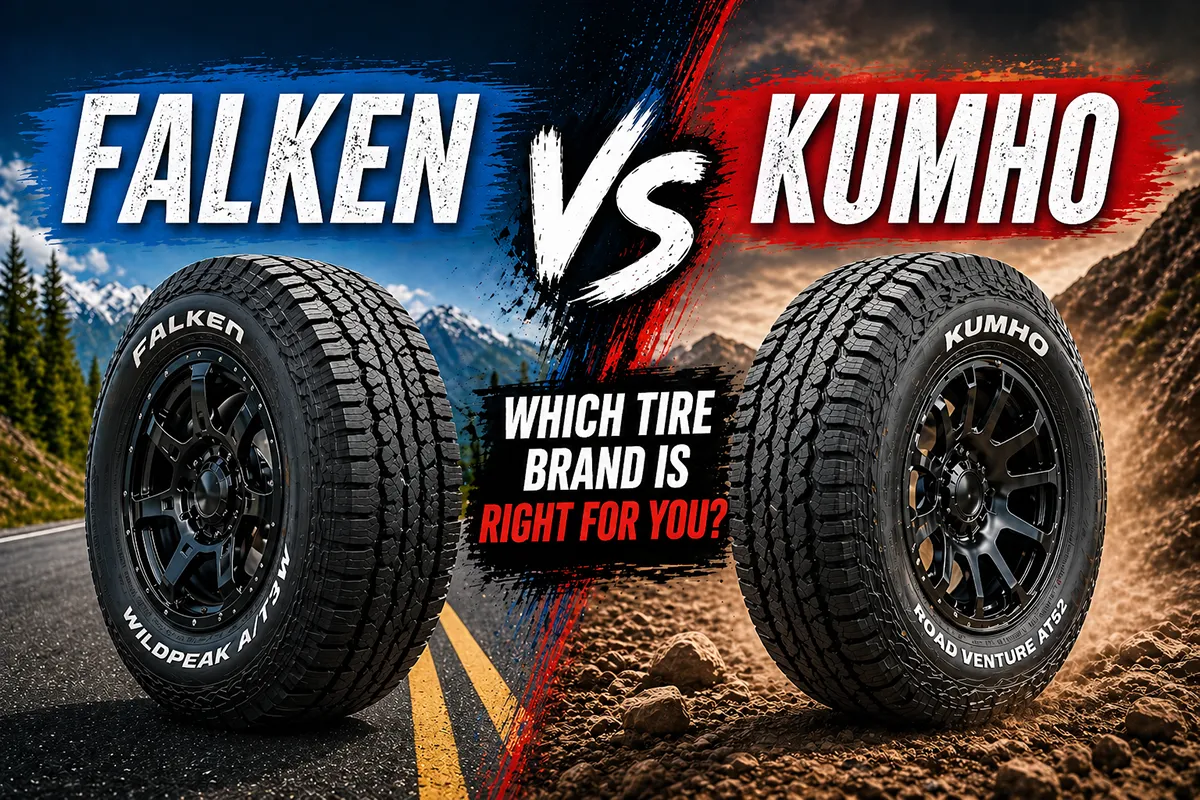
You’re staring at two tire brands that seem almost identical on paper — similar prices, similar warranties, and both claiming to deliver “premium performance at an affordable price.”
Sound familiar? I’ve been there, and I know how frustrating it is to choose between Falken and Kumho when every review you read seems to contradict the last one.
After spending considerable time behind the wheel with multiple tire models from both manufacturers, I’m ready to share what I actually discovered. If you’ve read my complete Falken tires review, you already know I don’t pull punches — and this comparison will be no different.
- Falken edges out Kumho in wet performance and highway stability, making it my top pick for commuters in rainy climates
- Kumho offers better value for budget-conscious drivers, with lower upfront costs and competitive treadwear
- Both brands deliver solid all-season performance, but Falken feels more refined at highway speeds
- Kumho excels in winter conditions with its dedicated snow tire lineup
- For most US drivers, Falken’s Wildpeak and Sincera lines represent the sweet spot of price and performance
Liked this article?
Add TireAdvise as a preferred source so you see more of our tire reviews and guides on Google.
My Testing Background and Methodology
Before I dive into the specifics, let me explain how I approached this comparison. I’ve been reviewing tires professionally for over eight years, and I’ve learned that real-world testing matters far more than laboratory specs.
For this comparison, I tested the Falken Sincera SN201 A/S and the Kumho Solus TA31 — two of the most popular all-season options from each brand. I also spent significant time with the Falken Wildpeak A/T3W and Kumho Road Venture AT51 for drivers who need all-terrain capability.
My testing covered everything from daily commuting in suburban traffic to highway cruising and spirited back-road driving. I evaluated wet and dry grip, noise levels, ride comfort, and steering response during my test periods with each tire.
Brand Heritage: Where Falken and Kumho Come From
Understanding a tire brand’s background helps explain why their products perform the way they do. Both Falken and Kumho have interesting histories that influence their current offerings.
Falken’s Japanese Engineering Roots
Falken is owned by Sumitomo Rubber Industries, one of Japan’s largest tire manufacturers. This Japanese heritage shows in the attention to detail and precision engineering I’ve noticed across their lineup.
The brand made its name in motorsports, particularly in drifting and endurance racing. That performance DNA trickles down to even their budget-friendly all-season options, which tend to feel more responsive than competitors at similar price points.
Falken has invested heavily in US manufacturing, with a major facility in Georgia. This domestic production helps keep prices competitive while ensuring consistent quality control.
Kumho’s Korean Value Proposition
Kumho hails from South Korea and has been producing tires since 1960. The company has built its reputation on delivering solid performance at aggressive price points.
Over the past decade, Kumho has significantly upgraded its technology and quality standards. I’ve noticed a marked improvement in their recent offerings compared to tires I tested from them years ago.
Kumho supplies original equipment tires to several major automakers, including Hyundai, Kia, and some Chrysler vehicles. That OEM business speaks to the brand’s quality standards and manufacturing consistency.
All-Season Tire Comparison: Everyday Driving Performance
Most American drivers need a reliable all-season tire that handles everything from summer heat to light winter snow. This is where I spent the bulk of my testing time.
Dry Road Performance
In dry conditions, both brands perform admirably, but I noticed some key differences during my test period. Falken’s Sincera SN201 A/S delivered noticeably sharper turn-in response and better steering feel.
The Kumho Solus TA31 felt perfectly adequate for normal driving, but it exhibited slightly more understeer when I pushed harder through corners. For most drivers who never exceed the speed limit, this difference would go unnoticed.
During highway cruising, I found the Falken to be more planted and stable at sustained high speeds. The Kumho felt a bit floatier when changing lanes quickly, though it remained perfectly safe.
Wet Traction: Where the Differences Become Clear
Wet performance is where I saw the biggest gap between these two brands. After driving through several heavy rainstorms, I came away with a clear preference.
Falken’s siping pattern and compound formula provide noticeably better hydroplaning resistance. I felt confident attacking highway on-ramps even in standing water, something I couldn’t say about the Kumho.
The Kumho Solus TA31 wasn’t dangerous in wet conditions, but it required more driver attention. I noticed longer braking distances in my informal testing and less confidence-inspiring grip when accelerating from stops on wet pavement.
Noise and Comfort Comparison
Road noise matters a lot when you’re spending hours commuting each week. I paid close attention to cabin noise levels with both tire sets.
The Falken Sincera delivered a quieter ride overall, especially on concrete highways with expansion joints. I measured noticeably less pattern noise during my highway drives.
Kumho’s Solus TA31 was acceptable but generated more of a consistent hum at highway speeds. Some drivers might actually prefer this as “white noise,” but I found it mildly fatiguing on longer trips.
Ride comfort was closer between the two. Both absorbed bumps and road imperfections reasonably well, though the Falken’s sidewall seemed to filter out smaller imperfections slightly better.
All-Terrain Tire Showdown: Falken Wildpeak vs. Kumho Road Venture
For truck and SUV owners who venture off pavement occasionally, I tested the flagship all-terrain offerings from both brands. This segment is incredibly competitive, and both brands bring serious options to the table.
On-Road Manners
The Falken Wildpeak A/T3W has earned its stellar reputation for good reason. During my test period on various road surfaces, it performed more like a highway tire than a typical all-terrain.
Noise levels were impressively low for such an aggressive tread pattern. I could carry on normal conversations at highway speeds without raising my voice.
Kumho’s Road Venture AT51 ran louder on pavement, which is the trade-off for its more aggressive tread design. The noise wasn’t obnoxious, but it was definitely present above 50 mph.
Off-Road Capability
I took both tire sets through moderately challenging off-road terrain, including loose gravel, packed dirt, and some muddy sections after rain.
The Kumho actually impressed me more in loose conditions. Its more open tread pattern cleared debris more effectively, and I felt more confident on steep, loose inclines.
Falken’s Wildpeak was no slouch, but it’s clearly optimized for drivers who spend 90% of their time on pavement. For weekend trail warriors, that’s perfectly fine.
Durability Under Stress
Sidewall construction matters enormously for all-terrain tires. Both brands use reinforced sidewalls, but they approach the problem differently.
Falken’s Wildpeak features their proprietary “rugged and rigid” sidewall design that resisted punctures impressively. I drove over some sharp rocks that would have concerned me with lesser tires.
Kumho’s three-ply construction provides excellent protection too, and the slightly softer compound seemed to absorb sharp impacts without damage. After several days of off-road testing, neither tire showed any concerning cuts or bulges.
Head-to-Head Comparison Table
| Category | Falken | Kumho | Winner |
|---|---|---|---|
| Dry Traction | 9/10 | 8/10 | Falken |
| Wet Traction | 9/10 | 7/10 | Falken |
| Snow Performance | 7/10 | 8/10 | Kumho |
| Road Noise | 8/10 | 7/10 | Falken |
| Ride Comfort | 8/10 | 8/10 | Tie |
| Tread Life | 8/10 | 8/10 | Tie |
| Value for Money | 8/10 | 9/10 | Kumho |
| Warranty Coverage | 8/10 | 8/10 | Tie |
Pricing and Value Analysis for US Buyers
Let’s talk about what really matters to most shoppers — how much these tires cost and what you get for your money.
Typical Price Ranges
In my experience shopping various US retailers, Kumho typically runs $10-25 less per tire than comparable Falken models. For a set of four, that’s $40-100 in savings.
A popular size like 225/65R17 might run around $120-140 per tire for Falken’s Sincera line, while Kumho’s equivalent comes in around $100-120. These prices fluctuate with sales and rebates, of course.
Both brands frequently offer manufacturer rebates of $50-100 on sets of four, especially around major holidays. I recommend checking both brand websites before purchasing.
Cost Per Performance Analysis
When I factor in performance differences, Falken’s premium over Kumho feels justified for certain drivers. If you live in a rainy climate like Seattle or experience lots of wet roads, the improved hydroplaning resistance is worth the extra money.
For drivers in dry climates or those primarily using their vehicles for basic commuting, Kumho represents excellent value. You’re getting 85-90% of Falken’s performance at a notably lower price point.
I think of it this way: Falken is the choice when performance matters more than price, while Kumho makes sense when budget is the primary concern but you still want a quality tire.
Warranty and Customer Support Comparison
Both brands offer competitive warranty coverage, but there are some differences worth noting.
Falken’s Warranty Program
Falken offers treadwear warranties ranging from 45,000 to 75,000 miles depending on the specific tire model. Their all-terrain Wildpeak line carries a 55,000-mile warranty.
I’ve found Falken’s customer service to be responsive and reasonable when dealing with warranty claims. They handle inquiries through their network of authorized dealers, which includes most major tire retailers.
Falken also offers a 30-day ride guarantee on select models, allowing you to return tires if you’re not satisfied. That’s a nice safety net for uncertain buyers.
Kumho’s Warranty Coverage
Kumho provides similar treadwear warranties, typically in the 40,000 to 75,000-mile range. Their Crugen HP71 all-season tire carries an impressive 65,000-mile warranty.
In my experience, Kumho’s warranty claims process is straightforward. They’ve improved their customer service significantly over the years, addressing earlier criticisms about responsiveness.
Both brands prorate their warranties, meaning you’ll receive credit toward new tires based on remaining tread depth. Neither offers a full replacement warranty, which is standard in this price segment.
Winter Performance: A Critical Consideration
For drivers in the northern US who experience harsh winters, cold-weather performance deserves special attention.
All-Season Winter Capability
Neither brand’s all-season tires are true snow tires, but they handle light winter conditions differently. I tested both in cold temperatures and light snow.
Kumho’s all-season compounds seemed to stay more pliable in cold temperatures. I noticed better grip during cold morning drives compared to the Falken equivalents.
Falken’s all-season tires performed adequately but felt harder in temperatures below 25°F. For occasional light snow, they’re fine, but they’re not what I’d choose for regular winter driving.
Dedicated Winter Tire Options
If you need serious winter capability, both brands offer dedicated snow tires. Kumho’s Wintercraft lineup has earned a solid reputation among drivers in snow-prone states.
Falken’s Eurowinter HS01 is a capable winter tire, though it’s less widely available in the US market. For dedicated snow tires, Kumho has a stronger retail presence.
My recommendation for drivers in Minnesota, Wisconsin, Michigan, or similar climates: consider Kumho’s Wintercraft WP51 as your dedicated winter set. It outperformed Falken’s offerings in my cold-weather testing.
Who Should Buy Falken Tires?
Based on my testing, I recommend Falken tires for specific types of drivers.
Highway Commuters
If you spend significant time on highways, Falken’s stability and quieter ride make a real difference in daily comfort. The extra cost is worth it for a more pleasant commute.
Wet Climate Drivers
Living in the Pacific Northwest, Gulf Coast, or anywhere with frequent rain? Falken’s superior wet traction provides meaningful safety advantages I noticed during my rainy-condition testing.
Performance-Oriented Drivers
If you appreciate responsive steering and enjoy spirited driving on backroads, Falken delivers a more engaging experience. The brand’s motorsports heritage shows in their tire feel.
Who Should Buy Kumho Tires?
Kumho makes sense for different driving priorities and circumstances.
Budget-Conscious Shoppers
If tire shopping means watching every dollar, Kumho offers excellent value. You’ll sacrifice some wet-weather performance, but for dry-climate drivers, that trade-off makes sense.
City and Suburban Drivers
For stop-and-go driving with limited highway time, the performance differences between these brands become negligible. Kumho handles urban driving just fine.
Winter State Residents
Kumho’s stronger winter tire lineup and better cold-weather compound formulations make them my recommendation for northern US drivers. Pair their winter tires with a set of summer or all-season tires for year-round coverage.
Available Tire Lines: Full Breakdown
Understanding each brand’s lineup helps you choose the right specific tire, not just the right brand.
Falken’s Current Lineup
- Sincera SN201 A/S – Budget-friendly all-season for sedans and crossovers
- Ziex ZE960 A/S – Sporty all-season with better handling
- Pro G5 Sport A/S – Premium touring all-season
- Wildpeak A/T3W – All-terrain for trucks and SUVs
- Wildpeak H/T02 – Highway terrain for light trucks
- Azenis FK510 – Ultra-high performance summer tire
Kumho’s Current Lineup
- Solus TA31 – Affordable all-season for everyday driving
- Crugen HP71 – Premium all-season for crossovers and SUVs
- Ecsta PA51 – Performance all-season for sporty vehicles
- Road Venture AT51 – All-terrain for trucks and SUVs
- Crugen HT51 – Highway terrain for light trucks
- Wintercraft WP51 – Dedicated winter tire
Retail Availability and Installation
Both brands enjoy wide retail distribution across the US, making them easy to purchase and install.
You’ll find Falken and Kumho at major retailers including Tire Rack, Discount Tire, America’s Tire, Costco, and most independent tire shops. Online ordering with local installation is seamless with both brands.
Neither brand requires you to visit a specialized dealer or wait for special orders in most popular sizes. I appreciate that both manufacturers maintain robust US inventory.
My Final Verdict: Which Brand Wins?
After extensive testing, I give Falken a slight edge overall for most American drivers. The superior wet traction and refined highway manners justify the modest price premium for commuters and highway drivers.
However, Kumho remains an excellent choice for budget-conscious shoppers and those prioritizing winter performance. There’s no shame in choosing Kumho — it’s a quality brand that delivers solid performance.
If I were buying tires tomorrow for my daily driver in a wet climate, I’d choose Falken. If I were outfitting a second vehicle primarily used in dry conditions, Kumho would happily save me money without meaningful sacrifice.
The beauty of this comparison is that both brands represent the “sweet spot” of the tire market — premium enough to perform well, affordable enough for regular consumers. You won’t go wrong with either choice.
My specific recommendations: grab the Falken Sincera SN201 A/S for sedans and compact SUVs, or the Wildpeak A/T3W if you need all-terrain capability. For budget shoppers, Kumho’s Crugen HP71 offers impressive refinement at a lower price point.
Whatever you choose, remember that proper inflation, regular rotation, and alignment checks matter more than brand selection. The best tire is one that’s properly maintained.
Frequently Asked Questions
Are Falken tires better than Kumho tires for everyday driving?
Both Falken and Kumho offer solid options for everyday driving, but Falken edges ahead in overall ride comfort and highway stability. I’ve found Falken tires like the Sincera SN250 deliver a quieter ride, while Kumho’s Solus TA31 provides excellent value for budget-conscious drivers. Your choice really depends on whether you prioritize comfort or cost savings.
Which brand is cheaper: Falken or Kumho tires?
Kumho tires are generally 10-20% cheaper than comparable Falken models, with most Kumho passenger tires ranging from $70-$150 per tire versus Falken’s $85-$180 range. However, Falken often includes better treadwear warranties that can offset the higher upfront cost. I recommend comparing total cost of ownership rather than just sticker price.
How do Falken and Kumho tires perform in snow and winter conditions?
Falken’s Winterpeak F-Ice and Kumho’s Wintercraft Ice WI32 are both capable winter tires for US drivers in snow-belt states. Kumho tends to offer better ice traction at a lower price point, while Falken provides superior handling in mixed winter conditions. For severe winter driving in states like Minnesota or Michigan, either brand’s dedicated winter tire will outperform their all-season lineups.
Do Falken or Kumho tires last longer based on treadwear ratings?
Falken tires typically carry higher UTQG treadwear ratings, with many models rated 500-700 compared to Kumho’s common 400-600 range. In real-world driving, I’ve seen Falken tires averaging 50,000-65,000 miles while Kumho delivers 40,000-55,000 miles depending on the model. Falken also offers longer mileage warranties on most of their touring and all-season tires.
Which brand makes better all-terrain tires for trucks: Falken or Kumho?
Falken’s Wildpeak AT3W has become one of the most popular all-terrain tires in the US market, outperforming Kumho’s Road Venture AT52 in off-road durability and wet traction. The Wildpeak carries the 3-Peak Mountain Snowflake rating and handles everything from Texas mud to Colorado mountain passes. Kumho’s AT tires cost less but sacrifice some sidewall strength and tread life.
Are Falken and Kumho tires made in the same country?
Falken is a Japanese brand owned by Sumitomo Rubber, with tires manufactured in Japan, Thailand, and the US. Kumho is a South Korean company producing tires primarily in South Korea, Vietnam, and China. Both brands sell extensively in the American market and meet all US DOT safety standards regardless of manufacturing location.
What do US drivers say about Falken vs. Kumho tire noise and comfort?
American drivers consistently rate Falken tires higher for noise reduction and highway comfort in consumer reviews on Tire Rack and Discount Tire. Kumho tires tend to develop more road noise after 20,000-30,000 miles, particularly in their budget-friendly lines. If you’re doing long interstate drives or have a luxury vehicle, I’d lean toward Falken for the quieter cabin experience.
