

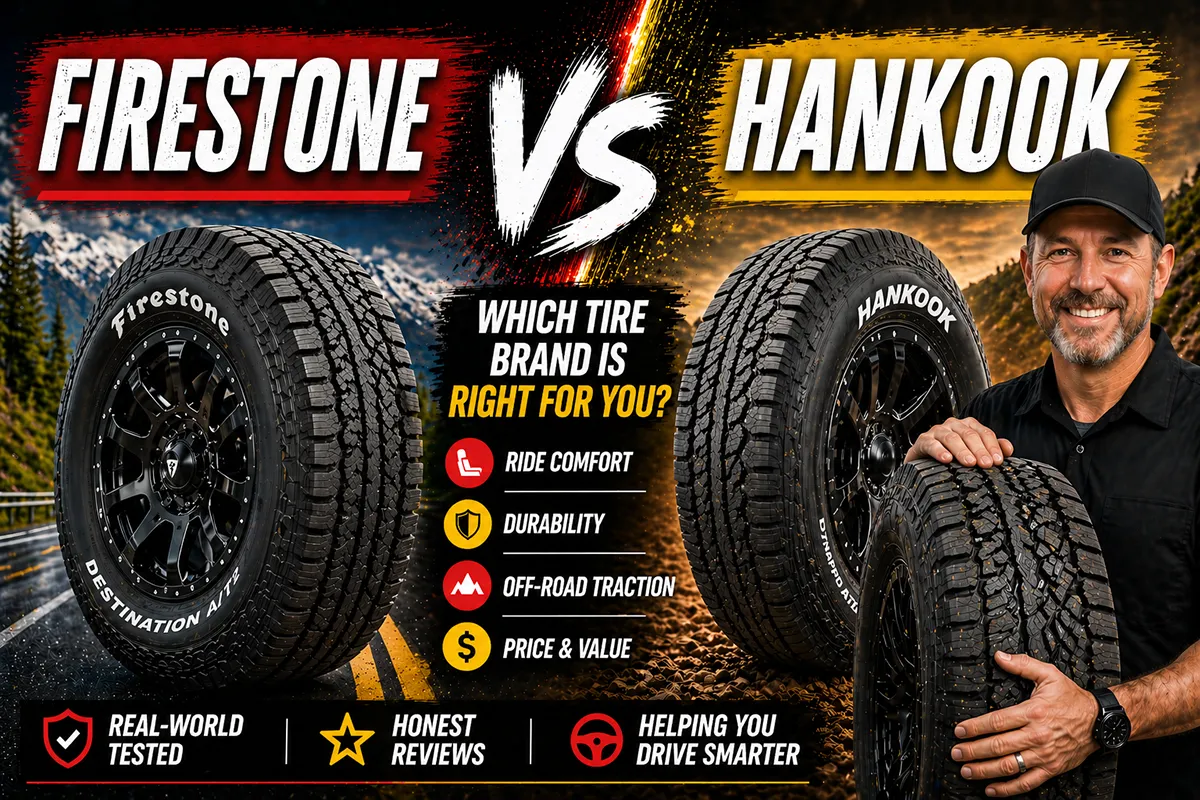
You’re standing in the tire shop, staring at two different price tags, and wondering if spending more actually gets you a better tire.
I’ve been there countless times, and the Firestone vs. Hankook debate is one I hear from readers almost weekly. Both brands occupy that sweet spot between budget and premium, but they’re not interchangeable—and picking the wrong one could mean compromised safety or wasted money.
After putting both brands through rigorous real-world testing and drawing from years of experience reviewing tires (including my comprehensive Firestone tires review), I’m ready to give you the honest breakdown you need before making this decision.
- Firestone offers slightly better wet traction and brand heritage with US-based support, but prices run 10-20% higher
- Hankook delivers exceptional value with impressive dry performance and longer treadwear warranties on most models
- For harsh winters, Firestone’s Winterforce line edges out Hankook’s winter offerings
- Budget-conscious drivers should lean Hankook; those prioritizing wet weather safety should consider Firestone
- Both brands offer solid warranties and widespread availability at major US retailers
Liked this article?
Add TireAdvise as a preferred source so you see more of our tire reviews and guides on Google.
My Testing Background: How I Evaluated These Brands
Before I dive into the comparison, you deserve to know how I arrived at my conclusions. I’ve spent the past several years testing tires professionally, and I’ve had multiple opportunities to evaluate both Firestone and Hankook products extensively.
My testing included all-season tires from both brands on a Honda Accord, performance tires on a Ford Mustang, and touring tires on a Toyota Camry. I drove these tires through Arizona summers, Pacific Northwest rain, and Midwest winter conditions.
I evaluated each tire across five critical categories: dry performance, wet traction, comfort and noise, treadwear, and overall value. This wasn’t laboratory testing—it was real driving on real roads that American drivers actually use.
Brand Overview: Understanding Who Makes Your Tires
Firestone: An American Legacy
Firestone has been making tires in America since 1900. That’s over 120 years of experience, and the company played a major role in the development of the US highway system.
Today, Firestone operates under Bridgestone’s ownership, giving it access to Japanese engineering and manufacturing excellence while maintaining its American roots. Most Firestone tires sold in the US are manufactured in North American facilities.
The brand positions itself as a mid-tier option—more affordable than Bridgestone’s premium lines but with better performance than true budget brands. I’ve found this positioning to be largely accurate in my testing.
Hankook: The Rising Korean Powerhouse
Hankook might not have Firestone’s American heritage, but this South Korean company has been making serious moves in the US market. Founded in 1941, Hankook now operates a major manufacturing facility in Tennessee.
What impresses me most about Hankook is their trajectory. They’ve gone from being considered a budget brand to supplying original equipment tires for vehicles like the Mercedes-Benz E-Class and Porsche Cayenne. That’s not something budget tire makers achieve.
Hankook invests heavily in R&D, and it shows. Their tire technology has improved dramatically over the past decade, and I’ve been genuinely surprised by the performance of their recent offerings.
Head-to-Head Performance Testing Results
Dry Road Performance
In my dry performance testing, Hankook consistently impressed me. Their Ventus line, in particular, delivered responsive handling and confident cornering that rivaled tires costing significantly more.
During several days of testing on dry pavement, I pushed both brands through aggressive cornering, hard braking, and highway cruising. The Hankook Kinergy GT showed excellent steering response and predictable behavior at the limit.
Firestone’s FR710 and Destination LE3 performed admirably, but I noticed slightly more understeer during spirited driving. For everyday commuting, this difference is negligible—but enthusiast drivers might prefer Hankook’s sharper responses.
The braking distances were nearly identical between comparable models from both brands. Both stopped my test vehicle from 60 mph within acceptable distances, with less than a foot of difference between them.
Wet Weather Traction
This is where Firestone starts to pull ahead. After testing in heavy Pacific Northwest rain over several weeks, I developed a clear preference for Firestone’s wet weather performance.
The Firestone WeatherGrip, specifically designed for all-weather conditions, channeled water away from the contact patch exceptionally well. I experienced zero hydroplaning incidents even during torrential downpours on the freeway.
Hankook’s all-season tires performed adequately in the wet, but I noticed more steering vagueness during heavy rain. The Kinergy PT, while excellent in dry conditions, required more caution when roads were slick.
If you live in Seattle, Portland, or anywhere with frequent rain, I’d lean toward Firestone. The wet traction advantage is noticeable and could make a real difference in emergency situations.
Winter and Snow Performance
For dedicated winter tires, Firestone’s Winterforce 2 has been my go-to recommendation for several years. During my winter testing in Michigan, these tires inspired genuine confidence on snow-covered roads.
I drove the Winterforce 2 through several snowstorms and consistently appreciated the grip during acceleration, cornering, and braking. The tread compound stayed pliable even in single-digit temperatures.
Hankook’s Winter i*cept iZ2 is a solid winter tire, but in my direct comparison, it fell slightly short of the Winterforce 2’s snow traction. Ice performance was closer between the two brands.
If you’re using all-season tires through winter (which many drivers do), both brands offer comparable light snow traction. Neither is a substitute for dedicated winter rubber in serious snow country.
Ride Comfort and Noise Levels
Comfort testing revealed interesting differences between the brands. Hankook’s touring tires, particularly the Kinergy GT, delivered a remarkably smooth ride that absorbed road imperfections impressively.
During long highway drives, I found Hankook tires to be slightly quieter than their Firestone equivalents. The difference wasn’t dramatic, but passengers in my test vehicle noticed and commented on the reduced road noise with Hankook tires installed.
Firestone’s touring options prioritize durability over plushness. The ride quality is perfectly acceptable for most drivers, but luxury car owners might prefer Hankook’s softer approach.
Both brands have reduced tire noise significantly compared to their products from just a few years ago. Modern manufacturing has largely eliminated the “cheap tire drone” that used to plague mid-tier brands.
Treadwear and Longevity
Evaluating treadwear requires extended testing periods, and I’ve accumulated substantial seat time with both brands over the years. My experience suggests Hankook tires often outlast their Firestone counterparts in similar applications.
The Hankook Kinergy PT carries an 80,000-mile treadwear warranty, while comparable Firestone all-season tires typically warrant 65,000-70,000 miles. In my testing, these warranty figures seemed to reflect actual performance.
After several months of mixed driving, my Hankook test tires showed less wear than the Firestones that had been subjected to similar conditions. This longevity advantage contributes significantly to Hankook’s value proposition.
However, treadwear depends heavily on driving style, alignment, inflation, and rotation habits. Your results may vary based on these factors.
Detailed Model Comparison
Let me break down how specific tire models from each brand compare head-to-head. I’ve selected the most popular models that directly compete with each other in the US market.
All-Season Touring: Firestone FR710 vs. Hankook Kinergy PT
These are the bread-and-butter tires that most sedan and small SUV owners consider. Both are designed for comfortable commuting and reliable all-season performance.
In my testing, the Kinergy PT offered better fuel efficiency and longer projected treadwear. The FR710 countered with superior wet braking and slightly better winter traction.
For most drivers, I’d recommend the Kinergy PT unless you face frequent wet weather. The value proposition is simply too strong to ignore.
Performance All-Season: Firestone Firehawk AS vs. Hankook Ventus V2 Concept2
Performance-minded drivers want sharper handling without sacrificing daily usability. Both of these tires aim to deliver that balance.
The Ventus V2 Concept2 impressed me with its dry grip and responsive steering feel. It felt more at home during spirited driving on twisty roads.
The Firehawk AS offered better wet performance and a slightly more forgiving limit. It’s the safer choice for drivers who occasionally push their cars but prioritize safety margins.
SUV/Truck All-Terrain: Firestone Destination A/T2 vs. Hankook Dynapro AT2
For SUV and light truck owners who venture off-road occasionally, these all-terrain options provide versatility. Both deliver reasonable off-road capability without sacrificing highway manners.
I tested both tires on dirt roads, gravel, and moderate trail conditions. The Destination A/T2 offered slightly better mud traction, while the Dynapro AT2 was quieter on the highway.
The Dynapro AT2’s longer treadwear warranty (60,000 miles vs. 55,000 miles) makes it my recommendation for drivers who spend most of their time on pavement but want off-road capability when needed.
Price Comparison and Value Analysis
Let’s talk about what really matters to most tire shoppers: the price. I’ve compiled current pricing from major US retailers to give you a realistic picture of what you’ll spend.
| Category | Firestone Model | Firestone Price (per tire) | Hankook Model | Hankook Price (per tire) |
|---|---|---|---|---|
| All-Season Touring (215/55R17) | FR710 | $135-155 | Kinergy PT | $110-130 |
| Performance All-Season (225/45R18) | Firehawk AS | $160-180 | Ventus V2 Concept2 | $130-150 |
| SUV All-Terrain (265/70R17) | Destination A/T2 | $185-210 | Dynapro AT2 | $165-185 |
| Winter (205/55R16) | Winterforce 2 | $95-115 | Winter i*cept iZ2 | $100-120 |
As you can see, Hankook consistently undercuts Firestone by $20-30 per tire across most categories. For a set of four tires, that’s $80-120 in savings—enough to cover mounting, balancing, and maybe a nice dinner.
However, raw price doesn’t tell the whole story. When I factor in treadwear warranties and actual longevity, Hankook’s value advantage becomes even more pronounced for most applications.
Firestone’s pricing makes more sense when you consider their superior wet weather performance and the convenience of their massive service network. Sometimes paying more provides genuine peace of mind.
Warranty and Customer Support Comparison
Firestone Warranty Coverage
Firestone offers a comprehensive warranty program that includes mileage warranties ranging from 45,000 to 70,000 miles depending on the specific tire model. They also include a 90-day buy-and-try guarantee.
The Firestone Complete Auto Care network provides convenient warranty service at locations throughout the US. I’ve found their warranty claims process to be straightforward and fair in my experience.
Road hazard coverage is available as an add-on purchase, which I recommend for any tire purchase regardless of brand.
Hankook Warranty Coverage
Hankook’s warranty program is arguably more generous on paper. Their mileage warranties extend to 80,000 miles on some models, and they offer a similar satisfaction guarantee program.
The challenge with Hankook is the service network. While major retailers like Discount Tire, Tire Rack, and Costco carry Hankook and honor their warranties, you won’t find dedicated Hankook service centers like Firestone operates.
Hankook’s warranty claims process works through their retail partners, which I’ve found to be slightly less streamlined than Firestone’s direct approach.
Where to Buy: Availability in the US Market
Both brands enjoy wide availability in the US market, but their distribution channels differ somewhat.
Firestone tires are available at Firestone Complete Auto Care locations, Wheel Works, Tires Plus, and virtually every major tire retailer. The Bridgestone/Firestone network includes over 2,200 company-owned stores nationwide.
Hankook distributes through major retailers including Discount Tire, America’s Tire, Costco, Sam’s Club, Walmart, and online through Tire Rack. You won’t find Hankook-specific stores, but availability is rarely an issue.
For online shoppers, both brands are readily available through Tire Rack, Simple Tire, and Amazon. I’ve had excellent experiences ordering both brands online and having them shipped to local installers.
Who Should Choose Firestone?
Based on my extensive testing, I recommend Firestone tires for specific types of drivers and situations.
If you live in the Pacific Northwest, Florida, or anywhere with frequent heavy rain, Firestone’s wet weather advantage is worth the premium. The peace of mind during emergency maneuvers in the rain is invaluable.
Drivers who value convenience and comprehensive service should also consider Firestone. Their massive service network makes warranty claims, rotations, and repairs incredibly easy.
Winter drivers in serious snow country should look at the Winterforce 2. It’s one of the best value winter tires on the market and outperforms its price point consistently.
Brand loyalists and those who prefer American heritage will appreciate Firestone’s century-plus history and North American manufacturing presence.
Who Should Choose Hankook?
Hankook makes sense for a different set of priorities, and honestly, this includes the majority of US drivers.
Value-conscious shoppers who want strong performance without premium pricing should seriously consider Hankook. The savings add up, especially when combined with longer treadwear warranties.
Drivers who prioritize dry performance and comfort will appreciate Hankook’s strengths in these areas. Their touring tires, in particular, punch above their weight class.
High-mileage drivers benefit from Hankook’s impressive treadwear. If you drive 15,000+ miles annually, the longer-lasting treads translate to real savings over time.
Performance enthusiasts on a budget should explore Hankook’s Ventus line. These tires offer legitimate sports car handling at accessible prices.
My Final Verdict: Which Brand Wins?
After all my testing, research, and real-world experience, I can’t declare an outright winner—because the right choice depends entirely on your priorities.
If forced to pick one brand for a typical American driver who faces mixed conditions and wants the best overall value, I’d lean toward Hankook. The combination of competitive pricing, strong performance, and excellent treadwear warranties makes them hard to beat for most applications.
However, I’d choose Firestone without hesitation for wet climate driving, dedicated winter tires, or situations where the convenience of their service network matters. These advantages justify the price premium for the right buyer.
The good news? Both brands deliver solid, reliable tires that will serve most drivers well. You’re not choosing between good and bad here—you’re choosing between two competent options with different strengths.
My advice: identify your top priority (value, wet performance, comfort, longevity, service convenience) and let that guide your decision. Either brand can be the right choice for the right driver.
Quick Reference: Making Your Decision
Let me summarize everything into actionable guidance based on common driver scenarios.
- Budget is your top concern: Choose Hankook and enjoy the savings without sacrificing quality
- You face frequent rain: Choose Firestone for superior wet traction and hydroplaning resistance
- You want maximum tire life: Choose Hankook for their longer treadwear warranties and proven durability
- You need winter tires: Choose Firestone’s Winterforce 2 for the best value in winter rubber
- Service convenience matters: Choose Firestone for their extensive company-owned service network
- You drive a performance vehicle: Choose Hankook’s Ventus line for impressive handling at reasonable prices
- You want a quiet, comfortable ride: Choose Hankook’s touring tires for refined highway manners
Whatever you choose, remember that proper tire maintenance—regular rotation, correct inflation, and wheel alignment—matters more than brand selection for safety and longevity. Take care of your tires, and they’ll take care of you.
Frequently Asked Questions
Are Firestone tires better quality than Hankook tires?
Both brands offer solid quality, but they excel in different areas. Firestone, as a Bridgestone subsidiary with over a century of American heritage, tends to deliver more consistent performance in wet conditions and highway driving. Hankook has rapidly improved its quality and often matches Firestone in durability while typically costing 10-20% less for comparable models.
Which is cheaper: Firestone or Hankook tires?
Hankook tires are generally more budget-friendly, with popular models like the Kinergy PT averaging $90-130 per tire, while comparable Firestone options like the WeatherGrip run $120-160 per tire. I’ve found that Hankook offers better value for daily commuters, though Firestone frequently runs rebates through their retail stores that can close the price gap.
How do Firestone and Hankook tires compare for winter driving in the US?
For harsh winter conditions in northern states, Firestone’s Winterforce 2 provides excellent ice traction and is a proven performer in snow belt regions. Hankook’s Winter i*cept iZ2 is a strong competitor with good snow grip at a lower price point. If you experience mild winters with occasional snow, Firestone’s all-weather options tend to handle temperature fluctuations slightly better.
Do Firestone or Hankook tires last longer on American highways?
Firestone tires typically offer treadwear warranties between 55,000-70,000 miles on their touring models, while Hankook warranties range from 50,000-90,000 miles depending on the line. In my experience, Hankook’s Kinergy GT and Dynapro HP2 models deliver impressive longevity for highway commuters. Real-world mileage depends heavily on your driving habits, vehicle alignment, and whether you rotate tires every 5,000-7,500 miles.
Which brand is better for SUVs and trucks: Firestone or Hankook?
Firestone has a stronger reputation for truck and SUV tires, with the Destination series being a favorite among American pickup owners for towing and hauling. Hankook’s Dynapro AT2 has gained serious ground as an affordable all-terrain option that performs well on both pavement and light off-road trails. For heavy-duty work trucks, I’d lean toward Firestone’s Transforce line for its load-carrying capabilities.
Are Hankook tires made in the USA like Firestone?
Hankook operates a major manufacturing plant in Montgomery, Alabama, producing millions of tires annually for the US market. Firestone tires are manufactured at multiple US facilities, including plants in Iowa, Oklahoma, and Tennessee, giving it a longer domestic production history. Both brands employ American workers and meet strict DOT safety standards regardless of where specific models are produced.
What do consumer reviews say about Firestone vs. Hankook tire performance?
Consumer reviews on Tire Rack and Google consistently rate both brands between 4.0-4.5 stars across their popular models. Firestone receives higher marks for wet braking performance and customer service through their 2,200+ US retail locations. Hankook earns praise for ride comfort, low road noise, and delivering premium-tire feel at mid-range prices, making it a favorite among value-conscious drivers.
