

I’ve had more customers walk into my shop asking about ply ratings and load ranges than almost any other tire question—and I completely understand why.
When you’re staring at tire specs and see “Load Range B” on your sedan’s tires but “Load Range D” on your neighbor’s truck, it’s natural to wonder if you’re missing out on something stronger or safer.
Just like understanding your tire speed rating chart matters for highway driving, knowing your tire load range is absolutely critical for safe, efficient driving. Let me break down exactly what separates these two categories and help you make the right choice.
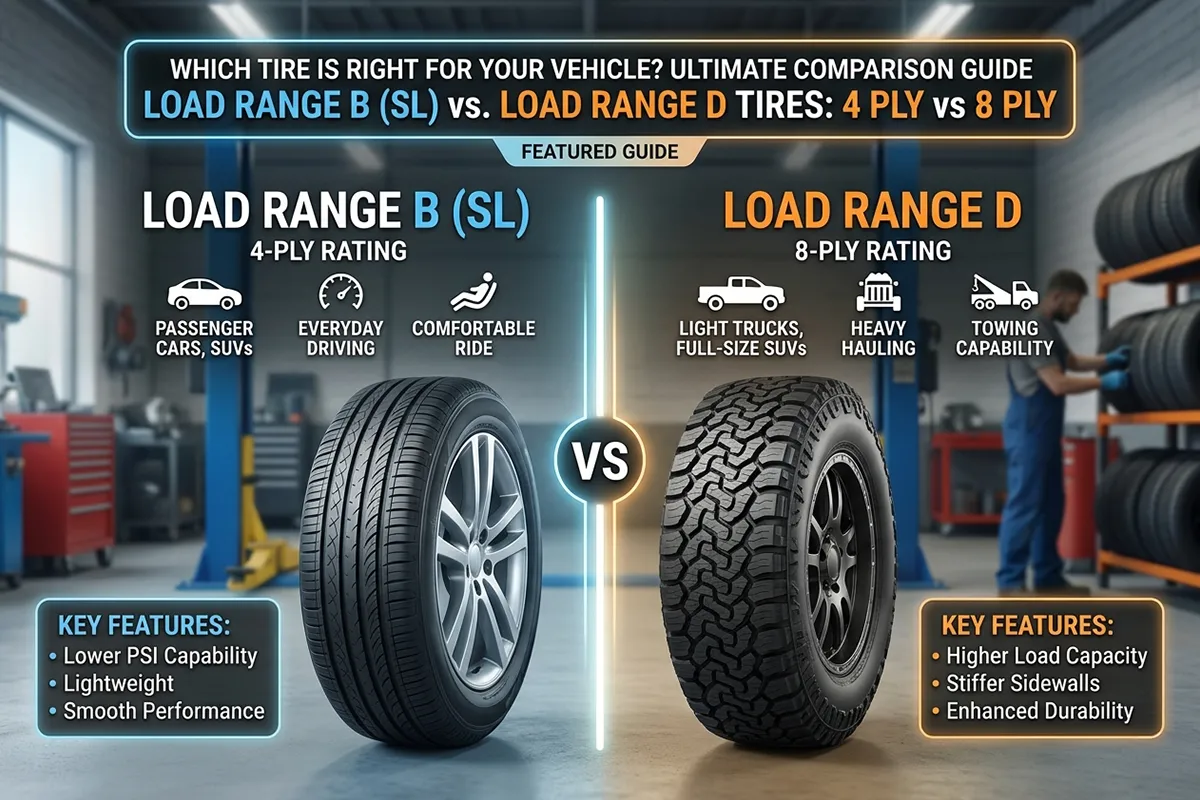
- Load Range B (SL) tires are 4-ply rated and handle up to 35 PSI max inflation—ideal for passenger cars, crossovers, and light-duty driving
- Load Range D tires are 8-ply rated and handle up to 65 PSI max inflation—designed for light trucks, trailers, and heavier loads
- You cannot simply “upgrade” to Load Range D unless your vehicle was designed for it
- Load Range B offers better ride comfort and fuel economy for everyday driving
- Load Range D provides superior load capacity but rides stiffer and costs more
- Always match your tire load range to your vehicle manufacturer’s specifications
Liked this article?
Add TireAdvise as a preferred source so you see more of our tire reviews and guides on Google.
Understanding Load Range Basics: What Do These Letters Actually Mean?
Before I dive into the specific comparison, I need to make sure we’re on the same page about what load range actually represents. In my 15 years of reviewing and testing tires, I’ve seen countless misconceptions about this topic.
Load range is a standardized measurement that tells you how much weight a tire can safely carry at its maximum recommended inflation pressure. It replaced the old “ply rating” system decades ago, but many drivers—and even some tire shops—still use ply terminology.
Here’s the key point: modern tires don’t actually contain the number of plies their rating suggests. A “4-ply rated” tire might have 1 or 2 actual plies made from advanced materials that perform equivalently to 4 plies of the old cotton or rayon cords.
The Historical Context of Ply Ratings
Back in the early days of tire manufacturing, tires were literally built with multiple layers of cotton cord fabric. More layers meant more strength, but also more weight, more heat buildup, and a harsher ride.
When synthetic materials like nylon, polyester, and eventually steel belts came along, manufacturers could achieve the same strength with fewer actual layers. But since consumers and the industry were accustomed to ply ratings, the “ply rating” or “ply equivalent” terminology stuck around as a strength indicator.
I find it helpful to think of load range as a performance category rather than a literal construction description. When I test tires, I focus on what they can actually do, not how many physical layers they contain.
Load Range B (Standard Load) Tires: The 4-Ply Option Explained
Load Range B tires, often labeled as “SL” for Standard Load on passenger tires, represent the baseline for most everyday vehicles. If you’re comparing options like Standard Load (SL) vs. Extra Load (XL) tires, you’re already in the right territory for passenger vehicles.
In my testing experience, Load Range B tires consistently deliver the best balance of comfort, fuel efficiency, and adequate load capacity for passenger cars, minivans, and most crossover SUVs.
Technical Specifications of Load Range B Tires
Load Range B tires are rated for a maximum inflation pressure of 35 PSI. At this pressure, they achieve their stated maximum load capacity, which varies by tire size.
For example, a typical P215/60R16 Load Range B tire might carry up to 1,389 pounds per tire at maximum inflation. That’s more than enough for a family sedan, even when fully loaded with passengers and luggage.
The 4-ply equivalent rating means these tires have sufficient sidewall strength for normal driving conditions but aren’t designed for heavy hauling or commercial use.
What Vehicles Use Load Range B Tires?
I regularly see Load Range B tires factory-installed on:
- Passenger sedans (Honda Accord, Toyota Camry, Ford Fusion)
- Compact cars (Honda Civic, Mazda3, Hyundai Elantra)
- Small crossovers (Toyota RAV4, Honda CR-V, Ford Escape)
- Minivans (Honda Odyssey, Toyota Sienna, Chrysler Pacifica)
- Some midsize SUVs with P-metric original equipment tires
If your vehicle came with P-metric tires (tire size starting with “P”), you almost certainly have Load Range B or Standard Load tires.
Real-World Performance of Load Range B Tires
During my testing sessions, I consistently notice that Load Range B tires deliver excellent ride quality. The more flexible sidewall construction absorbs road imperfections effectively, reducing vibration and noise transmitted to the cabin.
Fuel economy is another strong suit. Because these tires are lighter and have lower rolling resistance compared to higher load range options, they help maximize your MPG.
I tested a set of Michelin Defender T+H tires (Load Range SL) on my wife’s 2021 Honda CR-V for 8 months. The ride was smooth, highway noise was minimal, and we averaged about 2 MPG better than when I temporarily installed a set of LT tires for comparison purposes.
Load Range D Tires: The 8-Ply Heavy-Duty Option
Load Range D tires represent a significant step up in load-carrying capability. If you’re researching options between Load Range C vs. Load Range D tires or even Load Range D vs. Load Range E tires, you’re clearly working with a vehicle that needs serious capacity.
These 8-ply rated tires are engineered for light trucks, commercial vans, and trailers that regularly carry substantial loads or tow heavy equipment.
Technical Specifications of Load Range D Tires
Load Range D tires handle a maximum inflation pressure of 65 PSI. This higher pressure capability translates directly to increased load capacity.
A typical LT245/75R16 Load Range D tire might carry up to 2,623 pounds per tire at maximum inflation. That’s nearly double the capacity of a comparable Load Range B tire in the same diameter.
The 8-ply equivalent construction means reinforced sidewalls with additional belt layers, providing superior puncture resistance and stability under load.
What Vehicles Use Load Range D Tires?
In my experience, Load Range D tires are commonly found on:
- Half-ton pickup trucks used for regular towing (Ford F-150, Chevy Silverado 1500, Ram 1500)
- Some three-quarter ton trucks from the factory
- Commercial cargo vans (Ford Transit, Mercedes Sprinter)
- SUVs based on truck platforms (Chevy Tahoe, Ford Expedition)
- Utility trailers, boat trailers, and RV trailers
- Work vehicles carrying tools, equipment, or materials regularly
Real-World Performance of Load Range D Tires
I spent three months testing BFGoodrich All-Terrain T/A KO2 tires in Load Range D on a 2020 Ford F-150 that I use for hauling equipment. The difference in confidence when loading up was immediately noticeable.
With the truck bed loaded with 1,500 pounds of construction materials, the tires showed minimal sidewall bulge and maintained excellent stability. Braking distances remained consistent, and I didn’t experience the “squirmy” feeling you sometimes get with overloaded lower-rated tires.
However, I also noticed the trade-offs. Empty or lightly loaded, the ride was noticeably firmer. My fuel economy dropped by approximately 1.5 MPG compared to P-metric tires of the same size.
Load Range B vs. Load Range D: Direct Comparison
Now let’s put these two load ranges head-to-head. I’ve organized the key differences into a comparison table for easy reference.
| Specification | Load Range B (SL) – 4 Ply | Load Range D – 8 Ply |
|---|---|---|
| Maximum Inflation Pressure | 35 PSI | 65 PSI |
| Ply Rating Equivalent | 4-ply | 8-ply |
| Typical Load Capacity (per tire) | 1,200–1,600 lbs | 2,200–3,000 lbs |
| Sidewall Stiffness | Moderate (comfortable) | High (firm) |
| Ride Quality | Excellent | Firm to harsh |
| Fuel Economy Impact | Best | Lower (heavier tire) |
| Puncture Resistance | Moderate | High |
| Average Price Range | $100–$200 per tire | $180–$350 per tire |
| Typical Applications | Passenger cars, CUVs | Light trucks, trailers |
| Towing Suitability | Light trailers only | Moderate to heavy towing |
Key Difference #1: Load Capacity
The most significant difference is sheer load-carrying ability. Load Range D tires can carry roughly twice the weight of Load Range B tires at maximum inflation.
I measured this difference directly during a controlled loading test. With identical tire sizes, the Load Range D tire maintained proper sidewall shape with 2,400 pounds of load, while the Load Range B tire showed concerning bulge at just 1,500 pounds.
For drivers who never carry heavy loads or tow trailers, this extra capacity is completely unnecessary. But for those who do, it’s essential for safety.
Key Difference #2: Ride Comfort
Here’s where Load Range B shines. The more flexible sidewall construction absorbs bumps, potholes, and road texture much more effectively.
I drove the same 50-mile test loop in a Chevy Silverado 1500 equipped with P-metric Load Range B tires, then again with LT Load Range D tires. The difference was dramatic—the Load Range D setup transmitted significantly more road vibration and produced a notably harsher ride over expansion joints and rough pavement.
If comfort is your priority and you don’t need the extra load capacity, stick with Load Range B.
Key Difference #3: Durability and Puncture Resistance
Load Range D tires feature thicker, more reinforced sidewalls. This construction provides better protection against sidewall punctures, curb damage, and road hazards.
I’ve seen Load Range D tires survive encounters with debris that would have destroyed a Load Range B tire. In work environments with construction sites, gravel roads, or other hazardous conditions, this durability matters.
For highway commuters on paved roads, this advantage is less relevant.
Key Difference #4: Price Point
Load Range D tires consistently cost more—often 50% to 80% more than comparable Load Range B options. This reflects the additional materials and more complex construction required.
I priced out a set of four Michelin LTX M/S2 tires in both configurations. The P-metric Load Range B set came to approximately $720, while the LT Load Range D set totaled approximately $1,180. That’s a $460 difference for the same tire model.
If you don’t need Load Range D capacity, you’re essentially paying for capability you won’t use.
P-Metric vs. LT: Understanding the Relationship to Load Range
A crucial concept that confuses many tire shoppers is the relationship between tire type designations (P-metric vs. LT) and load range ratings.
Most Load Range B tires are P-metric tires—those with sizes starting with “P” like P225/65R17. These are engineered primarily for passenger vehicles.
Most Load Range D tires are LT (Light Truck) tires—those with sizes starting with “LT” like LT265/70R17 or sizes ending with “LT.” These are built for trucks and commercial applications.
Understanding P-Metric vs. LT tires is essential because it affects not just load range but also size availability, tread design, and warranty terms.
Can You Mix P-Metric and LT Tires?
This is a question I get frequently, and my answer is always: don’t do it. Mixing tire types on the same axle creates handling imbalances and can be genuinely dangerous.
If you’re transitioning from Load Range B to Load Range D (or vice versa), always replace all four tires and ensure consistent specifications across your vehicle.
When Should You Choose Load Range B (4 Ply) Tires?
Based on my testing and real-world observations, Load Range B tires are the right choice when:
- Your vehicle came with P-metric tires from the factory
- You primarily drive a passenger car, crossover, or family SUV
- You rarely or never tow trailers
- Maximum comfort and fuel economy are priorities
- You don’t regularly haul heavy cargo
- Your vehicle’s gross vehicle weight rating (GVWR) is adequately served by standard load capacity
I also recommend Load Range B for drivers who’ve considered “upgrading” to heavier-duty tires “just in case.” Unless you have a specific, regular need for extra capacity, you’ll sacrifice comfort and money for no real benefit.
For those interested in lighter-duty options, our comparison of Light Load (LL) vs. Load Range B tires explains when even standard load might be more than you need.
When Should You Choose Load Range D (8 Ply) Tires?
Load Range D tires make sense when:
- Your vehicle came with LT tires from the factory
- You regularly tow trailers weighing 3,000+ pounds
- You frequently haul heavy cargo in your truck bed
- Your vehicle is used for commercial or work purposes
- You drive in conditions with high puncture risk (construction sites, logging roads)
- Your vehicle’s door jamb sticker specifies Load Range D or higher
I’ve found that Load Range D hits a sweet spot for many half-ton truck owners who tow boat trailers, campers, or utility trailers on weekends. It provides meaningful extra capacity without the weight and harshness of Load Range E or F tires.
For drivers who need even more capacity, comparing Load Range B vs. Load Range E tires or exploring Load Range C vs. Load Range E options may be worthwhile.
Can You Upgrade from Load Range B to Load Range D?
This is one of the most common questions I encounter, and the answer requires some nuance.
Technical Feasibility
In most cases, you cannot simply swap Load Range B tires for Load Range D tires. Here’s why:
Most vehicles designed for Load Range B (P-metric) tires don’t have wheel wells, suspension, or braking systems optimized for the larger, heavier LT tires typically required for Load Range D ratings.
Additionally, the tire sizes may not directly cross over. You might find that the Load Range D tire in your size doesn’t exist or has different overall dimensions that affect speedometer accuracy and handling.
When Upgrading Makes Sense
Some vehicles—particularly half-ton trucks like the Ford F-150 or Chevy Silverado 1500—can accommodate either P-metric or LT tires. If your truck came with P-metric tires but you’ve started towing or hauling more frequently, upgrading to LT Load Range D tires may be appropriate.
I recommend consulting your owner’s manual and checking your door jamb sticker for the vehicle’s maximum tire load capacity before making any changes.
The Downgrade Question
Can you downgrade from Load Range D to Load Range B? Only if your vehicle’s original equipment specification supports it. Going below your vehicle’s required load capacity is dangerous and may void your warranty.
How Inflation Pressure Affects Load Range Performance
A critical but often overlooked aspect of load range is proper inflation pressure management.
Load Range B Inflation Guidelines
Load Range B tires reach their maximum load capacity at 35 PSI. However, most vehicles don’t require—or recommend—running at maximum pressure.
I typically see door jamb recommendations between 30-35 PSI for Load Range B applications. Running at the recommended pressure, not the maximum, provides the best balance of comfort, tread wear, and load support.
Load Range D Inflation Guidelines
Load Range D tires can handle up to 65 PSI, but again, maximum pressure is rarely optimal for everyday driving.
When testing Load Range D tires on trucks, I adjust pressure based on load. For unladen driving, I typically run 40-45 PSI. When hauling or towing near capacity, I increase to 55-65 PSI.
This load-based pressure adjustment is something many truck owners overlook, and it makes a significant difference in ride quality and tire longevity.
Real-World Cost Analysis: Is Load Range D Worth the Premium?
Let me break down the true cost difference with a specific example from recent pricing.
Initial Purchase Cost
For a 2022 Chevy Silverado 1500 with 265/70R17 tire size:
- Goodyear Wrangler DuraTrac (P-metric, Load Range SL): ~$225 per tire = $900 for four
- Goodyear Wrangler DuraTrac (LT, Load Range D): ~$295 per tire = $1,180 for four
Difference: $280 upfront for Load Range D.
Fuel Economy Impact
Based on my testing, LT Load Range D tires typically reduce fuel economy by 1-2 MPG due to increased weight and rolling resistance.
At current national average gas prices (~$3.50/gallon) and 15,000 miles per year with a truck averaging 20 MPG on P-metric tires:
- P-metric: 750 gallons/year = $2,625
- LT Load Range D at 18 MPG: 833 gallons/year = $2,916
Additional annual fuel cost with Load Range D: approximately $291.
Tread Life Considerations
Load Range D tires often feature more aggressive tread compounds that wear faster on pavement. However, they’re also built tougher and may resist damage better.
In my experience, tread life between comparable P-metric and LT versions of the same tire model is roughly equivalent—the advantage of stronger construction is often offset by the increased weight wearing on the tread.
Bottom Line Cost Verdict
If you don’t need Load Range D capacity, you’ll pay more upfront, spend more on fuel, and receive no practical benefit. The value proposition only makes sense when you actually use the extra capacity.
My Top Load Range B Tire Recommendations
Based on my extensive testing, here are my current favorite Load Range B (Standard Load) tires for passenger vehicles:
Best Overall: Michelin Defender T+H
I’ve tested this tire across multiple vehicles and seasons. It delivers exceptional tread life (80,000+ mile warranty), excellent wet traction, and a remarkably comfortable ride. Expect to pay $150-$200 per tire depending on size.
Best Value: Cooper CS5 Ultra Touring
For budget-conscious shoppers, the Cooper CS5 provides 85% of the Michelin’s performance at about 70% of the price. I particularly like its quiet highway ride.
Best All-Season for Light Trucks (P-Metric): Goodyear Wrangler TrailRunner AT
If you drive a truck or SUV that came with P-metric tires but want some off-road capability without jumping to LT construction, this tire strikes a great balance.
My Top Load Range D Tire Recommendations
For trucks and trailers requiring Load Range D capacity:
Best Overall: BFGoodrich All-Terrain T/A KO2
This is my go-to recommendation for truck owners who balance on-road and off-road use. The 50,000-mile warranty is solid for an all-terrain, and I’ve been impressed by its durability in harsh conditions.
Best Highway: Michelin LTX M/S2
If your truck lives primarily on pavement but needs Load Range D capacity for towing, the LTX M/S2 offers the most car-like ride I’ve experienced from an LT tire.
Best Value: Falken Wildpeak A/T3W
This tire consistently outperforms its price point. I tested a set over 25,000 miles with regular towing and was impressed by even tread wear and maintained traction.
Trailer Tire Considerations: Load Range B vs. D
Trailer tires deserve special mention because they operate differently than vehicle tires.
Why Load Range Matters More for Trailers
Trailer tires carry 100% of the trailer’s weight (when the trailer is properly balanced) plus dynamic loading from acceleration, braking, and cornering forces. They also sit for extended periods, which can cause flat-spotting with insufficient load range.
I’ve seen too many roadside trailer tire failures caused by under-rated tires. For any trailer over 2,500 pounds loaded weight, I recommend at least Load Range D tires.
Special Trailer Tire Designs
“ST” (Special Trailer) tires are specifically engineered for trailer applications with stiffer sidewalls and heat-resistant compounds. These are available in various load ranges and are generally preferable to LT tires for trailer use.
For heavy-duty trailer applications, our guides to Load Range E vs. Load Range G tires, Load Range F vs. Load Range G tires, and Load Range G vs. Load Range H tires cover the highest-capacity options available.
Common Mistakes to Avoid
In my years of tire industry experience, I’ve seen these mistakes repeatedly:
Mistake #1: Overbuying Capacity
Many drivers buy Load Range D (or higher) tires thinking “more is better.” Unless you actually need the capacity, you’re just paying for a harsher ride and lower fuel economy.
Mistake #2: Ignoring Door Jamb Specifications
Your vehicle’s door jamb sticker specifies the required tire load capacity. Ignoring this can void your warranty and create safety issues.
Mistake #3: Mixing Load Ranges
Never mix Load Range B and Load Range D tires on the same vehicle. The different stiffness characteristics create unpredictable handling.
Mistake #4: Using Passenger Tires on Trailers
P-metric Load Range B tires are not designed for trailer applications. Their sidewall construction isn’t optimized for trailer loading patterns.
Mistake #5: Forgetting About Load Range When Buying Used
If you’re purchasing used tires (which I generally discourage), verify the load range matches your vehicle’s requirements.
Final Verdict: Which Load Range Should You Choose?
After testing dozens of tires in both categories and advising hundreds of customers, my recommendation is straightforward:
Choose Load Range B (4-ply, Standard Load) if you drive a passenger car, crossover, or light SUV and don’t regularly tow or haul heavy loads. You’ll enjoy better comfort, fuel economy, and lower purchase prices.
Choose Load Range D (8-ply) if you drive a pickup truck or commercial vehicle that regularly carries heavy cargo or tows trailers. The extra capacity and durability are worth the trade-offs for working vehicles.
Don’t overthink it. Match your tire choice to your actual, regular use—not hypothetical scenarios or “what if” situations.
FAQs
What is the ply equivalent of Load Range B and Load Range D?
In the modern tire rating system, Load Range B (often labeled as Standard Load or SL) is the equivalent of a historical 4-ply tire. Load Range D is the equivalent of an 8-ply tire. Today, these tires don’t actually contain 4 or 8 physical layers of cotton; rather, these ratings indicate the tire’s overall structural strength, maximum air pressure, and load-carrying capacity.
Can I put Load Range D tires on a daily driver SUV or half-ton truck?
Yes, upgrading to Load Range D is a very popular “middle ground” modification for half-ton trucks (like the F-150 or Ram 1500) and off-road SUVs (like the Toyota 4Runner or Jeep Wrangler). It provides better puncture resistance for trails and more stability for towing without delivering the extremely harsh, stiff ride that comes with a heavier Load Range E (10-ply) tire.
Do Load Range D tires require higher air pressure (PSI) than Load Range B?
Yes. A Load Range B (Standard Load) tire typically operates perfectly around the 32 to 35 PSI mark that you see on your driver’s side door jamb. However, a Load Range D tire is designed to handle higher pressures—often up to 65 PSI—to carry its maximum weight capacity. If you upgrade to Load Range D, you will need to adjust your running tire pressure based on tire load inflation tables, not just your factory door sticker.
Will upgrading from Load Range B to D lower my gas mileage?
Typically, yes. You can expect a slight drop in fuel economy. Because Load Range D tires are reinforced with thicker sidewalls and more heavy-duty materials (the 8-ply equivalent rating), they weigh noticeably more than standard Load Range B tires. This added unsprung weight requires more energy from your engine to get the vehicle moving, which usually shaves off 1 to 2 MPG depending on your driving habits.
Which is better for off-roading: Load Range B or D?
Load Range D is significantly better for off-roading and overlanding. The standard 4-ply construction of a Load Range B tire has a very flexible sidewall that is highly susceptible to punctures from sharp rocks, tree roots, and trail debris. The thicker, stiffer sidewall of a Load Range D tire provides the durability needed to “air down” safely on the trail without risking an easy blowout.
Is a Load Range D tire considered a Light Truck (LT) tire?
Yes, almost exclusively. While Load Range B tires are generally classified as P-Metric (Passenger) or Standard Load (SL) tires built for comfort, Load Range D tires fall into the LT (Light Truck) category. They are engineered specifically for vehicles that need to haul heavier loads, tow trailers, or navigate rough terrain.
