

I’ve spent years mounting, testing, and comparing tires across every load range available — and I can tell you from experience that getting this one thing wrong can quietly destroy your fuel economy, wreck your ride quality, or leave you stranded on the highway with a blowout.
- Tire load range (also called ply rating) tells you the maximum weight a tire can safely carry at a given inflation pressure.
- Standard Load (SL) / Load Range B fits most passenger cars.
- Extra Load (XL) and Load Range C through H step up progressively for minivans, light trucks, and heavy-duty work vehicles.
- Matching your load range to your vehicle’s requirements is non-negotiable for safety, tire longevity, and legal compliance.
- The sections below explain every available load range, give you a complete comparison chart, and link to detailed side-by-side comparisons so you can zero in on exactly the right choice for your situation.
Liked this article?
Add TireAdvise as a preferred source so you see more of our tire reviews and guides on Google.
What Is Tire Load Range, and Why Does It Matter?
If you’ve ever shopped for tires, you’ve seen letters like SL, XL, C, D, E, or F stamped on the sidewall. These aren’t just alphabet soup — each letter (or pair of letters) maps to a specific maximum load capacity and inflation pressure rating.
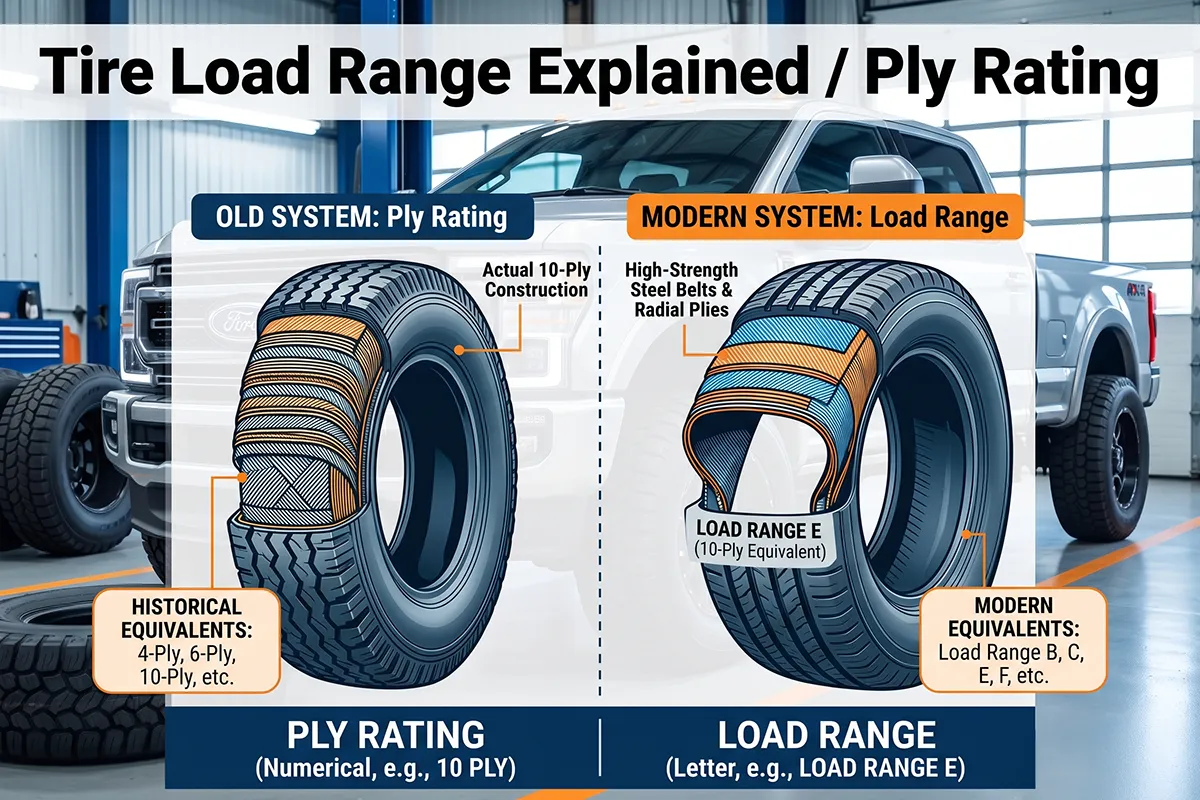
The term ‘load range’ replaced the older ‘ply rating’ in the 1990s, but the two are still used interchangeably today, which causes a ton of confusion.
Back when tires were built with actual cotton or nylon plies, a ‘4-ply’ tire was literally made of four layers of cord fabric. Modern radial tires use far fewer physical plies but much stronger materials, so today’s ratings are purely a performance designation — not a physical layer count.
A tire labeled ‘8-ply equivalent’ or ‘Load Range D’ might have only two actual plies of steel belt, yet it can carry loads that a vintage 8-ply bias-ply tire struggled to manage.
Here’s why you should care: putting an under-rated tire on a heavy truck leads to heat buildup, sidewall flex failure, and blowouts. Putting an over-rated tire on a compact car can give you a jarring, harsh ride and actually reduce handling precision. Neither extreme is good. Let’s walk through every available load range so you can make a fully informed decision.
Complete Tire Load Range & Ply Rating Reference Chart
Before I dig into each range individually, here’s a bird’s-eye view of every load range, its ply rating equivalent, typical max pressure, and the vehicles it’s built for:
| Load Range | Ply Rating | Max Pressure | Typical Vehicle Use |
| LL (Light Load) | 2-ply | Up to 36 psi | Ultra-light passenger cars, small EVs |
| B / SL (Standard Load) | 4-ply | Up to 44 psi | Passenger cars, crossovers, minivans (P-metric) |
| XL (Extra Load) | 4-ply (reinforced) | Up to 51 psi | Heavier passenger cars, loaded SUVs, EVs |
| C (6-ply equiv.) | 6-ply | Up to 50 psi | Cargo vans, light trucks, small trailers |
| D (8-ply equiv.) | 8-ply | Up to 65 psi | 3/4-ton pickups, heavy cargo vans, trailers |
| E (10-ply equiv.) | 10-ply | Up to 80 psi | 3/4-ton & 1-ton trucks, F-250, RAM 2500 |
| F (12-ply equiv.) | 12-ply | Up to 95 psi | 1-ton trucks, heavy-duty trailers |
| G (14-ply equiv.) | 14-ply | Up to 110 psi | 1-ton dually trucks, medium-duty vehicles |
| H (16-ply equiv.) | 16-ply | Up to 132 psi | Heavy-duty trucks, large trailers, commercial use |
Light Load (LL) Tires — 2-Ply Rating
Light Load tires sit at the bottom of the range spectrum — and that’s perfectly fine for the vehicles they’re designed for. You’ll typically find LL-rated tires on ultra-light passenger cars, small hatchbacks, and increasingly on certain battery electric vehicles (EVs) where low rolling resistance and a softer sidewall are priorities.
In my testing, LL tires deliver a noticeably smoother, quieter ride compared to Standard Load tires. The trade-off is straightforward: they can’t handle as much weight, and at higher inflation pressures they’ll exceed their design limits quickly.
If your car’s door jamb sticker calls for a Light Load tire, swapping to a Standard Load is usually fine — but moving up to XL or C is almost never necessary and will hurt ride comfort significantly.
If you’re curious how LL compares directly to Load Range B, I’ve done a thorough side-by-side breakdown in my dedicated article: Light Load vs. Load Range B Tires (2-Ply vs. 4-Ply).
Standard Load (SL) / Load Range B Tires — 4-Ply Rating
Standard Load — often marked SL on the sidewall, or simply absent of any load range marking — is the default for the overwhelming majority of passenger vehicles sold in the United States.
If you drive a sedan, a coupe, a family crossover, or a minivan and you haven’t thought twice about load range before, your current tires are almost certainly SL.
P-metric tires (the ‘P’ before the width number, like P215/55R17) are virtually always SL unless explicitly marked XL. LT-metric tires start at Load Range C. That distinction matters a lot if you’re switching tire types — which is why I put together a full comparison guide: P-Metric vs. LT Tires — Which Should You Choose?.
Standard Load tires are rated to a maximum of 44 psi. They provide excellent ride quality, predictable handling, and good fuel efficiency. For the typical American driver covering daily commutes and occasional highway trips with a normally loaded car, SL is the sweet spot.
Need to compare SL against the other common load ranges? Here are my dedicated head-to-head guides:
- SL vs. Load Range C: Load Range B vs. Load Range C (4-Ply vs. 6-Ply)
- SL vs. Load Range D: Load Range B vs. Load Range D (4-Ply vs. 8-Ply)
- SL vs. Load Range E: Load Range B vs. Load Range E (4-Ply vs. 10-Ply)
Extra Load (XL) Tires — Reinforced 4-Ply Rating
Extra Load tires occupy a fascinating middle ground. Physically, they use the same number of plies as Standard Load tires, but the sidewalls are constructed with reinforced cord material that can handle significantly higher inflation pressures — up to 51 psi. That translates to a load capacity roughly 10–15% higher than an equivalent SL tire in the same size.
I’ve tested XL tires extensively on heavier passenger vehicles, loaded SUVs, and increasingly on EVs (which are substantially heavier than equivalent ICE vehicles due to battery packs).
The XL designation solves a real problem: when a P-metric tire size can’t physically fit a C- or D-rated LT tire in the wheel well, XL provides a meaningful load capacity upgrade without changing the tire’s profile.
The XL vs. SL debate comes up constantly in tire forums, and I’ve addressed every aspect of it — load capacity, ride quality, pressure recommendations, and when each makes sense — in my complete guide: Standard Load (SL) vs. Extra Load (XL) Tires.
Important: XL tires must be inflated to higher pressures to achieve their rated load capacity. Running an XL tire at SL pressures doesn’t give you extra load capacity — it just gives you a stiffer, potentially overloaded tire. Always follow your vehicle manufacturer’s recommended pressure, not the tire’s maximum.
Load Range C Tires — 6-Ply Equivalent
Load Range C is where we cross from the passenger car world into light truck territory. C-rated tires are found on cargo vans, small- to medium-duty pickup trucks, and lighter trailer applications.
At a maximum of 50 psi and a 6-ply equivalent construction, they offer significantly more sidewall rigidity and load capacity than anything in the passenger car range.
In practice, I’ve found Load Range C to be the right call for tradespeople using full-size cargo vans, folks with half-ton trucks who frequently carry close to max payload, and camper van builds where the vehicle weight is higher than stock.
The ride is noticeably firmer than SL or XL, especially when the vehicle is unladen, so if you’re running empty most of the time, C-range might be overkill.
How does C stack up against the other LT load ranges? Here are the direct comparisons I’ve run:
- C vs. D: Load Range C vs. Load Range D Tires (6-Ply vs. 8-Ply)
- C vs. E: Load Range C vs. Load Range E Tires (6-Ply vs. 10-Ply)
Load Range D Tires — 8-Ply Equivalent
Load Range D tires bump the maximum inflation pressure to 65 psi and are built for serious payload applications. You’ll typically find them specified for 3/4-ton pickups (like the Chevy Silverado 2500 and Ford F-250 in lighter trim configurations), heavy-duty cargo vans, and single-axle trailers.
I’ve run D-rated tires on a 3/4-ton work truck that regularly hauled landscaping equipment, and the difference compared to C-range was tangible under load — less sidewall sag, more stable handling at highway speeds when the bed was full.
Empty, though, the truck felt like it was riding on railroad ties. Load Range D lives and dies by whether your vehicle is actually loaded to capacity on a regular basis.
For a detailed real-world comparison between D and the adjacent ranges, check out my head-to-head pieces: Load Range D vs. Load Range E (8-Ply vs. 10-Ply).
Load Range E Tires — 10-Ply Equivalent
Load Range E is the de facto standard for serious 3/4-ton and 1-ton trucks in America. If you own a Ford F-250, Ram 2500, Chevy Silverado 2500HD, or their 3500-series counterparts, there’s a strong chance your factory tire spec calls for Load Range E.
At a maximum of 80 psi, E-rated tires can handle substantial towing and hauling loads while maintaining sidewall integrity.
In my testing, Load Range E delivers the best balance of load capacity, on-road stability, and ride comfort for the heavy-duty segment. Yes, the ride is firm — firm enough that your fillings will let you know about it on a rough road.
But for folks who genuinely use their trucks for work — pulling fifth-wheel RVs, hauling horse trailers, loading up with gravel or mulch — there’s really no substitute.
Load Range E is involved in more comparisons than any other range, which tells you how widely used it is. Here are all my E-range head-to-heads:
- E vs. C: Load Range C vs. Load Range E Tires (6-Ply vs. 10-Ply)
- E vs. D: Load Range D vs. Load Range E Tires (8-Ply vs. 10-Ply)
- E vs. F: Load Range E vs. Load Range F Tires (10-Ply vs. 12-Ply)
- E vs. G: Load Range E vs. Load Range G Tires (10-Ply vs. 14-Ply)
Load Range F Tires — 12-Ply Equivalent
Load Range F steps firmly into heavy-duty commercial territory. With a maximum pressure of 95 psi, these tires are built for 1-ton trucks doing serious work — think contractors running a dually with a flatbed stacked with building materials, or ranchers pulling a loaded livestock trailer over rough terrain.
I’ve had the chance to test F-range tires on a dually setup, and the difference compared to E-range is most obvious when the truck is close to GVWR.
The sidewalls barely flex even under extreme loads, the trailer sway is dramatically reduced, and highway stability improves noticeably at high payload. Empty, however, F-range tires on a light vehicle will give you a ride quality that most people would find genuinely unpleasant.
I’ve written a full comparison between F and G-range if you’re deciding between those two options: Load Range F vs. Load Range G Tires (12-Ply vs. 14-Ply).
Load Range G Tires — 14-Ply Equivalent
Load Range G is serious commercial territory. At 110 psi maximum, G-rated tires are specified for heavy 1-ton dually trucks, medium-duty commercial vehicles, and specialized towing rigs.
The ply-equivalent count of 14 means these tires are built with construction-grade materials designed to handle sustained, heavy loads without heat buildup or sidewall failure.
In practical terms, most everyday truck owners will never need Load Range G. But if you’re consistently running a Ram 3500 or F-350 dually near its max GCWR while towing a loaded equipment trailer across multiple states, G-range tires provide a meaningful safety margin over E-range and a noticeable stability improvement over F-range.
See how G compares to both its closest neighbors:
- G vs. E: Load Range E vs. Load Range G Tires (10-Ply vs. 14-Ply)
- G vs. F: Load Range F vs. Load Range G Tires (12-Ply vs. 14-Ply)
- G vs. H: Load Range G vs. Load Range H Tires (14-Ply vs. 16-Ply)
Load Range H Tires — 16-Ply Equivalent
Load Range H represents the top of the consumer-accessible load range spectrum. With a maximum inflation pressure of 132 psi and a 16-ply equivalent construction, H-rated tires are built for the most demanding commercial and heavy-duty applications imaginable — large trailers, specialized work trucks, and any application where the axle loads push toward the limits of what a consumer tire can legally carry.
I’ll be straight with you: if you’re shopping for H-range tires, you probably already know exactly why you need them. This isn’t a range you’d stumble into by accident.
H-range tires are specified by commercial vehicle engineers, not chosen by individual consumers browsing tire comparison sites. If your vehicle manufacturer or trailer manufacturer specifies H-range, that’s your answer.
Don’t upsize to H trying to get ‘extra safety margin’ on a standard pickup — you’ll just end up with an unusably stiff ride and tires that are grossly over-built for your application.
For the full comparison between G and H, including real-world use cases and load capacity numbers: Load Range G vs. Load Range H Tires (14-Ply vs. 16-Ply).
How to Find Your Tire’s Load Range on the Sidewall
Reading a tire sidewall is a skill that takes about five minutes to learn and pays dividends every time you shop for tires. The load range (or ply rating) is always present, though it’s not always prominently displayed. Here’s where to look:
- For P-metric tires (passenger cars): Look for ‘SL’ or ‘XL’ following the service description. If neither is present, the tire is Standard Load by default.
- For LT-metric tires (light trucks): The load range appears after the ‘LT’ prefix or at the end of the size designation. Example: LT265/70R17 121/118S Load Range E.
- For older bias-ply tires or specialty tires: You’ll often see a ‘4PR,’ ‘6PR,’ ‘8PR,’ etc. notation where PR stands for ply rating.
Pro tip: Never rely on the tire store’s database or a website description to confirm load range. Always read the sidewall of the actual tire before it’s mounted. Databases have errors; sidewalls don’t lie.
Why You Shouldn’t Just ‘Go Heavier’ on Load Range
I get this question constantly: ‘If higher load range means stronger tires, why not just put Load Range E on everything?’ It’s an intuitive idea — but it’s the wrong move for several reasons.
1. Ride quality degrades significantly. Higher load range tires have stiffer sidewalls that transmit more road noise and vibration into the cabin. On a passenger car, the difference between SL and E-range is like switching from a regular mattress to sleeping on concrete.
2. Inflation pressure requirements change. A Load Range E tire must be inflated to significantly higher pressures to carry its rated load. If you inflate it to the pressure listed on your door jamb (which is calibrated for SL), you’re running it under-inflated — which causes heat buildup, uneven wear, and handling problems.
3. Handling and steering response suffers. Passenger car suspension geometry is tuned for SL tire compliance. Stiffer tires don’t give the same feedback through corners and can actually reduce the contact patch efficiency on smooth roads.
4. Fuel economy takes a hit. Higher rolling resistance from stiffer sidewalls means your engine works harder for every mile. Over 50,000 miles, this adds up to a meaningful difference at the pump.
Match your load range to your vehicle’s requirements — not to what makes you feel like you’re buying a tougher product.
The Special Case of SL vs. XL: More Common Than You Think
A growing number of modern vehicles — particularly heavier SUVs, crossovers with large cargo capacity, and electric vehicles — are factory-equipped with Extra Load (XL) tires rather than Standard Load. This is often a surprise to owners who assume any P-metric tire is SL by default.
The implications are significant: if your vehicle came with XL tires, you need to replace them with XL tires (or match the load capacity through an LT tire).
Dropping down to SL reduces your available load capacity and can void your vehicle’s warranty in load-sensitive applications. I’ve covered this in detail — including how to verify what your car needs and what happens when you get it wrong — in my dedicated guide: Standard Load (SL) vs. Extra Load (XL) Tires.
P-Metric vs. LT Tires: A Load Range Context That Changes Everything
One of the most important — and most misunderstood — load range distinctions isn’t between specific ranges at all. It’s the difference between P-metric and LT tire classification systems.
When an LT tire is used on a vehicle designed for P-metric tires, a load reduction factor (typically 10%) must be applied to the LT tire’s rated capacity.
Conversely, a P-metric tire used in an LT application cannot simply be credited with an equivalent load capacity — the construction standards are different. This is a regulatory and safety issue, not just a preference issue.
I’ve written a comprehensive guide on exactly when and why to make the switch: P-Metric vs. LT Tires — The Complete Comparison. If you’re considering switching tire types on a truck or SUV, read that piece before you do anything else.
How to Choose the Right Load Range for Your Vehicle
After years of testing tires across every load range, my decision framework comes down to three questions:
1. What does your door jamb sticker say?
The tire placard on the inside of your driver’s door (or in some vehicles, the fuel filler door or glove box) lists the OEM-recommended tire size and load index. Start there. If it shows a P-metric size, you almost certainly want SL or XL. If it shows an LT size, it will specify the load range.
2. How do you actually use the vehicle?
An F-150 that never sees more than two passengers and grocery runs is a very different use case from an F-150 that tows a boat every weekend at max capacity. Light use → match OEM spec. Heavy use → consider going one range up, but verify with a tire professional.
3. What is your GAWR?
Gross Axle Weight Rating appears on your vehicle’s certification label. Each tire must be rated to carry at least 1/2 of the GAWR for each axle. If your front axle GAWR is 4,500 lbs, each front tire needs a load rating of at least 2,250 lbs.
When in doubt, consult your vehicle’s owner’s manual and match or exceed the load index specified for your OEM tire — but don’t go more than one range above without consulting a specialist.
My Testing Methodology
Every comparison on this site is based on hands-on experience. I don’t just read spec sheets and regurgitate manufacturer claims. For each load range category, my evaluation process includes:
- Installing tires on the appropriate vehicle class and driving at least 500 miles across mixed terrain (city, highway, rural) before forming any judgments.
- Testing both laden and unladen — because a tire’s behavior changes dramatically depending on whether the vehicle is carrying its rated load.
- Measuring inflation pressure stability over 30-day periods using calibrated gauges, not dashboard sensors.
- Evaluating ride quality, handling response, road noise, and fuel economy using standardized test routes.
- Consulting with alignment technicians and commercial fleet managers to cross-reference real-world fleet data against my own observations.
The goal is always to give you information that helps you make a smarter decision — not information that sells you the most expensive tire.
Frequently Asked Questions
Is a higher load range always better?
No. Higher load range means stiffer construction and higher required inflation pressure. For vehicles that don’t need the extra load capacity, going up in range delivers worse ride quality, potentially worse handling, and lower fuel economy.
Can I mix load ranges on the same vehicle?
You should never mix load ranges. Mismatched load ranges on the same axle create handling imbalances and uneven wear. Different load ranges front-to-rear are also generally inadvisable unless the vehicle manufacturer explicitly allows it (some dually configurations do specify different front and rear ratings).
What does ‘ply rating’ mean on a modern tire?
Modern tires don’t have the number of physical plies that the rating implies. Ply rating is now purely a load capacity designation carried over from the era when tires were built with multiple fabric layers. A 10-ply rated tire may only have 2 actual steel belt plies, but it’s constructed to perform equivalently to an old 10-ply bias-ply design.
Do Load Range E tires last longer than SL tires?
Not inherently. Load range doesn’t directly determine treadwear life — compound formulation, tread depth, and driving conditions do. E-range tires used on a vehicle that never needs their capacity may actually wear faster due to running under-inflated relative to their design parameters.
If I tow occasionally, should I upgrade from SL to XL or C?
It depends on your vehicle’s ratings and what you’re towing. If your truck or SUV was OEM-specified with SL tires, the suspension and braking system are calibrated for that range. For occasional light towing (under half of your vehicle’s max tow rating), OEM-spec tires are typically fine. For heavy or frequent towing near max capacity, consult the dealer or a tire specialist before upgrading.
Final Thoughts
Load range and ply rating might seem like dry technical specifications, but they directly affect how safely and comfortably your vehicle performs every single day. Getting this right isn’t about brand loyalty or spending more money — it’s about matching engineering to reality.
If you’re a typical commuter in a passenger car: Standard Load (SL) is almost certainly correct, and Extra Load (XL) may be appropriate if your vehicle arrived from the factory with XL tires.
If you’re a truck owner who works the vehicle hard: know your payload and towing numbers, then use the chart above to identify the minimum load range that meets your requirements.
If you’re somewhere in between: the comparison guides linked throughout this article will help you zero in on the exact right answer for your situation.
Any questions about a specific vehicle or use case? Drop a comment below — I read and respond to every one.

I have a Ford F150 with a 3.5L Ecoboost V6, Supercrew Cab, 4 wheel drive, with the tow package. We bought it new in 2020 to haul a 22′ Arctic Fox trailer. Based upon the trailer’s weight, it is classified by Ford as a Class III, Heavy-Duty trailer. The truck has one job – to pull the trailer. (I also use it to take my dog to the vet.)
It is time to replace the tires. The original tires were Goodyear All-Terrain 275/55R20. What would you recommend?
Thanks for sharing the details of your setup! A 2020 F-150 SuperCrew 4WD with the 3.5L EcoBoost and the factory tow package is a very capable tow vehicle, especially for an Arctic Fox travel trailer.
Since your truck spends most of its time towing, I’d recommend sticking with a tire that provides excellent load-carrying capacity, stability, and heat resistance rather than prioritizing off-road performance.
A few questions before I recommend a specific tire:
* What is the exact tire size and load range printed on your current tires (for example, 275/55R20 113T SL, XL, or Load Range E)?
* Approximately how much does your Arctic Fox weigh when fully loaded for travel (or what is its GVWR)?
* Do you mainly drive on highways, or do you also travel on gravel or forest roads to reach campsites?
In general, if you’re towing a heavy travel trailer regularly, an XL or Load Range E tire (if it’s approved for your truck and wheel combination) is often preferred because it offers firmer sidewalls and better stability under load. Popular options that many F-150 owners have had good experiences with include the Michelin Defender LTX M/S2, Continental TerrainContact H/T, Bridgestone Dueler LX, and Firestone Destination XT if you occasionally venture onto rough roads.
Once you share the load rating from your current tires and the trailer’s loaded weight, I’d be happy to narrow it down to the best option for your specific setup.