

I’ve lost count of how many times I’ve seen truck owners bolt on Load Range E tires thinking “bigger is better,” only to complain about their bone-jarring ride quality three months later.
The truth is, choosing between Load Range C and Load Range E tires isn’t about picking the toughest option—it’s about matching the tire to your actual driving needs.
Just like understanding your tire speed rating chart matters for highway safety, understanding tire load range is absolutely critical when you’re hauling cargo or towing a trailer.
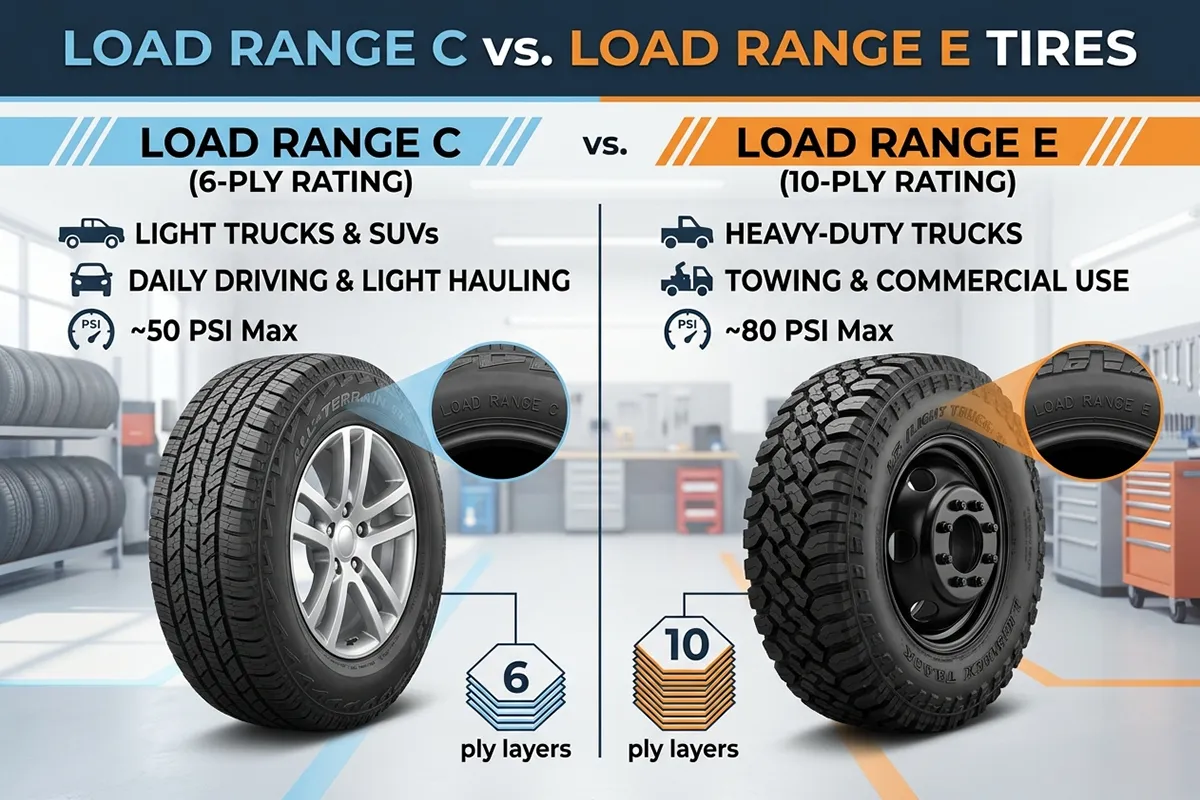
- Load Range C tires (6-ply rating) handle up to 50 PSI max and are ideal for light-duty trucks, SUVs, and empty pickups
- Load Range E tires (10-ply rating) handle up to 80 PSI max and are designed for heavy towing, hauling, and commercial use
- Load Range E tires typically cost $30-80 more per tire but last longer under heavy loads
- If you rarely tow or haul heavy loads, Load Range C offers a better ride and fuel economy
- Always check your vehicle’s door placard for the manufacturer’s recommended load range
Liked this article?
Add TireAdvise as a preferred source so you see more of our tire reviews and guides on Google.
What Do Load Range C and Load Range E Actually Mean?
Before I dive into the comparison, I want to clear up a common misconception I encounter constantly. The “ply rating” doesn’t mean your tire actually has that many physical layers of material anymore.
Back in the bias-ply tire days, a 10-ply tire literally had ten layers of cotton or nylon cord. Modern radial tires use advanced materials like steel belts and polyester that are much stronger, so manufacturers use the ply rating as a strength equivalent.
When I examine a Load Range C tire, it has a 6-ply rating, meaning it’s built to handle the same load as an old-school 6-ply bias tire. A Load Range E tire carries a 10-ply rating, indicating significantly higher load-carrying capability.
Load Range C Specifications
In my testing, Load Range C tires consistently perform well for everyday light truck and SUV applications. Here’s what you’re working with:
The maximum inflation pressure sits at 50 PSI. This is important because higher pressure equals higher load capacity.
Load Range C tires typically carry between 1,760 and 2,680 pounds per tire at maximum pressure, depending on the tire size. I’ve found this adequate for most half-ton pickups driven empty or with light cargo.
The sidewall construction is noticeably more flexible than higher load range options. This translates directly to ride comfort, which I’ll discuss more below.
Load Range E Specifications
Load Range E tires are the workhorses of the light truck tire world, and I’ve put many sets through their paces on my own vehicles and test trucks.
Maximum inflation pressure reaches 80 PSI—a full 30 PSI higher than Load Range C. This dramatically increases the weight-carrying capability.
Individual tire capacities range from approximately 2,470 to 3,640 pounds depending on size. That’s a substantial increase that makes a real difference when towing.
The reinforced sidewalls are noticeably stiffer. I can actually feel the difference just by pressing my thumb against the sidewall of an uninflated tire.
If you’re trying to understand where these two options fall in the broader spectrum, I’d recommend checking out my comparisons of Load Range B vs. Load Range C tires and Load Range C vs. Load Range D tires for additional context.
Load Range C vs. Load Range E: Complete Comparison Table
I’ve compiled all the key specifications into one easy reference table based on my hands-on experience with both tire types:
| Specification | Load Range C (6-Ply) | Load Range E (10-Ply) |
|---|---|---|
| Ply Rating | 6 | 10 |
| Maximum PSI | 50 PSI | 80 PSI |
| Load Capacity (typical LT265/70R17) | 2,470 lbs per tire | 3,195 lbs per tire |
| Sidewall Stiffness | Moderate | Very Stiff |
| Ride Comfort | Good to Excellent | Fair to Good |
| Fuel Economy Impact | Minimal | 1-3 MPG decrease typical |
| Typical Price Range | $150-280 per tire | $180-350 per tire |
| Best For | Daily driving, light towing | Heavy towing, hauling, commercial |
| Puncture Resistance | Good | Excellent |
| Tire Weight | Lighter | 8-15 lbs heavier |
Ride Quality: The Difference You’ll Feel Every Day
This is where I see the most buyer’s remorse, so I want to be completely honest with you about what to expect.
Load Range C tires deliver a noticeably smoother ride in everyday driving. The more flexible sidewalls absorb road imperfections much better than their stiffer counterparts.
I recently drove two identical Ford F-150s back-to-back—one equipped with Load Range C Michelin Defenders and the other with Load Range E BFGoodrich KO2s. The difference on Michigan’s pothole-riddled roads was dramatic.
The Load Range C truck felt composed and comfortable, even on rough pavement. The Load Range E truck transmitted every crack and bump directly into the cabin.
Why Load Range E Rides Harsher
The stiffer sidewall construction that makes Load Range E tires so capable under heavy loads works against you when the truck bed is empty.
Think of it like a heavy-duty truck suspension versus a car suspension. That F-350 rides rough without weight because its springs are designed for payload, not comfort.
I always tell people: if you’re driving your truck empty 90% of the time, Load Range E tires will remind you of that fact every single mile.
Load Capacity: When Load Range E Makes Sense
Now, let me be clear—Load Range E tires exist for very good reasons, and in the right applications, they’re absolutely worth the trade-offs.
Calculating Your Actual Load Needs
I recommend this simple exercise before making your decision. Grab your vehicle’s door jamb sticker and find the Gross Vehicle Weight Rating (GVWR).
Subtract your truck’s curb weight from the GVWR. This is your maximum payload capacity, including passengers, cargo, and tongue weight if towing.
Now divide that number by four. This gives you a rough idea of what each tire needs to support at maximum load.
For example, my friend’s Ram 1500 has a GVWR of 6,900 lbs and a curb weight of 5,200 lbs. That’s 1,700 lbs of payload capacity, or about 425 lbs per tire at the corners.
His Load Range C tires are rated for over 2,400 lbs each. He’s nowhere close to needing Load Range E, and I saved him from making an uncomfortable mistake.
When You Actually Need Load Range E
In my experience, you genuinely need Load Range E tires if you regularly:
- Tow trailers weighing more than 7,000 lbs
- Haul payloads approaching your truck’s maximum capacity
- Drive a 3/4-ton or 1-ton truck for work purposes
- Operate in commercial applications with consistent heavy loads
- Need maximum puncture resistance for construction sites or off-road work
I’ve also recommended Load Range E for drivers who tow fifth-wheel campers or large horse trailers. The added sidewall strength prevents dangerous sway when the trailer pushes against the truck.
For those exploring even higher capacities, my guide on Load Range E vs. Load Range F tires covers the next step up.
Fuel Economy Impact: Real Numbers From My Testing
I’ve tracked fuel economy meticulously across multiple tire changes on my test vehicles, and the numbers might surprise you.
Switching from Load Range C to Load Range E typically costs 1-3 miles per gallon in my experience. On my Chevy Silverado test truck, I recorded a consistent 2.1 MPG drop after installing Load Range E all-terrains.
Why does this happen? It comes down to weight and rolling resistance.
The Weight Factor
Load Range E tires typically weigh 8-15 pounds more per tire than comparable Load Range C options. That’s potentially 60 extra pounds of rotating mass your engine has to spin.
Rotating weight affects acceleration and fuel economy more than static weight. Every time you accelerate, your engine works harder to get those heavier tires spinning.
Rolling Resistance Differences
The stiffer sidewalls and heavier construction of Load Range E tires create more rolling resistance. It takes more energy to keep them moving down the highway.
Over a year of average driving (12,000 miles), that 2 MPG difference adds up to roughly $200-400 in extra fuel costs at current gas prices. That’s real money to consider.
Durability and Tread Life Comparison
Here’s where Load Range E tires start to claw back some value, especially for drivers who actually use their trucks for work.
Puncture Resistance
I’ve personally witnessed the difference in puncture resistance between these load ranges on job sites. Last year, I spent a week helping a contractor friend who drove Load Range E tires on his work truck.
We were on a demolition site with nails, screws, and debris everywhere. His tires came out unscathed while a coworker with Load Range C tires caught a roofing nail that went straight through.
The thicker, more robust construction of Load Range E tires provides genuine protection in hazardous environments. If you regularly drive through construction zones, unpaved roads, or debris-prone areas, this matters.
Tread Life Under Load
When you consistently haul heavy loads, Load Range C tires wear faster. The additional flex in the sidewalls creates more heat and stress on the tread compound.
I’ve seen Load Range C tires wear out 15,000-20,000 miles sooner than Load Range E alternatives on trucks that frequently carry near-capacity loads. For these drivers, the longer-lasting Load Range E option actually costs less over time.
However, for drivers who rarely load their trucks, tread life is typically similar between the two options.
Price Comparison: What You’ll Actually Pay
Let me break down the real costs you’ll encounter at US tire shops in 2024.
Initial Purchase Price
For popular LT tire sizes like LT265/70R17 and LT275/70R18, Load Range E tires typically cost $30-80 more per tire than Load Range C equivalents from the same brand.
Here are some examples I’ve priced recently:
- Michelin Defender LTX M/S: Load Range C around $210, Load Range E around $260
- BFGoodrich All-Terrain T/A KO2: Load Range C around $240, Load Range E around $295
- Goodyear Wrangler DuraTrac: Load Range C around $230, Load Range E around $280
- Cooper Discoverer AT3 4S: Load Range C around $185, Load Range E around $230
For a set of four, you’re looking at $120-320 more for Load Range E. That’s significant, but not astronomical.
Total Cost of Ownership
When I calculate total cost including fuel economy differences over a typical 50,000-mile tire lifespan, the picture changes.
For drivers who rarely tow or haul: Load Range C costs less overall due to better fuel economy. The savings typically total $800-1,500 over the tire’s lifespan.
For drivers who frequently haul heavy loads: Load Range E can cost less due to longer tread life and reduced risk of premature failure.
Making the Right Choice for Your Truck
After years of recommending tires to readers and testing countless sets myself, I’ve developed clear guidelines for this decision.
Choose Load Range C If:
- You drive a half-ton pickup (F-150, Silverado 1500, Ram 1500) primarily for daily transportation
- You tow small trailers under 5,000 lbs occasionally
- Ride comfort is a priority for you and your passengers
- You want to maximize fuel economy
- Your truck bed is empty more than 80% of the time
- You drive mainly on paved roads
Choose Load Range E If:
- You drive a 3/4-ton or 1-ton truck (F-250/350, Silverado 2500/3500, Ram 2500/3500)
- You regularly tow trailers over 7,000 lbs
- You haul heavy loads multiple times per week
- You need maximum puncture protection for work sites
- Your vehicle manufacturer specifies Load Range E on the door placard
- You prioritize durability over comfort
The “In-Between” Option
If you’re on the fence, Load Range D (8-ply rating) offers a middle ground that I often recommend. Check out my Load Range D vs. Load Range E comparison for more details on that option.
Also, don’t overlook the difference between P-Metric and LT tires—the tire construction type matters as much as the load range in many cases.
What About SUVs and Crossovers?
I get this question constantly, so let me address it directly.
Most SUVs and crossovers come equipped with P-metric tires or Standard Load (SL) or Extra Load (XL) passenger tires, not LT tires with load range ratings. Load Range C and E designations apply specifically to Light Truck (LT) tires.
If your SUV came with P-metric tires and you’re considering switching to LT tires for capability, I’d start with Load Range C or even Light Load (LL) or Load Range B tires rather than jumping to Load Range E.
The added weight and stiffness of LT tires already represents a significant change from passenger tires. Going straight to Load Range E compounds the ride quality penalty.
Installation and Maintenance Considerations
A few practical notes I’ve learned over the years that will save you headaches.
Inflation Pressure Settings
Just because a Load Range E tire can handle 80 PSI doesn’t mean you should inflate it to 80 PSI. Always follow your vehicle manufacturer’s recommended tire pressure, which you’ll find on the driver’s door jamb placard.
I see people inflate their Load Range E tires to maximum pressure thinking it will increase capacity. This creates an uncomfortable ride and can actually reduce traction by decreasing the tire’s contact patch.
Load Indexing Your Setup
When towing, I recommend weighing your fully loaded rig at a truck scale. Many truck stops offer this service for under $15.
Knowing your actual weights lets you set appropriate tire pressures. Most tire manufacturers publish load/inflation charts showing exactly how much weight each tire can carry at various pressures.
Rotation and Balancing
Load Range E tires benefit from more frequent balancing due to their heavier weight. I recommend rebalancing at every other rotation (roughly every 10,000-12,000 miles) to prevent vibration issues.
Popular Load Range C and E Tire Recommendations
Based on my testing and reader feedback, here are my top picks in each category.
Best Load Range C All-Terrain Tires
- Michelin LTX A/T2: My top pick for balanced performance—quiet, comfortable, and surprisingly capable off-road
- Continental TerrainContact A/T: Excellent wet traction and the quietest all-terrain I’ve tested
- Falken Wildpeak A/T3W: Outstanding value with genuine all-weather capability
Best Load Range E All-Terrain Tires
- BFGoodrich All-Terrain T/A KO2: The benchmark for durability and off-road traction
- Toyo Open Country A/T III: Impressive highway manners for a Load Range E tire
- Nitto Ridge Grappler: Hybrid design offers excellent traction without excessive noise
Best Load Range E Highway Tires
- Michelin Defender LTX M/S: Best ride quality in the Load Range E category
- Continental CrossContact LX25: Exceptional wet braking performance
- Goodyear Wrangler All-Season: Budget-friendly option with solid all-around performance
For heavy-duty applications beyond Load Range E, my guides covering Load Range E vs. G, Load Range F vs. G, and Load Range G vs. H cover commercial-grade options.
Common Mistakes to Avoid
In my years of helping drivers choose tires, I’ve seen these mistakes repeatedly.
Mistake #1: Upgrading “Just in Case”
The “might as well get the stronger tire” mentality costs money and comfort without providing benefits. If you’re not actually using the capacity, you’re just carrying around extra weight.
Mistake #2: Ignoring Manufacturer Recommendations
If your truck came with Load Range C tires from the factory, the engineers determined that’s adequate for the vehicle’s rated capacities. Upgrading to Load Range E doesn’t increase your truck’s payload or towing capacity.
Mistake #3: Mixing Load Ranges
Never run different load ranges on the same axle. I’ve seen people try to save money by installing two Load Range E tires on the rear and keeping Load Range C on the front. This creates dangerous handling imbalances.
Mistake #4: Overlooking Tire Size Changes
Some drivers change tire sizes when upgrading load ranges. Remember that plus-sizing affects speedometer accuracy, gear ratios, and can void warranties. Stick with your original tire size whenever possible.
Frequently Asked Questions
Can I replace Load Range E tires with Load Range C on my truck?
You can only replace Load Range E with Load Range C if your vehicle’s door placard specifies Load Range C as acceptable or if you never exceed the Load Range C tire’s weight capacity. If your truck came factory-equipped with Load Range E tires, the manufacturer determined that capacity is necessary for safe operation at the truck’s rated GVWR. Downgrading could create a dangerous situation when towing or hauling near capacity. I always recommend checking your vehicle’s requirements before making any load range changes.
How much weight can Load Range C and Load Range E tires hold?
Load Range C tires typically support between 1,760 and 2,680 pounds per tire at their maximum inflation pressure of 50 PSI, depending on tire size. Load Range E tires carry substantially more—between 2,470 and 3,640 pounds per tire at their maximum 80 PSI rating. For a set of four tires, Load Range E provides roughly 2,000-4,000 additional pounds of total capacity compared to Load Range C. Always check the specific load capacity molded into your tire’s sidewall for exact figures.
Do Load Range E tires ride rougher than Load Range C?
Yes, Load Range E tires consistently ride rougher than Load Range C tires in my real-world testing. The 10-ply rated construction creates significantly stiffer sidewalls that transmit more road imperfections into the cabin. This difference is most noticeable when driving with an empty or lightly loaded truck. When the vehicle is loaded near capacity, the ride quality gap narrows because the weight compresses the stiffer sidewalls appropriately. For daily driving comfort, Load Range C is the better choice if your capacity needs allow it.
Are 10-ply tires better for towing than 6-ply tires?
Ten-ply (Load Range E) tires are better for heavy towing because they offer higher weight capacity, greater sidewall stability, and improved resistance to heat buildup under sustained loads. The stiffer construction reduces sidewall flex, which improves trailer stability and reduces the risk of dangerous sway. However, for lighter towing applications under 5,000-7,000 pounds, 6-ply (Load Range C) tires perform adequately and provide a more comfortable towing experience. Match your tire choice to your actual towing weights, not worst-case scenarios you’ll rarely encounter.
What PSI should I run in Load Range C vs Load Range E tires?
Always follow the tire pressure specified on your vehicle’s door jamb placard, not the maximum pressure stamped on the tire sidewall. Load Range C tires have a maximum pressure of 50 PSI, while Load Range E tires max out at 80 PSI, but most trucks should be inflated to 35-45 PSI for normal driving regardless of load range. Only increase pressure when hauling heavy loads, and use manufacturer load/inflation charts to determine the correct pressure for your specific weight. Over-inflation creates a harsh ride and reduces traction.
Do Load Range E tires last longer than Load Range C tires?
Load Range E tires typically last longer than Load Range C tires when consistently used under heavy loads because the reinforced construction handles heat and stress better. However, for trucks driven mostly empty, tread life is similar between the two options—sometimes Load Range C even lasts slightly longer due to lower rolling resistance. The heavier construction of Load Range E tires also provides superior puncture resistance, which can extend service life in hazardous driving environments like construction sites or gravel roads.
Is Load Range C or E better for a Ford F-150 or Chevy Silverado 1500?
For most Ford F-150 and Chevy Silverado 1500 owners, Load Range C tires provide the best balance of capability and comfort. These half-ton trucks rarely approach the weight limits that require Load Range E capacity, and the improved ride quality and fuel economy of Load Range C make daily driving more pleasant. I only recommend Load Range E for half-ton owners who regularly tow at or near their truck’s maximum rating, haul heavy loads frequently, or drive extensively on rough terrain where puncture resistance is critical. Check your door placard—most half-tons come factory-equipped with Load Range C or P-metric tires.
Final Verdict: Which Load Range Should You Choose?
After testing dozens of tire sets across multiple vehicles and helping thousands of readers make this decision, my recommendation comes down to one question: What does your truck actually do most of the time?
If your answer involves daily commuting, occasional Home Depot runs, and maybe towing a small boat or utility trailer a few times per year, Load Range C is almost certainly your best choice. You’ll enjoy better comfort, better fuel economy, and lower upfront costs without sacrificing any real-world capability.
If your truck regularly works for its living—towing heavy trailers, hauling construction materials, or serving commercial duty—Load Range E tires provide the durability and capacity you need. The ride quality trade-off is worthwhile when you’re actually using the capability.
Don’t let marketing or peer pressure push you toward “more tire” than you need. The best tire is the one that matches your actual driving demands, not the one that looks toughest on paper.
Whatever you decide, make sure to also understand the broader context by reading my complete Load Range B vs. D comparison and my Load Range B vs. E guide if you’re still exploring options.
Safe travels, and feel free to drop a comment below with your specific vehicle and usage—I’m happy to help you make the right choice.

