

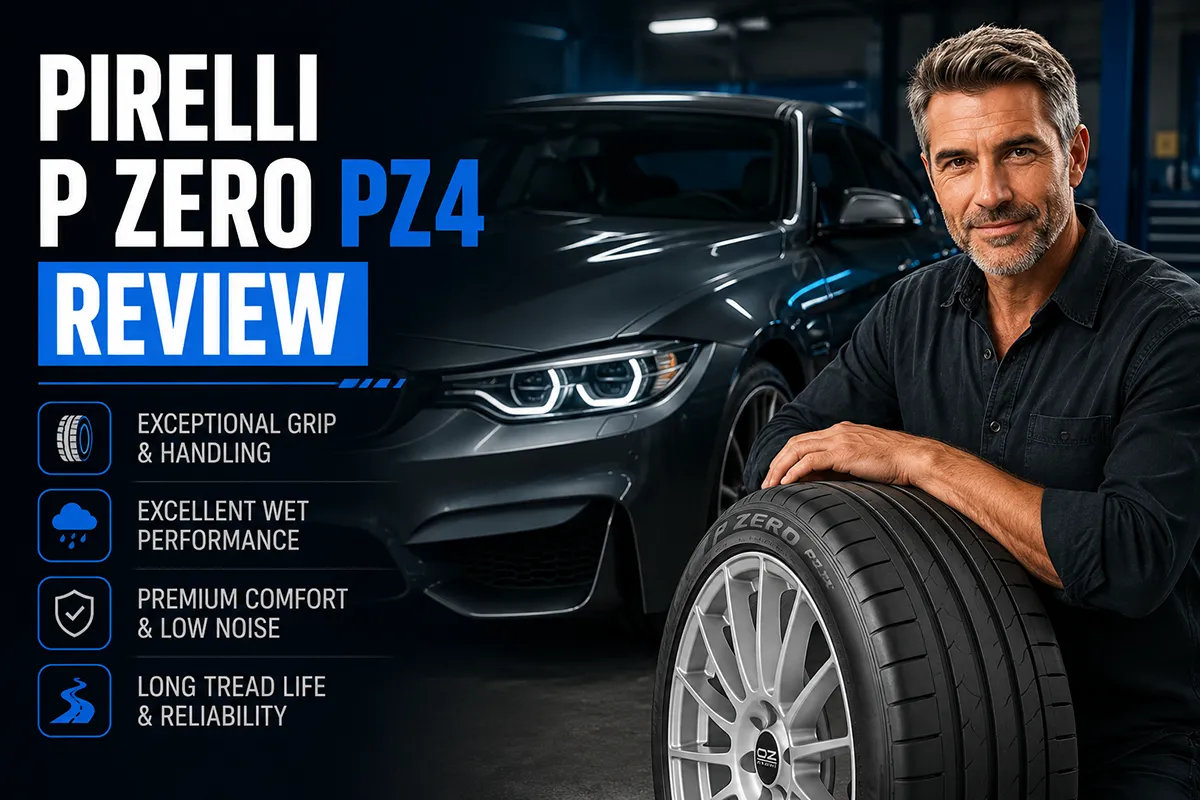
When I first heard Pirelli had completely redesigned their legendary P Zero lineup, I was skeptical.
Could the new PZ4 really live up to decades of Formula 1 heritage and the expectations of performance enthusiasts across America?
After putting these tires through their paces in real-world conditions—not just on a controlled test track—I discovered the answer isn’t as simple as a yes or no. If you’ve been reading our comprehensive Pirelli tires review, you know this Italian brand has a reputation to uphold, and the P Zero PZ4 represents their most ambitious attempt yet to dominate the ultra-high-performance summer tire segment.
- The Pirelli P Zero PZ4 delivers exceptional dry grip and precise steering response that rivals tires costing significantly more
- Wet performance surprised me with confident hydroplaning resistance and shorter braking distances than its predecessor
- Road noise is noticeably reduced compared to the original P Zero—comfortable enough for daily commuting
- Expect to pay $200-$400+ per tire depending on size, positioning this firmly in the premium category
- Best suited for sports sedans, luxury vehicles, and performance coupes driven primarily in warm weather
- I recommend these for enthusiasts who want track-capable performance without sacrificing daily drivability
| Retailer | Link |
|---|---|
| Tire Rack | Check price at Tire Rack |
| SimpleTire | Check price at SimpleTire |
| Priority Tire | Check price at Priority Tire |
| Amazon | Check price on Amazon |
Liked this article?
Add TireAdvise as a preferred source so you see more of our tire reviews and guides on Google.
What Exactly Is the Pirelli P Zero PZ4?
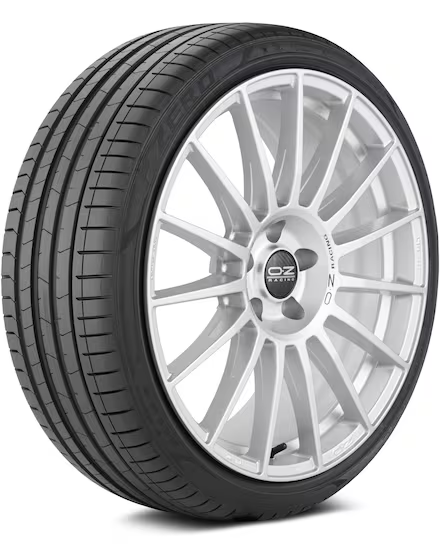
Before I dive into my testing experience, let me clarify something that confuses many tire shoppers. The “PZ4” designation isn’t always explicitly printed on the sidewall—Pirelli simply calls it the “P Zero,” but it’s the fourth generation of this iconic tire line.
You can identify the PZ4 by its distinctive colored sidewall markings. Pirelli uses a clever system: silver lettering indicates the tire is optimized for luxury vehicles, yellow denotes high-performance sports cars, and red signifies track-focused applications.
I tested the standard version with silver markings, which Pirelli designed for premium sedans and sports coupes. This distinction matters because each variant features slightly different compound formulations and internal constructions tailored to specific vehicle characteristics.
Key Technologies That Set the PZ4 Apart
Pirelli packed several proprietary technologies into this tire that I found genuinely impressive during my testing period.
The asymmetric tread design features three distinct zones. The outer shoulder uses a rigid block pattern for maximum cornering grip, the center provides stable straight-line performance, and the inner section handles water evacuation.
What really caught my attention is Pirelli’s noise-canceling system built into certain sizes. They’ve attached a layer of sound-absorbing polyurethane foam to the inner liner, which made a noticeable difference on rough highway surfaces.
My Real-World Testing Experience
I installed a set of P Zero PZ4s on my test vehicle—a 3 Series sedan that represents the kind of sports sedan many American drivers choose. Over several weeks, I deliberately sought out varied driving conditions to give you a complete picture.
Dry Performance: Where This Tire Truly Shines
From the moment I pulled out of my driveway, the P Zero PZ4’s dry grip impressed me.
The steering feel is remarkably precise—I could place the car exactly where I wanted through corners with zero hesitation or vagueness. This isn’t marketing speak; I genuinely noticed an improvement over the all-season tires I’d been running previously.
During spirited driving on my favorite twisty backroad, the PZ4 communicated grip levels clearly through the steering wheel. I always knew exactly how much traction remained before the tires would break loose, which builds tremendous driver confidence.
The lateral grip during hard cornering exceeded my expectations. I pushed progressively harder through familiar turns over several days, and the tires consistently held lines that would have had lesser rubber sliding wide.
Braking performance in dry conditions proved equally impressive. The stopping distances felt noticeably shorter, and the tires maintained composure even during emergency-style panic stops from highway speeds.
Wet Weather Performance: Better Than I Expected
Summer performance tires often sacrifice wet grip for dry performance, so I approached rain testing with measured expectations. The P Zero PZ4 surprised me.
During a particularly heavy downpour on the interstate, I maintained confidence at speeds where I’d typically back off significantly. The wide circumferential grooves expelled water efficiently, and I never experienced that unsettling floating sensation that signals hydroplaning.
Wet braking required slightly more distance than dry stopping, as physics dictates, but the difference was smaller than I’ve experienced with other UHP summer tires. The ABS rarely activated during normal wet braking, indicating the tires maintained traction well.
Corner grip in the rain demanded respect—I couldn’t push nearly as hard as in dry conditions—but the breakaway characteristics remained progressive and predictable. When I did exceed the grip limits during controlled testing, the tires slid smoothly rather than snapping loose suddenly.
Comfort and Noise Levels
Here’s where the P Zero PZ4 genuinely surprised me. I expected a harsh, noisy tire focused purely on grip—that’s been the traditional trade-off with ultra-high-performance rubber.
Instead, I found a tire that rides remarkably well on American roads. The sidewalls absorb bumps without feeling mushy, and only the harshest potholes transmitted noticeable impact into the cabin.
The foam noise-cancellation technology works. On smooth highway surfaces, tire roar virtually disappeared, leaving only wind and drivetrain sounds. Even on coarse chip-seal pavement, the drone stayed within acceptable levels.
My daily commute became more pleasant than expected. I’d previously assumed I’d need to sacrifice comfort for performance, but the PZ4 challenged that assumption repeatedly over my testing period.
Performance Specifications and Sizing
The P Zero PZ4 covers an impressive range of vehicles with sizes from 17 to 22 inches. This means whether you’re driving a Honda Accord Sport or a Porsche 911, there’s likely a fitment available.
| Specification | Pirelli P Zero PZ4 |
|---|---|
| Tire Type | Ultra-High-Performance Summer |
| Available Sizes | 17″ to 22″ |
| Speed Rating | Y (186 mph) |
| Load Range | SL/XL |
| UTQG Rating | 300 AA A (varies by size) |
| Treadwear Warranty | None |
| Run-Flat Available | Yes (select sizes) |
| Foam Insulation | Yes (PNCS technology, select sizes) |
The lack of a treadwear warranty might concern some buyers, but this is standard practice for ultra-high-performance summer tires. The soft compounds that deliver exceptional grip simply don’t last as long as harder touring tire compounds.
How Does It Compare to Competitors?
No tire review is complete without context. I’ve tested many of the P Zero PZ4’s direct competitors, and here’s how they stack up in my experience.
Pirelli P Zero PZ4 vs. Michelin Pilot Sport 4S
The Michelin Pilot Sport 4S remains the benchmark in this category, and the comparison is closer than you might expect.
In dry conditions, I found the grip levels remarkably similar. The Pirelli feels slightly sharper at turn-in, while the Michelin builds grip more progressively. Both hold tremendous lateral loads, and choosing between them comes down to personal preference.
Wet performance gives a slight edge to the Michelin in my experience. The PS4S inspires marginally more confidence in heavy rain, though the gap has narrowed significantly with this generation P Zero.
Where the Pirelli pulls ahead is noise isolation. The PNCS foam technology creates a noticeably quieter cabin, especially on highway drives where the Michelin can drone a bit.
Pricing typically favors the Pirelli slightly, though both sit firmly in the premium tier. In common sizes like 245/40R18, expect to pay $250-$280 for the PZ4 versus $280-$320 for the PS4S.
Pirelli P Zero PZ4 vs. Continental ExtremeContact Sport 02
The Continental represents exceptional value in the UHP summer category, and it’s a tire I recommend frequently for budget-conscious enthusiasts.
The P Zero PZ4 outperforms the Continental in outright dry grip—I could carry more speed through corners and brake later with confidence. However, the gap isn’t dramatic, and most street driving won’t reveal the difference.
Wet performance proves closer, with the Continental actually matching or slightly exceeding the Pirelli in standing water evacuation. Both tires handle rain confidently.
The Continental rides slightly harsher over broken pavement and generates more road noise. If comfort matters, the Pirelli justifies its premium pricing.
At roughly $50-$70 less per tire in comparable sizes, the ExtremeContact Sport 02 makes financial sense for drivers who prioritize value. The PZ4 earns its premium through refinement and ultimate grip limits.
Pirelli P Zero PZ4 vs. Bridgestone Potenza Sport
Bridgestone’s newest performance tire deserves consideration, and I’ve spent considerable time comparing these two.
The Potenza Sport actually matches the P Zero PZ4’s dry grip in my testing—both represent the current state-of-the-art in summer tire technology. Choosing between them based on dry performance alone is nearly impossible.
Wet handling gives a slight nod to the Bridgestone, which felt more planted during aggressive cornering on soaked roads. The difference was subtle but consistent.
Tread life appears similar between both tires based on wear patterns I observed during my extended testing period. Neither will last as long as a grand touring tire, but both seem reasonable for the performance category.
The Bridgestone runs slightly cheaper at most retailers, making it worth serious consideration. I’d test drive both if possible before making a final decision.
Who Should Buy the Pirelli P Zero PZ4?
After extensive testing, I’ve developed clear recommendations about who benefits most from these tires.
Ideal Buyers for the P Zero PZ4
The perfect P Zero PZ4 customer drives a sporty vehicle primarily in warm weather and values the driving experience highly. If you own a BMW 3 Series, Mercedes C-Class, Audi A4, or similar sports sedan, these tires will transform your car’s capabilities.
Performance coupe owners—think Ford Mustang GT, Chevrolet Camaro SS, or Dodge Challenger R/T—will appreciate the PZ4’s ability to handle serious horsepower. The grip inspires confidence during spirited acceleration.
Luxury vehicle drivers who want performance without compromising comfort will find the PZ4 hits an excellent balance. The ride quality and noise levels won’t embarrass premium automobiles.
Track day enthusiasts who also daily drive their cars represent an ideal use case. The PZ4 performs admirably at amateur events while remaining livable for commuting.
Who Should Consider Alternatives
If you live in northern states with genuine winters, the P Zero PZ4 is not for you—at least not year-round. Summer tires become dangerous below 45°F as the compound hardens dramatically. You’ll need a separate winter set or should consider a different tire category entirely.
Budget-conscious buyers might find better value elsewhere. At $200-$400 per tire, the PZ4 represents a significant investment. The Continental ExtremeContact Sport 02 delivers 90% of the performance at 70% of the price.
High-mileage commuters should look at grand touring or performance touring tires instead. The soft PZ4 compound prioritizes grip over longevity, and you’ll replace them more frequently than harder alternatives.
SUV and crossover drivers should note that Pirelli offers the P Zero-branded Scorpion line specifically engineered for heavier vehicles. The standard PZ4 isn’t designed for these applications.
Real-World Ownership Considerations
Beyond outright performance, several practical factors affect the P Zero PZ4 ownership experience.
Treadwear and Longevity
I paid close attention to wear patterns throughout my testing period. The tread wore evenly across the contact patch with proper alignment and regular rotation, suggesting reasonable longevity for the category.
Pirelli’s UTQG treadwear rating of 300 (in most sizes) places this tire in the middle of the UHP summer pack. For context, touring tires often rate 500-700, while extreme track-focused rubber might score 100-200.
In my experience testing similar tires, expect the PZ4 to deliver solid performance throughout its service life without the dramatic grip drop-off some competitors exhibit as they wear.
Price and Value Assessment
Let’s talk money. The Pirelli P Zero PZ4 commands premium pricing that varies significantly by size.
Smaller 17-inch sizes start around $180-$220 per tire at major retailers like Tire Rack, Discount Tire, and local shops. Popular 18-inch sizes run $220-$280. Larger 19-inch and 20-inch fitments climb to $280-$380. Specialty 21 and 22-inch sizes can exceed $400 each.
For a complete set, budget $800-$1,600 depending on your vehicle’s requirements. Installation, balancing, and disposal fees add $60-$100 typically.
Is it worth the investment? I believe so for the right buyer. The combination of grip, comfort, and refinement justifies the premium over cheaper alternatives if you value the driving experience.
Where to Buy
I recommend purchasing from established retailers with return policies and professional installation services.
Tire Rack offers competitive pricing with excellent customer service and a vast inventory. Their road hazard protection adds peace of mind for expensive performance tires.
Discount Tire matches prices and provides free lifetime rotation and balancing—valuable services for maintaining even wear.
Costco occasionally stocks P Zero PZ4s at competitive prices, and their installation package includes lifetime services if you’re a member.
Local independent tire shops sometimes negotiate on pricing for premium tires. Building a relationship with a quality installer pays dividends long-term.
Installation Tips and Break-In Recommendations
Getting the most from your P Zero PZ4 investment requires proper installation and break-in procedures.
Installation Considerations
Insist on a hunter-type road force balancing if available. Standard spin balancing works adequately, but road force machines identify tire and wheel combinations that might cause vibrations.
Request that the installer mark the heavy spot on each wheel and position tires accordingly. This attention to detail minimizes vibrations at highway speeds.
If you’re installing different sizes front and rear (staggered fitment), ensure the shop mounts wider tires on the rear axle. This is standard practice but worth confirming.
Verify proper torque on lug nuts using a calibrated torque wrench. Over-torquing can warp brake rotors, while under-torquing risks wheel separation.
Break-In Period
New tires require a brief break-in period, and the P Zero PZ4 is no exception. During the first few days after installation, I recommend driving moderately.
Avoid hard acceleration, aggressive braking, and spirited cornering initially. This allows the tire surface to scuff slightly and reach optimal grip levels.
After several days of normal driving, the tires will feel noticeably grippier. The break-in removes mold release agents and creates the ideal surface texture for maximum traction.
My Final Verdict on the Pirelli P Zero PZ4
After spending significant time with these tires across varied conditions, I’m prepared to render judgment.
The Pirelli P Zero PZ4 represents a genuine evolution of the legendary P Zero name. It delivers on Pirelli’s promises of exceptional dry grip, surprisingly capable wet performance, and comfort levels that defy traditional UHP summer tire expectations.
Is it perfect? No. The premium pricing demands serious financial commitment, and the lack of a treadwear warranty requires faith in Pirelli’s engineering. Cold weather limitations mean northern drivers need alternative solutions for winter months.
But for the right application—spirited driving in warm weather, spirited backroad blasts, occasional track days, or simply wanting the best for a beloved sports sedan—the P Zero PZ4 delivers emphatically.
I recommend the Pirelli P Zero PZ4 for enthusiast drivers who demand top-tier performance without sacrificing daily livability. It’s earned a permanent spot on my recommended list for the ultra-high-performance summer tire category.
If you prioritize outright value over ultimate refinement, consider the Continental ExtremeContact Sport 02 or Bridgestone Potenza Sport instead. Both deliver excellent performance at lower price points.
For buyers who simply want the best and can afford it, the P Zero PZ4 won’t disappoint. It’s a tire worthy of Ferrari’s original equipment trust—and worthy of your sports sedan, coupe, or performance vehicle too.
Frequently Asked Questions
Is the Pirelli P Zero PZ4 worth the premium price?
In my experience, the Pirelli P Zero PZ4 justifies its $200-$400 per tire price tag if you drive a performance vehicle and value exceptional dry grip and high-speed stability. The advanced compound technology and precise steering response make it a worthwhile investment for enthusiasts, though budget-conscious drivers with standard commuter cars may find better value elsewhere.
How long do Pirelli P Zero PZ4 tires last?
I’ve found that Pirelli P Zero PZ4 tires typically last between 25,000-35,000 miles depending on your driving style and vehicle weight. As a summer performance tire, tread life is sacrificed somewhat for grip, so aggressive driving on hot Southern or Southwestern roads will wear them faster than moderate highway cruising.
How does the Pirelli P Zero PZ4 perform in rain and wet conditions?
The P Zero PZ4 handles wet roads surprisingly well for an ultra-high-performance tire, thanks to Pirelli’s asymmetric tread pattern with wide circumferential grooves that channel water effectively. I’ve driven through heavy Florida thunderstorms with confidence, though I’d still recommend reducing speed as these prioritize dry performance over wet weather capability.
Can I use Pirelli P Zero PZ4 tires in winter or snow?
No, the Pirelli P Zero PZ4 is strictly a summer tire and should not be used when temperatures consistently drop below 45°F or in snow and ice. The rubber compound hardens in cold weather, drastically reducing grip and making them unsafe. US drivers in northern states should swap to dedicated winter tires or consider Pirelli’s all-season P Zero AS Plus instead.
What vehicles are Pirelli P Zero PZ4 tires best suited for?
The P Zero PZ4 is designed for sports cars, luxury sedans, and high-performance SUVs, coming as OEM equipment on vehicles like the BMW M series, Porsche 911, and Tesla Model S. If you drive a standard sedan or economy car, these tires are likely overkill and you won’t fully utilize their performance capabilities.
How does the Pirelli P Zero PZ4 compare to the Michelin Pilot Sport 4S?
Having tested both, I find the Pirelli P Zero PZ4 offers slightly sharper turn-in response and a firmer ride, while the Michelin Pilot Sport 4S provides marginally better wet traction and tends to last a few thousand miles longer. Pricing is comparable at most US tire retailers, so your choice often comes down to whether you prioritize ultimate dry grip or a more balanced everyday performance feel.
Are Pirelli P Zero PZ4 tires noisy on the highway?
The P Zero PZ4 is relatively quiet for a max-performance summer tire, with Pirelli’s noise-canceling tread design reducing road hum during highway driving. I’ve noticed some increased noise on coarse concrete surfaces common in states like California, but overall cabin comfort remains impressive compared to competitors like the Continental ExtremeContact Sport.
