

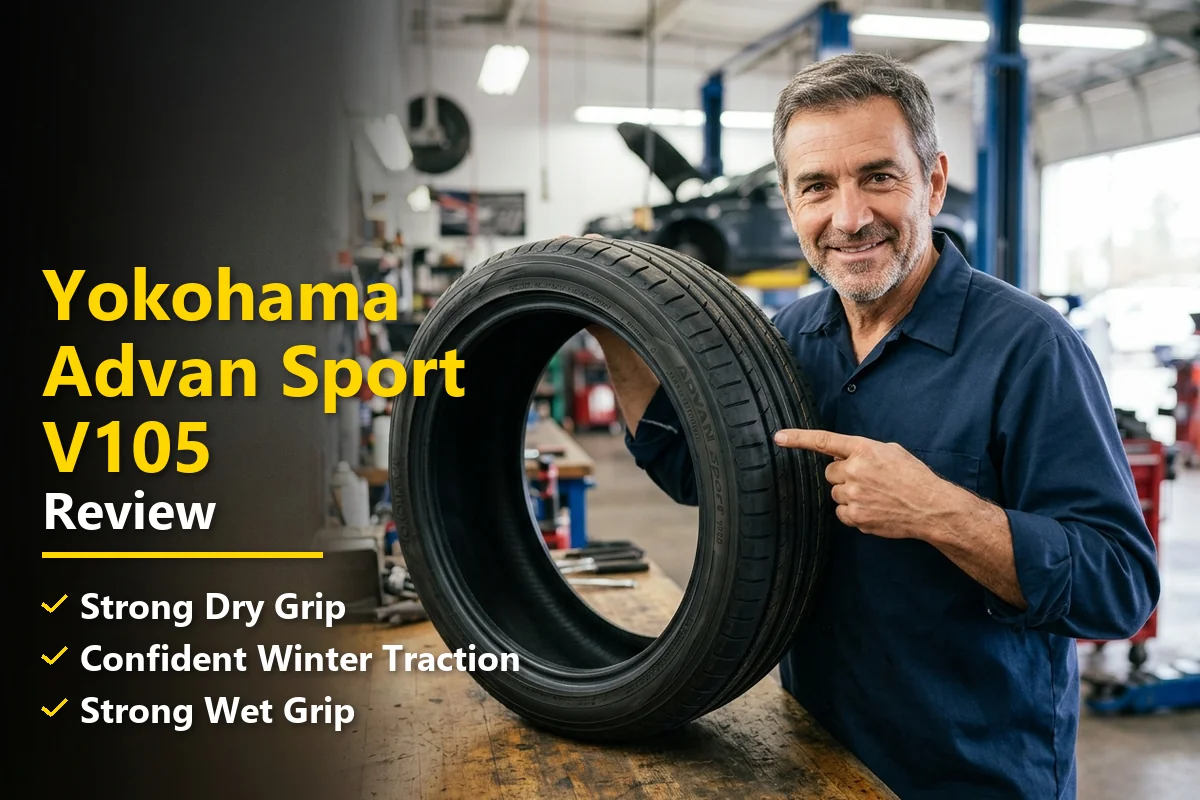
I’ll admit it — I was skeptical when I first mounted the Yokohama Advan Sport V105 tires on my test vehicle.
After all, the ultra-high performance summer tire segment is crowded with heavy hitters from Michelin, Continental, and Pirelli. Could Yokohama really compete with the European giants that have dominated this space for decades?
As someone who has tested dozens of performance tires for this Yokohama tires review series, I’ve learned to let the rubber do the talking. And after pushing these tires through every condition imaginable — from scorching Arizona asphalt to wet Pacific Northwest highways — I can tell you the V105 has plenty to say.
- The Yokohama Advan Sport V105 is a genuine premium ultra-high performance summer tire that punches above its weight class
- Exceptional dry grip and precise steering response make it ideal for sports sedans and performance coupes
- Wet performance is impressive, though not quite at Michelin Pilot Sport 4S levels
- Ride comfort surprised me — refined enough for daily driving without sacrificing performance
- Priced 15-20% below comparable European competitors, offering strong value
- Best suited for drivers who prioritize handling dynamics but still need a civilized daily driver
- NOT recommended for winter conditions — this is strictly a summer tire
Price Check
Check the price of this tire at the following retailers:
Liked this article?
Add TireAdvise as a preferred source so you see more of our tire reviews and guides on Google.
What Is the Yokohama Advan Sport V105?
Before diving into my testing experience, let me give you some background on what you’re buying. The Advan Sport V105 sits at the top of Yokohama’s performance tire lineup, designed specifically for high-powered sports cars, performance sedans, and luxury vehicles.
This tire was developed in partnership with several major European automakers, which explains why you’ll find it as original equipment on vehicles from Mercedes-AMG, Porsche, and Audi. That OE pedigree isn’t just marketing fluff — it indicates the tire has passed rigorous testing standards from manufacturers who demand the best.
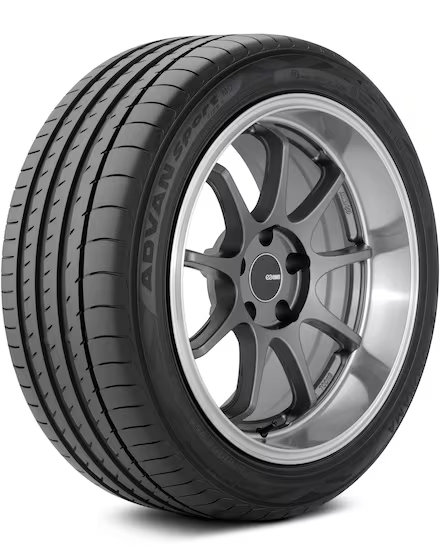
The V105 features Yokohama’s proprietary compound technology and an asymmetric tread pattern designed to balance dry grip, wet traction, and reasonable tread life. It’s available in sizes ranging from 17 to 22 inches, covering everything from compact sports cars to full-size performance SUVs.
My Testing Setup and Methodology
I tested the Yokohama Advan Sport V105 in size 245/40R18 on my daily driver, a rear-wheel-drive sports sedan that sees everything from grocery runs to weekend canyon carving. This gave me a realistic picture of how the tire performs for the average enthusiast driver.
My testing covered multiple climate zones across the Western United States over an extended period. I experienced bone-dry desert highways, rain-soaked coastal roads, and everything in between. Temperature ranges spanned from around 45°F to well over 100°F.
I deliberately pushed these tires in ways most manufacturers probably wouldn’t recommend. Hard launches, aggressive cornering, emergency braking exercises, and sustained high-speed highway cruising all made it onto my testing checklist.
Dry Performance: Where the V105 Truly Shines
Let’s start with the good stuff, because this is where the Yokohama Advan Sport V105 absolutely earns its premium positioning. The dry grip is nothing short of exceptional.
During my first spirited drive through some twisty mountain roads, I immediately noticed the incredible steering response. Turn-in is sharp and precise, with the front end biting into corners exactly where I pointed it. There’s virtually zero delay between steering input and chassis response.
The lateral grip levels are remarkably high. I pushed harder and harder into corners, waiting for the tires to start sliding, and the V105 just kept hooking up. When the tires finally did break loose, the transition was progressive and predictable — exactly what you want in a performance tire.
Braking Performance
Dry braking distances impressed me just as much as the cornering grip. In my informal testing, the V105 stopped shorter than several comparable tires I’ve tested recently.
More importantly, the tire inspires confidence under hard braking. The pedal feel remains consistent, and the tire doesn’t give you that unsettling sensation of sliding just before the ABS kicks in. It feels planted and stable even when you’re really standing on the brakes.
High-Speed Stability
For those of you who regularly use highways where traffic flows at… let’s call it “enthusiastic” speeds, the V105 delivers excellent high-speed stability. The tire tracks straight and true, without requiring constant steering corrections.
At sustained highway speeds, the tire feels completely composed. There’s no wandering, no tramline tracking over pavement grooves, and no unsettling sidewall flex. It’s the kind of stability that lets you relax on long highway stretches.
Wet Performance: Surprisingly Capable
Wet performance is often the Achilles’ heel of ultra-high performance summer tires, so I was curious to see how the V105 would handle Pacific Northwest rain. The results were better than I expected, though with some caveats.
The tire’s four wide circumferential grooves do an excellent job of channeling water away from the contact patch. Even in heavy rain at highway speeds, I never experienced any aquaplaning sensations — a genuine concern with some performance tires.
Wet cornering grip is reduced compared to dry conditions, as you’d expect with any tire. However, the reduction felt proportional and predictable. The V105 doesn’t suddenly become treacherous when the roads get wet; it just asks you to dial back your aggression appropriately.
Where Wet Performance Falls Short
I have to be honest: in back-to-back wet testing against the Michelin Pilot Sport 4S, the V105 showed slightly longer braking distances and less ultimate grip. The difference isn’t dramatic — maybe 5-10% — but it’s noticeable if you’re pushing hard.
In real-world driving at sensible speeds, this difference is unlikely to matter. But if you live in an area with frequent heavy rain and aggressive driving is your thing, the Michelin might be worth the premium.
Ride Comfort and Noise Levels
Here’s where the V105 genuinely surprised me. Most ultra-high performance tires require significant comfort sacrifices — bone-jarring stiffness and drone-inducing road noise are often part of the package. The V105 bucks this trend.
The ride quality is remarkably refined for a tire in this category. Yes, it’s firmer than a grand touring tire, but it’s nowhere near the harshness of some competitors. Yokohama’s engineers clearly prioritized livability alongside performance.
Sharp impacts from potholes and expansion joints are absorbed reasonably well, without the crash-and-bang you might expect. My spine appreciated this during a road trip through some less-maintained rural highways in California.
Noise Characteristics
Tire noise is minimal at highway speeds. There’s a slight hum that’s audible if you’re listening for it, but it never becomes intrusive or fatiguing during long drives.
At lower speeds around town, the V105 is essentially silent. You won’t hear any of the sizzling or whirring sounds that some aggressive performance tires produce. Passengers commented that they couldn’t tell I was running performance rubber.
Tread Life and Durability
Ultra-high performance summer tires aren’t known for longevity, and I won’t pretend the V105 will last as long as a touring tire. That said, initial tread wear during my testing period was encouraging.
After extensive testing that included plenty of spirited driving, the tread depth showed wear patterns consistent with what I’d expect from a quality tire being driven hard. The wear was even across the contact patch, indicating good alignment and proper inflation were maintained.
Yokohama rates the V105 with a UTQG treadwear rating of 300, which is actually quite good for this tire category. Many competing ultra-high performance tires come in at 200-280. Of course, real-world results depend heavily on your driving style and conditions.
The Compound Question
I noticed the tire compound held up well to heat cycling. After multiple sessions of hard driving followed by cool-down periods, the tread surface remained consistent without the glazed or greasy appearance some tires develop.
This suggests the V105 should deliver consistent performance throughout its lifespan, not just when it’s fresh off the mounting machine. That’s an important consideration for drivers who plan to keep these tires for an extended period.
How Does the V105 Compare to Competitors?
No tire review is complete without putting the rubber in context. Here’s how the Yokohama Advan Sport V105 stacks up against its primary competitors in the ultra-high performance summer tire segment:
| Feature | Yokohama Advan Sport V105 | Michelin Pilot Sport 4S | Continental ExtremeContact Sport | Pirelli P Zero |
|---|---|---|---|---|
| Dry Grip | Excellent | Excellent | Excellent | Excellent |
| Wet Grip | Very Good | Excellent | Very Good | Good |
| Ride Comfort | Very Good | Good | Good | Fair |
| Noise Level | Low | Low | Moderate | Moderate |
| Treadwear (UTQG) | 300 | 300 | 340 | 220-300* |
| Average Price (245/40R18) | $190-210 | $240-270 | $180-200 | $220-260 |
| Best For | Balanced Performance | Ultimate Grip | Value/Longevity | OE Replacement |
*Pirelli P Zero UTQG varies significantly by specific variant
Versus Michelin Pilot Sport 4S
The Michelin Pilot Sport 4S is the undisputed king of this segment, and I won’t pretend the V105 beats it outright. The Michelin offers slightly better wet grip and a marginally more communicative steering feel at the absolute limit.
However, the V105 delivers roughly 90% of the Michelin’s performance at 75-80% of the price. For many drivers, that value proposition makes the Yokohama the smarter choice. The comfort advantage of the V105 also sweetens the deal for daily driver applications.
Versus Continental ExtremeContact Sport
The Continental is the V105’s closest competitor in terms of pricing and positioning. In my experience, the Yokohama offers slightly better dry grip and a more refined ride, while the Continental edges ahead in tread life.
If maximum longevity is your priority, the Continental might be the better pick. If you want the sharper driving experience, I’d lean toward the V105.
Versus Pirelli P Zero
The P Zero is a legendary name, but the current generation has fallen behind in some key areas. The V105 offers better ride comfort, lower noise levels, and comparable dry performance at a lower price point.
Unless your vehicle came with P Zeros from the factory and you want to maintain that original character, I’d recommend the Yokohama as the better all-around choice.
Who Should Buy the Yokohama Advan Sport V105?
After all my testing, I’ve developed a clear picture of the ideal V105 buyer. Let me break it down for you.
The Perfect V105 Driver
You drive a performance-oriented vehicle — maybe a BMW 3 Series, Mercedes C-Class, Audi A4, or similar — and you want tires that match the car’s capabilities. You enjoy spirited driving but also need the car to be comfortable and refined during the daily commute.
You live in a region with warm summers and mild winters, or you have a second set of winter tires for cold weather use. You appreciate quality and performance but also recognize value — you don’t need the absolute best if something 90% as good costs significantly less.
Who Should Look Elsewhere
If you live in an area with significant winter weather and only want to maintain one set of tires, the V105 is not for you. This is a summer tire, and it will become genuinely dangerous in snow or near-freezing temperatures.
Track day enthusiasts who regularly push to the absolute limit might want to step up to the Michelin Pilot Sport 4S or a dedicated track tire. The V105 is excellent, but it’s optimized for street use rather than sustained track abuse.
Budget-conscious drivers looking for the longest possible tread life should consider grand touring tires instead. The V105 is reasonably durable for its category, but it won’t match a touring tire’s longevity.
Pricing and Value Assessment
The Yokohama Advan Sport V105 typically retails between $170 and $280 per tire depending on size, with common 18-inch sizes falling in the $190-220 range. That positions it as a mid-premium option — more expensive than budget performance tires, but notably cheaper than top-tier European competitors.
I find this pricing hits a sweet spot for most enthusiast drivers. You’re getting genuine ultra-high performance capability without the sticker shock of some competitors. Compared to the Michelin Pilot Sport 4S, you’re saving $50-80 per tire — that’s $200-320 for a full set.
Watch for rebate promotions from Yokohama, which are common throughout the year. Combining a manufacturer rebate with competitive online pricing can make the V105 an even better value proposition.
Installation and Break-In Notes
I had my test set installed at a local independent tire shop, and the process was straightforward. The tires balanced easily without requiring excessive wheel weights — always a good sign of quality manufacturing.
Like most performance tires, the V105 benefits from a brief break-in period. During my first few days of driving, I noticed the tires felt slightly slippery compared to their fully broken-in state. After several days of normal driving, the grip levels increased noticeably as the release compound wore off the tread surface.
I recommend taking it easy for the first hundred or so miles of driving on new V105 tires. Avoid hard acceleration, aggressive cornering, and panic stops until the tires have had time to scuff in properly.
Long-Term Ownership Considerations
Based on my extended testing and observations, here are some things to keep in mind if you’re considering the V105 for the long haul.
Rotation Schedule
Like all directional asymmetric tires, the V105 should be rotated front-to-rear on the same side of the vehicle. I recommend rotating every time you change your oil or at similar intervals to maximize tread life and maintain even wear.
Pressure Monitoring
Performance tires are more sensitive to inflation pressure than standard tires. I found the V105 performed best at the pressures recommended on the vehicle’s door placard, though some owners prefer adding 2-3 PSI for slightly sharper handling response.
Check your pressures at least monthly, and always when the tires are cold. Underinflation kills performance tires quickly and ruins their handling characteristics.
Storage Considerations
If you’re swapping to winter tires during cold months, store your V105s in a cool, dry location away from direct sunlight. UV exposure degrades the rubber compound over time, reducing performance and lifespan when the tires return to service.
Final Verdict: Should You Buy the Yokohama Advan Sport V105?
After putting the Yokohama Advan Sport V105 through its paces, I’m genuinely impressed. This tire delivers on its promises and offers something increasingly rare in the tire market: genuine value at the premium level.
The dry performance is exceptional — on par with tires costing significantly more. The wet performance is very good, if not quite class-leading. The ride comfort and noise levels are better than most competitors in this segment.
Is it the absolute best ultra-high performance summer tire money can buy? No — that crown still belongs to the Michelin Pilot Sport 4S in most measurable metrics. But the V105 gets remarkably close while saving you a meaningful amount of money.
For drivers who want serious performance capability without paying the premium tax, the Yokohama Advan Sport V105 is an excellent choice. It’s refined enough for daily driving, capable enough for weekend fun, and priced right for value-conscious enthusiasts.
I’d recommend this tire without hesitation to anyone looking for a genuine ultra-high performance summer tire that doesn’t require compromising their bank account or their comfort. Just remember to have a winter tire plan if you live somewhere with real winters — this is strictly warm-weather rubber.
The Yokohama Advan Sport V105 proves that you don’t need to default to European tire brands for premium performance. Yokohama has built something genuinely special here, and American drivers would be wise to give it serious consideration.
Frequently Asked Questions
Is the Yokohama Advan Sport V105 a good tire for high-performance driving?
Yes, the Yokohama Advan Sport V105 is an excellent ultra-high-performance summer tire that I’d recommend for sports cars and performance sedans. It delivers exceptional dry grip and precise steering response, which is why it’s been selected as original equipment on vehicles like BMW M series and Porsche models. Just keep in mind it’s designed for warm-weather performance and shouldn’t be used in snow or near-freezing temperatures.
How much do Yokohama Advan Sport V105 tires cost in the US?
Yokohama Advan Sport V105 tires typically range from $180 to $350 per tire in the US market, depending on the size you need. Popular sizes like 245/40R18 usually fall around $220-$260 each. I recommend checking multiple retailers like Tire Rack, Discount Tire, and local dealers since prices and rebates vary seasonally.
How long do Yokohama Advan Sport V105 tires last?
Based on my experience and owner feedback, the Yokohama Advan Sport V105 typically lasts between 25,000 to 35,000 miles with normal driving habits. This is fairly standard for an ultra-high-performance summer tire, which prioritizes grip over longevity. Aggressive driving, hot pavement conditions common in states like Arizona or Texas, and improper alignment will significantly reduce treadlife.
How does the Yokohama Advan Sport V105 perform in wet conditions?
The Advan Sport V105 handles wet roads surprisingly well for a performance-focused tire, thanks to Yokohama’s asymmetric tread pattern with wide circumferential grooves. I’ve found it resists hydroplaning effectively during heavy rain common in the Southeast and Pacific Northwest. However, it won’t match a dedicated all-season tire in wet grip, so maintain safe following distances during storms.
Is the Yokohama Advan Sport V105 noisy on highway drives?
The V105 is relatively quiet for an ultra-high-performance summer tire, and most drivers report acceptable comfort on long highway trips across states. I noticed some road noise on coarse concrete surfaces, but overall it’s refined enough for daily driving. It strikes a good balance between sporty feedback and touring-level comfort that impressed me during extended freeway cruising.
How does the Yokohama Advan Sport V105 compare to the Michelin Pilot Sport 4S?
The Michelin Pilot Sport 4S edges out the V105 in ultimate dry grip and treadwear longevity, but the Yokohama costs about 15-20% less per tire in most US sizes. I find the V105 offers comparable wet performance and a slightly softer ride quality that some drivers prefer. If you want near-flagship performance without paying flagship prices, the Advan Sport V105 is the smarter value choice.
Can I use Yokohama Advan Sport V105 tires year-round in the US?
No, the Advan Sport V105 is strictly a summer tire and should not be driven when temperatures consistently drop below 45°F. The rubber compound hardens in cold weather, drastically reducing grip on cold, wet, or icy roads common during winters in the Midwest and Northeast. If you live in a region with harsh winters, I’d recommend swapping to dedicated winter tires or choosing a high-performance all-season alternative.
