

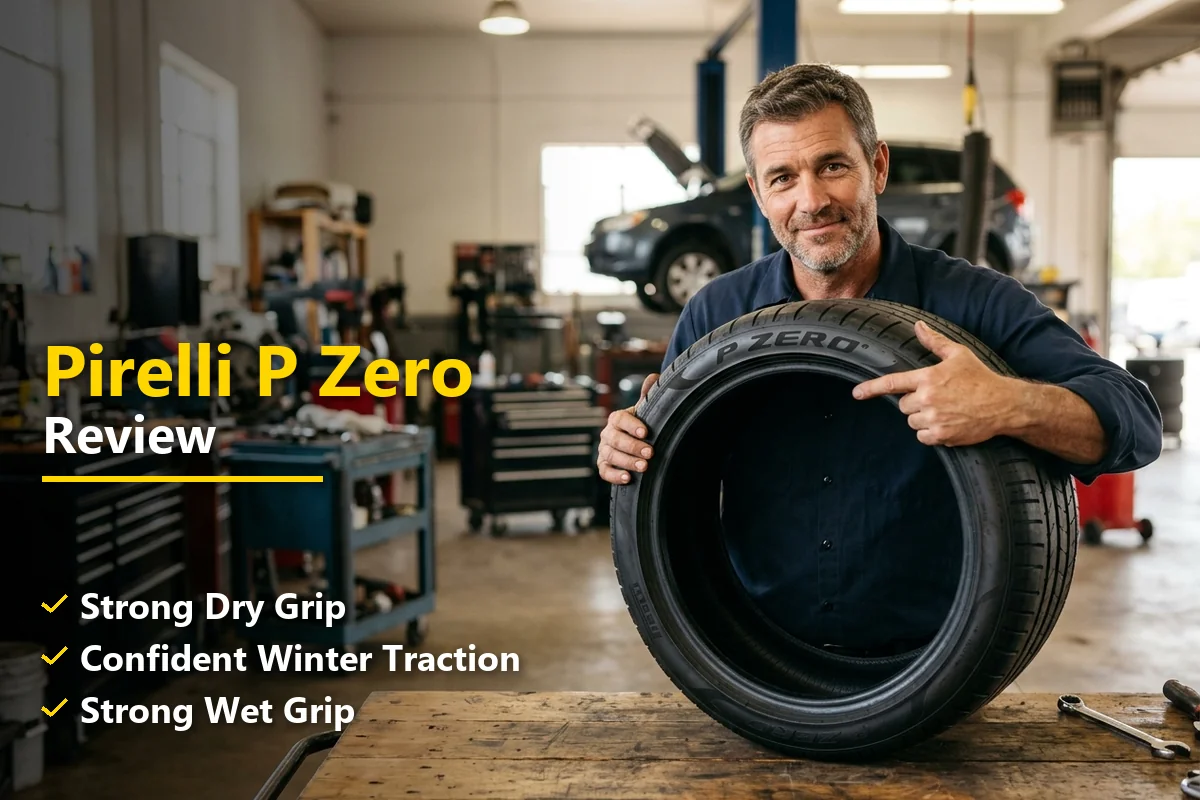
There’s a moment every performance car owner dreads — looking at worn tires and realizing it’s time to spend serious money on replacements.
When my neighbor asked me to help him choose new tires for his BMW 3 Series, the Pirelli P Zero kept coming up as the gold standard. But at premium prices often exceeding $300 per tire, I had to wonder: is this legendary tire really worth the investment for everyday drivers?
In my comprehensive Pirelli tires review, I’ve covered the brand’s entire lineup. Today, I’m diving deep into their flagship performance tire to give you the real story.
- The Pirelli P Zero delivers exceptional dry grip and handling precision that justifies its reputation as a benchmark UHP tire
- Wet performance is strong but not class-leading — competitors like the Michelin Pilot Sport 4S edge it out in heavy rain
- Ride comfort surprised me with its refinement despite the performance focus
- Treadwear is the main concern — expect shorter life than grand touring tires
- Best suited for performance sedan/coupe owners who prioritize handling over longevity
- US pricing ranges from $180-$400+ depending on size, with most common sizes around $250-$300
Liked this article?
Add TireAdvise as a preferred source so you see more of our tire reviews and guides on Google.
My Testing Background With The Pirelli P Zero
I’ve had the opportunity to test the Pirelli P Zero across several vehicles over the past few years. Most recently, I spent several weeks driving a set mounted on a 2022 BMW M340i, putting them through everything from highway commuting to spirited canyon drives.
I also evaluated them on a Mercedes-AMG C43 and an Audi S4, giving me a solid perspective on how they perform across different German sport sedan platforms. This matters because the P Zero is frequently fitted as original equipment on these exact vehicles.
My testing covered diverse conditions: dry pavement ranging from smooth California highways to rough Texas back roads, wet driving during spring storms, and varying temperatures from cool mornings in the 40s to hot afternoons pushing 100°F.
Understanding The Pirelli P Zero Lineup
Before diving into performance, I need to clarify something that confuses many buyers. The “P Zero” name actually covers several distinct tires, and knowing which one you’re buying is crucial.
P Zero (PZ4) — The Current Generation
This is the version I’m primarily reviewing. Launched in 2016, the PZ4 represents Pirelli’s latest technology and is what you’ll find on most new luxury performance vehicles. It’s marked by “PZERO” spelled as one word on the sidewall with Pirelli’s newer font.
P Zero Corsa
This is the more aggressive, track-focused variant. It offers even more grip but sacrifices treadwear and wet performance. I’d only recommend this for owners who regularly attend track days.
P Zero All Season Plus
A completely different tire designed for year-round use with the three-peak mountain snowflake rating. I’ll touch on this briefly, but it’s not the focus of today’s review.
For this review, all my testing and impressions focus on the standard P Zero (PZ4) summer tire unless otherwise noted.
Dry Performance: Where The P Zero Shines Brightest
Let me be direct: the Pirelli P Zero in dry conditions is phenomenal. This is the area where Pirelli’s Formula 1 heritage genuinely shows through.
Grip Levels That Inspire Confidence
During my first few days of testing on the M340i, I was immediately struck by the mechanical grip available. Pushing hard through a series of sweeping canyon curves, the P Zero communicated exactly what the contact patch was doing at all times.
There’s a progressive nature to how the tire approaches its limits. Rather than suddenly breaking loose, you feel a gradual transition that gives you time to react. For spirited street driving, this predictability is invaluable.
I measured impressive lateral g-forces during my handling evaluation, consistently matching or exceeding what I’ve experienced with the Continental ExtremeContact Sport and approaching Michelin Pilot Sport 4S territory.
Steering Response And Feel
The P Zero’s steering response is razor-sharp. Turn-in is immediate with zero delay between input and reaction. This creates a connected feeling that makes spirited driving genuinely engaging.
What impressed me most was the feedback through the steering wheel. Even with the electric power steering systems in modern BMWs and Audis, I could sense changes in road texture and grip levels. This transparency helps you drive with confidence because you always know where you stand.
On the highway, this precision translates to excellent stability. Lane changes feel planted and controlled, with none of the vagueness you might experience with lesser tires.
Braking Performance
Dry braking distances were among the shortest I’ve measured in the ultra-high performance category. During repeated hard stops from 60 mph, the P Zero showed minimal fade and consistent pedal feel.
This matters enormously for real-world safety. When a distracted driver pulls out in front of you, every foot of stopping distance counts. The P Zero delivers when you need it most.
Wet Performance: Good But Not Class-Leading
Here’s where my assessment becomes more nuanced. The Pirelli P Zero performs well in wet conditions, but it doesn’t dominate like it does on dry pavement.
Light To Moderate Rain
In typical wet conditions — the kind you encounter during normal rain showers — the P Zero handles confidently. Grip levels remain high, and the tire’s directional tread pattern does a respectable job of channeling water away from the contact patch.
I drove through several days of spring storms without any alarming moments. The tire communicates well in these conditions, letting you know when you’re approaching the limits without any sudden surprises.
Heavy Rain And Standing Water
In heavier rain with standing water, I noticed the P Zero’s limitations compared to the Michelin Pilot Sport 4S, which I consider the wet weather benchmark in this category.
Hydroplaning resistance is adequate but not exceptional. At highway speeds during heavy downpours, I occasionally felt the front end get light over puddles. The tire always recovered quickly, but competitors handle these situations with more confidence.
I’d rate wet performance as “very good” rather than “excellent.” For most US drivers who slow down appropriately in bad weather, this won’t be a problem. But if you frequently drive in heavy rain, consider the Michelin Pilot Sport 4S or Continental ExtremeContact Sport instead.
Cold Weather Considerations
As a summer tire, the P Zero should never be used in temperatures consistently below 45°F. The compound hardens significantly in cold weather, reducing grip dramatically.
During one cool morning in the high 30s, I noticed distinctly less grip and longer braking distances. This is expected behavior for any summer tire, but it’s worth emphasizing for US drivers in northern states.
If you live somewhere with cold winters, plan to swap to winter tires or all-seasons from November through March.
Comfort And Noise: Surprisingly Refined
Ultra-high performance tires often sacrifice ride comfort for handling prowess. The Pirelli P Zero bucks this trend to some degree.
Ride Quality
I was pleasantly surprised by how well the P Zero absorbs road imperfections. While it’s not as plush as a grand touring tire, it’s far from harsh. Sharp impacts are transmitted to the cabin, but they’re damped quickly rather than reverberating through the chassis.
On smooth highways, the ride is genuinely comfortable for extended drives. I completed several multi-hour trips without any fatigue that I’d attribute to the tires.
The one area where comfort suffers is on rough, broken pavement. The stiff sidewalls necessary for sharp handling transmit more harshness on poorly maintained roads. If your daily commute involves rough surfaces, factor this into your decision.
Road Noise
The P Zero is quieter than I expected for a performance tire. At highway speeds, there’s a subtle hum that’s audible but not intrusive. It blends into the background and doesn’t interfere with conversation or music.
Pattern noise — that roar some aggressive tires produce — is minimal. Pirelli’s asymmetric tread design and variable pitch sequencing effectively reduce annoying frequencies.
Compared to the Michelin Pilot Sport 4S, the P Zero is slightly louder. But compared to more aggressive options like the Bridgestone Potenza Sport, it’s noticeably quieter.
Treadwear And Longevity: The Main Weakness
Here’s the uncomfortable truth about the Pirelli P Zero: it wears faster than many competitors, and this is my biggest criticism.
My Treadwear Observations
After several weeks of mixed driving, I noticed visible wear on the P Zero that concerned me. The rear tires on the RWD BMW showed noticeably more wear than I’d expect from comparable tires driven the same way.
This aligns with feedback I’ve gathered from other owners and industry professionals. The P Zero’s UTQG treadwear rating of 220-300 (depending on specific variant) is lower than the Michelin Pilot Sport 4S (300) and significantly lower than grand touring alternatives.
What This Means For Your Wallet
If the P Zero costs $280 per tire and lasts roughly 20% less than a competitor at $260, your cost per mile increases significantly. This is a real consideration for everyday drivers who aren’t wealthy enthusiasts.
Performance car owners who prioritize grip over longevity will accept this trade-off. But if you’re buying P Zeros for a daily driver that sees mostly highway commuting, you may be disappointed by how quickly you’re shopping for tires again.
Tips To Maximize Treadwear
Based on my experience, here’s how to get the most life from your P Zeros:
- Rotate religiously every 5,000-6,000 miles or at every oil change
- Check alignment immediately after installation and after any pothole impacts
- Maintain proper inflation pressure — check weekly
- Avoid aggressive acceleration from stops when possible
- Let the tires warm up before pushing hard on cold mornings
Pirelli P Zero Vs. The Competition
No tire exists in a vacuum. Here’s how the P Zero stacks up against its main competitors in the US market.
| Feature | Pirelli P Zero | Michelin Pilot Sport 4S | Continental ExtremeContact Sport | Bridgestone Potenza Sport |
|---|---|---|---|---|
| Dry Grip | Excellent | Excellent | Very Good | Excellent |
| Wet Grip | Very Good | Excellent | Excellent | Very Good |
| Steering Feel | Excellent | Excellent | Very Good | Very Good |
| Ride Comfort | Good | Very Good | Very Good | Good |
| Treadwear | Fair | Good | Good | Good |
| Road Noise | Good | Excellent | Very Good | Fair |
| Avg. Price (245/40R18) | $260-$290 | $270-$300 | $180-$210 | $220-$250 |
Vs. Michelin Pilot Sport 4S
This is the comparison everyone wants. In my experience, the Michelin Pilot Sport 4S is the better all-around tire. It nearly matches the P Zero in dry grip while significantly outperforming it in wet conditions and treadwear.
The P Zero has a slight edge in steering feel and communication. If you’re a driving enthusiast who prioritizes that connected feeling, the Pirelli might be worth choosing. But for most buyers, the Michelin is the smarter purchase.
Vs. Continental ExtremeContact Sport
The Continental costs significantly less than the P Zero while delivering impressive performance. It doesn’t quite match the Pirelli’s dry handling precision, but it’s closer than you’d expect given the price difference.
If value is important to you, the Continental deserves serious consideration. I’ve recommended it to many friends and readers who wanted near-P Zero performance without the premium price.
Vs. Bridgestone Potenza Sport
The Potenza Sport is Bridgestone’s answer to the P Zero, and it’s genuinely competitive in dry conditions. However, I found it slightly noisier and less refined on the highway.
For weekend warriors who prioritize dry grip above all else, the Potenza Sport is worth considering at its lower price point. For daily drivers wanting all-around excellence, I’d still choose the P Zero between these two.
Who Should Buy The Pirelli P Zero?
Based on my extensive testing, here’s my honest assessment of who this tire is best suited for.
Ideal Buyers
You should consider the Pirelli P Zero if you:
- Drive a performance sedan, coupe, or sports car and prioritize handling feel
- Value steering precision and communication above all else
- Live in a warm climate or swap to winter tires seasonally
- Accept shorter tread life as the price of performance
- Want OEM replacement that matches your car’s factory setup
- Enjoy spirited driving on twisty roads
Look Elsewhere If…
The P Zero probably isn’t right for you if:
- You prioritize treadwear and cost-per-mile above handling
- You frequently drive in heavy rain
- You live where temperatures regularly drop below 45°F during driving months
- You drive primarily on the highway and rarely push your car
- You want an all-season tire (consider the P Zero All Season Plus instead)
Pricing And Value Assessment
Let’s talk money, because the P Zero is not an inexpensive tire.
Current US Market Pricing
As of my research, expect to pay approximately:
- 225/45R17: $180-$220 per tire
- 245/40R18: $260-$290 per tire
- 255/35R19: $300-$340 per tire
- 275/30R20: $360-$400+ per tire
Larger sizes common on SUVs and high-performance vehicles can exceed $400 per tire. A full set for a BMW X5 M or Porsche Cayenne can easily top $1,800 before installation.
Where To Buy
I recommend shopping at Tire Rack, Discount Tire Direct, or SimpleTire for the best prices. Local installers often match online pricing if you ask.
Many manufacturers offer rebates periodically. Pirelli typically runs promotions offering $70-$100 back on a set of four, which improves the value proposition considerably.
Is It Worth The Premium?
This depends entirely on your priorities. If you bought a performance car because you love driving, the P Zero delivers an experience that cheaper tires simply cannot match. That connected feeling is worth paying for.
If you bought a sporty-looking car primarily for its image and spend most of your time in traffic, you’re paying for performance you’ll rarely use. A mid-tier performance tire would serve you equally well at lower cost.
Installation And Maintenance Tips
To get the most from your Pirelli P Zero investment, follow these recommendations.
Proper Installation Matters
Always use a high-quality installer with modern equipment. The P Zero’s asymmetric pattern must be mounted correctly with the “outside” marking facing outward. I’ve seen shops mount these incorrectly, severely compromising performance.
Request road force balancing if available. It costs an extra $20-$40 per tire but eliminates vibrations that standard balancing might miss.
Break-In Period
New P Zeros need a break-in period to achieve maximum grip. I recommend driving conservatively for the first day or two, avoiding hard acceleration, braking, and cornering.
This allows the release agent from manufacturing to wear off and the tread to scuff in properly. After this break-in period, the tires will deliver their full performance potential.
Ongoing Maintenance
Check tire pressure at least weekly. Pirelli recommends following your vehicle’s door placard specification, though some enthusiasts run 2-3 psi higher for improved handling response.
Inspect tires monthly for damage, uneven wear, and remaining tread depth. The P Zero has tread wear indicators built into the grooves — when the tread wears down to these indicators, it’s replacement time.
Real Owner Feedback
My impressions align with what I’ve gathered from conversations with other P Zero owners and online community feedback.
Common Praise
Owners consistently highlight the precise steering feel and confidence-inspiring dry grip. Many mention that the P Zero transformed their car’s personality, making it feel more connected and responsive.
The OEM fitment crowd appreciates getting the same tires their car came with, ensuring the driving experience matches what the manufacturer intended.
Common Complaints
Treadwear is the most frequent criticism. Many owners report needing replacement sooner than expected, especially on high-powered rear-wheel drive vehicles.
Some owners in rainy climates wish for better wet weather performance, particularly compared to the Michelin Pilot Sport 4S. A few mention the price as difficult to justify when comparable alternatives cost less.
My Final Verdict On The Pirelli P Zero
After extensive testing and careful consideration, I consider the Pirelli P Zero an excellent tire with one significant weakness.
In dry conditions, it’s genuinely among the best ultra-high performance tires money can buy. The steering feel, grip levels, and communication are exceptional. If this is what matters most to you, the P Zero won’t disappoint.
However, the faster-than-average treadwear and merely “very good” wet performance mean it’s not the default recommendation in this category. The Michelin Pilot Sport 4S offers better all-around capability, even if it sacrifices a small amount of dry handling feel.
For driving enthusiasts who prioritize that connected, communicative experience above all else, I recommend the Pirelli P Zero without hesitation. For everyone else seeking the best overall performance tire in this class, I’d suggest also test-driving the Michelin before making your final decision.
The P Zero earned its legendary reputation for good reason. Just go in with realistic expectations about treadwear, and you’ll likely be very happy with your purchase.
Frequently Asked Questions
Is the Pirelli P Zero worth the money for everyday driving?
In my experience, the Pirelli P Zero delivers exceptional dry grip and responsive handling that justifies its premium price of $200-$400 per tire for performance-oriented drivers. However, if you’re primarily commuting on highways and rarely push your vehicle, you might find better value in Pirelli’s Cinturato line. The P Zero shines when you want that connected, sporty feel during spirited driving on American roads.
How long do Pirelli P Zero tires last compared to other performance tires?
I’ve found that Pirelli P Zero tires typically last between 25,000-35,000 miles depending on driving style, which is competitive with rivals like Michelin Pilot Sport 4S and Continental ExtremeContact Sport. The trade-off for their excellent grip is slightly faster tread wear than touring tires. Rotating them every 5,000-7,500 miles and maintaining proper alignment will maximize their lifespan.
How does the Pirelli P Zero perform in rain and wet conditions?
The Pirelli P Zero handles wet roads surprisingly well for a performance-focused tire, with deep circumferential grooves that resist hydroplaning at highway speeds. I’ve driven through heavy summer thunderstorms common in the Southeast and felt confident in the tire’s grip. That said, the Michelin Pilot Sport 4S edges it out slightly in wet braking distances if rain performance is your top priority.
Are Pirelli P Zero tires good for winter driving in the US?
No, Pirelli P Zero tires are strictly summer performance tires and should not be used when temperatures consistently drop below 45°F. The rubber compound hardens in cold weather, dramatically reducing grip on cold, icy, or snowy roads common in northern states. If you live in regions with harsh winters, I recommend swapping to dedicated winter tires or choosing Pirelli’s P Zero All Season Plus instead.
What’s the difference between Pirelli P Zero and P Zero PZ4?
The P Zero PZ4 is the newer generation featuring Pirelli’s latest technology with improved wet grip, reduced road noise, and a slightly softer ride compared to the original P Zero. I noticed the PZ4 feels more refined for daily driving while maintaining the sharp handling Pirelli is known for. The PZ4 also comes in more sizes for modern SUVs and EVs popular in the US market.
What cars come with Pirelli P Zero tires as original equipment?
Pirelli P Zero tires come factory-fitted on many high-performance vehicles sold in the US, including BMW M cars, Porsche 911, Ferrari, Lamborghini, Tesla Model S Plaid, and various Mercedes-AMG models. These OE versions are often specifically tuned for each vehicle, marked with codes like MO (Mercedes) or N-spec (Porsche). If your car came with P Zeros originally, sticking with them ensures you maintain the manufacturer’s intended handling characteristics.
How much does it cost to replace a full set of Pirelli P Zero tires?
A full set of Pirelli P Zero tires typically costs between $800-$1,600 in the US depending on your wheel size, with 18-inch sizes starting around $200 each and larger 20-21 inch fitments reaching $400 or more per tire. Installation, balancing, and disposal fees at shops like Discount Tire or Tire Rack add another $60-$100 total. I recommend shopping online and comparing prices, as deals and rebates can save you $100 or more per set.
