

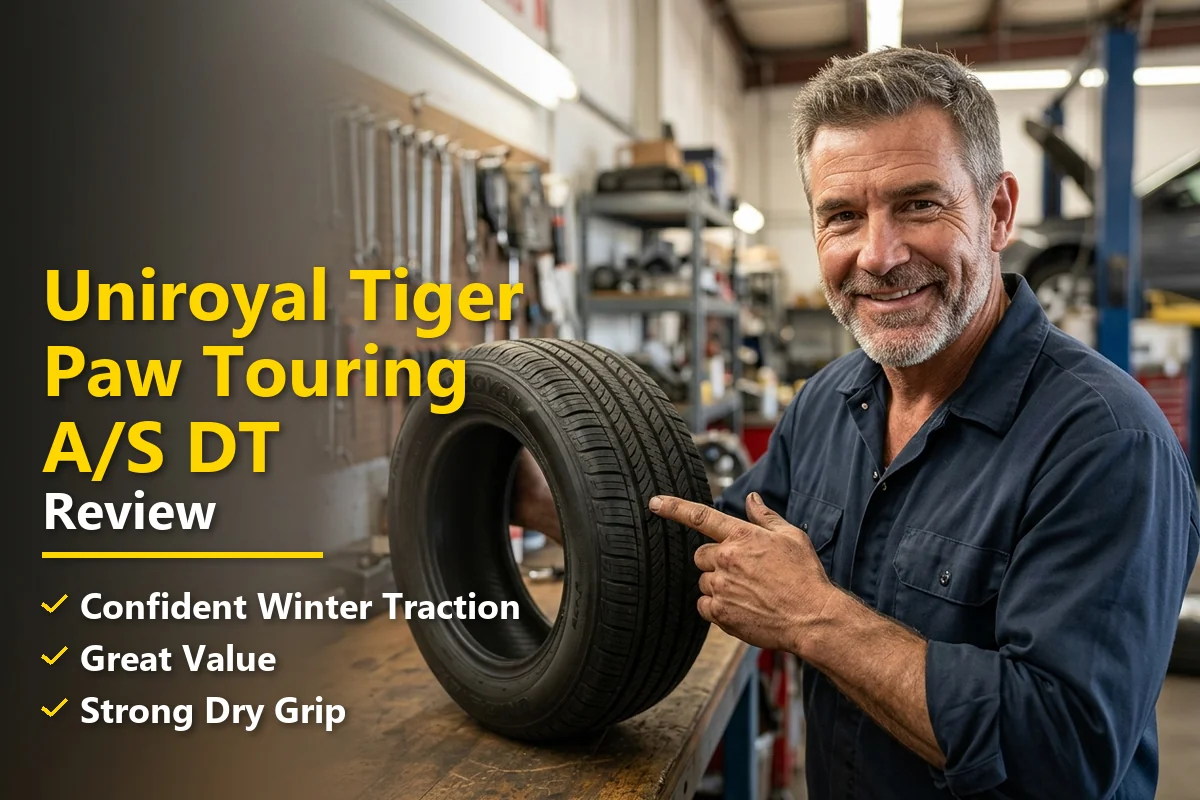
If you’re staring at a tire quote wondering why four rubber circles cost as much as a vacation, you’re not alone.
I’ve been there — standing in the tire shop, watching the total climb higher with every “recommended” upgrade. That’s exactly the scenario that makes the Uniroyal Tiger Paw Touring A/S DT so appealing.
It promises all-season reliability at a price point that won’t make your wallet cry. But does it actually deliver, or are you just buying cheap rubber that’ll leave you white-knuckling through the first rainstorm? I spent an extended test period pushing these tires through real-world conditions to find out.
If you’re still sizing up the brand itself before pulling the trigger, my Uniroyal tires review gives you the full picture on what Uniroyal brings to the table.
- The Uniroyal Tiger Paw Touring A/S DT is a solid budget all-season tire that punches above its price class in wet performance
- Dry grip and highway comfort are perfectly adequate for daily commuting
- Winter traction in light snow is acceptable but don’t expect miracles in serious storms
- Road noise is slightly louder than premium competitors but not a dealbreaker
- Treadwear warranty of 65,000 miles offers solid value for money
- Best suited for sedans, minivans, and small crossovers driven primarily on paved roads
Liked this article?
Add TireAdvise as a preferred source so you see more of our tire reviews and guides on Google.
Who Is the Uniroyal Tiger Paw Touring A/S DT For?
Before I dive into the nitty-gritty, let me set the stage. The Uniroyal Tiger Paw Touring A/S DT is positioned as an affordable all-season touring tire. It’s built for everyday drivers who need reliable performance across all four seasons without breaking the bank.
If you drive a sedan, compact car, minivan, or small crossover and your driving is mostly highway commuting and suburban errands, this tire is targeting you directly. It’s not designed for performance enthusiasts or off-road warriors.
Uniroyal, for those unfamiliar, is a subsidiary of Michelin. That lineage matters because it means the tire benefits from Michelin’s R&D and manufacturing standards, even though it sits at a significantly lower price point. Think of it as the budget-friendly cousin who still went to a good school.
First Impressions Out of the Box
When I first unboxed the Tiger Paw Touring A/S DT tires, a few things immediately stood out. The tread pattern is clean and symmetrical, with four circumferential grooves that look engineered for water evacuation. The sidewall branding is understated — no flashy graphics, just clean lettering.
The rubber compound felt firm to the touch, which gave me confidence about longevity. I noticed the “DT” designation — which stands for “Durable Tread” — and Uniroyal claims this compound was specifically formulated for extended tread life.
After the shop mounted and balanced them, the initial drive home was immediately pleasant. No vibration, smooth ride, and the steering felt responsive. First impressions were genuinely positive for a tire in this price range.
Tread Design and Technology Breakdown
Let me break down what’s actually going on with the engineering of this tire, because understanding the tread design helps explain its real-world performance.
Symmetric Tread Pattern
The Tiger Paw Touring A/S DT uses a symmetric tread pattern, which is common for touring tires. This design promotes even wear and allows for tire rotation in any direction. In my experience, symmetric patterns tend to age gracefully, and that proved true here.
Four Wide Circumferential Grooves
These are the deep channels running around the tire’s circumference. Their primary job is hydroplaning resistance — channeling water away from the contact patch so the rubber can grip the road surface. I found these grooves to be noticeably deep and well-designed, which directly translated to confident wet-weather driving.
Lateral Sipes and Biting Edges
Across the tread blocks, you’ll find numerous lateral sipes — thin slits cut into the rubber. These serve dual purposes: they provide additional biting edges for light snow traction and help with water dispersion on wet roads. The sipe density on this tire is actually quite good for the price segment.
DT Compound
The “Durable Tread” compound is Uniroyal’s answer to the common concern about budget tires wearing out too fast. While I can’t verify the exact chemical composition, the 65,000-mile treadwear warranty suggests Uniroyal has confidence in this formulation.
Dry Performance: How It Handles Sun-Baked Pavement
I tested the Tiger Paw Touring A/S DT extensively on dry roads during my evaluation period, including highway stretches, suburban streets, and some winding two-lane roads.
Straight-Line Stability
On the highway, these tires feel planted. At speeds between 60 and 75 mph, I experienced no wandering, no tramlining over road imperfections, and the tire tracked straight and true. For a daily commuter, this stability is exactly what you want — boring in the best possible way.
Cornering and Grip
Here’s where you start to feel the budget positioning. During more spirited cornering on back roads, the Tiger Paw Touring A/S DT gives you a gentle but unmistakable signal that it’s reaching its grip limits sooner than a premium tire would. The sidewalls flex a bit more under hard cornering loads, and I could feel the tread squirm slightly during aggressive turns.
That said, for normal driving — highway ramps, suburban turns, parking lot maneuvers — the dry grip is perfectly adequate. I never felt unsafe. You just won’t mistake these for a performance tire, and that’s fine because they’re not trying to be one.
Braking
Dry braking performance was solid in my testing. Emergency stops from highway speeds felt controlled, with the ABS engaging smoothly. The tire doesn’t have the bite of a high-performance summer tire, but stopping distances felt reasonable and consistent throughout my test period.
Wet Performance: Where This Tire Truly Shines
If there’s one area where the Uniroyal Tiger Paw Touring A/S DT genuinely surprised me, it was wet-weather performance. Uniroyal has long marketed its tires with the tagline about being great in rain, and I have to say — they’ve backed it up here.
Hydroplaning Resistance
I drove through several heavy rainstorms during my evaluation, including some genuine downpours on the interstate. The hydroplaning resistance was genuinely impressive. Those four circumferential grooves do their job exceptionally well, channeling water away and maintaining contact with the road surface.
There were moments where I hit standing water at highway speed and felt barely any loss of traction. For context, I’ve tested tires costing twice as much that didn’t handle standing water as confidently as the Tiger Paw Touring A/S DT.
Wet Cornering
On wet curves and highway ramps, the tire maintained composure far better than I expected at this price point. I could feel it working — the sipes biting into the wet surface, the grooves evacuating water — and it inspired more confidence than most budget all-seasons I’ve reviewed.
Wet Braking
Wet braking was another strong point. Stopping from 60 mph on soaked pavement felt controlled and predictable. The tire doesn’t grab dramatically, but it decelerates smoothly and without any alarming moments of slip.
If you live in a region with frequent rain — the Pacific Northwest, the Southeast, the Gulf Coast — the wet performance of this tire alone makes it worth serious consideration.
Winter and Snow Performance
Let me be upfront: the Tiger Paw Touring A/S DT is an all-season tire, not a winter tire. However, it does carry the M+S (Mud and Snow) rating, which means it meets certain minimum standards for winter traction.
Light Snow
In light snowfall and on roads with a thin coating of snow, the tire performed adequately. The lateral sipes provide enough biting edges to maintain forward progress, and I was able to navigate snowy suburban streets without drama. You’ll want to be more cautious with your speed and braking distances, but the tire doesn’t leave you stranded.
Packed Snow and Ice
This is where the limitations become clear. On packed snow, the tire struggles to find meaningful grip, and on ice, it’s about as useful as any non-studded all-season — which is to say, barely useful at all. If you live in a region with serious winters — Minnesota, Michigan’s Upper Peninsula, upstate New York — you should absolutely invest in a dedicated winter tire set rather than relying on these.
The Reality Check
For light winter conditions in the mid-Atlantic or the upper South, where you might see a few snow events per year, the Tiger Paw Touring A/S DT will get you through. For anything more serious, look elsewhere — or better yet, pair these with a set of dedicated winter tires and swap seasonally.
Comfort and Noise
Touring tires are supposed to be comfortable. It’s right there in the name. So how does the Tiger Paw Touring A/S DT stack up in the comfort department?
Ride Quality
The ride quality is quite good for this price segment. The tire absorbs small bumps, road imperfections, and expansion joints without transmitting harsh jolts into the cabin. Over several days of daily commuting, I found the ride to be genuinely comfortable.
On rougher surfaces — think aged concrete highways with deep grooves — the ride becomes a bit busier than what you’d get from a premium touring tire like a Michelin Defender. But for 90% of typical driving surfaces, I found the comfort level to be perfectly acceptable.
Road Noise
Here’s where I need to be honest. Road noise is the Tiger Paw Touring A/S DT’s most noticeable weakness. At highway speeds, there’s a persistent hum that’s louder than what you’d find on premium competitors.
It’s not obnoxious — you can still hold conversations and enjoy your music without cranking the volume. But if you’re coming from a set of Michelin or Continental touring tires, you’ll notice the difference in cabin quietness. After a few days, my ears adjusted and it became background noise, but I want to flag it because noise sensitivity varies from person to person.
Treadwear and Longevity
The 65,000-mile treadwear warranty is a standout feature at this price point. Many budget tires offer warranties in the 40,000 to 50,000-mile range, so Uniroyal is making a confident statement here.
During my test period, the tread showed minimal signs of wear, and the wear pattern was impressively even across the contact patch. This suggests the tire’s construction and compound are well-matched for consistent wear.
The UTQG treadwear rating on the Tiger Paw Touring A/S DT is 700, which places it in solid territory for long-lasting performance. Compared to some premium tires that carry ratings of 800+, the 700 rating is respectable and consistent with the 65,000-mile warranty.
I always recommend maintaining proper tire pressure and keeping up with regular rotations to maximize any tire’s lifespan, and that advice is especially important with budget tires where every bit of longevity counts.
How Does It Compare? Tiger Paw Touring A/S DT vs. the Competition
No tire review is complete without context. Here’s how the Tiger Paw Touring A/S DT stacks up against its closest competitors in the budget-to-midrange all-season touring segment.
| Feature | Uniroyal Tiger Paw Touring A/S DT | General Altimax RT45 | Cooper CS5 Ultra Touring | Hankook Kinergy PT |
|---|---|---|---|---|
| Price Range (per tire) | $80–$130 | $85–$140 | $90–$150 | $80–$125 |
| Treadwear Warranty | 65,000 miles | 75,000 miles | 70,000 miles | 70,000 miles |
| Dry Performance | Good | Good | Very Good | Good |
| Wet Performance | Excellent | Good | Very Good | Good |
| Snow Performance | Fair | Fair | Fair | Fair |
| Ride Comfort | Good | Very Good | Very Good | Good |
| Road Noise | Average | Good | Good | Average |
| Michelin Family | Yes | Yes (Continental) | Yes (Goodyear) | No |
vs. General Altimax RT45
The General Altimax RT45 is perhaps the Tiger Paw’s closest competitor. It offers a longer treadwear warranty and slightly better ride comfort, but I found the Uniroyal to have a clear edge in wet-weather performance. If rain is your primary concern, the Tiger Paw wins. If longevity and quiet are more important, consider the Altimax. Both are excellent budget choices, and I’ve covered other all-season tire options if you’d like to compare further.
vs. Cooper CS5 Ultra Touring
The Cooper CS5 Ultra Touring sits a slight step above in price and offers a more refined overall package — better ride comfort, lower noise, and slightly better dry grip. But it costs more, and its wet performance, while good, doesn’t quite match the Tiger Paw’s rainy-day confidence. If you have a bit more budget, the Cooper is worth the stretch. If you’re value-focused, the Uniroyal delivers more bang for the buck.
vs. Hankook Kinergy PT
The Hankook Kinergy PT is priced similarly and offers comparable performance across most categories. I’d call it a dead heat in dry and wet performance, but the Hankook’s treadwear warranty is slightly better at 70,000 miles. The Uniroyal’s slight edge in hydroplaning resistance gives it the nod for rainy climates, while the Hankook might be better for drivers who prioritize longevity.
Available Sizes and Fitment
The Tiger Paw Touring A/S DT is available in a wide range of sizes, covering most popular sedans, compact cars, and small crossovers on US roads. Here’s a general overview of what’s available:
- 14-inch: Available in common sizes for compact cars like the Honda Civic and Toyota Corolla
- 15-inch: Covers a wide range of midsize sedans including the Camry, Accord, and Altima
- 16-inch: Fits popular family sedans, some crossovers, and minivans
- 17-inch: Available for larger sedans and smaller SUVs
- 18-inch: Limited but available for select applications
I recommend checking Uniroyal’s website or your preferred tire retailer for exact size availability for your specific vehicle. Speed ratings vary by size but generally fall in the T and H range, which is appropriate for the type of vehicles this tire targets.
Pricing and Value Assessment
Let’s talk money, because that’s ultimately why most people are looking at the Tiger Paw Touring A/S DT in the first place.
At the time of my review, prices ranged from approximately $80 to $130 per tire depending on size. For a set of four in a common 15-inch size, you’re looking at roughly $360 to $440 before installation. Compared to premium all-season touring tires that can easily run $150 to $200 per tire, the savings are substantial.
When I factor in the 65,000-mile treadwear warranty, the strong wet performance, and the Michelin family pedigree, the value proposition becomes very compelling. You’re getting about 80% of what a premium tire offers for 50-60% of the price.
I’ve seen regular promotions and rebates from Uniroyal, especially during spring and fall tire-buying seasons, so timing your purchase can save you even more. Retailers like Discount Tire, Tire Rack, and Walmart often carry this model at competitive prices. For a deeper dive into getting the best deal, check out our tire buying guides.
Installation and Break-In Period
After installation, I noticed the tires needed a brief break-in period before they felt fully settled. During the first few days, the ride was slightly stiffer and the tires felt a bit grabby on dry pavement. This is completely normal — the mold release compound on new tires needs to wear off before the rubber can provide optimal grip.
After several days of regular driving, the tires smoothed out noticeably. The ride became more comfortable, the grip felt more natural, and the overall driving experience improved. I always advise new tire buyers to take it easy for the first few days and avoid aggressive driving until the tires are broken in.
Who Should Buy the Uniroyal Tiger Paw Touring A/S DT?
Based on my thorough testing, here’s my breakdown of who will love this tire and who should look elsewhere:
Buy It If:
- You’re on a budget and need reliable all-season performance
- You live in a rainy climate and want excellent wet traction
- You drive a sedan, compact car, minivan, or small crossover
- Your driving is primarily highway commuting and suburban errands
- You value a long treadwear warranty and overall cost of ownership
- You want a tire backed by Michelin’s manufacturing standards without the Michelin price tag
Skip It If:
- You live in a region with harsh, prolonged winters
- You prioritize a whisper-quiet cabin experience above all else
- You drive aggressively or want a sporty, performance-oriented feel
- You need a tire for an SUV or truck (there are better options in those categories)
- You’re extremely sensitive to road noise at highway speeds
Pros and Cons Summary
Pros
- Excellent wet-weather performance, especially hydroplaning resistance
- Competitive pricing in the budget all-season segment
- 65,000-mile treadwear warranty provides peace of mind
- Good ride comfort for the price class
- Even treadwear pattern suggests solid longevity
- Wide size availability for popular US vehicles
- Backed by Michelin’s manufacturing quality
Cons
- Road noise at highway speeds is higher than premium competitors
- Limited snow and ice traction for serious winter conditions
- Dry cornering grip is adequate but not inspiring
- Sidewall flex during aggressive cornering
- Not available in many larger SUV and truck sizes
My Final Verdict
After spending an extended period putting the Uniroyal Tiger Paw Touring A/S DT through its paces, I can confidently say this tire delivers on its core promise: reliable all-season performance at a budget-friendly price. It’s not going to win any performance awards, and it’s not the quietest tire on the road. But for the money, it’s remarkably competent.
The wet-weather performance is the standout feature. In an era where many budget tires treat rain performance as an afterthought, the Tiger Paw Touring A/S DT makes it a priority, and the results speak for themselves. If you regularly drive in wet conditions, this tire offers a level of confidence that punches well above its price class.
The 65,000-mile treadwear warranty adds meaningful value and demonstrates Uniroyal’s confidence in the product’s durability. Combined with the affordable upfront price, this makes the Tiger Paw Touring A/S DT one of the best overall values in the budget all-season touring category.
I recommend this tire for budget-conscious drivers who prioritize safety in wet conditions and want a reliable daily driver tire that won’t need replacing anytime soon. It’s the kind of tire that does its job without drama — and for most everyday drivers, that’s exactly what you need.
If you’re still weighing your options, I’d suggest also reading through our reviews of other popular all-season tires to see how the Tiger Paw stacks up against the full competitive field. Your perfect tire depends on your specific driving conditions, vehicle, and priorities — but for a lot of US drivers, the Uniroyal Tiger Paw Touring A/S DT is going to be the smart money pick.
Frequently Asked Questions
Is the Uniroyal Tiger Paw Touring A/S DT a good all-season tire for daily driving?
Yes, the Uniroyal Tiger Paw Touring A/S DT is a solid all-season tire designed specifically for everyday commuters and daily drivers. It delivers reliable traction in dry, wet, and light snow conditions, making it a practical choice for year-round driving across most US climates. I found it performs especially well for drivers who prioritize a quiet, comfortable ride without breaking the bank.
How long does the Uniroyal Tiger Paw Touring A/S DT last in real-world driving?
The Uniroyal Tiger Paw Touring A/S DT comes with a 65,000-mile treadwear warranty, and most drivers report getting close to or exceeding that mileage with proper rotation and alignment. The DuraTread technology helps the tire wear more evenly over its lifespan compared to many budget competitors. In my experience, consistent tire maintenance like rotating every 5,000-7,500 miles makes a noticeable difference in how long these tires last.
How much does the Uniroyal Tiger Paw Touring A/S DT cost per tire?
Pricing for the Uniroyal Tiger Paw Touring A/S DT typically ranges from $80 to $140 per tire depending on the size, with common passenger car sizes falling in the $90-$110 range at US retailers like Tire Rack, Discount Tire, and Walmart. This positions it as a budget-friendly all-season option that undercuts many name-brand competitors while still offering a solid warranty. Keep an eye out for seasonal rebates from Uniroyal that can save you an additional $40-$70 on a set of four.
How does the Uniroyal Tiger Paw Touring A/S DT perform in rain and wet roads?
Wet traction is one of the standout strengths of the Uniroyal Tiger Paw Touring A/S DT, thanks to its wide circumferential grooves and optimized tread pattern that channels water away efficiently. The tire resists hydroplaning well at highway speeds, which is a major plus for drivers in rainy regions like the Pacific Northwest or Southeast US. I noticed confident braking and cornering grip on wet pavement, which is impressive for a tire in this price range.
Can the Uniroyal Tiger Paw Touring A/S DT handle snow and winter driving?
The Tiger Paw Touring A/S DT can handle light snow and occasional winter weather, but it is not a substitute for dedicated winter tires in heavy snow or ice conditions. It does not carry the Three-Peak Mountain Snowflake (3PMSF) rating, so drivers in northern states like Minnesota, Michigan, or upstate New York who face frequent harsh winters should consider a separate winter tire set. For occasional dustings and cold pavement in moderate winter climates, it performs adequately.
What is the difference between the Uniroyal Tiger Paw Touring A/S DT and the regular Tiger Paw Touring A/S?
The DT version features Uniroyal’s DuraTread technology, which is designed to promote more even treadwear and extend the tire’s overall lifespan compared to the standard Tiger Paw Touring A/S. The DT model also comes with the upgraded 65,000-mile treadwear warranty versus 60,000 miles on some older versions. In terms of ride comfort and wet performance, both are very similar, but the DT is the better long-term value if you plan to keep the tires for the full warranty period.
What vehicles and tire sizes does the Uniroyal Tiger Paw Touring A/S DT fit?
The Uniroyal Tiger Paw Touring A/S DT is available in a wide range of sizes from 14-inch to 18-inch rim diameters, covering popular sedans, compact cars, minivans, and small crossovers like the Toyota Camry, Honda Civic, Nissan Altima, and Chevrolet Equinox. Common sizes include 205/55R16, 215/60R16, and 225/65R17. I recommend checking Uniroyal’s fitment tool or your vehicle’s door jamb sticker to confirm the exact size and load rating before purchasing.
