

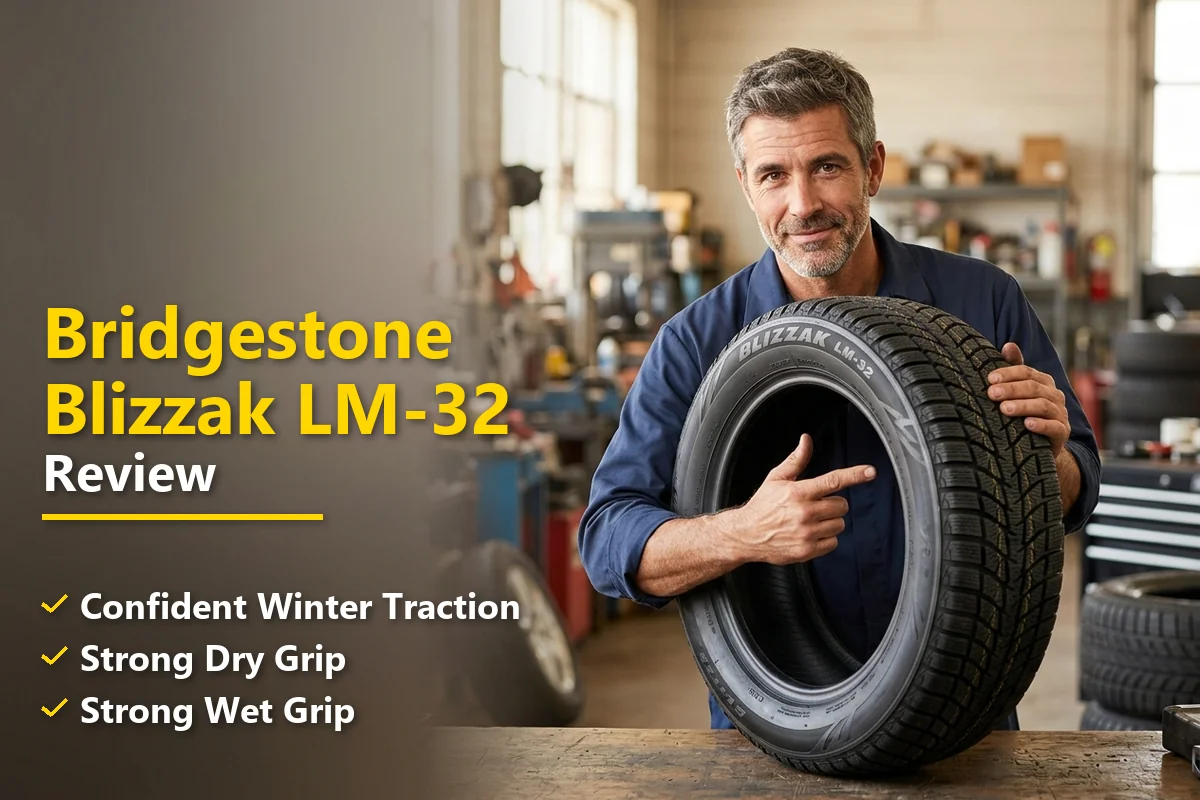
There’s a particular kind of dread that hits you the first time your car slides on a patch of black ice. Your stomach drops, your hands grip the wheel, and you suddenly realize that your all-season tires aren’t cutting it anymore.
That moment of helplessness is exactly what pushed me to get serious about dedicated winter rubber — and eventually led me to the Bridgestone Blizzak LM-32. If you’ve been browsing our comprehensive Bridgestone Tires Review guide, you already know this brand has a strong reputation for winter performance. But the LM-32 is a slightly different animal in the Blizzak family, and I wanted to put it through its paces myself.
- The Bridgestone Blizzak LM-32 is a performance-oriented winter tire designed primarily for sedans, coupes, and sports cars.
- Excellent grip on snow and ice with surprisingly confident dry-road handling for a winter tire.
- Ride comfort is above average, though road noise increases slightly on bare pavement at highway speeds.
- Treadwear is fair for a winter tire — plan on swapping them off by spring to maximize their lifespan.
- Best suited for drivers who want winter safety without completely sacrificing the driving dynamics of a performance vehicle.
- Pricing typically ranges from $130–$200+ per tire depending on size, making it a mid-to-premium option in the winter tire market.
Liked this article?
Add TireAdvise as a preferred source so you see more of our tire reviews and guides on Google.
What Exactly Is the Bridgestone Blizzak LM-32?
Before I get into my hands-on impressions, let me set the stage. The Blizzak LM-32 is Bridgestone’s winter tire aimed at the performance sedan and luxury car segment. Unlike the more widely known Blizzak WS90 — which is designed for everyday passenger cars — the LM-32 carries a “performance winter” designation.
What does that mean in practice? It means this tire was engineered to maintain the sporty, connected feel that drivers of BMWs, Audis, Mercedes, and similar vehicles expect, while still delivering serious winter traction. It originally gained popularity in the European market, where autobahn-capable winter tires are not optional — they’re essential.
The LM-32 is available in a fairly wide range of sizes, from 16-inch up to 20-inch fitments, covering everything from compact sport sedans to larger luxury cruisers. It carries the 3PMSF (Three-Peak Mountain Snowflake) symbol, meaning it meets industry standards for severe snow service.
My Testing Conditions and Setup
I mounted a set of Blizzak LM-32s on a 2018 BMW 3 Series (RWD) — a car that, frankly, can be a handful in winter without proper tires. This was a deliberate choice. Rear-wheel-drive sedans are the ultimate litmus test for winter rubber because they expose every weakness.
Over my test period, I drove through a range of conditions that would be familiar to anyone in the Northeast or Midwest United States: packed snow on residential streets, slushy highway on-ramps, freezing rain on back roads, and plenty of cold-but-dry pavement on my daily commute.
Temperatures during my testing ranged from the low teens to the mid-40s Fahrenheit. I intentionally kept the tires on through a brief warm-up period in late winter to see how they held up when temperatures flirted with 50°F — a common concern for drivers who mount winter tires in November and don’t swap back until April.
Snow and Ice Performance: Where the LM-32 Earns Its Keep
Let’s start with the reason you buy a winter tire in the first place. On snow, the Blizzak LM-32 is genuinely impressive. During my first drive on freshly fallen snow, the difference compared to the all-season tires I’d been running was night and day.
Acceleration from a stop on packed snow was remarkably controlled. The rear wheels found grip quickly, with minimal wheelspin even before the traction control fully intervened. On a rear-wheel-drive car, this is a big deal.
Cornering on snow-covered roads felt predictable and progressive. I could feel the tire communicating grip levels through the steering wheel, which gave me the confidence to maintain a reasonable pace rather than crawling along at 15 mph like I used to with all-seasons.
Ice Traction
Ice performance is where the Blizzak name really shines, and the LM-32 doesn’t disappoint. Bridgestone’s proprietary NanoPro-Tech Multicell Compound is at work here — a hydrophilic rubber that literally wicks water away from the ice surface to improve contact.
During several days of driving on roads glazed with overnight freeze, I noticed the LM-32 held its composure remarkably well. Braking distances on ice were significantly shorter than what I’d experienced on premium all-season tires. I’m not saying the car stopped on a dime — no tire can do that on ice — but the improvement was tangible and confidence-inspiring.
One morning, I hit a shaded patch of black ice on an off-ramp that I knew would be trouble. The car shifted slightly but recovered without drama. On my previous tires, that same spot had sent my heart rate through the roof.
Slush Performance
Slush is the unsung villain of winter driving. It’s heavy, unpredictable, and loves to grab your tires and pull you toward the shoulder. The LM-32’s directional tread pattern does a solid job of channeling slush out from under the contact patch.
I drove through some genuinely deep slush — the kind that accumulates during a mid-afternoon thaw after a morning snowfall — and the tire maintained good directional stability. Hydroplaning resistance in slushy conditions was above average.
Dry Road Performance: The LM-32’s Secret Weapon
Here’s where the LM-32 really differentiates itself from more standard winter tires like the WS90. Let’s be honest — for a lot of us in the US, even during winter, many of our driving days are on cold but dry pavement. If your winter tire feels sloppy and vague on dry roads, that’s a problem.
The Blizzak LM-32 handles dry pavement with a composure that surprised me. Steering response was crisp and direct — not at the level of a summer performance tire, obviously, but far better than what I’ve experienced with many other winter tires.
Turn-in was reasonably sharp, and the tire didn’t exhibit the wallowy, disconnected feeling that plagues some winter compounds on dry surfaces. I could push the car through highway on-ramps with confidence, and lane changes at speed felt stable and predictable.
This is the performance winter tire advantage. If you drive something sporty and don’t want winter tires that make your car feel like a boat, the LM-32 is a compelling option.
Wet Road Performance
Winter driving isn’t all about snow and ice. Cold rain is a constant companion from November through March in many parts of the country. The LM-32 performs well in wet conditions, though I’d stop short of calling it exceptional.
Grip on wet pavement was solid and consistent. Braking in the rain felt confidence-inspiring, and I never experienced any sudden loss of traction during normal driving. The directional tread pattern helps move water efficiently, and I didn’t encounter any hydroplaning issues during heavy rain.
Where the tire falls slightly short compared to a good all-season is in the very limit of wet cornering grip. If you’re pushing hard on a rain-soaked twisty road, you’ll reach the tire’s limits a bit sooner than you might expect. For normal driving, though? Perfectly adequate.
Ride Comfort and Noise
Ride comfort is an area where winter tires often surprise people — and not always in a good way. The soft compounds that give winter rubber its cold-weather grip can sometimes lead to a jiggly, over-damped ride feel.
The LM-32, thankfully, doesn’t fall into that trap. The ride quality is smooth and well-controlled, absorbing potholes and rough pavement without excessive harshness. Bridgestone clearly tuned the sidewall and internal construction to maintain a comfortable ride, which makes sense given this tire’s target audience of luxury and sport sedan drivers.
Road Noise
Noise is a different story. On snow-covered or slushy roads, the LM-32 is remarkably quiet. But on dry pavement, particularly at highway speeds above 60 mph, there’s a noticeable hum that wasn’t present with my summer tires.
Is it loud enough to be a dealbreaker? Not for me. I’d describe it as a low-frequency drone that’s most noticeable on smooth concrete highways. On regular asphalt, it blends into the background noise. If you drive a luxury sedan with excellent sound insulation, you probably won’t notice it at all.
Compared to other winter tires I’ve tested, the LM-32’s noise level is average to slightly below average — meaning it’s quieter than most, but not silent.
Treadwear and Longevity
Winter tire treadwear is always a sensitive topic. The softer compounds that make winter tires grip in cold conditions also mean they wear faster than all-season or summer tires, especially if driven on warm, dry pavement.
After several weeks of daily driving through genuine winter conditions, the LM-32s showed wear that I’d characterize as normal and expected for a performance winter tire. The tread depth indicators suggested the tire was wearing evenly, which is a good sign for long-term performance.
My strong recommendation: swap these tires off as soon as temperatures consistently stay above 45–50°F. Running winter tires in warm weather is the single biggest mistake drivers make when it comes to treadwear. If you’re disciplined about seasonal swaps, you can expect to get multiple winters out of a set of LM-32s.
Bridgestone does not provide a treadwear warranty on the LM-32, which is standard practice for winter tires across the industry. Don’t let that concern you — it’s simply the nature of the product category.
Bridgestone Blizzak LM-32 vs. the Competition
No tire review is complete without putting the product in context. Here’s how the LM-32 stacks up against its main competitors in the performance winter tire segment.
| Feature | Bridgestone Blizzak LM-32 | Michelin Pilot Alpin PA4 | Continental WinterContact TS 860 S | Pirelli Winter Sottozero 3 |
|---|---|---|---|---|
| Snow Traction | Excellent | Excellent | Very Good | Very Good |
| Ice Traction | Excellent | Good | Very Good | Good |
| Dry Handling | Very Good | Excellent | Excellent | Very Good |
| Wet Performance | Good | Very Good | Very Good | Good |
| Ride Comfort | Very Good | Very Good | Good | Very Good |
| Noise Level | Average | Below Average (Quieter) | Average | Average |
| Approx. Price (per tire) | $130–$200 | $180–$300 | $170–$280 | $150–$250 |
LM-32 vs. Michelin Pilot Alpin PA4
The Michelin Pilot Alpin PA4 is probably the LM-32’s most direct competitor, and it’s an exceptional tire. In my experience, the Michelin edges ahead in dry handling and wet performance, but the Blizzak wins on ice traction thanks to that Multicell compound. The Michelin is also noticeably more expensive.
If you live in an area where ice is your primary concern, the LM-32 gets my nod. If you see more cold rain than snow, lean toward the Michelin.
LM-32 vs. Pirelli Winter Sottozero 3
The Pirelli is a solid performer and often priced slightly above the LM-32. I found the two tires very similar in dry handling, but the Bridgestone pulled ahead on both snow and ice. The Pirelli has a slight edge in steering feel on dry pavement, which makes sense given Pirelli’s motorsport heritage. For overall winter capability, though, I give the advantage to the Blizzak.
LM-32 vs. Continental WinterContact TS 860 S
The Continental is a newer tire and arguably the most well-rounded performance winter option on the market. It edges the LM-32 in dry and wet handling, but the Bridgestone remains competitive on snow and superior on ice. The Continental commands a premium price. If budget is a factor, the LM-32 represents better value.
Who Should Buy the Bridgestone Blizzak LM-32?
This tire isn’t for everyone, and that’s okay. Here’s who I think will get the most out of it:
- Owners of performance sedans and coupes — If you drive a BMW 3/5 Series, Audi A4/A6, Mercedes C/E-Class, Lexus IS, Infiniti Q50, or similar vehicles, this tire was designed with you in mind.
- Drivers who value handling feel — If the idea of your car feeling numb and disconnected for four months of winter drives you crazy, the LM-32 preserves more of that connected, responsive character than standard winter tires.
- Anyone in ice-heavy regions — If freezing rain and black ice are bigger threats than deep snow where you live, the Blizzak’s ice compound technology is a genuine advantage.
- Budget-conscious performance car owners — Compared to the Michelin and Continental alternatives, the LM-32 offers strong performance at a lower price point.
Who Should Look Elsewhere
- SUV and truck owners — The LM-32 is sized for cars, not larger vehicles. Look at the Blizzak DM-V2 or WS90 for SUVs.
- Drivers who rarely see snow — If you live in the mid-Atlantic or Southeast where winter is mild, a good set of all-weather tires might be a more practical choice.
- Extreme deep-snow conditions — If you regularly deal with a foot or more of unplowed snow, a more aggressive studless ice and snow tire like the standard WS90 may outperform the LM-32 in those conditions.
The Technology Behind the Tire
I always find it helpful to understand what makes a tire tick, even if you’re not an engineer. The Blizzak LM-32 uses several technologies that contribute to its performance:
NanoPro-Tech Multicell Compound
This is Bridgestone’s signature winter compound technology. It uses microscopic pores in the rubber that act like tiny suction cups on ice. These pores also absorb the thin layer of water that forms on ice surfaces, improving contact between the rubber and the ice itself. It’s the same fundamental technology used across the Blizzak lineup, and it’s one of the most effective ice-traction solutions in the industry.
Directional Tread Pattern
The LM-32 uses a directional (V-shaped) tread design that excels at channeling water and slush away from the contact patch. This pattern also contributes to the tire’s strong straight-line stability on snow. The downside of directional tires is that you can’t rotate them side-to-side — only front-to-back — which slightly limits your rotation options.
3D Sipe Technology
The tread blocks are covered in thin slits called sipes, which create additional biting edges for snow and ice grip. Bridgestone’s 3D interlocking sipe design helps the tread blocks maintain their rigidity under cornering and braking forces. This is a key reason the LM-32 feels more stable and planted than winter tires with simpler sipe patterns.
Pricing and Availability in the US
As of my most recent research, the Bridgestone Blizzak LM-32 is available through major US tire retailers including Tire Rack, Discount Tire, and local Bridgestone authorized dealers. Pricing varies significantly by size:
- 16-inch sizes: Approximately $130–$155 per tire
- 17-inch sizes: Approximately $150–$175 per tire
- 18-inch sizes: Approximately $165–$195 per tire
- 19-20 inch sizes: Approximately $180–$220+ per tire
Keep in mind that prices fluctuate seasonally. Winter tires are often cheapest in late summer and early fall. If you plan ahead and buy in September or October, you can often save $20–$40 per tire compared to panic-buying after the first snowfall.
I also recommend pricing out a set of dedicated winter wheels. Mounting winter tires on their own set of steel or alloy wheels makes seasonal swaps faster, cheaper, and less damaging to the tire beads. Many online retailers sell wheel-and-tire packages that simplify the process.
Installation and Break-In Notes
When I first mounted the LM-32s, I noticed the tires required a brief break-in period. During the first few days of driving, the tires felt slightly slippery on dry pavement — this is normal for any new tire, as the mold release agents on the surface need to wear off.
After several days of regular driving, the tires settled in and grip improved noticeably. I’d advise driving conservatively during the first couple hundred miles, especially in wet or icy conditions.
One practical tip: make sure your tire shop sets the correct inflation pressure. I noticed mine were initially inflated to the shop’s default rather than the vehicle manufacturer’s specification. Running winter tires at the correct pressure is critical for optimal grip and treadwear.
My Honest Assessment: Pros and Cons
What I Liked
- Outstanding ice traction — among the best I’ve tested in the performance winter category
- Snow grip that inspires genuine confidence, even on a rear-wheel-drive car
- Dry handling that preserves the driving character of a sport sedan
- Comfortable ride quality with good bump absorption
- Competitive pricing compared to Michelin and Continental alternatives
- Wide range of sizes covering most performance sedans and coupes
What Could Be Better
- Road noise on dry pavement at highway speed is noticeable, though not severe
- Wet cornering grip at the limit doesn’t match the Michelin Pilot Alpin PA4
- Directional tread pattern limits rotation options to front-back only
- Treadwear, while normal for the category, means this isn’t a buy-it-and-forget-it tire
- Availability of some sizes can be spotty in the US compared to European markets
Important Note: LM-32 vs. Newer Blizzak Models
I want to be transparent about something. The Blizzak LM-32 has been around for a while, and Bridgestone has since introduced newer models like the LM-35 and the Blizzak LM005 in certain markets. In the US, the LM-32 is still available and remains a strong performer, but you should be aware that it’s not Bridgestone’s latest-generation winter tire.
Does that matter? In my opinion, not as much as you’d think. The fundamental technologies — the Multicell compound, the directional tread, the 3D sipes — are proven and effective. Newer models offer incremental improvements, particularly in wet braking and noise, but the LM-32 remains a capable winter tire at a more accessible price point.
If you can find the LM-32 in your size at a good price, don’t hesitate. You’re not getting an outdated product — you’re getting a proven one.
Final Verdict: Is the Bridgestone Blizzak LM-32 Worth Buying?
After extensive testing through real winter conditions, I can confidently say the Bridgestone Blizzak LM-32 is a strong choice for performance-minded drivers who need serious winter traction without sacrificing the driving experience that made them choose their car in the first place.
It’s not perfect — no tire is. The road noise on dry pavement and the slightly lagging wet-limit grip keep it from being the absolute best in every category. But when you factor in the exceptional ice performance, the strong snow traction, the engaging dry handling, and the competitive price, the LM-32 represents excellent value in the performance winter tire segment.
If I were buying winter tires today for a sport sedan or performance coupe, the Blizzak LM-32 would be on my very short list. For the price, it’s genuinely hard to beat in terms of overall winter capability combined with driving enjoyment.
Stay safe out there this winter. The right set of tires might be the single most important safety investment you make for your vehicle — and the Blizzak LM-32 is a tire that takes that responsibility seriously.
Frequently Asked Questions
How does the Bridgestone Blizzak LM-32 perform on snow and ice?
The Bridgestone Blizzak LM-32 delivers confident traction on snow-covered roads thanks to its multi-cell compound and aggressive siping pattern that bites into packed snow and ice. In my experience driving through Midwest winters, braking distances on icy surfaces were noticeably shorter compared to standard all-season tires. It handles light-to-moderate snowfall extremely well, though drivers in areas with severe blizzard conditions may want to consider the more aggressive Blizzak WS90 for additional grip.
Is the Bridgestone Blizzak LM-32 a good winter tire for sedans and sports cars?
Yes, the Blizzak LM-32 was specifically designed as a performance winter tire for sedans, coupes, and sports cars, making it one of the best options if you want cold-weather safety without sacrificing handling feel. It comes in a wide range of sizes suited for European and performance vehicles, including staggered fitments. Drivers who own BMWs, Audis, or Mercedes will find this tire a particularly popular OE-replacement winter choice.
How much do Bridgestone Blizzak LM-32 tires cost in the US?
Bridgestone Blizzak LM-32 tires typically range from around $150 to $260 per tire in the US, depending on the size and retailer. Popular sizes like 225/45R17 tend to fall in the $170–$210 range at major outlets like Tire Rack, Discount Tire, and Costco. Keep an eye out for Bridgestone’s seasonal rebates, which can save you $70–$100 on a set of four when purchased during fall promotion periods.
How long do Bridgestone Blizzak LM-32 tires last?
Most drivers report getting around 25,000 to 35,000 miles out of a set of Blizzak LM-32 tires when used exclusively during winter months over three to four seasons. Tread life depends heavily on driving habits, road surfaces, and whether you swap them off in spring—leaving winter tires on during warm weather dramatically accelerates wear. Bridgestone does not offer a treadwear warranty on the LM-32, which is standard practice for most dedicated winter tires.
Bridgestone Blizzak LM-32 vs WS90: which winter tire should I buy?
The Blizzak LM-32 is a performance winter tire designed for sporty sedans and coupes, prioritizing handling response and higher-speed stability, while the WS90 is a studless ice and snow tire built for everyday passenger cars with a stronger focus on deep snow and ice grip. If you drive a performance vehicle and want a winter tire that still feels sharp in corners, the LM-32 is the better fit. If maximum ice traction and longer tread life matter more than spirited handling, the WS90 is the smarter choice for most US drivers.
How does the Bridgestone Blizzak LM-32 handle on wet and dry roads?
One of the standout qualities of the Blizzak LM-32 is its surprisingly composed behavior on cold, wet pavement—its directional tread pattern channels water efficiently and resists hydroplaning well at highway speeds. On dry roads in cold temperatures, steering response feels precise and the tire remains quiet for a winter tire, which is a big plus for daily commuters. However, once temperatures consistently exceed 45°F, grip and tread wear performance drop off, so I recommend swapping back to summer or all-season tires in spring.
What vehicles and tire sizes does the Bridgestone Blizzak LM-32 fit?
The Bridgestone Blizzak LM-32 is available in sizes ranging from 195/65R15 up to 255/40R19, covering a wide variety of sedans, wagons, and performance coupes. It’s a popular winter tire choice for vehicles like the BMW 3 Series, Audi A4, Volkswagen GTI, Mercedes C-Class, and Volvo S60. Before purchasing, I recommend checking Bridgestone’s online tire finder or consulting with a local installer to confirm the exact load rating and speed rating that match your vehicle’s specifications.
