

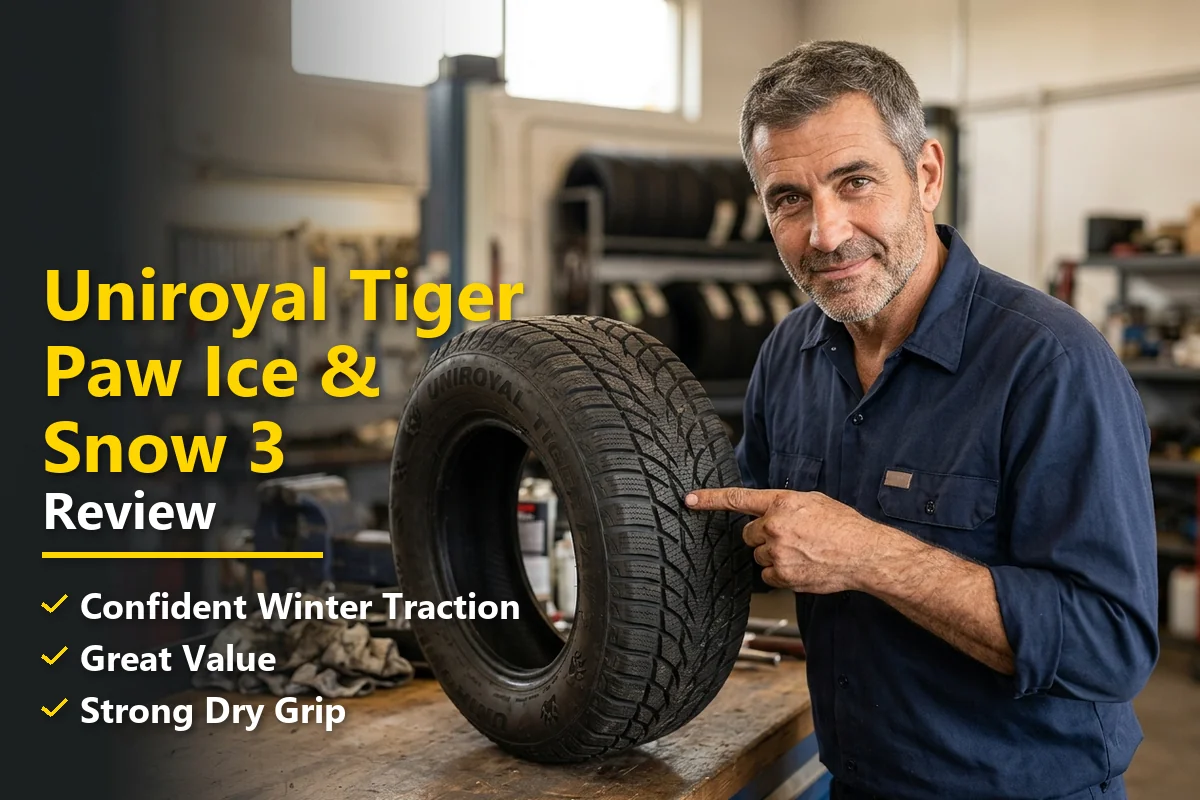
If you’ve ever white-knuckled your way through a snowy commute on all-season tires, you already know that sinking feeling when your car starts sliding and nothing you do seems to matter.
The thing is, dedicated winter tires don’t have to cost a fortune — and the Uniroyal Tiger Paw Ice & Snow 3 is proof of that. But does going budget on winter rubber mean sacrificing the grip you actually need when conditions get ugly?
I put a set of these tires through real-world winter driving to find out whether they’re a smart buy or a false economy. Here’s everything I learned.
If you want to get a fuller sense of the brand before committing to a set, my Uniroyal tires review breaks down exactly what Uniroyal stands for and whether they’ve earned that trust.
- The Uniroyal Tiger Paw Ice & Snow 3 is one of the most affordable dedicated winter tires on the US market, typically priced between $70–$120 per tire depending on size.
- Snow traction is genuinely impressive for the price — it bites into packed snow and slush with confidence.
- Ice performance is adequate but not class-leading; don’t expect miracles on black ice.
- Road noise is noticeable at highway speeds, and dry-road handling feels vague compared to premium options.
- Best suited for budget-conscious drivers in the Midwest, Northeast, and mountain regions who need a reliable winter tire without breaking the bank.
- I recommend these for daily commuters and family vehicles — not performance-oriented drivers.
Liked this article?
Add TireAdvise as a preferred source so you see more of our tire reviews and guides on Google.
Who Makes the Uniroyal Tiger Paw Ice & Snow 3?
Uniroyal is a brand that flies under the radar for a lot of American drivers, but it has deep roots in the US tire industry. Originally an American company, Uniroyal is now part of the Michelin family of brands — which means these tires benefit from Michelin’s R&D and manufacturing capabilities.
That’s an important detail. When you’re buying a Uniroyal tire, you’re not buying some unknown off-brand. You’re getting a budget-tier product backed by one of the largest and most respected tire companies in the world.
The Tiger Paw Ice & Snow 3 is the third generation of Uniroyal’s dedicated winter tire line. It carries the Three-Peak Mountain Snowflake (3PMSF) symbol, which means it meets the industry standard for severe snow performance — something all-season tires with only the M+S rating can’t claim.
First Impressions and Installation
When I first pulled the Tiger Paw Ice & Snow 3 out of the box, a few things stood out immediately. The tread compound felt noticeably softer than the all-season tires I’d been running — which is exactly what you want in a winter tire, since softer rubber stays pliable in freezing temperatures and maintains grip.
The tread pattern features deep, aggressive grooves with a directional V-shaped design. You can see the sipes (those tiny slits cut into the tread blocks) across the entire surface, and there are a lot of them. Sipes are critical for winter performance because they create biting edges that grip snow and ice.
I had them mounted and balanced at a local tire shop, and the process was straightforward. No issues with fitment. The tires I tested were a common sedan size, and they went on without any fuss.
Snow Performance: Where This Tire Shines
Let’s get straight to the most important question — how does this tire handle snow?
In my experience, the Tiger Paw Ice & Snow 3 performs remarkably well in snow for its price point. During my test period, I drove through several snowstorms ranging from light dustings to heavier accumulations, and the tire consistently inspired confidence.
Light to Moderate Snow
On roads with a couple inches of fresh snow, these tires felt planted and predictable. Acceleration from a stop was smooth, with minimal wheelspin. I could feel the tread blocks biting into the snow and finding traction, which is a night-and-day difference compared to all-season tires in the same conditions.
Lane changes and turns felt controlled, without that unsettling moment of hesitation you get when a tire is searching for grip. For the daily commute through snow-covered suburban and city streets, the Tiger Paw Ice & Snow 3 delivers exactly what you need.
Heavy and Packed Snow
Things got more interesting when I drove through deeper, packed snow. The directional tread pattern does an excellent job of channeling snow through the grooves, and I could feel the tire maintaining forward momentum even when conditions got thick.
I did notice some limitations in very deep, unplowed snow — the tire would occasionally struggle to find purchase, requiring a gentler throttle application. But honestly, that’s something I’d expect from any tire in this price range. For the vast majority of winter driving scenarios that everyday commuters encounter, the snow performance is genuinely impressive.
Slush Performance
Slush is where a lot of winter tires separate themselves, because it combines the challenges of water evacuation and cold-weather grip. The Tiger Paw Ice & Snow 3 handled slushy roads better than I expected.
The deep grooves do a solid job of channeling slush away from the contact patch, and I didn’t experience any significant hydroplaning even at moderate highway speeds. After several days of driving through that ugly, gray, half-melted mess that accumulates during thaw cycles, I came away pleased with how the tires maintained composure.
Ice Performance: Adequate, But Know the Limits
Here’s where I need to be completely honest — ice performance is the Tiger Paw Ice & Snow 3’s weakest link relative to premium winter tires.
On icy surfaces, the tire provides more grip than any all-season tire I’ve ever tested. That’s not up for debate. The dense siping does create biting edges that help the rubber cling to slick surfaces, and braking distances on ice were noticeably shorter than what I’d experienced on all-seasons.
However, compared to premium winter tires like the Michelin X-Ice Snow or Bridgestone Blizzak WS90, the Tiger Paw Ice & Snow 3 falls short. On glare ice, I could feel the tires reaching their limit sooner, and I had to be more deliberate with steering inputs and braking to avoid losing traction.
If you live in an area where freezing rain and black ice are common hazards, this is worth considering. The Tiger Paw Ice & Snow 3 will keep you safer than all-seasons, but it won’t match the ice grip of a tire costing twice as much. For occasional icy patches during your commute, it’s perfectly serviceable. For regular driving on iced-over roads, you might want to invest in a premium option.
Dry Road Handling and Comfort
Winter tires always involve trade-offs on dry pavement, and the Tiger Paw Ice & Snow 3 is no exception.
Dry Grip
On cold but dry roads, the tire felt stable and secure. Braking distances were reasonable, and I never felt unsafe during normal driving. The soft winter compound provides decent grip on dry asphalt, especially in temperatures below 40°F where it’s designed to operate.
Where I noticed a difference was in steering precision. The tire felt a bit vague and mushy compared to a good all-season or summer tire. There’s a slight delay between turning the steering wheel and feeling the car respond, which is typical of winter tires with their softer rubber and deeper tread.
For everyday driving — commuting, errands, school drop-offs — this is a non-issue. But if you’re the kind of driver who enjoys spirited driving on twisty roads, you’ll notice the compromise.
Ride Comfort
The ride quality is surprisingly decent. The soft tread compound absorbs small bumps and road imperfections well, and the tire doesn’t transmit harsh vibrations through the cabin. I’d rate the ride comfort as above average for a winter tire in this price range.
Road Noise
This is one area where the Tiger Paw Ice & Snow 3 earns a mediocre grade. At highway speeds, there’s a noticeable hum from the aggressive tread pattern. It’s not unbearable — I could still hold a conversation and listen to podcasts without cranking the volume — but it’s definitely louder than a touring all-season tire.
On city streets and at lower speeds, the noise is much less noticeable. But if you spend a lot of time on the highway during winter months, the drone might bother you over time.
Treadwear and Durability
I want to be upfront about something: winter tires inherently wear faster than all-season tires, especially if you drive on them after temperatures consistently climb above 45°F. The soft compound that gives them winter grip is also the reason they chew through tread faster on warm pavement.
During my test period, the Tiger Paw Ice & Snow 3 showed normal wear patterns. The tread depth remained consistent across the width of the tire, which tells me the tire is well-designed and distributes forces evenly.
Uniroyal backs this tire with a limited tread life warranty, but it’s not as generous as what you’d find on their all-season offerings. This is standard for winter tires across the industry. My advice: swap these off as soon as winter ends and store them properly. Running winter tires in the spring and summer is the fastest way to burn through them prematurely.
For seasonal use — mounting them in late fall and removing them in early spring — I’d expect most drivers to get several winters out of a set, depending on driving habits and climate severity.
Uniroyal Tiger Paw Ice & Snow 3 vs. the Competition
To give you proper context, here’s how the Tiger Paw Ice & Snow 3 stacks up against some of the most common winter tires available in the US market:
| Feature | Uniroyal Tiger Paw Ice & Snow 3 | Bridgestone Blizzak WS90 | General Altimax Arctic 12 | Cooper Evolution Winter |
|---|---|---|---|---|
| Approx. Price (per tire) | $70–$120 | $100–$180 | $80–$130 | $75–$125 |
| Snow Traction | ★★★★☆ | ★★★★★ | ★★★★☆ | ★★★★☆ |
| Ice Traction | ★★★☆☆ | ★★★★★ | ★★★★☆ | ★★★☆☆ |
| Dry Road Handling | ★★★☆☆ | ★★★★☆ | ★★★☆☆ | ★★★☆☆ |
| Road Noise | ★★★☆☆ | ★★★★☆ | ★★★☆☆ | ★★★☆☆ |
| 3PMSF Certified | ✅ Yes | ✅ Yes | ✅ Yes | ✅ Yes |
| Studdable | ❌ No | ❌ No | ✅ Yes | ✅ Yes |
| Value Rating | ★★★★★ | ★★★☆☆ | ★★★★☆ | ★★★★☆ |
Tiger Paw Ice & Snow 3 vs. Bridgestone Blizzak WS90
The Blizzak WS90 is the gold standard in the winter tire category, and honestly, it outperforms the Tiger Paw in almost every measurable way — especially on ice. Bridgestone’s multi-cell compound technology gives the Blizzak an edge on icy surfaces that’s hard to match at any price.
But here’s the thing: you’re paying a significant premium for that performance. In many sizes, the Blizzak costs 40–60% more per tire. If your budget allows it, the Blizzak is the better tire. But if you’re looking at the total cost of outfitting your car with winter rubber, the Tiger Paw saves you a meaningful amount of money while still delivering strong snow performance. For a deeper look at premium winter options, check out our guide on the best winter tires available this year.
Tiger Paw Ice & Snow 3 vs. General Altimax Arctic 12
The General Altimax Arctic 12 is the Tiger Paw’s closest competitor. They’re priced similarly, offer comparable snow performance, and share the same parent company (both Uniroyal and General are Michelin-owned brands).
The key difference is that the Altimax Arctic 12 is studdable. If you live in a state that allows studded tires and regularly encounter icy roads, the Altimax with studs will provide significantly better ice traction. Without studs, I found the two tires to be very similar in real-world performance, with the Altimax having a slight edge on ice and the Tiger Paw feeling marginally better in deep snow.
Tiger Paw Ice & Snow 3 vs. Cooper Evolution Winter
The Cooper Evolution Winter is another budget-friendly option that competes directly with the Tiger Paw. In my experience, the two are extremely close in overall performance. The Cooper might have a very slight edge in treadwear durability, while the Uniroyal feels a touch more confident in heavy snow.
Either tire is a solid choice for budget-minded winter driving. It often comes down to which one you can find a better deal on and which is available in your specific tire size.
Available Sizes and Fitment
The Uniroyal Tiger Paw Ice & Snow 3 is available in a decent range of sizes covering many popular sedans, compact cars, and some smaller crossovers. Common sizes include:
- 185/65R15
- 195/65R15
- 205/55R16
- 205/65R16
- 215/55R17
- 215/60R16
- 225/45R17
- 225/50R17
- 225/65R17
- 235/55R17
One limitation I should mention is that the size range isn’t as extensive as what Bridgestone or Michelin offer in their winter tire lines. If you drive a larger SUV or truck, you may not find a Tiger Paw Ice & Snow 3 in your size. In that case, you’ll want to look at alternatives like the best winter tires for SUVs that we’ve reviewed separately.
For the popular vehicle categories this tire does cover — think Honda Civic, Toyota Camry, Hyundai Elantra, Subaru Impreza, Volkswagen Jetta, and similar — the size selection is solid.
Pricing and Value: The Biggest Selling Point
Let me be blunt: the price is the reason most people will consider the Tiger Paw Ice & Snow 3, and it’s a very good reason.
At roughly $70–$120 per tire depending on size, you can outfit a sedan with a full set for somewhere around $280–$480 before installation. Compare that to a set of Bridgestone Blizzaks at $400–$720 or Michelin X-Ice Snows at $450–$800, and the savings are substantial.
For a lot of families and budget-conscious drivers, the choice between spending $350 on four Tiger Paws versus $600+ on four premium winter tires is an easy one — especially when the Tiger Paw delivers 80–85% of the snow performance at roughly 60% of the cost.
I always tell people: a budget winter tire is dramatically safer than an expensive all-season tire when the snow starts falling. If the alternative to buying the Tiger Paw Ice & Snow 3 is running your all-seasons through winter because you can’t afford premium winter tires, then the Uniroyal is the obvious play.
If you’re still weighing whether dedicated winter tires are worth it at all, take a look at our breakdown of winter tires vs. all-season tires.
What I Liked About the Uniroyal Tiger Paw Ice & Snow 3
- Excellent snow traction for the money. In moderate to heavy snow, this tire performs well above its price class.
- Confident slush evacuation. The directional tread pattern channels water and slush effectively, reducing hydroplaning risk.
- Very affordable. One of the lowest-priced 3PMSF-certified winter tires you can buy in the US.
- Backed by Michelin. Even though it’s a budget brand, the Michelin connection provides peace of mind regarding quality control and warranty support.
- Comfortable ride. The soft compound absorbs road imperfections nicely, making it pleasant for daily commuting.
- Wide availability. Easy to find at Tire Rack, Discount Tire, Walmart, and most independent tire shops across the US.
What I Didn’t Like
- Ice performance is merely adequate. If icy roads are your primary concern, you’ll want to spend more on a tire specifically engineered for ice grip.
- Road noise at highway speeds. The aggressive tread pattern creates a noticeable hum that some drivers will find annoying on longer highway drives.
- Vague dry-road handling. Steering feel is mushy and imprecise, which is typical of budget winter tires but still worth noting.
- Limited size range. If you drive an SUV or truck, you’ll likely need to look elsewhere.
- Not studdable. In states where studded tires are legal and ice is a major concern, this limitation could be a deal-breaker.
Who Should Buy the Uniroyal Tiger Paw Ice & Snow 3?
Based on my testing, here’s who I think will be happiest with this tire:
Budget-Conscious Commuters
If you drive a sedan or compact car and need winter tires that won’t wreck your monthly budget, the Tiger Paw Ice & Snow 3 is one of the smartest buys in the category. You get real winter performance — backed by 3PMSF certification — at a price that makes dedicated winter tires accessible.
Drivers in Snow-Heavy Regions
If you live in places like Minnesota, Wisconsin, Michigan, upstate New York, or the mountain states where snow is the primary winter hazard (as opposed to pure ice), this tire’s strengths align perfectly with your needs. Snow traction is genuinely its strong suit.
Second-Car or Teen Driver Vehicles
I know plenty of families that keep a second vehicle for winter use or have a teenager who just started driving. Outfitting these cars with affordable winter tires makes a lot of sense, and the Tiger Paw is an ideal candidate.
Who Should Look Elsewhere
If you regularly drive on icy roads and need maximum ice grip, I’d steer you toward the Bridgestone Blizzak WS90 or the Michelin X-Ice Snow. If you need a studdable tire, look at the General Altimax Arctic 12. And if you drive a larger SUV or truck, you’ll need to explore winter tires with broader size availability.
Tips for Getting the Most Out of These Tires
After spending significant time on the Tiger Paw Ice & Snow 3, here are a few practical tips I’d pass along:
- Mount them on a dedicated set of wheels. Buying an inexpensive set of steel wheels for your winter tires saves you the cost of mounting and balancing twice a year and extends the life of both your winter and summer/all-season tires.
- Swap them off when temperatures consistently stay above 45°F. Running winter tires in warm weather accelerates tread wear dramatically. The soft compound isn’t designed for spring and summer temperatures.
- Store them properly in the off-season. Keep them in a cool, dry place away from direct sunlight. Tire tote bags are inexpensive and help protect the rubber.
- Check tire pressure frequently during winter. Cold temperatures cause air pressure to drop — roughly 1 PSI for every 10°F decrease in temperature. Under-inflated winter tires lose much of their grip advantage.
- Always install winter tires in full sets of four. Running winter tires only on the drive axle creates a dangerous handling imbalance. I’ve seen this go wrong firsthand, and it’s not worth the savings.
Where to Buy
The Uniroyal Tiger Paw Ice & Snow 3 is widely available through major US retailers. I’ve seen competitive pricing at:
- Tire Rack — Often has the best online pricing and can ship directly to your preferred installer.
- Discount Tire / America’s Tire — Great for in-store purchases with free installation on tires bought through them.
- Walmart Auto — Consistently low pricing, though installer availability varies by location.
- Local independent tire shops — Don’t overlook your neighborhood tire shop; many can order Uniroyal products and offer competitive pricing plus personalized service.
I always recommend comparing prices across at least two or three of these sources before purchasing. Seasonal sales and manufacturer rebates can knock an additional $40–$80 off the price of a full set.
Final Verdict: Is the Uniroyal Tiger Paw Ice & Snow 3 Worth It?
After putting the Uniroyal Tiger Paw Ice & Snow 3 through real winter conditions over an extended test period, my conclusion is straightforward: this is one of the best values in the winter tire market for everyday drivers.
It’s not the best winter tire money can buy — and it doesn’t pretend to be. The ice grip has room for improvement, the road noise is noticeable, and the steering feel won’t impress anyone who prioritizes driving dynamics.
But none of that matters as much as this: the Tiger Paw Ice & Snow 3 will make your car dramatically safer in snow and cold weather than any all-season tire, and it does so at a price that almost anyone can afford.
For budget-conscious American drivers who face real winters — whether it’s lake-effect snow in Ohio, nor’easters in New England, or heavy snowfall in Colorado — I recommend the Tiger Paw Ice & Snow 3 without hesitation. It’s proof that you don’t have to spend a fortune to stay safe when the roads turn white.
If winter tires have felt like a luxury you couldn’t justify, this tire changes that equation. Put a set on before the first storm hits, and you’ll wonder why you waited so long to make the switch.
Frequently Asked Questions
Is the Uniroyal Tiger Paw Ice & Snow 3 a good winter tire for daily driving?
Yes, the Uniroyal Tiger Paw Ice & Snow 3 is a solid budget-friendly winter tire for daily commuters across the US. It features a directional tread pattern with wide circumferential grooves that channel slush and water effectively, and I found it delivers confident grip on packed snow and light ice. For drivers in the Midwest and Northeast who face regular winter storms, it’s a dependable choice without the premium price tag of competitors like Bridgestone Blizzak or Michelin X-Ice.
How much does the Uniroyal Tiger Paw Ice & Snow 3 cost per tire?
The Uniroyal Tiger Paw Ice & Snow 3 typically costs between $75 and $140 per tire depending on the size, with most popular passenger car sizes falling in the $85 to $110 range. Prices vary by retailer, and you can often find deals at Tire Rack, Discount Tire, or Walmart. Compared to premium winter tires that can run $150 to $250 each, the Tiger Paw Ice & Snow 3 offers significant savings while still carrying the Three-Peak Mountain Snowflake (3PMSF) certification.
How does the Uniroyal Tiger Paw Ice & Snow 3 perform on ice compared to the Bridgestone Blizzak WS90?
On pure ice, the Bridgestone Blizzak WS90 has a noticeable edge thanks to its multicell compound technology, which bites into icy surfaces more aggressively. However, the Uniroyal Tiger Paw Ice & Snow 3 still performs respectably on ice for its price point, using high-density siping and a winter-specific rubber compound to maintain traction. If you regularly drive on black ice or heavily glazed roads, the Blizzak is worth the extra investment, but for mixed winter conditions with more snow than ice, the Uniroyal holds its own.
What sizes are available for the Uniroyal Tiger Paw Ice & Snow 3?
The Uniroyal Tiger Paw Ice & Snow 3 is available in a wide range of sizes from 14-inch to 18-inch wheel diameters, covering most popular sedans, compact cars, minivans, and smaller crossovers sold in the US. Common fitments include sizes like 205/55R16, 215/60R16, and 225/65R17, which fit vehicles like the Honda Civic, Toyota Camry, and Honda CR-V. I recommend checking Uniroyal’s official site or a retailer like Tire Rack to confirm exact availability for your vehicle’s year, make, and model.
How long does the Uniroyal Tiger Paw Ice & Snow 3 tread last?
Uniroyal does not offer a specific treadwear mileage warranty on the Tiger Paw Ice & Snow 3, which is common for dedicated winter tires. In my experience and based on user reviews, most drivers get around 3 to 4 winter seasons out of a set when used exclusively during cold months and stored properly in the off-season. Tread life depends heavily on driving habits, road conditions, and whether you swap back to all-season or summer tires once temperatures rise above 45°F consistently.
Is the Uniroyal Tiger Paw Ice & Snow 3 loud on dry pavement?
The directional tread pattern on the Tiger Paw Ice & Snow 3 does generate more road noise on dry and cleared highways compared to a typical all-season tire, but it’s not excessive for a dedicated winter tire. Most drivers notice a mild hum at highway speeds above 55 mph, which is on par with other budget winter tires in its class. If you’re only mounting these for the winter months and don’t mind a slight increase in cabin noise, the trade-off for improved snow and ice traction is well worth it.
Should I buy the Uniroyal Tiger Paw Ice & Snow 3 or just use all-season tires in winter?
If you live in a state that regularly sees snow, ice, or sustained temperatures below 40°F—like Michigan, Minnesota, Pennsylvania, or upstate New York—a dedicated winter tire like the Tiger Paw Ice & Snow 3 will significantly outperform even the best all-season tires. Winter tires use a softer rubber compound that stays pliable in freezing temperatures, giving you shorter braking distances and better cornering grip when it matters most. I always recommend a separate set of winter tires mounted on steel wheels for easy seasonal swaps, as it can actually extend the life of both your winter and all-season sets.
