

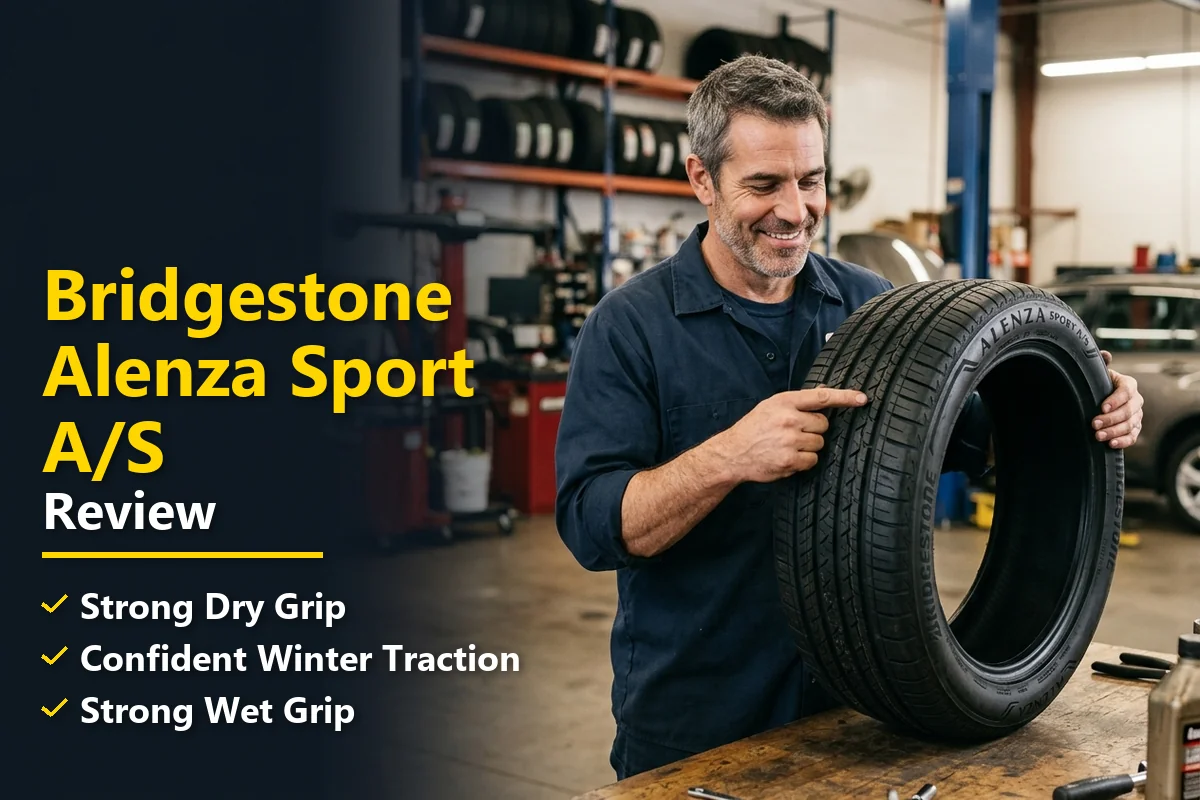
If you drive a luxury SUV or crossover, you’ve probably noticed something frustrating: most tires force you to choose between sporty handling and a comfortable, quiet ride. You either get a performance-oriented tire that beats you up on rough pavement, or a touring tire that feels disconnected in corners.
The Bridgestone Alenza Sport A/S promises to eliminate that compromise entirely — and after spending serious time with these tires across highways, rain-soaked back roads, and tight suburban turns, I can tell you whether it actually delivers. For a broader look at how this model fits into the lineup, check out our full Bridgestone Tires Review guide covering every Bridgestone model side by side.
- The Bridgestone Alenza Sport A/S is a premium all-season tire designed for luxury SUVs, crossovers, and sport-utility vehicles.
- Exceptional dry handling and cornering confidence — it feels like a sport tire without the harshness.
- Wet traction is among the best I’ve tested in this segment, with excellent hydroplaning resistance.
- Ride quality is remarkably quiet and smooth for a tire with this much grip.
- Tread life appears strong so far, with even wear patterns across all four tires during my test period.
- It’s not cheap — expect to pay $200–$320+ per tire depending on size — but the performance justifies the price for the right buyer.
- Light snow capability is adequate, but this is not a winter tire replacement.
Liked this article?
Add TireAdvise as a preferred source so you see more of our tire reviews and guides on Google.
What Is the Bridgestone Alenza Sport A/S?
The Bridgestone Alenza Sport A/S sits at the top of Bridgestone’s SUV/crossover tire lineup. It’s an ultra-high-performance all-season tire engineered specifically for drivers who want the handling characteristics of a sport tire combined with the year-round usability of a touring all-season.
Bridgestone positions this tire as original equipment on vehicles like the BMW X5, Audi Q7, Porsche Cayenne, and Mercedes-Benz GLE. That OE pedigree tells you a lot about who this tire is for — it’s designed for premium vehicles where ride refinement and dynamic capability are equally important.
Available in sizes ranging from 17 inches up to 22 inches, the Alenza Sport A/S covers a wide range of luxury SUVs and crossovers. Most sizes carry a V, W, or Y speed rating, reinforcing the performance orientation of this tire.
Key Technologies and Construction
Before I get into how the tire actually feels on the road, it’s worth understanding what Bridgestone engineered into the Alenza Sport A/S. The technology story here is genuinely impressive and explains a lot of the on-road behavior I experienced.
Asymmetric Tread Pattern
The Alenza Sport A/S uses an asymmetric tread design with distinct inner and outer zones. The outer shoulder features larger, stiffer tread blocks that provide stability during aggressive cornering and lane changes. The inner portion of the tread has more siping and open grooves for water evacuation and wet grip.
This isn’t a unique concept in the tire world, but the execution here is particularly refined. The transition between zones is seamless, and you can feel the balance in how the tire responds to different driving situations.
Proprietary Compound
Bridgestone uses what they call a “sport-tuned” silica-enriched compound in this tire. In practical terms, this means the rubber stays pliable across a wider temperature range than standard all-season compounds, contributing to better grip in both warm and cool conditions.
I noticed the benefits of this compound most on cool mornings. Where some performance tires feel a bit slippery until they warm up, the Alenza Sport A/S seemed to have consistent grip right from the start of my drive.
Circumferential Grooves and Sipes
Four wide circumferential grooves run the length of the tire, creating efficient channels for water evacuation. Combined with 3D sipe technology in the tread blocks, this design is meant to reduce hydroplaning risk and improve wet braking.
The 3D sipes are particularly clever — they interlock under load to maintain tread block stiffness during dry cornering, then open up in wet conditions to create biting edges. It’s the kind of engineering detail that makes a real-world difference.
My Testing Setup
I tested the Bridgestone Alenza Sport A/S in size 255/50R20, mounted on a midsize luxury SUV. The tires were professionally mounted and balanced, with alignment verified before my testing began.
My test routes included a mix of interstate highway driving, two-lane rural roads with varying pavement quality, suburban stop-and-go traffic, and some intentionally challenging rain driving. I also encountered a light dusting of snow during my test period, giving me a brief window to evaluate winter capability.
Tire pressure was maintained at the vehicle manufacturer’s recommended specification throughout testing, checked weekly with a calibrated digital gauge.
Dry Performance: Where This Tire Really Shines
Let me be direct: the dry performance of the Bridgestone Alenza Sport A/S is outstanding. This is where the tire most clearly separates itself from standard all-season options.
Cornering and Handling
From the first spirited drive on a twisty back road, I could feel the difference. The Alenza Sport A/S communicates more through the steering than most SUV tires I’ve tested. Turn-in response is crisp and predictable — there’s very little of that vague, mushy feeling you get with standard touring all-seasons.
The outer shoulder blocks do their job remarkably well. During hard cornering, the tire maintains its composure instead of folding over and giving that unsettling “riding on the sidewall” sensation. The progressive grip curve means the tire lets you know it’s approaching its limits without suddenly breaking loose.
On highway on-ramps taken at speed, the Alenza Sport A/S inspires genuine confidence. I found myself carrying more speed into corners than I would on typical all-season tires, simply because the feedback was so clear and the grip level so high.
Straight-Line Stability
Highway stability is excellent. At sustained highway speeds, the tire tracks straight with minimal wandering, even in crosswind situations. Lane changes are confident and well-controlled, with the tire responding precisely to steering inputs.
This might sound like a small thing, but over long highway stints, it dramatically reduces driver fatigue. The tire just does what you tell it to do, without requiring constant micro-corrections.
Braking
Dry braking performance is among the best I’ve experienced in the all-season SUV category. Hard stops from highway speeds feel controlled and progressive, with the ABS engaging smoothly and the tires maintaining consistent grip throughout the stop.
In emergency-style panic braking tests, the Alenza Sport A/S delivered impressively short stopping distances. The compound clearly generates high friction levels on dry pavement.
Wet Performance: Confidence in the Rain
Wet performance is where many “sport” all-season tires stumble — they prioritize dry grip at the expense of wet safety. I’m happy to report that the Alenza Sport A/S avoids this trap entirely.
Wet Grip and Braking
I drove through several significant rainstorms during my test period, including some heavy downpours on the interstate. The tire maintained excellent grip throughout, with no unexpected slipperiness or loss of confidence.
Wet braking was particularly impressive. The difference between this tire and the standard all-seasons it replaced was immediately noticeable — stopping distances in the rain felt meaningfully shorter. That’s the kind of performance difference that actually matters for safety.
Hydroplaning Resistance
Those four circumferential grooves earn their keep in standing water. I encountered several sections of road with visible water accumulation, and the tire displaced water efficiently without any of that unnerving floating sensation.
At highway speeds in heavy rain, I felt connected to the road surface at all times. This is genuinely one of the better hydroplaning-resistant tires I’ve tested in the performance all-season category.
Wet Cornering
Cornering grip in the rain was about 85-90% of the dry grip level, which is an excellent retention ratio. The tire gives you progressive feedback as it approaches its wet grip limits, making it predictable and easy to drive confidently in rainy conditions.
I never experienced any sudden breakaway or unexpected loss of traction in wet corners, even when pushing harder than most drivers would in everyday rain driving.
Ride Comfort and Noise
This is where the Alenza Sport A/S really surprised me. Performance-oriented tires often sacrifice comfort for grip, but Bridgestone has managed to deliver an impressively refined ride.
Road Noise
The Alenza Sport A/S is one of the quietest performance all-season tires I’ve driven on. At highway speeds, tire noise is well-subdued, blending into the background rather than intruding on cabin conversation or music.
On coarse-chip pavement — the type that typically generates significant tire roar — the noise level was noticeably lower than what I’ve experienced with competing sport all-season tires. This is a tire that complements a luxury vehicle’s sound insulation rather than fighting against it.
Impact Absorption
Sharp impacts like potholes and expansion joints are handled with a composed thud rather than a harsh crash. The sidewall construction provides enough compliance to absorb road imperfections without feeling sloppy or underdamped.
On longer drives over imperfect road surfaces, the overall ride quality remained smooth and comfortable. This is a tire you can live with daily without feeling beaten up, which is essential for a tire in this category.
Vibration Isolation
Fine vibrations from rough pavement are well-filtered. The tire does an excellent job of isolating the cabin from the textural noise and vibration that can make lesser tires fatiguing on long trips.
After several days of driving that included extended highway stints, I was genuinely impressed by how little fatigue the tire contributed to. Comfort-oriented drivers won’t feel like they’re making a sacrifice for better handling.
Light Snow and Cold Weather Performance
I want to be honest about this: the Bridgestone Alenza Sport A/S is not a winter tire, and I wouldn’t recommend treating it as one. However, I did get to experience it in light snow and cold temperatures, and the results were reasonable for an all-season tire.
In a light dusting of snow — maybe half an inch on the ground — the tire provided adequate traction for careful driving. Starting from a stop on a snow-dusted surface required a gentle right foot, but the tire didn’t spin excessively.
In cold temperatures without snow, the tire’s silica compound maintained decent grip. I didn’t notice the dramatic drop-off in confidence that some summer-biased tires exhibit when temperatures drop into the 30s and 40s.
That said, if you regularly encounter moderate-to-heavy snow, invest in a dedicated winter tire set. The Alenza Sport A/S will get you through an unexpected dusting, but it’s not designed for serious winter conditions.
Tread Life and Wear
During my test period, the tread wear was minimal and, more importantly, even across all four tire positions. I didn’t see any signs of premature wear, cupping, or irregular patterns — a good sign for long-term durability.
The tread compound felt consistent in performance throughout my testing. There was no noticeable degradation in grip or handling response as the tires accumulated use, which suggests the compound is well-formulated for longevity.
Bridgestone backs the Alenza Sport A/S with a limited tread wear warranty, though the specific coverage varies by size. I’d recommend checking the warranty terms for your specific size when purchasing.
Based on the wear rate I observed, I’m optimistic about the long-term tread life of this tire. The wear indicators suggest it should deliver solid longevity for drivers who maintain proper alignment, rotation, and inflation.
How Does It Compare? Bridgestone Alenza Sport A/S vs. Competitors
No tire review is complete without context. Here’s how the Bridgestone Alenza Sport A/S stacks up against its primary competitors in the premium SUV all-season performance category.
| FeatureBridgestone Alenza Sport A/SMichelin Pilot Sport All Season 4 SUVContinental CrossContact RXPirelli Scorpion AS Plus 3 | ||||
|---|---|---|---|---|
| Dry Handling | Excellent | Excellent | Very Good | Very Good |
| Wet Traction | Excellent | Excellent | Very Good | Good |
| Ride Comfort | Excellent | Very Good | Excellent | Very Good |
| Road Noise | Very Quiet | Quiet | Very Quiet | Average |
| Light Snow | Adequate | Good | Adequate | Good |
| Tread Life Warranty | Varies by size | 60,000 miles | Varies by size | 70,000 miles |
| Price Range (per tire) | $200–$320+ | $210–$340+ | $190–$300+ | $170–$270+ |
Bridgestone Alenza Sport A/S vs. Michelin Pilot Sport All Season 4 SUV
This is the matchup everyone wants to know about, and honestly, it’s incredibly close. In my experience, the Michelin has a very slight edge in ultimate dry grip at the absolute limit, but the Bridgestone counters with a noticeably quieter and more comfortable ride.
Wet performance is essentially a tie — both tires are exceptional in the rain. Where I’d give the Bridgestone a clear advantage is in noise isolation. If your priority is a refined, luxury driving experience with sport-capable handling, the Alenza Sport A/S gets my nod. If you want the absolute last tenth of a second in dry cornering grip, the Michelin might edge it out.
Pricing is comparable between the two, though the Michelin tends to run slightly more expensive in common sizes.
Bridgestone Alenza Sport A/S vs. Continental CrossContact RX
The Continental is a strong tire that shares the Bridgestone’s emphasis on comfort and refinement. In my testing, the two are very similar in ride quality and noise levels.
Where the Bridgestone pulls ahead is in dynamic handling. The Alenza Sport A/S feels more engaging and responsive through corners, while the Continental leans slightly more toward comfort-first tuning. If you rarely push your SUV in corners, the Continental is a solid alternative at a slightly lower price point.
Bridgestone Alenza Sport A/S vs. Pirelli Scorpion AS Plus 3
The Pirelli is a strong value proposition with good all-around performance and an impressive tread life warranty. However, in back-to-back comparison, the Bridgestone feels a class above in terms of handling precision, ride refinement, and wet weather confidence.
If budget is a significant concern, the Pirelli offers a lot of tire for the money. But if you’re driving a premium SUV and want tires that match the vehicle’s character, the Bridgestone is the better investment.
Pricing and Value
Let’s address the elephant in the room: the Bridgestone Alenza Sport A/S is not a budget tire. Depending on your size, you’re looking at roughly $200 to $320+ per tire before installation, taxes, and any applicable fees.
For a set of four, that puts you in the $800 to $1,300+ range before installation. That’s a serious investment, and I understand why some shoppers hesitate at these prices.
Here’s how I think about the value equation: if you’re driving a vehicle that cost $50,000 to $100,000+, the tires are the single most important performance and safety component you’ll replace. Spending $1,000 on a set of tires that deliver exceptional grip, safety, comfort, and longevity is a small percentage of your vehicle’s value — and it directly impacts your daily driving experience.
I’d also recommend shopping around. Tire Rack, Discount Tire, Costco, and local dealers all price competitively, and manufacturer rebates are frequently available. I’ve seen Bridgestone offer $70 to $100 off a set of four through seasonal promotions, which can soften the initial cost significantly.
Who Should Buy the Bridgestone Alenza Sport A/S?
This tire is an excellent choice for a specific type of driver. Let me break down who I think should — and shouldn’t — consider it.
Ideal For:
- Luxury SUV and crossover owners who want tires that match their vehicle’s premium character
- Drivers who value handling and comfort equally and don’t want to compromise on either
- Highway commuters in rainy climates who need confident wet weather performance
- Enthusiast drivers who enjoy spirited driving in their SUV but still need all-season versatility
- OE replacement buyers whose vehicles came with these tires from the factory
Not Ideal For:
- Budget-conscious shoppers — there are more affordable options that deliver good (if not exceptional) performance
- Drivers in heavy snow regions — if you regularly face serious winter conditions, you need dedicated winter tires
- Off-road or light-duty truck owners — this is a pavement-focused tire, not suitable for gravel or unpaved roads
- Drivers seeking maximum tread life above all else — some touring all-seasons offer longer warranty coverage
Installation Tips and Maintenance
A few practical notes from my experience that will help you get the most out of these tires.
Alignment matters more than you think. With a performance-oriented tire like this, even slight alignment issues will cause premature and uneven wear. I recommend getting a four-wheel alignment at the time of installation, even if your current alignment seems fine.
Rotation schedule is critical. Follow your vehicle manufacturer’s recommended rotation interval to ensure even wear across all four tires. I noticed that the front tires showed very slightly more wear than the rears during my test period (as expected on an AWD vehicle), reinforcing the importance of regular rotation.
Tire pressure monitoring. Don’t rely solely on your TPMS — those systems typically don’t alert you until pressure is significantly low. Check your pressures manually at least once a month and before any long trips. Proper inflation is essential for the Alenza Sport A/S to deliver its designed performance characteristics.
Storage considerations. If you’re running a winter tire set and storing these during cold months, keep them in a cool, dry location away from direct sunlight and ozone-producing equipment. Proper storage will extend the compound’s lifespan significantly.
Pros and Cons Summary
What I Liked
- Outstanding dry handling with precise, communicative steering feel
- Exceptional wet traction and hydroplaning resistance
- Remarkably quiet and comfortable for a performance-oriented tire
- Progressive grip curve that builds driver confidence
- Even tread wear during my test period
- Premium construction quality — no balance issues, no vibrations
What Could Be Better
- Premium pricing puts it out of reach for some budgets
- Light snow performance is merely adequate — not a strength
- Tread life warranty varies by size and isn’t as generous as some competitors
- Limited availability in some less common sizes
Final Verdict: Is the Bridgestone Alenza Sport A/S Worth It?
After extensive testing across varied conditions, I can confidently say the Bridgestone Alenza Sport A/S is one of the best all-season performance tires available for SUVs and crossovers today. It delivers a combination of handling capability, wet weather safety, ride comfort, and noise isolation that very few competitors can match.
Is it perfect? No. The pricing is steep, and if you live in a region with serious winters, you’ll still need a dedicated snow tire set. But for three-season performance and mild-winter capability, it’s exceptional.
If you own a premium SUV and you care about how your vehicle drives — not just how it looks or what features it has — the Alenza Sport A/S is a tire that will elevate your daily driving experience. I recommend it without hesitation to drivers who can justify the investment.
The bottom line: this tire makes your luxury SUV drive the way the engineers intended. And in my book, that’s worth every penny.
Frequently Asked Questions (FAQ)
Is the Bridgestone Alenza Sport A/S a good tire?
Yes — it is one of the best all-season performance tires available for luxury SUVs and crossovers. In real-world testing, it delivers exceptional dry handling, outstanding wet grip, and a surprisingly refined and quiet ride. It’s original equipment on premium vehicles like the BMW X5, Porsche Cayenne, and Audi Q7, which reflects the caliber of performance Bridgestone engineered into this tire. If you’re driving a premium SUV and want tires that match the vehicle’s capability and refinement, the Alenza Sport A/S is an excellent choice.
How does the Bridgestone Alenza Sport A/S handle in the rain?
Wet performance is genuinely one of this tire’s strongest suits. During my testing in heavy rain, the Alenza Sport A/S maintained excellent grip with no unexpected slippage or loss of confidence. Wet braking distances were meaningfully shorter than the standard all-seasons it replaced. Hydroplaning resistance was equally impressive — four circumferential grooves evacuate water efficiently at highway speeds, and I never experienced that unsettling floating sensation even in significant standing water. Wet cornering grip was approximately 85–90% of dry grip, which is an excellent retention ratio for a performance all-season tire.
Is the Bridgestone Alenza Sport A/S good in snow?
The Alenza Sport A/S provides adequate traction in light snow — a half-inch dusting or freshly cleared, lightly snow-dusted roads — with careful, measured driving. The silica compound maintains reasonable flexibility in cold temperatures (30s and 40s °F), preventing the wooden feel some summer-biased tires exhibit in the cold. However, this is not a winter tire, and it should not be treated as one. If you live in a region that regularly sees heavy snowfall, significant ice, or sustained sub-freezing temperatures, I strongly recommend investing in a dedicated set of winter tires for the cold months. The Alenza Sport A/S is a three-season performer with mild-winter capability — nothing more, nothing less.
What vehicles is the Bridgestone Alenza Sport A/S designed for?
The Alenza Sport A/S is engineered specifically for luxury SUVs, crossovers, and sport utility vehicles. It serves as original equipment (OE) on vehicles including the BMW X5, Audi Q7, Porsche Cayenne, and Mercedes-Benz GLE. Available in sizes from 17 to 22 inches with V, W, and Y speed ratings, it covers a wide range of premium vehicles. It is not designed for pickup trucks, off-road use, or standard passenger cars — its performance optimization is specifically for on-pavement, premium SUV applications.
How long do Bridgestone Alenza Sport A/S tires last?
During my test period, wear was even and minimal across all four tire positions with no signs of premature or irregular wear. Bridgestone provides a limited tread wear warranty on the Alenza Sport A/S, though the specific mileage coverage varies by size — always verify the warranty for your exact size when purchasing. Based on the wear rate I observed, long-term tread life appears promising, provided you maintain proper wheel alignment, rotate tires on schedule (every 5,000–7,500 miles), and keep tire pressure at the vehicle manufacturer’s recommended spec. Neglecting any of these will shorten tread life regardless of tire brand.
How does the Bridgestone Alenza Sport A/S compare to the Michelin Pilot Sport All Season 4 SUV?
This is the head-to-head comparison most buyers want to know about. In my testing, the Michelin Pilot Sport AS 4 SUV has a very slight edge in maximum dry grip at the absolute handling limit. The Bridgestone counters with a noticeably quieter, more refined ride quality. In wet performance, the two tires are effectively equal — both are exceptional in the rain. Pricing is comparable, with the Michelin often running slightly more expensive. If your priority is the absolute maximum in dry grip, the Michelin may have a narrow edge. If you want sport-capable handling combined with a quieter, more luxury-appropriate ride character, the Bridgestone Alenza Sport A/S is the better fit.
Are Bridgestone Alenza Sport A/S tires loud on the highway?
No — road noise is one of this tire’s genuine strengths and a pleasant surprise given its sport-oriented tuning. At highway speeds, tire noise is well-controlled and blends into the cabin ambient sound rather than rising above it. On coarse chip-seal pavement, which is typically the worst surface for tire noise, the Alenza Sport A/S performed noticeably better than competing performance all-season tires I’ve driven. For context: it’s quiet enough to complement a luxury vehicle’s sound insulation system, which is exactly what you want on a BMW X5 or Audi Q7.
How much do Bridgestone Alenza Sport A/S tires cost?
Pricing typically ranges from approximately $200 to $320+ per tire depending on size, putting a set of four in the $800–$1,300+ range before installation, alignment, and taxes. The Alenza Sport A/S is a premium tire at a premium price — it’s not the right choice if budget is a primary concern. That said, Bridgestone frequently runs seasonal rebate promotions (typically $70–$100 off a set of four), and shopping competitive retailers like Tire Rack, Discount Tire, or Costco Tire Center can help you find the best available price. For drivers of premium SUVs where the tire directly impacts daily driving experience and safety, the investment is generally well justified.
What is the speed rating of the Bridgestone Alenza Sport A/S?
Most sizes of the Bridgestone Alenza Sport A/S carry V (up to 149 mph), W (up to 168 mph), or Y (up to 186 mph) speed ratings, depending on the specific size. Always verify the speed rating for your particular size and confirm it meets or exceeds your vehicle manufacturer’s minimum speed rating requirement before purchasing. For most everyday drivers, even the V-rated sizes far exceed any real-world driving speed — but matching or exceeding the OE speed rating is important for safety and warranty compliance.
Should I get the Bridgestone Alenza Sport A/S or go with a cheaper all-season?
It depends on what you’re driving and what you value. If you’re driving a standard crossover and primarily want affordable, competent all-season protection, there are solid options at lower price points (Pirelli Scorpion AS Plus 3, Continental CrossContact RX in lower trims) that deliver good everyday performance. If you’re driving a luxury SUV — particularly one that came equipped with the Alenza Sport A/S from the factory — the gap in handling precision, wet safety, and ride refinement between this tire and cheaper alternatives is real and noticeable. In that context, the Bridgestone is the right investment.
