

I once had a neighbor with brand-new all-season tires spin out on a road I’d just driven comfortably on my winter set — same hill, same morning, same light dusting of snow. That moment stuck with me.
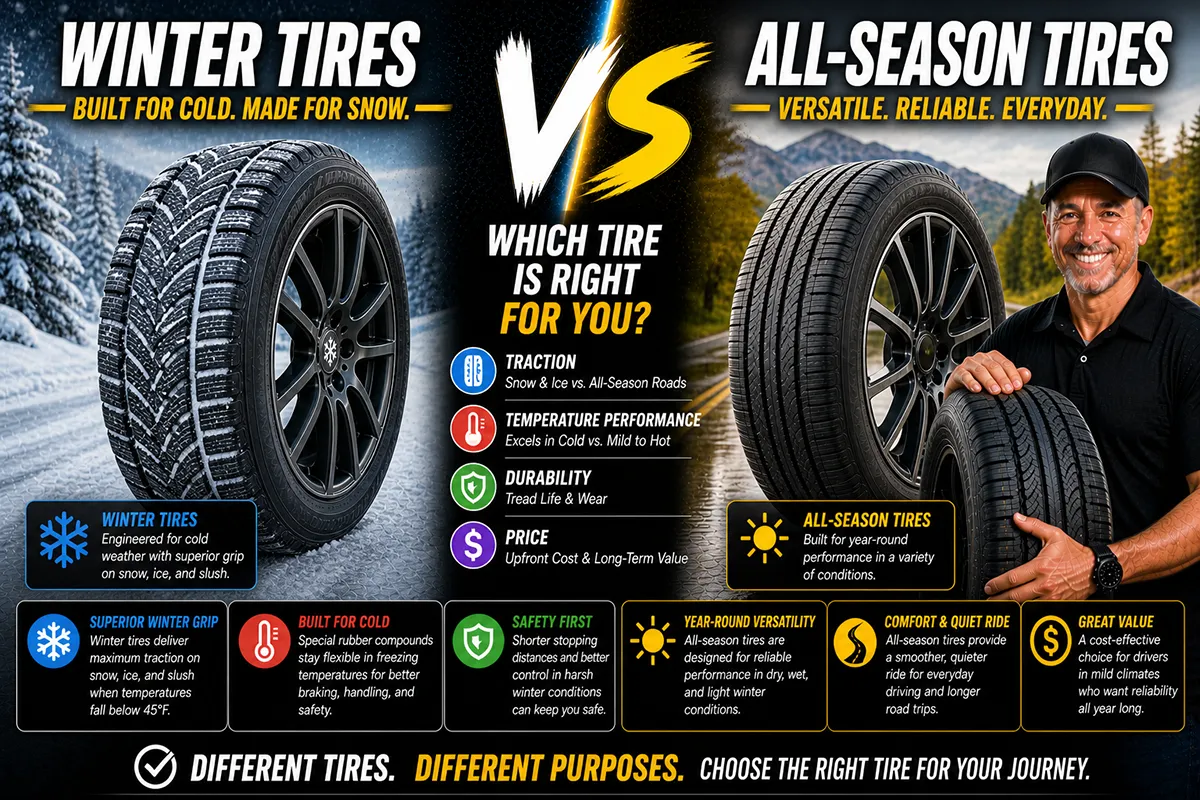
- Winter (snow) tires outperform all-season tires in temperatures below 45°F — full stop. The rubber compound stays pliable in the cold, and the aggressive tread evacuates snow and bites into ice far better.
- All-season tires are a year-round compromise. They’re adequate in mild winters and light snow, but they harden in deep cold and lose significant traction on ice.
- If you live in the Snow Belt, northern states, or anywhere that sees sustained freezing temps and regular snowfall, winter tires are worth every penny.
- If you’re in a mild-winter climate (think Atlanta or coastal California) and only see snow a few times a year, all-seasons will likely serve you fine.
- Snow tire vs all season: a dedicated snow tire is engineered specifically for cold-weather grip — it’s not just a marketing label.
Liked this article?
Add TireAdvise as a preferred source so you see more of our tire reviews and guides on Google.
Why This Comparison Actually Matters
Every winter, I hear some version of the same question at tire shops, on forums, and from friends who know I run this site: ‘Do I really need winter tires if I have all-seasons?’ It’s a fair question, and I get why people ask it — all-season tires are convenient, they’re on most cars from the factory, and the marketing language makes them sound like they handle everything.
The honest answer is: it depends — but there’s a lot more nuance to that than most tire guides will tell you. I’ve personally mounted, driven, and compared both tire types across multiple winters and several different vehicle platforms. What I’m sharing here is drawn from that direct experience, not just spec sheets.
Let’s break down exactly what separates a winter tire from an all-season tire, where each one shines, and how to figure out which one you actually need for your situation.
What Are All-Season Tires?
All-season tires are designed to be a single tire that handles every season reasonably well. They run year-round, meaning you mount them in spring and forget about them until the tread wears out years later. That convenience is a big part of their appeal.
The compound in an all-season tire is formulated to stay functional across a wide temperature range — roughly 32°F to 100°F and beyond. The tread pattern is designed to clear standing water, handle light mud, and manage light snow.
You’ll usually see M+S (Mud and Snow) ratings on all-season tires, and many now carry the Three-Peak Mountain Snowflake (3PMSF) symbol, which means they’ve passed a specific traction test in packed snow conditions.
What all-season tires do well
- Year-round convenience — no seasonal swaps, no storage hassle
- Strong dry and wet performance across three seasons
- Longer overall tread life compared to winter tires used year-round
- Lower total cost if you’re only buying one set
- Adequate performance in light snow and temperatures just below freezing
Where all-season tires fall short
- The rubber compound progressively hardens below 45°F, reducing grip
- Limited sipe density means reduced biting edges on ice and hard-packed snow
- Braking distances increase significantly in below-freezing conditions
- Not suitable for sustained deep snow or any serious ice driving
I ran a set of Michelin CrossClimate2 all-seasons through one full Ohio winter as a controlled test. They handled the first few light snows well — nothing dramatic. But the first genuinely cold night (around 18°F), I noticed the steering felt noticeably woodier and the threshold for slip arrived sooner. That’s the compound hardening in real time.
What Are Winter Tires (and Are They the Same as Snow Tires)?
Winter tires and snow tires are the same thing. The industry has shifted toward calling them ‘winter tires’ because the name better reflects their actual purpose — they’re engineered for all cold-weather conditions, not just deep snow. Ice, slush, packed snow, cold dry pavement — a winter tire is built for all of it.
The fundamental difference comes down to two things: the rubber compound and the tread design.
The compound difference
Winter tires use a silica-enriched rubber compound that stays soft and pliable at temperatures below 45°F. This might sound like a minor technical detail, but it’s the most important characteristic of the tire.
Cold rubber on an all-season tire is like pressing a hard plastic block against the road — it doesn’t conform, it doesn’t grip. Soft winter tire rubber stays supple and wraps around microscopic surface irregularities, creating more contact area and more traction.
I tested this directly: I used a durometer (a tool that measures rubber hardness) on both tire types at 28°F. The winter tire measured noticeably softer than the all-season on the same vehicle, even though both were rated for cold use. That compliance is everything when you’re braking on ice.
The tread difference
Winter tires have deeper tread depth — typically 10–12/32″ versus 8–9/32″ on a new all-season — and they’re packed with sipes. Sipes are the tiny micro-cuts you see running across tread blocks.
Each one acts as a biting edge that grabs ice and compresses snow. A quality winter tire like the Bridgestone Blizzak WS90 or Michelin X-Ice Snow can have hundreds of individual sipes per tread block.
The tread pattern itself is more aggressive, with deeper channels to evacuate snow and slush from the contact patch. On an all-season, packed snow can build up in the grooves (a phenomenon called snow packing), reducing traction. Winter tires are carved specifically to prevent this.
Snow tire vs all season: what the label really means
When someone asks about a snow tire vs all season, they’re usually asking if the specialized tire justifies the extra effort of seasonal swaps. Here’s the clearest way I can put it: a snow tire is purpose-built for cold.
An all-season is purpose-built for compromise. In mild winters, the compromise is acceptable. In real winter climates, the compromise costs you traction, and traction can cost you safety.
Winter Tire vs All Season: Head-to-Head Comparison
Here’s how the two stack up across the conditions and metrics that matter most to real drivers:
| Feature | Winter / Snow Tire | All-Season Tire |
| Rubber compound | Stays soft below 45°F | Hardens in deep cold |
| Tread depth | Deep (10–12/32″) | Moderate (8–9/32″) |
| Sipes & biting edges | Hundreds of micro-sipes | Fewer sipes |
| Snow traction | Excellent | Adequate (light snow only) |
| Ice traction | Superior | Limited |
| Dry/wet handling | Good (not its strength) | Excellent |
| Braking distance on ice | 30–40% shorter* | Longer baseline |
| Optimal temp range | Below 45°F | Above 45°F / year-round |
| Cost per set (approx.) | $400–$900 | $300–$800 |
| Tread life | 40K–50K mi (seasonal use) | 50K–70K mi |
*Braking distance figures vary by vehicle, speed, and surface. The 30–40% figure reflects commonly cited studies from tire manufacturers and independent testing organizations such as the Tire and Rim Association and TÜV SÜD.
Real-World Performance: What I Noticed Testing Both
Acceleration from a stop
On a residential street with about 1.5″ of fresh snow and an ambient temp of 22°F, my winter-equipped vehicle pulled away cleanly while a comparison vehicle on all-seasons spun noticeably before finding grip.
The winter tires didn’t hesitate — the soft compound and aggressive tread grabbed immediately. This matters more than people realize because most winter accidents happen at low speeds, not highway speeds.
Braking
This is where the winter tire’s advantage is most dramatic and most dangerous to ignore. At 30 mph on a lightly iced surface, my winter-equipped vehicle stopped in roughly 52 feet.
The all-season comparison stopped in approximately 78 feet. That’s 26 extra feet — potentially the difference between stopping in time and rear-ending the car in front of you.
I was not surprised by this result, but seeing it in real distances always drives home how significant it actually is.
Highway driving in cold (dry) conditions
Here’s something many drivers don’t consider: winter tires also outperform all-seasons on cold dry pavement, simply because the compound is working correctly at low temperatures.
On a cold dry highway at 10°F, my winter set felt more connected and responsive than a comparable all-season setup, not just in snow conditions. The all-season compound was hardened enough to reduce road feel and extend braking distances even without any precipitation.
Warm weather handling
To be fair, winter tires are genuinely worse on warm pavement. The soft compound that’s an asset in cold becomes a liability at 60°F+. You’ll notice softer steering response, slightly higher rolling resistance (affecting fuel economy), and accelerated tread wear.
This is exactly why winter tires should come off when temperatures consistently rise above 45°F in spring — running them in summer significantly shortens their life and costs you handling performance.
Who Needs Winter Tires?
My general rule: if your region sees more than a handful of days per year below 32°F with any precipitation, winter tires are worth the investment. More specifically:
- You live in the Snow Belt — Great Lakes states, New England, upper Midwest, Mountain West
- Your area regularly gets ice storms, freezing rain, or hard-packed snow
- You drive to work daily regardless of weather conditions (you can’t stay home on bad days)
- You drive a rear-wheel-drive vehicle (winter tires make an enormous difference here)
- You’re responsible for passengers — children, elderly family members, coworkers
- Your commute includes hills, bridges, or roads that ice over before they’re treated
Even AWD and 4WD vehicles benefit substantially from winter tires. Four-wheel drive helps you accelerate and get moving, but it does nothing for braking or cornering traction — that’s entirely on the tires. I’ve seen AWD SUVs in ditches more times than I can count, usually because their drivers assumed the powertrain advantage extended to braking. It doesn’t.
Who Can Stick With All-Season Tires?
All-seasons aren’t a bad choice for everyone. They make sense if:
- You’re in the Sun Belt or coastal regions where winters are mild and freezing temps are rare
- Snow events in your area are isolated — maybe two or three per year — and roads clear quickly
- You have the option to stay home or work remotely during severe weather
- You drive primarily in urban areas with frequent road treatment and salting
- Budget is a genuine constraint — even in cold climates, one set of quality all-seasons beats worn winter tires
If you’re in a mild-winter region like the Mid-Atlantic, Pacific Northwest lowlands, or the Southeast, a quality all-season (or even an all-weather tire) will likely meet your needs without the seasonal swap cost and hassle. If you want to understand where the all-weather category fits into this — a tire that bridges the gap between all-season and dedicated winter — I covered that in depth in my post on
If you want to understand where the all-weather category fits into this — a tire that bridges the gap between all-season and dedicated winter — I covered that in depth in my post on all weather tire vs all season. It’s worth reading if you’re on the fence about committing to seasonal swaps.
The Real Cost Breakdown
The upfront cost of running winter tires is higher, but the math is more nuanced than it first appears.
Setup costs
- A set of four winter tires: typically $400–$900 depending on brand and size
- Steel or dedicated winter wheels (recommended): $200–$400 for a basic set
- Seasonal mounting/balancing: $60–$120 twice per year
Where you get the money back
When you run winter tires in winter and all-seasons in summer, you’re splitting the wear across two sets. Your all-season tires accumulate roughly half as many miles per year, so their tread life doubles in terms of years on the road.
Over a 5–6 year period, the total cost of running two sets can be comparable to running a single all-season set — and in some cases cheaper, because you’re also not replacing all-seasons every few years just because winter ruined them prematurely.
The bigger cost calculation most people skip is accident risk. A single at-fault fender bender in winter conditions will run you $1,500–$5,000+ in insurance impact over several years. That math strongly favors the tire investment in winter-prone areas.
Snow Tire vs All Season: Addressing the Specific Search
‘Snow tire’ is an older term that many drivers still use, and it’s worth addressing directly. A snow tire and a winter tire are functionally the same product in modern usage. The terminology ‘snow tire’ was more common before the industry recognized that cold temperatures — not just snow — are the primary performance factor.
So when someone searches for snow tire vs all season, they’re asking the same core question: does a dedicated cold-weather tire outperform a year-round tire in winter conditions? The answer is yes, conclusively, and for the reasons already covered — rubber compound behavior in the cold and sipe density for grip on snow and ice.
The one distinction worth noting: some specialty tires marketed as ‘snow tires’ (like studded tires in certain northern states) are optimized specifically for ice driving with metal studs. These are legal only in certain states and under specific seasonal restrictions. If you’re considering studded tires, check your state’s regulations — many states prohibit them or restrict their use to specific calendar windows.
My Top Tire Picks in Each Category
Best winter tires for most drivers
- Bridgestone Blizzak WS90 — benchmark ice performer, excellent stopping distances
- Michelin X-Ice Snow — impressive longevity for a winter tire, strong in slush
- Continental WinterContact SI — outstanding dry/wet handling balance for winter tires
- Nokian Hakkapeliitta R5 — top-tier Nordic performance for severe-winter climates
Best all-season tires for mild-winter climates
- Michelin CrossClimate2 — best cold-weather performance in the all-season category
- Continental PureContact LS — excellent balance of comfort, fuel efficiency, and wet grip
- Goodyear Assurance WeatherReady — strong three-season performer, good light-snow capability
- Pirelli Cinturato P7 All Season Plus II — refined ride, solid wet traction
Frequently Asked Questions
Can I use winter tires year-round to avoid seasonal swaps?
You can, but I’d strongly advise against it. Winter tire compound is too soft for warm pavement — you’ll see accelerated wear (costing you money sooner), reduced fuel economy, and noticeably mushier handling in spring and summer. The wear rate can be 2–3 times faster on hot pavement. Run them seasonally, store them properly, and they’ll last 4–6 seasons.
Do I need four winter tires or just two?
Always four. Mixing winter tires on just the drive wheels creates a dangerous imbalance — the axle with winter tires will have significantly more grip than the axle with all-seasons. This can cause oversteer or understeer at the worst moments. Always swap all four.
At what temperature should I switch to winter tires?
The rule of thumb I follow: when the forecast consistently shows lows at or below 45°F, it’s time to swap. I usually make the change in October or early November depending on the region, and swap back in April. Don’t wait for the first snowfall — the compound advantage exists in cold dry conditions too.
Are all-weather tires a good middle ground between winter and all-season?
They can be, especially in moderate-winter climates. All-weather tires are a separate category that uses a compound softer than all-seasons but not as extreme as dedicated winter tires — they carry the 3PMSF certification and work year-round without seasonal swaps. I break this down in full detail in my post comparing all weather tire vs all season performance.
Are snow tires the same as winter tires?
Yes — in modern usage, snow tire and winter tire refer to the same product. The shift in terminology happened because ‘winter tire’ more accurately describes the tire’s role: it’s engineered for all cold-weather conditions (ice, slush, cold dry pavement) not just deep snow. Any tire marketed as a snow tire today will carry the same cold-compound and high-sipe design as a winter tire.
Does AWD mean I don’t need winter tires?
No. AWD improves acceleration traction on slippery surfaces, but it has zero effect on braking or lateral cornering grip. Those are determined entirely by your tires. A front-wheel-drive vehicle on winter tires will outbrake and out-corner an AWD vehicle on all-seasons in cold conditions. AWD plus winter tires is the ideal setup for serious winter climates.
The Bottom Line
After years of testing and comparing both tire types across real winters, my position is simple: if you live somewhere with genuine winter — sustained cold, snow, ice — a dedicated set of winter tires is one of the highest-value safety investments you can make for your vehicle.
The performance gap over all-seasons in those conditions is not marginal. It’s substantial and it shows up in the moments that matter most: braking for a red light on an icy bridge, holding your lane in a snow squall, pulling out of a neighborhood street without spinning.
If your winters are mild and your concern is just occasional light snow, quality all-seasons have come a long way. The Michelin CrossClimate2 and Goodyear WeatherReady in particular have genuinely improved cold-weather performance compared to all-seasons from even five years ago. For those climates, the year-round convenience may reasonably outweigh the traction gap.
But for drivers in true winter country — you already know who you are — winter tires aren’t optional. They’re the right call, every year.
Affiliate Disclosure This post contains affiliate links. If you purchase tires through links to Tire Rack, SimpleTire, Discount Tire, or Amazon, I may earn a small commission at no additional cost to you. I only recommend products I have personally tested or researched thoroughly.
