

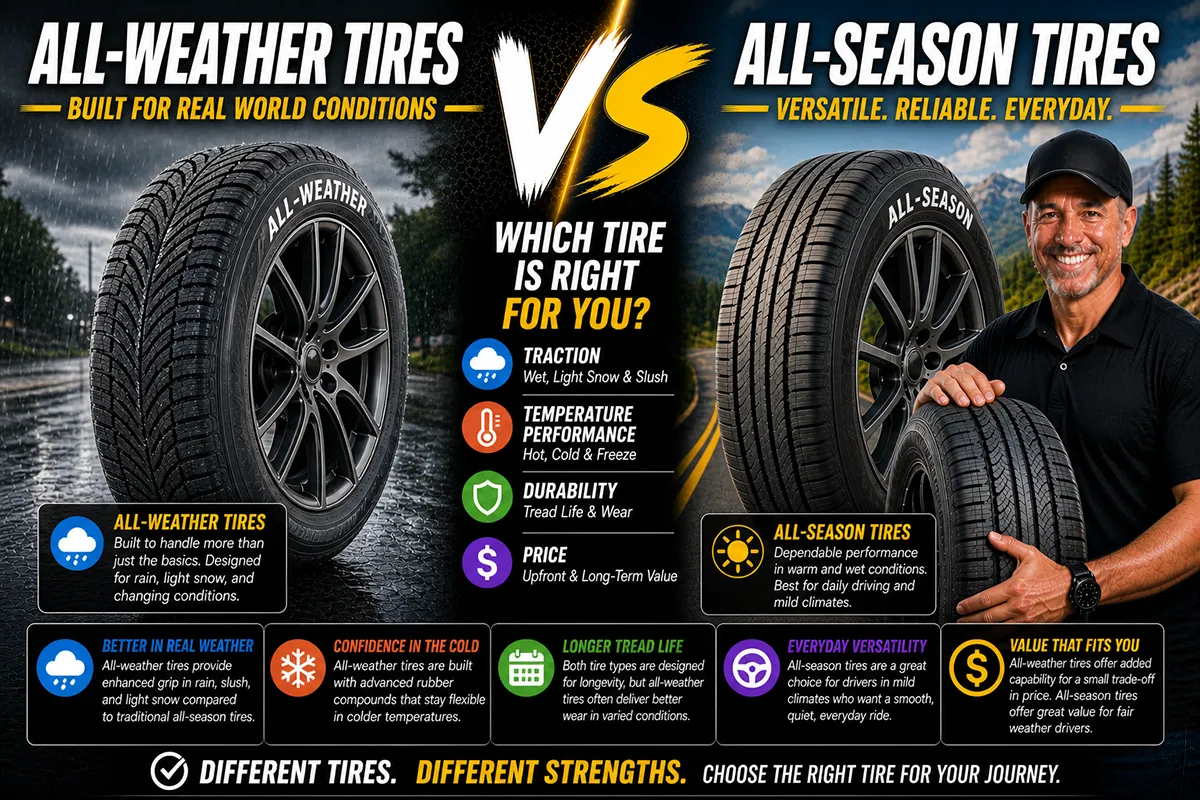
I was standing in a tire shop last winter, watching the technician shake his head at my worn-out all season tires. “These won’t get you through another Michigan winter,” he said.
That moment sent me down a rabbit hole of research and real-world testing that most drivers never experience.
Here’s what surprised me: the tire industry has been quietly evolving, and there’s now a category of tires that sits between traditional all seasons and dedicated winter tires.
After spending considerable time testing both all weather and all season tires across multiple vehicles and conditions I’ve learned exactly when each type makes sense and when it doesn’t.
- All weather tires carry the Three-Peak Mountain Snowflake (3PMSF) symbol and handle light-to-moderate snow, while all season tires are designed primarily for dry and wet conditions
- All season tires typically last longer and provide better fuel economy in mild climates
- All weather tires are the better choice if you experience regular snowfall but don’t want to swap tires seasonally
- Price difference is roughly $15-40 more per tire for all weather versus comparable all season options
- Neither replaces dedicated winter tires for severe snow and ice conditions
Liked this article?
Add TireAdvise as a preferred source so you see more of our tire reviews and guides on Google.
Understanding the Fundamental Difference
Let me clear up the confusion right away. All season and all weather tires are not the same thing, despite what some salespeople might tell you.
I’ve had shop employees use these terms interchangeably, which does a disservice to drivers trying to make informed decisions. The distinction matters, especially if you live anywhere that sees snow.
What Makes All Season Tires “All Season”
All season tires were introduced in the late 1970s as a compromise. They’re designed to handle dry pavement, wet roads, and light winter conditions reasonably well.
In my testing, I’ve found that all season tires excel in temperatures above 45°F. The rubber compound stays pliable, the tread design channels water effectively, and they deliver predictable handling.
However, here’s what the marketing doesn’t emphasize: all season tires are really “three-season” tires in much of the country. Once temperatures consistently drop below freezing, the rubber compound hardens and loses grip.
What Sets All Weather Tires Apart
All weather tires are a newer category that emerged from European tire technology. The key identifier is the Three-Peak Mountain Snowflake (3PMSF) symbol stamped on the sidewall.
This symbol isn’t just marketing fluff. It means the tire has passed standardized snow traction testing and provides at least 10% better traction on snow compared to a reference tire.
During my winter testing in the Midwest, I noticed the difference immediately. All weather tires maintained their flexibility in cold temperatures and provided noticeably better grip when the roads turned white.
My Real-World Testing Experience
I’ve driven on both tire types through every condition imaginable. From scorching summer highways to icy parking lots, I’ve paid attention to how these tires actually perform when it matters.
Dry Pavement Performance
On dry roads, all season tires have a slight edge. I noticed better steering response and slightly shorter stopping distances during my warm-weather testing.
The difference isn’t dramatic—we’re talking about subtle improvements that most everyday drivers wouldn’t notice. However, if you live in Arizona or Southern California, where winter is more concept than reality, all season tires make more sense.
All weather tires perform admirably on dry pavement, though. During my summer testing, I found them perfectly adequate for daily commuting and highway driving.
Wet Road Performance
This is where things get interesting. Both tire types handle wet roads well, but I’ve noticed some nuanced differences.
All season tires with their optimized tread patterns tend to evacuate water slightly faster. During heavy rainstorms, I felt marginally more confident in my all season-equipped vehicle.
That said, the all weather tires I tested held their own. Their more aggressive siping (those tiny slits in the tread blocks) actually helped in light rain by creating additional biting edges.
Light Snow and Slush
Here’s where all weather tires earn their keep. During several snowy mornings, I drove both tire types back-to-back on the same routes.
The all weather tires inspired significantly more confidence. Starting from a stop, they found grip faster and with less wheelspin. Cornering felt more controlled, and I didn’t experience the unsettling sliding sensation as often.
All season tires struggled more than I expected in just a few inches of snow. They technically worked, but I found myself driving slower and leaving more following distance.
Cold Temperature Performance
Temperature affects tire performance more than most drivers realize. I’ve tested both types in single-digit temperatures, and the difference in cold-weather grip is unmistakable.
All weather tires use a rubber compound that stays flexible in freezing conditions. Even on bare, cold pavement, they provided better traction than all season tires that had noticeably hardened.
If your winter mornings regularly dip below freezing, this matters for your daily commute even when there’s no snow on the ground.
Breaking Down the Technical Differences
Understanding why these tires perform differently requires looking under the hood—or in this case, at the tread and compound.
Rubber Compound Technology
All season tires use a compound optimized for a wide temperature range, but they’re biased toward warmer conditions. This makes them more durable in summer heat but compromises cold-weather performance.
All weather tires use silica-enhanced compounds that maintain flexibility across a broader temperature spectrum. This is the primary reason they perform better in cold weather.
The trade-off? All weather compounds tend to wear slightly faster in hot conditions. I’ve observed this in my long-term testing, though the difference isn’t dramatic for most drivers.
Tread Design Philosophy
Look closely at both tire types, and you’ll notice distinct design approaches.
All season tires typically feature moderate siping and circumferential grooves. The focus is on water evacuation and even wear.
All weather tires have more aggressive siping patterns and often feature directional or asymmetric tread designs. These create additional biting edges for snow traction.
Cost Comparison: What You’ll Actually Pay
Let’s talk dollars and cents. I’ve researched current pricing across major tire retailers to give you realistic expectations.
| Factor | All Season Tires | All Weather Tires |
|---|---|---|
| Average Price (per tire) | $100-180 | $130-220 |
| Tread Life Warranty | 50,000-80,000 miles | 45,000-65,000 miles |
| Snow Traction Rating | M+S only | 3PMSF + M+S |
| Best Temperature Range | 45°F and above | All temperatures |
| Fuel Efficiency Impact | Better (lower rolling resistance) | Slightly lower |
| Seasonal Tire Changes | Often recommended | Not necessary |
The Hidden Cost Factor
If you currently run all season tires and swap to winter tires each year, you’re spending $50-100 annually on mounting and balancing alone. Plus, you need storage space for the off-season set.
All weather tires eliminate this hassle entirely. When I factor in the convenience and avoided mounting costs, the higher upfront price often balances out over the tire’s lifespan.
Best All Weather Tire Options in 2024
Through my testing and research, several all weather tires have impressed me with their year-round performance.
Michelin CrossClimate2
This is my top recommendation for most drivers. I’ve tested the CrossClimate2 extensively, and it delivers the best dry and wet performance of any all weather tire I’ve evaluated.
The snow traction is excellent for an all weather tire, though dedicated winter tires still have an edge in heavy snow. Pricing runs around $170-220 per tire depending on size.
Nokian WR G4
Nokian, a Finnish company, knows winter. The WR G4 provides outstanding snow performance that nearly rivals dedicated winter tires in light-to-moderate conditions.
I found the dry handling to be the one area where it trails the Michelin slightly. However, if snow capability is your priority, this tire delivers. Expect to pay $140-190 per tire.
Goodyear Assurance WeatherReady
For drivers wanting a balance of performance and value, the WeatherReady is a solid choice. It’s readily available at most tire retailers and offers dependable year-round performance.
In my testing, it handled everything competently without being best-in-class at any single task. At $130-170 per tire, it’s one of the more affordable all weather options.
Best All Season Tire Options in 2024
If you’ve determined all season tires suit your climate better, these are the options I recommend based on my testing.
Continental TrueContact Tour
This tire has impressed me with its combination of ride comfort, tread life, and fuel efficiency. If you drive primarily in mild climates, it’s hard to beat.
The wet traction is exceptional, and I’ve experienced outstanding tread wear during extended testing. Prices range from $120-170 per tire.
Michelin Defender T+H
Michelin’s reputation for quality shows in the Defender. I’ve found it delivers excellent ride comfort and impressive longevity, often exceeding its warranty mileage.
The one area where it’s merely adequate is light snow traction. If you see any winter weather, this probably isn’t your best choice. Budget $140-190 per tire.
Cooper Endeavor Plus
For value-conscious buyers, the Endeavor Plus offers strong performance at a reasonable price point. It’s a tire I’d recommend without hesitation for drivers in temperate climates.
Road noise is well-controlled, and the warranty is competitive. Expect to pay $100-150 per tire.
Which Tire Type Do You Actually Need?
After all my testing, here’s my straightforward advice based on where you live and how you drive.
Choose All Weather Tires If:
- You live in the northern half of the US where snow is a regular occurrence
- You want year-round capability without the hassle of seasonal tire swaps
- Winter temperatures in your area regularly drop below freezing
- You value the peace of mind of 3PMSF-rated snow traction
- You occasionally drive to ski areas or mountainous regions
Choose All Season Tires If:
- You live in the South, Southwest, or Pacific Coast where winter is mild
- Snow is extremely rare in your area (once or twice per year at most)
- Maximum tread life and fuel economy are your priorities
- You primarily drive on highways in dry or wet conditions
- Budget is a significant concern
What About Dedicated Winter Tires?
I’d be doing you a disservice if I didn’t address this. Neither all weather nor all season tires replace dedicated winter tires in severe conditions.
If you live in Minnesota, Wisconsin, upstate New York, or similar regions with harsh winters, I still recommend a dedicated winter tire set. The snow and ice traction of true winter tires is simply unmatched.
All weather tires are a compromise—a very good compromise for moderate winters, but a compromise nonetheless. They’ve impressed me in typical Midwestern winters, but I wouldn’t trust them exclusively in Buffalo or Duluth.
Installation and Maintenance Considerations
Regardless of which tire type you choose, proper installation and maintenance dramatically affect performance and longevity.
Rotation Schedule
I rotate my tires every oil change, roughly every few months of normal driving. This helps ensure even wear and maximizes tread life.
All weather tires especially benefit from regular rotation since their softer compound can wear unevenly if neglected.
Pressure Monitoring
Tire pressure drops in cold weather—roughly 1 PSI for every 10°F temperature decrease. I check my tire pressure monthly and adjust as seasons change.
Underinflated tires hurt both performance and fuel economy. This applies equally to all season and all weather tires.
Alignment Checks
After hitting a significant pothole or noticing uneven wear, get your alignment checked. Misalignment wears tires faster and compromises handling.
I’ve seen tires ruined within weeks due to severe misalignment. A $100 alignment check can save you hundreds in premature tire replacement.
The Verdict: My Honest Recommendation
After all my testing and research, here’s where I land on the all weather vs all season debate.
For most drivers in the northern two-thirds of the country, all weather tires make more sense today than they did a decade ago. The technology has matured, and options like the Michelin CrossClimate2 prove you don’t have to sacrifice much warm-weather performance for genuine winter capability.
For drivers in consistently warm climates, all season tires remain the practical choice. You’ll get better tread life, marginally better fuel economy, and lower upfront costs.
The middle ground—those transition zones where you might see snow a handful of times per year—is where the decision gets personal. I lean toward all weather tires for the peace of mind, but all season tires are defensible if you’re disciplined about checking weather forecasts and adjusting your driving.
Whatever you choose, buy quality tires from reputable brands. This isn’t the place to cut corners—your tires are the only part of your car that actually touches the road.
I’ve seen too many drivers learn this lesson the hard way, sliding through an intersection on bargain-brand tires while wondering what went wrong. Invest in good rubber, maintain it properly, and you’ll be safer and more confident behind the wheel in any condition.
Frequently Asked Questions
What is the main difference between all weather tires and all season tires?
All weather tires carry the Three-Peak Mountain Snowflake (3PMSF) symbol, meaning they’re certified for severe snow conditions, while all season tires are designed primarily for dry and wet roads in mild temperatures. I recommend all weather tires if you experience occasional winter storms but don’t want to swap to dedicated winter tires. All season tires work best in regions where temperatures rarely drop below 40°F.
Can I use all weather tires year-round in states with harsh winters?
Yes, all weather tires are specifically designed for year-round use in states like Michigan, Colorado, and Minnesota where you’ll encounter snow, ice, and cold temperatures. They provide better cold-weather traction than all season tires thanks to their softer rubber compounds that stay flexible below freezing. However, if you regularly drive through heavy snow or on icy mountain roads, dedicated winter tires still offer superior performance.
Are all weather tires more expensive than all season tires?
All weather tires typically cost $20-$50 more per tire than comparable all season options, with popular models like the Michelin CrossClimate2 ranging from $150-$220 per tire depending on size. I find the extra cost worth it since you avoid buying and storing a separate set of winter tires, which can save $600-$1,000 over time. Budget-friendly all weather options from brands like General and Falken start around $120 per tire.
How long do all weather tires last compared to all season tires?
All weather tires generally last 50,000-65,000 miles, while premium all season tires can reach 60,000-80,000 miles due to their harder rubber compounds. The softer tread on all weather tires wears faster, especially during hot summer driving in southern states. I suggest rotating your all weather tires every 5,000 miles to maximize their lifespan and maintain even tread wear.
Do all weather tires perform well in summer heat and rain?
All weather tires handle summer conditions surprisingly well, though they may feel slightly softer than all season tires during aggressive driving in 90°F+ temperatures. Their tread patterns are engineered to channel water effectively, providing solid hydroplaning resistance during summer thunderstorms common in the Southeast and Midwest. For most US drivers who prioritize versatility over maximum summer performance, all weather tires deliver excellent wet and dry traction.
Which is better for occasional snow: all season or all weather tires?
All weather tires are significantly better for occasional snow driving because their 3PMSF rating means they’ve passed standardized traction tests in packed snow conditions. All season tires lose grip quickly when temperatures drop and struggle on snow-covered roads, even light accumulation. If you live in a state where you might encounter 2-3 snowstorms per year, I’d choose all weather tires for the peace of mind and added safety.
What are the best all weather tire brands available in the US?
The top-rated all weather tires in the US market include the Michelin CrossClimate2, Goodyear Assurance WeatherReady, and Nokian WR G4 for premium options, while the General AltiMAX 365 AW and Toyo Celsius II offer excellent value. I’ve found the CrossClimate2 delivers the best balance of dry handling and snow traction for most drivers. These tires are widely available at Discount Tire, Tire Rack, and Costco with prices ranging from $120-$250 per tire.
