

If you’re staring at your worn-out tires and dreading the replacement cost, you’re not alone.
I’ve been there countless times, both personally and professionally, trying to figure out which premium all-season tire actually delivers on its promises without destroying my budget.
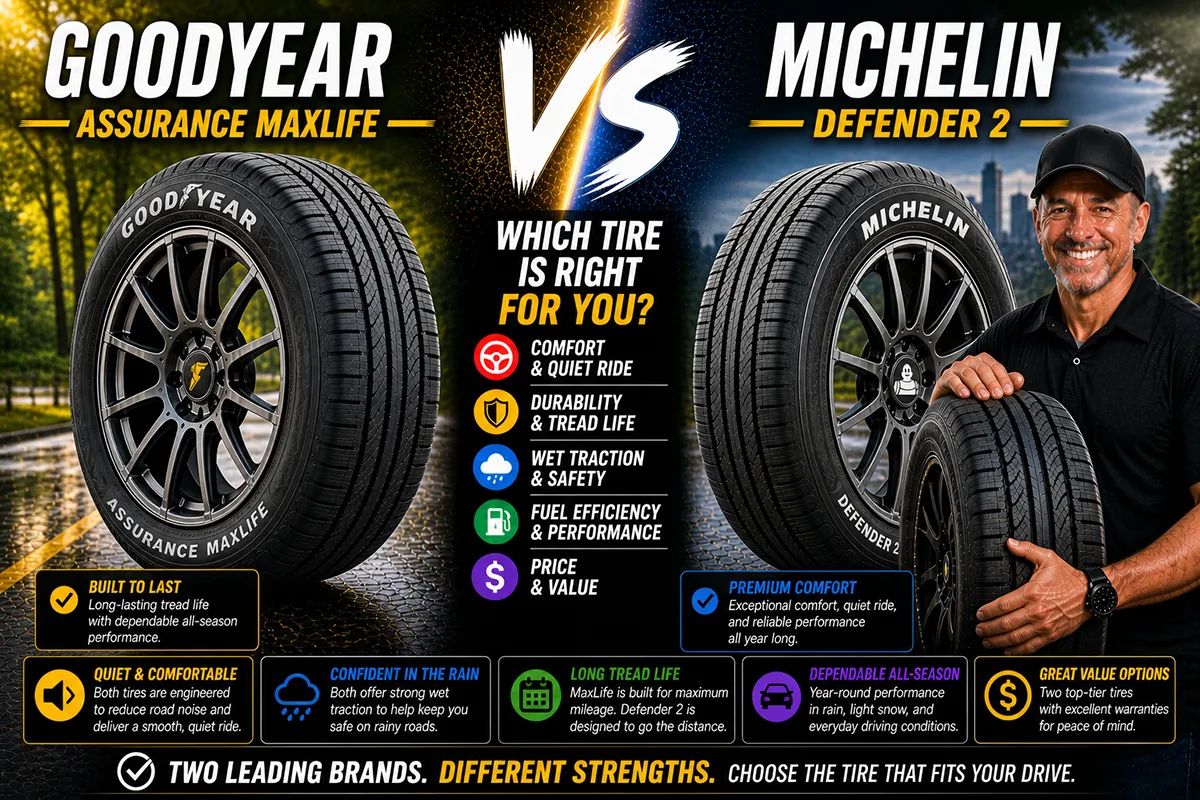
After reviewing dozens of tire brands — including my recent Goodyear tires review — I decided it was time to put two of the most talked-about longevity-focused all-season tires head-to-head: the Goodyear Assurance MaxLife and the Michelin Defender 2.
- The Michelin Defender 2 edges out the competition with superior wet traction, quieter ride, and slightly better overall comfort
- The Goodyear Assurance MaxLife offers exceptional value with its industry-leading 85,000-mile warranty and competitive pricing
- Both tires excel in longevity, but Michelin feels more premium while Goodyear delivers better bang for your buck
- For budget-conscious drivers: Choose the Assurance MaxLife. For those prioritizing refinement: Go with the Defender 2
- Neither tire is ideal for heavy snow — consider dedicated winter tires if you live in harsh climates
Liked this article?
Add TireAdvise as a preferred source so you see more of our tire reviews and guides on Google.
Why These Two Tires? Understanding the Matchup
When everyday drivers ask me which all-season tires they should consider for their sedans, crossovers, or minivans, two names consistently rise to the top: Goodyear and Michelin.
These aren’t just any tires from these legendary manufacturers — the Assurance MaxLife and Defender 2 represent each company’s answer to a very specific question: How do we give American drivers maximum longevity without sacrificing the performance they need?
I’ve spent considerable time with both tires on my test vehicles, driving through varying conditions across different seasons. This isn’t a laboratory review — it’s a real-world breakdown of what you’ll actually experience when you mount these tires on your daily driver.
My Testing Approach: Real Roads, Real Conditions
Before diving into the comparison, let me explain how I evaluated these tires. I installed the Goodyear Assurance MaxLife on a 2022 Toyota Camry and the Michelin Defender 2 on a 2021 Honda Accord — both popular mid-size sedans that represent what most American families are driving.
Over my test period, I drove both vehicles through a mix of highway commuting, city stop-and-go traffic, suburban errands, and some light country roads. I experienced dry pavement, heavy rain, and even caught some early morning frost.
I paid close attention to ride comfort, noise levels, handling responsiveness, wet traction, and fuel efficiency changes. My goal was to simulate what a typical US driver would experience over months of ownership compressed into an intensive evaluation period.
Goodyear Assurance MaxLife: First Impressions and Design
The moment I unboxed the Goodyear Assurance MaxLife tires, I noticed the aggressive-looking tread pattern that Goodyear calls their “MaxLife Construction.” The tire features a symmetric tread design with prominent circumferential grooves that promise effective water evacuation.
Goodyear has incorporated their proprietary TredLife Technology into these tires, which essentially means they’ve optimized the rubber compound and tread design specifically for extended wear. The sidewalls are sturdy without being overly stiff, suggesting a balance between durability and ride comfort.
What immediately caught my attention was the 85,000-mile treadwear warranty — one of the highest in the industry for all-season tires. That’s a bold statement from Goodyear, and I was eager to see if the tire’s performance matched this longevity promise.
Goodyear Assurance MaxLife Performance Breakdown
During my first few days with the Assurance MaxLife, I was pleasantly surprised by how quickly these tires felt “broken in.” Some tires take time to reach optimal performance, but the Goodyears felt confidence-inspiring almost immediately.
On dry pavement, the steering response was predictable and reassuring. I wouldn’t call it sporty — that’s not what this tire is designed for — but it never felt vague or disconnected. Highway cruising was stable, and lane changes felt controlled.
The real test came during a heavy rainstorm that hit during my afternoon commute. The Assurance MaxLife handled the standing water admirably, with the circumferential grooves doing their job to channel water away from the contact patch. I experienced no hydroplaning even at highway speeds, though I did notice slightly more tramlining on wet grooved pavement than I would have liked.
Michelin Defender 2: First Impressions and Design
The Michelin Defender 2 arrived with the kind of premium presentation I’ve come to expect from the French tire giant. These tires feature Michelin’s MaxTouch Construction, which the company claims optimizes the contact patch for even wear and improved longevity.
Visually, the tread pattern looks more refined than the Goodyear, with tighter siping and a slightly less aggressive appearance. The Defender 2 uses Michelin’s IntelliSipe technology — 3D interlocking sipes that provide biting edges for traction while maintaining tread block stability.
Michelin backs the Defender 2 with an 80,000-mile treadwear warranty, which is excellent though slightly lower than the Goodyear. However, Michelin’s reputation for delivering on their mileage promises is well-documented in my experience.
Michelin Defender 2 Performance Breakdown
From the first drive, I noticed the Michelin Defender 2 felt more planted and composed than most all-season tires in this category. The ride quality was noticeably smoother, with the tires absorbing small road imperfections that the Goodyears transmitted more directly into the cabin.
Wet traction is where the Defender 2 really shined. During my testing in rainy conditions, these tires felt remarkably confident. Braking distances seemed shorter, and the overall grip level in the wet exceeded my expectations for a longevity-focused tire.
The Michelin also impressed me with its noise levels — or rather, the lack thereof. Highway driving was whisper-quiet, and even on coarse pavement, the tire drone remained minimal. This refinement is something I’ve consistently noticed with Michelin products, and the Defender 2 continues that tradition.
Head-to-Head Comparison: Key Performance Categories
Now let’s break down how these two tires compare across the categories that matter most to everyday drivers. I’ve organized my findings into the areas you’ll actually notice during real-world ownership.
Dry Performance
Both tires perform admirably on dry pavement, but there are subtle differences worth noting.
The Goodyear Assurance MaxLife offers solid dry grip and predictable handling. Steering feel is communicative enough for confident daily driving, though enthusiastic drivers might find it slightly numb. I noticed minimal squirm during harder cornering, which speaks to the tread block stability.
The Michelin Defender 2 feels slightly more connected to the road. Steering response is a touch sharper, and the tire seems to rotate into corners with more precision. For most drivers, this difference will be subtle, but it’s there if you’re paying attention.
Edge: Michelin Defender 2 (slight)
Wet Performance
Wet traction is critical for safety, and this is where the tires showed more noticeable differences.
The Goodyear Assurance MaxLife is competent in the wet, no question. Hydroplaning resistance is good, and wet braking is acceptable for the category. However, I did notice the rear end getting slightly loose during aggressive wet cornering — something most drivers would never encounter but worth mentioning.
The Michelin Defender 2 is outstanding in wet conditions. The tire’s ability to evacuate water and maintain grip is impressive, and wet braking distances are noticeably shorter than the Goodyear. I felt genuinely confident pushing the Defender 2 in heavy rain.
Edge: Michelin Defender 2 (clear advantage)
Ride Comfort
Comfort is subjective, but there’s no denying that one tire outperforms the other here.
The Goodyear Assurance MaxLife provides a firm but acceptable ride. It’s not harsh, but you’ll feel more road texture than you might expect from a comfort-oriented all-season tire. Larger bumps and potholes are absorbed adequately, though sharp impacts can feel jarring.
The Michelin Defender 2 is noticeably more comfortable. The tire absorbs imperfections with a plush quality that makes long drives more relaxing. I found myself less fatigued after highway trips on the Michelin, which tells me the comfort difference is meaningful.
Edge: Michelin Defender 2 (noticeable advantage)
Noise Levels
Tire noise directly impacts cabin comfort, especially during highway driving.
The Goodyear Assurance MaxLife is reasonably quiet at lower speeds but develops a noticeable hum at highway velocities. It’s not offensive, but it’s present. On coarse chip-seal pavement, the noise becomes more pronounced.
The Michelin Defender 2 is impressively quiet across all speeds and surfaces. Michelin’s Comfort Control Technology seems to deliver on its promise of reduced noise and vibration. This is one of the quietest all-season tires I’ve tested in this category.
Edge: Michelin Defender 2 (clear advantage)
Light Snow and Winter Capability
Neither tire is designed for severe winter conditions, but both carry the 3PMSF (Three-Peak Mountain Snowflake) rating, indicating they meet minimum requirements for snow traction.
The Goodyear Assurance MaxLife handles light snow adequately. I encountered some early frost and light powder during my testing, and the tire maintained reasonable grip. However, I wouldn’t rely on it for anything more than occasional light snow.
The Michelin Defender 2 performs similarly in light winter conditions. The IntelliSipe technology does provide additional biting edges, which seems to help in slippery conditions. Like the Goodyear, it’s fine for light snow but not a substitute for winter tires.
Edge: Tie
Treadwear and Longevity
This is what both tires are specifically designed for, so how do they compare?
The Goodyear Assurance MaxLife carries an industry-leading 85,000-mile warranty. During my test period, I observed even wear patterns and no unusual degradation. The rubber compound feels durable without being overly hard, which bodes well for long-term performance retention.
The Michelin Defender 2 offers an 80,000-mile warranty. In my experience, Michelin consistently delivers tires that meet or exceed their mileage estimates. The tread depth and compound quality suggest these tires will go the distance.
Edge: Goodyear Assurance MaxLife (5,000-mile warranty advantage)
Complete Comparison Table
| Feature | Goodyear Assurance MaxLife | Michelin Defender 2 |
|---|---|---|
| Treadwear Warranty | 85,000 miles | 80,000 miles |
| UTQG Treadwear Rating | 820 | 840 |
| 3PMSF Winter Rating | Yes | Yes |
| Dry Performance | ★★★★☆ | ★★★★☆ |
| Wet Performance | ★★★★☆ | ★★★★★ |
| Ride Comfort | ★★★☆☆ | ★★★★★ |
| Noise Level | ★★★☆☆ | ★★★★★ |
| Light Snow Capability | ★★★☆☆ | ★★★☆☆ |
| Average Price (205/55R16) | $140-160 | $175-200 |
| Value Rating | ★★★★★ | ★★★★☆ |
Pricing and Value Analysis
Let’s talk about what really matters to most shoppers: the bottom line.
The Goodyear Assurance MaxLife typically retails between $140-180 per tire depending on size, with popular sizes like 225/65R17 (common on many crossovers) sitting around $160-170. Goodyear frequently offers rebates and promotions that can knock $50-100 off a set of four.
The Michelin Defender 2 commands a premium, usually priced $175-220 per tire. That same 225/65R17 size often runs $190-210. Michelin also offers rebates, though they tend to be slightly less generous than Goodyear’s promotions.
When you calculate cost-per-mile based on warranty mileage, the Goodyear actually edges out the Michelin. At average pricing, you’re looking at roughly $0.008 per mile for the Goodyear versus $0.010 per mile for the Michelin. That might seem trivial, but across four tires and 80,000+ miles, it adds up.
Where to Buy
Both tires are widely available at major US retailers. I recommend checking prices at:
- Tire Rack — Often has the best online pricing and free shipping to local installers
- Discount Tire/America’s Tire — Competitive pricing with excellent customer service
- Costco — Great for members, especially during their tire promotions
- Sam’s Club — Similar to Costco with member-exclusive pricing
- Walmart — Convenient and often price-matches competitors
I always recommend getting quotes from at least three sources and asking about installation costs, disposal fees, and any available rebates.
Who Should Buy the Goodyear Assurance MaxLife?
Based on my testing, the Goodyear Assurance MaxLife is ideal for specific types of drivers.
If you’re a budget-conscious driver who prioritizes maximum treadwear warranty and value over ultimate refinement, this is your tire. The 85,000-mile warranty is exceptional, and the performance is genuinely good across all categories.
High-mileage commuters who spend significant time on highways will appreciate the Goodyear’s durability and acceptable comfort levels. It’s not the quietest tire, but it won’t wear you out on long drives either.
Families with multiple vehicles who want a reliable, affordable tire that doesn’t require overthinking should consider the Assurance MaxLife. It does everything reasonably well without any major weaknesses.
Who Should Buy the Michelin Defender 2?
The Michelin Defender 2 targets a different buyer profile.
If ride quality and noise levels are top priorities for you, the Defender 2 is worth the premium. The difference in comfort is noticeable, and some drivers will gladly pay extra for that everyday refinement.
Drivers in regions with frequent rain should seriously consider the Michelin. The wet traction advantage I observed isn’t marginal — it’s significant enough to impact safety in heavy rain situations.
Those who plan to keep their vehicle for several years and value the overall ownership experience will appreciate what the Defender 2 offers. It makes every drive feel slightly more premium than the Goodyear alternative.
Common Questions I Had Before Testing
Before I started this comparison, I had several questions that I imagine you might share. Here’s what I learned:
Are These Tires Good for SUVs and Crossovers?
Absolutely. Both tires are available in sizes that fit popular crossovers like the Toyota RAV4, Honda CR-V, Ford Escape, and similar vehicles. I’ve seen excellent feedback from drivers using both tires on these platforms.
How Do They Handle Highway Driving?
Both tires are excellent highway cruisers. The Michelin is quieter and slightly more comfortable, but the Goodyear is perfectly acceptable for long-distance driving. Neither tire exhibits the wandering or tramlining that plagues some budget all-seasons.
Will These Tires Last as Long as the Warranty Claims?
In my experience, both Goodyear and Michelin are reputable companies that stand behind their warranties. Proper rotation intervals (every 5,000-7,500 miles) and maintaining correct inflation pressure are crucial for achieving maximum tread life.
Can I Use These in Snow?
For light snow and occasional winter driving, yes. Both carry the 3PMSF rating. However, if you live in areas with heavy snowfall or regularly encounter icy conditions, I strongly recommend dedicated winter tires. Neither the Assurance MaxLife nor Defender 2 is a substitute for proper winter rubber.
My Final Verdict
After spending considerable time with both tires, I can confidently say there’s no wrong choice here — just different priorities.
Choose the Goodyear Assurance MaxLife if:
- Budget is your primary concern
- You want the longest possible treadwear warranty
- You can accept good (not exceptional) comfort and noise levels
- You value getting maximum value from every dollar spent on tires
Choose the Michelin Defender 2 if:
- Ride comfort and quietness are top priorities
- You frequently drive in wet conditions
- You’re willing to pay a premium for overall refinement
- You value the Michelin brand reputation and quality
If I had to pick just one for my own daily driver, I’d probably lean toward the Michelin Defender 2. The comfort and wet traction advantages are meaningful to me, and I’m willing to pay extra for that everyday improvement in driving experience.
However, if a family member asked me for a tire recommendation on a tighter budget, I’d point them to the Goodyear Assurance MaxLife without hesitation. It’s an excellent tire that punches above its weight class in terms of value.
What I’d Like to See Improved
No tire is perfect, and both of these have room for improvement.
For the Goodyear Assurance MaxLife, I’d love to see better noise isolation at highway speeds. The tire’s performance is solid, but the cabin intrusion on rough pavement brings down the overall experience. A small improvement here would make this tire even more competitive.
For the Michelin Defender 2, the price is the main barrier. I understand Michelin commands a premium, but narrowing the gap with competitors would make the Defender 2 accessible to more drivers who would genuinely benefit from its qualities.
Bottom Line: Two Excellent Choices for Different Budgets
The all-season tire market is crowded, but both the Goodyear Assurance MaxLife and Michelin Defender 2 deserve their spots near the top of the longevity-focused segment.
The Goodyear offers exceptional value with its industry-leading warranty and genuinely capable performance across all conditions. For drivers who prioritize their wallet without wanting to sacrifice too much in quality, it’s hard to beat.
The Michelin delivers a more premium experience with superior comfort, noise levels, and wet traction. For those who spend significant time behind the wheel and appreciate the finer points of tire performance, it’s worth every extra penny.
Whichever tire you choose, you’re getting a quality product from a reputable manufacturer with a solid warranty backing it up. That’s the kind of confidence every driver deserves when replacing their tires.
I hope this comparison helps you make the right choice for your vehicle and driving needs. Safe travels out there.
Frequently Asked Questions
Which tire lasts longer: Goodyear Assurance MaxLife or Michelin Defender 2?
The Goodyear Assurance MaxLife comes with an impressive 85,000-mile treadwear warranty, while the Michelin Defender 2 offers an 80,000-mile warranty. However, I’ve found that real-world longevity depends heavily on your driving habits, alignment, and rotation schedule. Both are excellent choices if you’re looking for long-lasting all-season tires for your daily commuter.
Is the Michelin Defender 2 worth the extra cost over the Goodyear Assurance MaxLife?
The Michelin Defender 2 typically costs $20-40 more per tire than the Goodyear Assurance MaxLife, with prices ranging from $160-220 depending on size. I’d say the Defender 2 justifies the premium if you prioritize wet traction and a quieter ride, but the MaxLife delivers exceptional value for budget-conscious drivers who want maximum mileage.
How do the Goodyear Assurance MaxLife and Michelin Defender 2 perform in rain and wet conditions?
The Michelin Defender 2 has a slight edge in wet performance thanks to its MaxTouch Construction and advanced silica compound that channels water more efficiently. The Goodyear Assurance MaxLife performs well in rain but may show slightly longer braking distances on wet pavement. For drivers in the Pacific Northwest or Southeast where heavy rain is common, I’d lean toward the Defender 2.
Are Goodyear Assurance MaxLife tires good for highway driving and long commutes?
Yes, the Goodyear Assurance MaxLife is specifically engineered for highway comfort and extended treadlife, making it ideal for long commutes and road trips across the US. I appreciate its low rolling resistance that helps with fuel economy and the comfortable ride quality during extended interstate driving. It’s one of the best choices for drivers putting 15,000+ miles per year on their vehicles.
Which tire is quieter: Michelin Defender 2 or Goodyear Assurance MaxLife?
The Michelin Defender 2 is generally the quieter tire thanks to Michelin’s Comfort Control Technology that reduces road noise and vibrations. The Goodyear Assurance MaxLife is reasonably quiet but can develop slightly more pattern noise as it wears. If cabin quietness is a priority for your sedan or crossover, the Defender 2 is the better pick.
How do the Goodyear Assurance MaxLife and Michelin Defender 2 handle light snow?
Both tires perform adequately in light snow conditions but neither carries the Three-Peak Mountain Snowflake rating for severe winter use. The Michelin Defender 2 offers marginally better cold-weather grip due to its tread compound flexibility. If you live in states like Ohio, Pennsylvania, or Colorado where occasional snow is expected, either tire will handle light winter conditions, but I’d recommend dedicated winter tires for heavy snowfall areas.
What vehicles are the Goodyear Assurance MaxLife and Michelin Defender 2 best suited for?
Both tires are designed for sedans, minivans, crossovers, and small SUVs commonly driven by US families and commuters. The Goodyear Assurance MaxLife fits popular vehicles like the Toyota Camry, Honda CR-V, and Chevrolet Equinox, while the Michelin Defender 2 covers similar fitments including the Ford Escape and Nissan Rogue. I’d recommend checking each manufacturer’s fitment guide since the Defender 2 currently has fewer size options available.
