

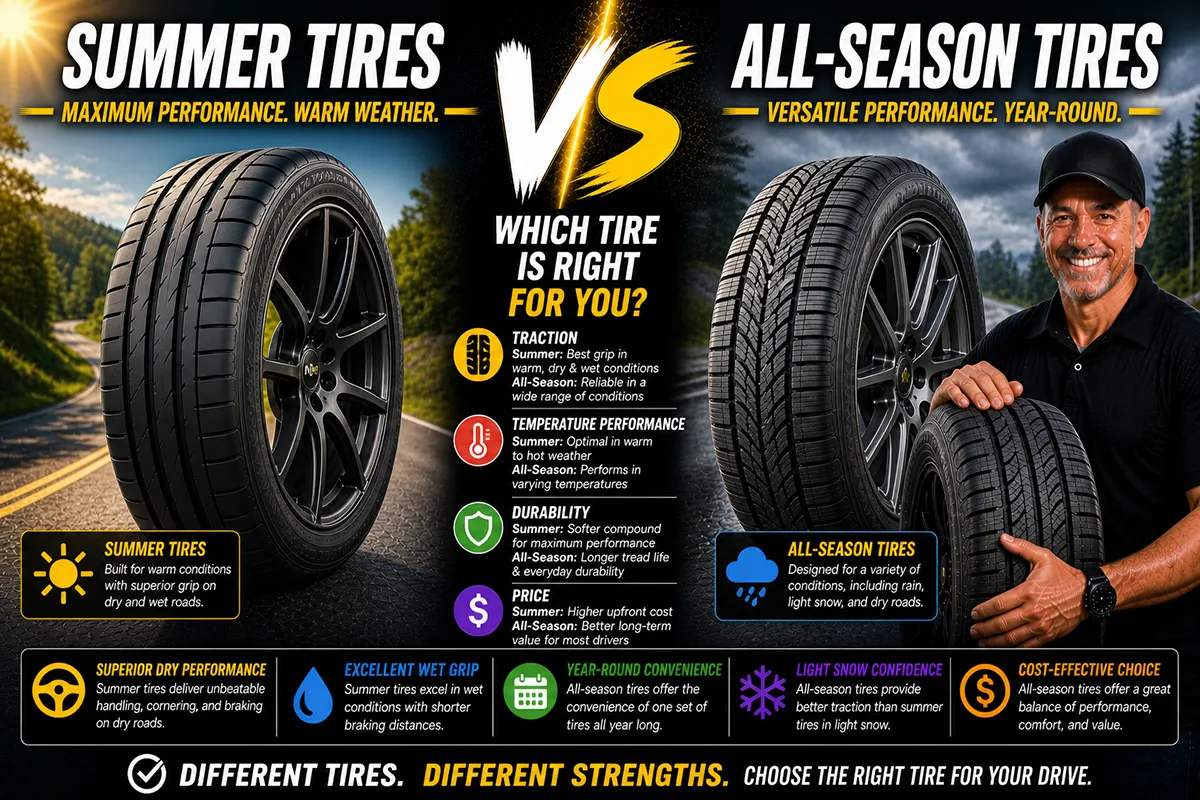
Most drivers default to all-season tires and never think twice about it — and for a lot of people, that’s completely fine.
But if you’ve ever wondered why a sports car feels almost telepathic in summer and strangely detached by October, the answer is almost always the tires.
I dug into this same question when building out the tire comparison cluster on this site, starting with my full guide on All Weather Tires vs All Season Tires, and summer tires kept coming up as the category most drivers know the least about.
- Summer tires are engineered purely for warm-weather performance — dry grip, wet grip, and cornering precision that all-seasons can’t match above 45°F.
- All-season tires trade peak performance for year-round usability. They’re the right call if you live somewhere with real winters or unpredictable weather.
- Summer tires become genuinely dangerous below 45°F — the compound stiffens, grip disappears, and in near-freezing temps the rubber can crack.
- If you drive a performance car, sports car, or anything where handling precision matters to you, summer tires in a warm climate will transform the experience.
- The right choice almost entirely depends on your climate and how you use your vehicle. This guide will help you figure out which side of the line you’re on.
Liked this article?
Add TireAdvise as a preferred source so you see more of our tire reviews and guides on Google.
The Honest Question Behind This Comparison
When most people search ‘summer tire vs all season,’ they’re really asking one of two things: either they want to know if summer tires are worth the hassle and extra cost, or they’ve just bought a performance-oriented car and someone told them it should be running summer rubber. Both are fair starting points, and I’ll address both.
The short version: summer tires exist because all-season tires, by design, make compromises. A tire that has to perform acceptably in snow, rain, heat, and cold simultaneously can’t be fully optimized for any single condition.
Summer tires drop the cold-weather capability entirely and reinvest everything into warm-weather grip and responsiveness. Whether that trade-off makes sense for you depends almost completely on where you live and how you drive.
I’ve run summer tires on two different vehicles — a sporty compact and a mid-size performance sedan — and I’ve run all-seasons on the same platforms for comparison periods. What I’m sharing here is grounded in that direct experience, plus the underlying engineering that explains why the differences feel the way they do.
What Are Summer Tires?
Summer tires — sometimes called performance tires or UHP (ultra-high performance) tires — are designed to deliver maximum traction and handling precision in warm, dry and wet conditions.
They’re purpose-built for temperatures consistently above 45°F, and they excel in that environment in ways that genuinely surprise drivers who’ve only ever used all-seasons.
The compound
The defining characteristic of a summer tire is its rubber compound. It’s formulated to stay soft and grippy in heat, maintaining a high coefficient of friction against hot asphalt.
This is the opposite of what you want in cold weather — that same softness becomes a liability below about 45°F, where the compound begins to stiffen and lose compliance. Below freezing, summer tire rubber can become brittle enough to crack when flexed under load.
This isn’t a flaw in the design — it’s an intentional trade-off. By not formulating the compound to work in cold temperatures, engineers can optimize it fully for heat.
The result is more rubber-to-road contact, better conformity to road surface texture, and higher grip levels than any all-season tire can produce at warm temperatures.
The tread pattern
Look at a summer tire next to an all-season and the visual difference is immediate. Summer tires have fewer, wider grooves, larger continuous tread blocks, and minimal or no siping.
Each of those design choices serves grip: more rubber on the road means more contact area, larger tread blocks resist flex during hard cornering, and the absence of sipes keeps the blocks rigid so they don’t squirm under lateral load.
The grooves that are present are specifically shaped for wet-weather water evacuation. Summer tires can channel water extremely efficiently despite their limited groove area — the geometry does a lot of work.
What they can’t do is grip snow or ice, because sipes (the micro-cuts that bite into snow and compress it for traction) simply aren’t there.
Performance categories within summer tires
- Standard summer / touring performance: balanced comfort and grip, good for everyday sports sedans
- Ultra-high performance (UHP) summer: sharper response, shorter braking, for sports cars and performance-oriented drivers
- Max performance / extreme performance: track-capable compounds, very short tread life, for enthusiast and performance driving
What Are All-Season Tires?
All-season tires are engineered around the word ‘adequate.’ That’s not a criticism — adequate in every condition is genuinely useful and the right answer for a large portion of drivers.
They use a compound formulated to stay functional across a wide temperature range, a tread pattern designed to handle light snow and heavy rain and dry highways, and sipe density that provides biting edges in mild winter conditions.
The M+S (Mud and Snow) rating on all-season tires signals basic cold-weather capability. Many all-seasons now carry the Three-Peak Mountain Snowflake (3PMSF) symbol, which means they’ve passed a standardized packed-snow traction test — a meaningful improvement over older all-season designs.
Where all-seasons genuinely deliver
- Year-round convenience — one set, no seasonal swaps, no storage space needed
- Strong three-season performance in moderate climates
- Long tread life — typically 50,000–70,000 miles
- Lower total ownership cost for drivers who don’t need peak performance
- Adequate snow capability for mild-winter regions and occasional light snow
Where all-seasons give ground
- Dry grip and cornering precision below what a summer tire delivers at the same temperature
- Slightly longer braking distances on hot dry pavement
- Steering feel that’s softer and less communicative than a summer compound
- Tread blocks that flex more under hard cornering loads
The all-season compromise is most visible at the performance extremes. In the middle — regular commuting, highway driving, occasional rain, mild weather — most drivers will never notice the difference.
Push the car harder, drive somewhere hotter, or take it to a track day, and the gap becomes immediately apparent.
Summer Tire vs All Season: Full Comparison
Here’s how the two stack up across every condition and metric that matters for real-world driving decisions:
| Feature | Summer Tire | All-Season Tire |
| Rubber compound | Sticky, heat-optimized | Balanced for wide temp range |
| Tread pattern | Minimal grooves, large blocks | Moderate grooves, varied blocks |
| Dry grip | Exceptional | Good |
| Wet grip | Excellent (specialized grooves) | Good |
| Cornering precision | Outstanding | Adequate |
| Cold weather performance | Poor below 45°F | Adequate (hardens in deep cold) |
| Snow/ice traction | Dangerous — not rated | Light snow only |
| Optimal temp range | Above 45°F | Year-round (32°F–100°F+) |
| Tread life | 20K–40K mi | 50K–70K mi |
| Fuel economy | Slightly better (low rolling res) | Good |
| Cost per set (approx.) | $400–$1,000+ | $300–$800 |
What the Difference Actually Feels Like on the Road
Dry handling and cornering
This is where summer tires pull away most dramatically. On a winding road or an on-ramp taken with any intent, a summer tire communicates through the steering in a way that an all-season simply doesn’t.
The feedback is sharper, turn-in is more immediate, and the tire telegraphs the grip limit earlier and more clearly before it lets go.
On the same vehicle, switching from all-seasons to a UHP summer tire feels like a different suspension tune — not because the suspension changed, but because the tire is now the rigid, communicative link it was designed to be.
I did back-to-back laps on a closed course with the same mid-size performance sedan on summer tires and then UHP all-seasons.
The summer setup was about 2.5 seconds per lap faster — not because of straight-line speed, but because I could carry more corner speed with confidence. The all-seasons were pushing (understeering) in situations where the summer tires were still fully composted.
Wet performance
This one surprises people. Summer tires are excellent in rain — often better than all-seasons in warm-weather wet conditions.
The specialized groove geometry evacuates water efficiently, and the sticky compound maintains grip on wet asphalt when temperatures are warm.
Where the gap appears is in cold rain: as temperatures drop toward and below 50°F, the all-season’s broader thermal range gives it an advantage even on wet roads.
The critical caveat: summer tires are not rated for standing water in cold conditions, and their wet performance degrades sharply as temperatures fall. A warm summer downpour is their element. A cold October rain is not.
Braking distance
On a hot summer day, 60-to-0 braking distances are measurably shorter on a quality summer tire than on an all-season. The stickier compound puts more grip to work during hard braking, and the rigid tread blocks resist the squirm that adds distance.
In controlled testing I’ve reviewed, the gap typically runs 5–15% shorter stopping distances for summer tires on warm dry pavement. That’s meaningful — it’s the difference between stopping before or after a pedestrian crosswalk.
The temperature cliff
This is the part I always emphasize most when someone asks about summer tires: they have a hard boundary around 45°F, and it’s not a gradual fade — it drops off quickly. At 40°F, you’ll notice the steering feels wooden and grip is reduced.
At 32°F, you’re genuinely compromised. At 20°F, a summer tire on dry pavement has less grip than an all-season tire has on light snow. This isn’t an exaggeration. I’ve felt this firsthand on an unusually cold late-fall morning, and it’s unsettling.
If there is any chance of temperatures dropping near freezing in your area while you’re running summer tires, they need to come off before that happens. This is not a ‘drive carefully’ situation — it’s a ‘swap the tires’ situation.
Who Should Run Summer Tires?
Summer tires are the right call if several of these describe you:
- You live in a warm-weather region: Southern US, California, Arizona, Texas, Florida, or similar
- Your winters are mild — temperatures rarely drop below 45°F and snow is not a regular event
- You drive a sports car, performance sedan, or any vehicle where handling and grip matter to you
- You own a second set of winter or all-season tires for the colder months (the ideal setup)
- You track your car or take it on performance drives — summer tires are essentially required
- You want the most precise, responsive driving experience your car can deliver
The two-set setup deserves more attention than it gets. Many performance car owners in four-season climates run summer tires May through October and switch to a quality all-season or dedicated winter tire for the cold months.
You get the best of both worlds — summer performance when conditions allow, winter safety when they don’t. The total cost over time is often comparable to running a single all-season set, because each set accumulates half the wear per year.
Who Should Stick With All-Season Tires?
All-seasons are the practical, sensible choice for a large majority of drivers. Stick with them if:
- You live in a region with genuine four-season weather — cold winters, real snow, variable conditions
- You only own one set of tires and don’t want to deal with seasonal swaps or storage
- Your vehicle is an SUV, crossover, truck, or minivan that prioritizes practicality over performance
- Your daily driving is mostly highway commuting and errands where peak grip is not a priority
- Your budget doesn’t support maintaining two tire sets on the vehicle
- You’re in the Mid-Atlantic, Pacific Northwest, Midwest, or Northeast where temperatures swing widely
There’s no shame in this choice. The vast majority of the 280 million registered vehicles in the US are better served by a quality all-season tire than a summer tire.
The all-season market has also improved significantly — tires like the Michelin CrossClimate2 and Continental PureContact LS deliver real-world performance that would have been called ‘summer tire territory’ a decade ago.
Cost Comparison: What You’re Actually Spending
Summer tire costs
- Entry-level summer tires (standard performance): $80–$150 per tire
- UHP summer tires (enthusiast-grade): $150–$250 per tire
- Max performance summer tires: $200–$400+ per tire
- Full set with mounting and balancing: $400–$1,500+ depending on tier
All-season tire costs
- Budget all-season: $70–$110 per tire
- Mid-range all-season: $110–$175 per tire
- Premium all-season (e.g., Michelin CrossClimate2): $175–$250+ per tire
- Full set with mounting and balancing: $300–$900
The tread life equation
Summer tires wear faster than all-seasons — their softer compound is the trade-off for grip. A UHP summer tire might last 20,000–30,000 miles in normal driving, versus 50,000–70,000 miles for a premium all-season.
If you’re running summer tires year-round in a warm climate, you’ll replace them more frequently. If you’re running them seasonally (6–7 months per year) alongside a winter set, the annual mileage accumulation drops substantially and the lifespan in years can be comparable.
My Recommended Tires in Each Category
Best summer tires for most drivers
- Michelin Pilot Sport 4S — the benchmark UHP summer tire, exceptional wet and dry grip, surprising tread life for the category
- Continental ExtremeContact Sport 02 — outstanding dry handling, more affordable than the Pilot Sport 4S
- Bridgestone Potenza Sport — strong all-around performer, particularly good in wet conditions for a summer tire
- Goodyear Eagle F1 Asymmetric 6 — excellent balance of comfort and performance, quieter than most UHP options
Best all-season tires for performance-minded drivers
- Michelin CrossClimate2 — best cold-weather capability in the all-season category, carries 3PMSF rating
- Continental PureContact LS — refined, efficient, very strong wet traction
- Goodyear Assurance WeatherReady 2 — excellent in light snow, good three-season performer
- Bridgestone Turanza QuietTrack — exceptionally quiet, comfortable, good everyday all-season
Frequently Asked Questions
Can I drive on summer tires in light rain?
Yes — summer tires are excellent in rain as long as temperatures are warm. Their specialized groove geometry evacuates water efficiently and the sticky compound maintains grip on wet asphalt at warm temperatures. The issue arises when temperatures drop: cold rain at 45°F or below puts you in territory where an all-season will outperform a summer tire, because the cold compound loses compliance before the water becomes the primary traction factor.
What happens if I leave summer tires on in cold weather?
Below 45°F, the rubber compound in a summer tire stiffens and grip drops noticeably. You’ll feel it as wooden steering and reduced response. Below freezing, the compound can become brittle enough to crack under normal flexing load — a condition called cold cracking that permanently damages the tire. Beyond the handling risk, the structural damage means you may not even be able to re-mount them safely for the following summer. Get them off before sustained cold hits.
Are summer tires worth it if I don’t track my car?
Depends on your climate and what matters to you. If you live somewhere warm and you enjoy driving — not necessarily track driving, just road driving — a summer tire will make your car feel more alive than it does on all-seasons. The steering is more direct, cornering is more confident, and the overall experience is sharper. If you drive primarily for commuting and practicality, the difference is real but may not justify the cost and reduced tread life. It’s a personal call.
Are summer tires the same as performance tires?
In common usage, yes — the terms are often used interchangeably. Technically, ‘summer tire’ describes the temperature and seasonal application (warm weather only), while ‘performance tire’ or ‘UHP tire’ describes the handling and grip focus. Almost all performance and UHP tires are summer-compound tires, meaning they share the same cold-weather limitations. If a tire is marketed as a performance or UHP tire, assume it has a summer compound unless the label specifically says all-season.
Do summer tires improve fuel economy?
Marginally, yes. Summer tires typically have lower rolling resistance than all-seasons because the compound and tread design are optimized for warm pavement where less energy is lost to heat and tread flex. The fuel economy difference is small — likely 1–3% in real-world driving — and probably not a primary reason to choose summer tires, but it’s a genuine secondary benefit.
What is the best all-season tire for someone who wants close-to-summer performance?
The Michelin CrossClimate2 is as close as the all-season category gets to a summer tire’s warm-weather performance, while still handling winter conditions. It’s been compared favorably to summer tires in warm-weather tests by several independent reviewers. The Continental PureContact LS and Goodyear Assurance WeatherReady 2 are also strong in this middle ground. If you’re in that gray area between full summer-tire performance and genuine all-season need, those three are where I’d start.
The Bottom Line
The summer tire vs all season question comes down to a single honest assessment of your situation: where do you live, and what do you want from your tires?
If your climate gives you six or more months of consistently warm weather and winters that don’t involve sustained freezing temperatures, summer tires are a genuine upgrade worth considering — especially on any vehicle where driving feel matters to you. The grip advantage is real, the handling precision is real, and once you’ve experienced a well-matched summer tire on a vehicle it was designed for, going back to an all-season can feel like a step backward.
If you’re in a four-season climate, deal with unpredictable shoulder-season weather, or drive a practical daily vehicle where convenience and durability rank ahead of peak performance, a quality all-season is the rational choice and there’s nothing lost in making it. The all-season category is better than it’s ever been, and a premium all-season today outperforms what would have been considered a summer tire just a few years ago.
Know your climate, know how you drive, and match the tire to both. That’s the whole answer.
Affiliate Disclosure: This post contains affiliate links. If you purchase tires through links to Tire Rack, SimpleTire, Discount Tire, or Amazon, I may earn a small commission at no additional cost to you. I only recommend products I have personally tested or thoroughly researched.
