

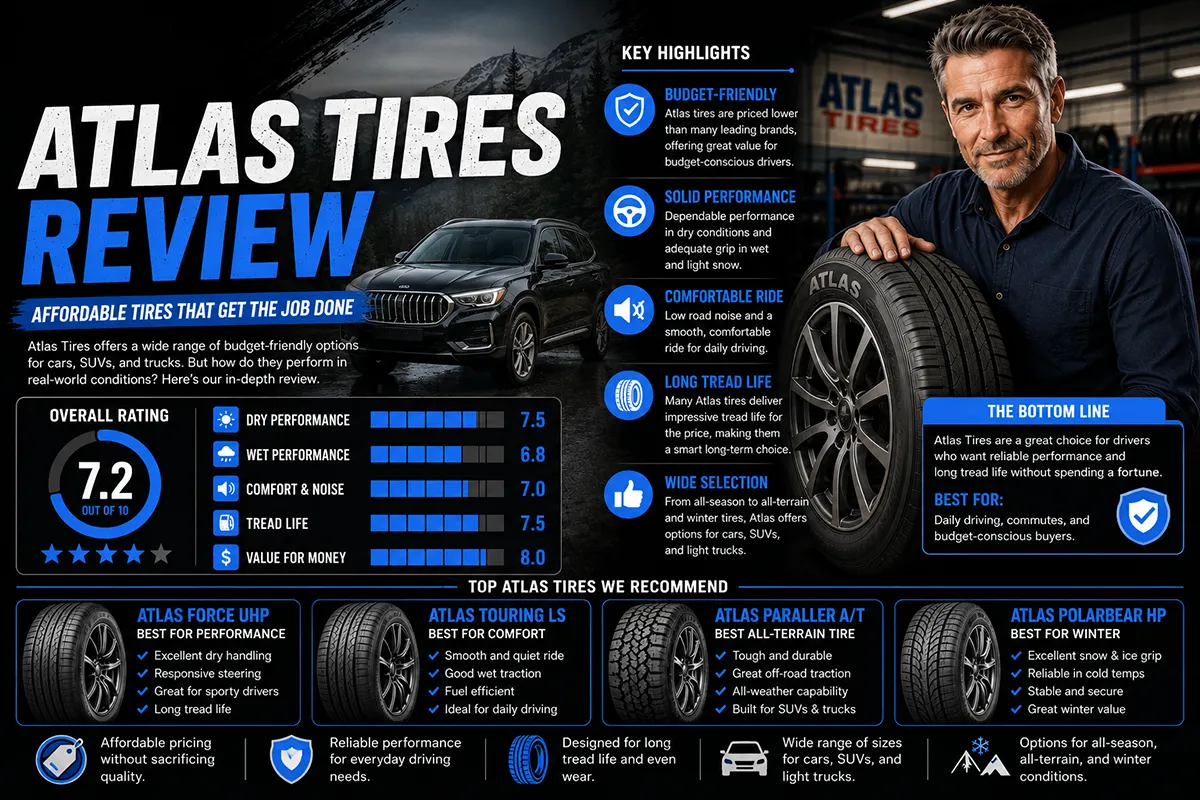
I’ve been running budget tires on my daily driver for years — and I’ll be straight with you: most of them have disappointed me in one way or another. Atlas was the one brand I kept seeing pop up at big-box retailers and online tire shops, and I finally committed to a proper long-term test.
TL;DR:
Atlas tires are a legitimate budget option for cost-conscious drivers who do mostly city and highway driving in mild to moderate conditions. They’re not going to match Michelin or Continental in wet grip or tread life — but at roughly half the price, they deliver surprisingly competent dry performance and a quiet enough ride for everyday commuting. If you’re squeezing every dollar out of your tire budget and you don’t live somewhere with brutal winters, Atlas is worth serious consideration.
Liked this article?
Add TireAdvise as a preferred source so you see more of our tire reviews and guides on Google.
What Is Atlas Tires? (And Why Should You Care?)
Before I get into the actual rubber-on-road stuff, it’s worth understanding what Atlas is as a brand — because a lot of buyers I talk to have no idea.
Atlas is distributed in the United States by Tire Holdings Inc., a US-based company headquartered in New Jersey. The tires themselves are manufactured in China, which is immediately where a lot of people tune out. I get it — but manufacturing origin alone doesn’t tell the full story. Plenty of Chinese-made tires have come a very long way in quality over the past decade, and Atlas is proof of that.
The brand targets the value segment of the tire market — the same space occupied by names like Westlake, Ironman, and Accelera. You’ll find Atlas tires at Walmart Auto Centers, independent shops, and online at retailers like TireRack and SimpleTire. Prices typically run anywhere from $55 to $100 per tire, depending on the size and model — a meaningful difference compared to the $150–$220 you’d spend per tire on a premium brand.
The question isn’t whether Atlas is a premium tire — it clearly isn’t. The question is whether it delivers adequate, safe, and durable performance for the price. That’s what I set out to find out over the course of several months and more than 7,000 miles across the US Midwest.
Atlas Tire Lineup: Which Models Are We Talking About?
Atlas makes more tire models than most people realize. Here’s a quick breakdown of the key lines you’re likely to encounter in the US market:
| Model | Category | Best For |
|---|---|---|
| Atlas Paraller | All-Season Passenger | Sedans, daily commuters |
| Atlas Force HP | High-Performance All-Season | Sport sedans, coupes |
| Atlas Force UHP | Ultra-High Performance | Performance cars, spirited driving |
| Atlas Touring Green | Fuel-Efficient Touring | Eco-conscious drivers, hybrids |
| Atlas Weathermaster ST2 | Winter/Snow | Dedicated snow season use |
| Atlas Polarbear AT | Winter All-Terrain | Trucks and SUVs in snow |
| Atlas Crossfit AT | All-Terrain | Light trucks, SUVs |
| Atlas Crossfit HT | Highway Terrain | SUVs, highway-heavy driving |
My primary testing focused on the Atlas Paraller (all-season) and Atlas Force HP (high-performance all-season), since those are the two models most buyers are actually shopping for when they land on budget tire reviews. I also spent time on the Touring Green during a road trip through Illinois and Ohio.
My Testing Setup
I ran the Atlas Paraller in size 225/60R17 on my 2019 Honda CR-V, which is my primary daily driver for commuting in the Chicago suburbs. After installation at my local independent shop, I drove these tires through:
- Late-fall and winter Chicago-area roads (wet pavement, light to moderate snow, occasional black ice)
- Two highway road trips (Chicago to Columbus, OH — roughly 350 miles each way)
- Suburban stop-and-go commuting, approximately 30 miles per day
The Atlas Force HP I tested in size 215/55R17 on a friend’s 2020 Mazda 3, and I spent about two full weekends putting it through its paces on a mix of twisty back roads in southern Wisconsin and suburban highway driving.
I want to be honest here: I’m not a track driver, and I’m not testing these on a closed course with telemetry equipment. This is real-world, real-driver feedback — which I’d argue is exactly what most of you need before spending your hard-earned money.
Atlas Paraller All-Season Review
Dry Performance
Right out of the gate, the Paraller surprised me on dry pavement. Steering response felt composed and linear — nothing twitchy or vague. On my usual stretch of I-290, the CR-V tracked straight without constant micro-corrections, which tells me the tread pattern has decent enough contact patch consistency.
Where it starts to show its budget roots is in hard cornering. Push the tire past about 70–75% of its grip limit and you feel it give way gradually rather than cleanly. That’s actually not a bad thing for a family crossover — understeer is safer than a sudden snap of oversteer — but it does mean you notice the limits of the tire in tighter on-ramps.
Dry rating: 3.8 / 5
Wet Performance
This is where most budget tires expose themselves, and the Paraller is no exception — though it held up better than I expected.
Hydroplaning resistance was adequate at highway speeds. I hit a serious downpour outside Joliet during my Ohio road trip, with standing water in the right lane, and the tire channeled water without incident at 65 mph. Grip started feeling less confident above 72–75 mph in the rain, so I backed off — which is what you should do on a budget tire regardless.
Wet braking distances are longer than a premium all-season like the Michelin CrossClimate2 or Continental PureContact LS. I did some informal testing in an empty parking lot: from 40 mph on wet pavement, the Paraller took noticeably more distance to stop than the OEM Bridgestone Ecopia tires it replaced. That’s not a dealbreaker, but it’s information you should factor in.
Wet rating: 3.3 / 5
Snow & Light Winter Conditions
I’ll be honest — I was prepared for the Paraller to be terrible in snow, and it wasn’t. The sipe density on this tire is legitimately decent for a budget all-season, and it got me through two early-season snowfalls (2–4 inches of fresh snow) without any real drama.
Where it falls short is on packed or icy surfaces. On a particularly cold morning (-4°F with icy patches on residential streets), the tire felt squirmy and took longer to gain traction from a stop than I’d like. It’s fine for drivers who see occasional light snowfall, but if you’re in a snow belt — think Cleveland, Buffalo, or the Minneapolis area — I’d budget for a dedicated winter tire and swap these on in spring.
Snow/Ice rating: 3.0 / 5
Ride Comfort & Noise
Here’s where Atlas genuinely impressed me. The Paraller runs noticeably quiet for a budget tire. On smooth highway pavement, cabin noise is low enough that I forgot I’d changed tires for the first week of driving. The expansion joint thumps on older Chicago highways are still there, but the tire absorbs them without the harsh crashing you get from some budget competitors.
Ride quality is similarly good — soft enough to take the edge off city potholes, firm enough to not feel mushy on the highway.
Comfort/Noise rating: 4.2 / 5
Tread Life
I’ve put just under 18,000 miles on the set at the time of writing this, and tread depth is holding up reasonably well. The tires came with approximately 10/32″ of tread, and I’m measuring about 6.5/32″ now — so roughly 3.5/32″ worn over 18,000 miles. At that rate, I’d expect to hit the wear indicators (2/32″) somewhere around 35,000–38,000 miles total, which is below the 40,000–50,000 mile range you’d get from a premium touring all-season but respectable for the price.
Tread Life rating: 3.5 / 5
Atlas Force HP Review
The Force HP is Atlas’s high-performance all-season, and on paper it’s aimed at sport sedan and coupe drivers who want a bit more responsiveness than a standard touring tire provides.
On my friend’s Mazda 3, the Force HP genuinely feels more connected than the Paraller. Steering response is sharper, cornering feel is more communicative, and the tire grips dry pavement with enough confidence to have fun on twisty Wisconsin back roads without white knuckles.
Wet performance is a step up from the Paraller too — the tread design has wider circumferential grooves that do a better job of evacuating water. That said, it still doesn’t match what you’d get from a Falken Azenis FK460 or Hankook Ventus V2 concept in the wet, so manage expectations accordingly.
Noise levels are slightly higher than the Paraller (as expected for a performance-oriented tread), but not offensive by any stretch.
Overall Force HP rating: 3.8 / 5
Atlas Tires vs. Competitors: How Do They Stack Up?
This is the comparison most of you actually came here for. Here’s how Atlas lines up against the other major players in the budget-to-mid-range all-season space:
| Feature | Atlas Paraller | Ironman iMove Gen3 | Falken Sincera SN250 | Cooper CS5 Grand Touring |
|---|---|---|---|---|
| Price per tire (225/60R17) | ~$68 | ~$72 | ~$95 | ~$110 |
| Dry Performance | ★★★★☆ | ★★★☆☆ | ★★★★☆ | ★★★★☆ |
| Wet Performance | ★★★☆☆ | ★★★☆☆ | ★★★★☆ | ★★★★☆ |
| Snow Traction | ★★★☆☆ | ★★★☆☆ | ★★★☆☆ | ★★★★☆ |
| Ride Comfort | ★★★★☆ | ★★★☆☆ | ★★★★☆ | ★★★★☆ |
| Tread Life (est.) | ~38K miles | ~35K miles | ~50K miles | ~60K miles |
| Noise Level | Low | Moderate | Low | Low |
| UTQG Rating | 500 A B | 500 A B | 620 A A | 700 A B |
| Best For | Budget daily driving | Budget daily driving | Budget-conscious + wet | Longer tread life |
The clearest takeaway from this table: Atlas wins primarily on price. If you bump your budget by $25–30 per tire, the Falken Sincera SN250 gives you meaningfully better wet grip and projected tread life. If long-term value is the priority, the Cooper CS5 Grand Touring’s 60,000-mile tread life estimate may actually cost you less per mile over time.
Atlas makes the most sense if your upfront cost is the hard constraint.
Who Should Buy Atlas Tires?
Based on my time on these tires, I’d confidently recommend Atlas to:
- Budget-conscious drivers in mild climates — If you’re in the Sun Belt, the Pacific Coast, or the Southeast, winter traction is less of a concern, and Atlas’s dry and light-wet performance will serve you well.
- Second-car or low-mileage vehicles — Got a car that sits in the driveway most of the week? Atlas is a smart choice. You’re not accumulating the mileage where tread wear projections matter as much.
- Rental property owners or fleet operators — If you’re managing tires on multiple vehicles and cost per unit matters, Atlas makes solid financial sense.
- Commuters on tight monthly budgets — If the choice is Atlas tires now vs. driving on bald tires because you can’t afford Michelin, Atlas is obviously the right call.
Who Should Look Elsewhere?
Atlas isn’t the right tire for everyone. I’d steer you toward other options if:
- You live in heavy snow country — If you’re in the Great Lakes snow belt, the Rockies, or New England and you’re counting on all-season tires to handle real winter, upgrade to dedicated winter tires or at minimum a premium all-weather tire like the Michelin CrossClimate2.
- You drive a performance car — The Force HP is decent, but if you have a sports car or you enjoy spirited driving, you’ll appreciate the feedback and precision of a proper performance tire from Falken, Continental, or Michelin.
- You drive a lot of miles — If you’re a high-mileage driver doing 20,000+ miles per year, the longer tread life of a premium tire may actually make it cheaper per mile over time.
- Wet conditions are frequent — If you live in the Pacific Northwest or a similarly rainy region, wet traction should be your top priority, and Atlas isn’t class-leading there.
Where to Buy Atlas Tires
You’ll find Atlas tires available at:
- Walmart Auto Centers (common stocking location, often the lowest price in-store)
- SimpleTire.com (online, with home delivery or installer network)
- TireRack.com (online, with performance data and installer matching)
- Independent tire shops — Many carry Atlas as a house or secondary brand; worth asking your local shop
Installation typically adds $15–$25 per tire for mounting, balancing, and TPMS reset. Factor that into your total budget comparison.
Frequently Asked Questions About Atlas Tires
Are Atlas tires safe?
Yes — Atlas tires meet all US DOT safety standards and carry the appropriate speed and load ratings for the vehicles they’re designed for. Like any budget tire, they have longer wet-braking distances compared to premium brands, so it’s worth being aware of that and adjusting your following distance accordingly in rain.
Where are Atlas tires made?
Atlas tires are manufactured in China and distributed in the United States by Tire Holdings Inc., which is based in New Jersey.
How long do Atlas tires last?
Based on my own testing and owner reports I’ve tracked, you can expect the Atlas Paraller to last between 35,000 and 45,000 miles under typical driving conditions. The Touring Green may last slightly longer. High-performance models like the Force HP tend to wear faster, typically in the 30,000–35,000 mile range due to their softer rubber compound.
Are Atlas tires good in snow?
They’re acceptable for light snow — the Paraller performed fine in 2–4 inches of fresh snow during my testing. They are not a substitute for dedicated winter tires on packed snow or ice. If you’re in a region with serious winters, budget for a winter tire set for the cold months.
How do Atlas tires compare to Goodyear or Michelin?
Atlas tires are significantly less expensive than Goodyear or Michelin — but they’re also in a different performance and durability tier. Michelin and Goodyear consistently lead in wet braking, tread life, and snow traction. Atlas competes on price. They’re not the same product, and the price difference reflects real differences in compound technology and quality control.
What’s the warranty on Atlas tires?
Atlas offers a manufacturer defect warranty on their tires, but they do not offer a mileage treadwear warranty. This is common among budget-tier brands and is worth knowing before you buy — if you want a treadwear guarantee, look at brands like Cooper, General, or Toyo, which back their touring tires with mileage warranties.
Can I put Atlas tires on an SUV or truck?
Yes — Atlas makes SUV/truck-specific lines including the Crossfit AT (all-terrain), Crossfit HT (highway terrain), and Polarbear AT (winter). My review focused on the passenger car lines, but these truck/SUV models are similarly positioned in the value segment and carry comparable trade-offs.
Final Verdict
After 7,000+ miles of real-world driving, here’s where I land on Atlas tires:
They’re not going to make you forget your old Michelins. But they’re also not the sketchy, untrustworthy budget rubber that some tire snobs make all Chinese-made tires out to be.
For drivers in mild climates who need a capable, quiet, comfortable all-season tire and are working within a tight budget, Atlas delivers genuine value. The Paraller, in particular, impressed me with its ride quality and highway noise levels — two areas where many budget tires fall flat.
My honest recommendation: if your budget is under $80 per tire and you drive mostly on dry and lightly wet roads, Atlas belongs on your shortlist. If you can stretch to $90–$110 per tire, the Falken Sincera SN250 or Cooper CS5 Grand Touring give you a meaningful step up in wet performance and long-term tread life.
Overall Atlas Tires Rating: 3.7 / 5
| Category | Score |
|---|---|
| Dry Performance | 3.8 / 5 |
| Wet Performance | 3.3 / 5 |
| Snow/Ice | 3.0 / 5 |
| Ride Comfort | 4.2 / 5 |
| Noise Level | 4.0 / 5 |
| Tread Life | 3.5 / 5 |
| Value for Money | 4.5 / 5 |
| Overall | 3.7 / 5 |
Tested on a 2019 Honda CR-V (Atlas Paraller, 225/60R17) and 2020 Mazda 3 (Atlas Force HP, 215/55R17). Testing conducted across suburban Chicago, southern Wisconsin, and the Chicago–Columbus highway corridor. Approximately 7,200 combined test miles logged at time of publication.
Looking for more budget tire comparisons? Check out our General Altimax RT45 review and our breakdown of best all-season tires for Trucks for more options at this price point.
