

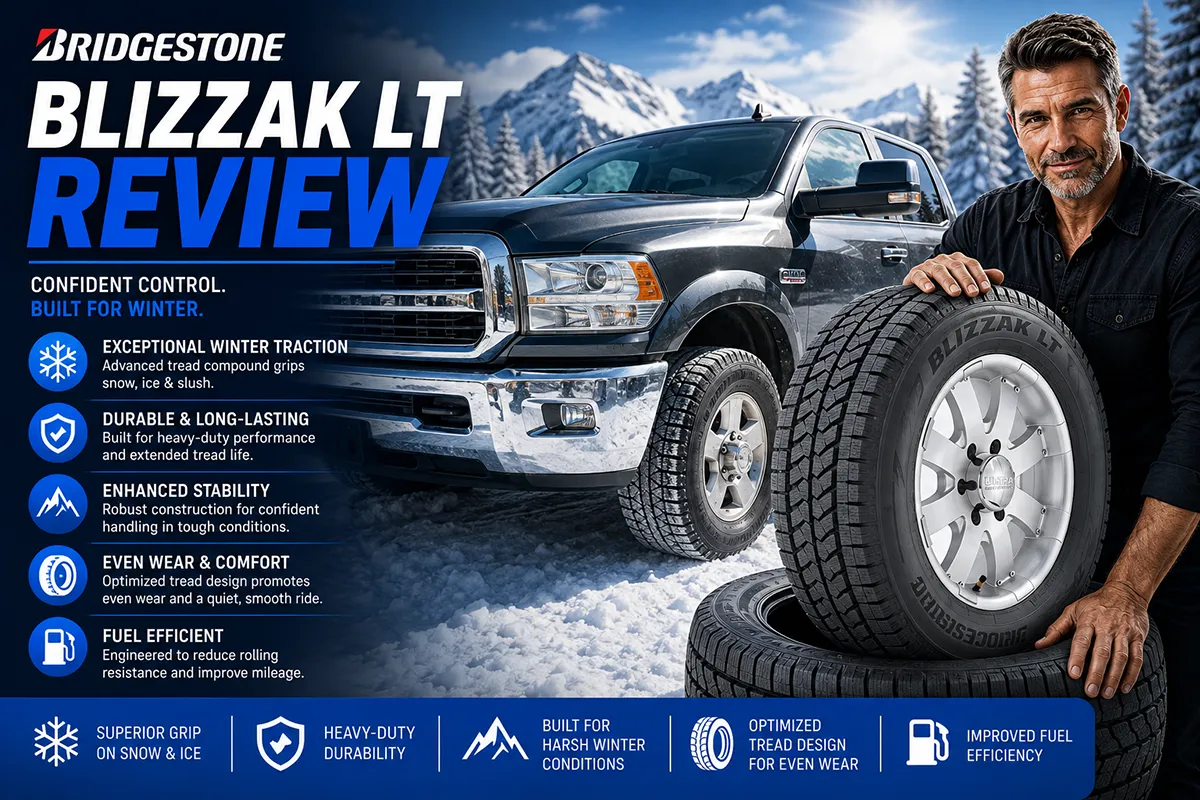
If you’ve ever white-knuckled your way through a snowstorm in a pickup truck or heavy SUV, you know that all-season tires just don’t cut it when winter gets serious. That moment when your rear end starts sliding on a packed-snow highway exit ramp — that’s the moment you start shopping for dedicated winter tires.
The Bridgestone Blizzak LT is specifically designed for light trucks, SUVs, and vans that need to perform in brutal winter conditions. But does it actually deliver, or is it just another premium-priced tire riding on brand recognition?
I put a set on my truck and drove them through everything winter could throw at me to find out. For a broader look at the brand’s lineup, our complete Bridgestone Tires Review guide covers every model side by side.
- The Bridgestone Blizzak LT is a dedicated studless winter tire built for light trucks, SUVs, and vans — and it’s one of the best I’ve tested in snow and ice.
- Snow traction is outstanding, with deep biting edges and Bridgestone’s Multi-Cell compound delivering confident grip even in sub-zero temps.
- Ice performance impressed me the most — braking distances were noticeably shorter compared to my previous winter tires.
- Highway comfort and noise levels are surprisingly refined for a winter tire with such aggressive tread.
- Tread life is decent for a winter tire, though you’ll want to swap them off once temperatures consistently stay above 45°F.
- Pricing runs $180–$320+ per tire depending on size, which is premium but justified by the performance.
Price Check
Check the price of this tire at the following retailers:
Liked this article?
Add TireAdvise as a preferred source so you see more of our tire reviews and guides on Google.
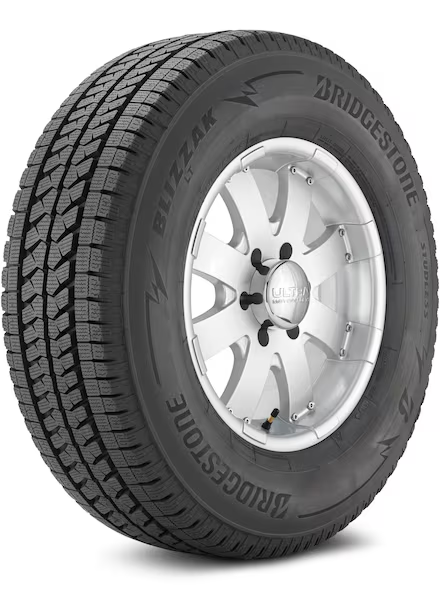
What Is the Bridgestone Blizzak LT?
The Blizzak LT sits within Bridgestone’s legendary Blizzak winter tire family, which has been a go-to name in cold-weather performance for decades. The “LT” designation stands for Light Truck, meaning this tire is engineered with the heavier load ratings, reinforced sidewalls, and tougher construction that trucks and large SUVs demand.
Unlike the Blizzak WS90 (designed for passenger cars) or the Blizzak DM-V2 (designed for SUVs and crossovers), the Blizzak LT is purpose-built for vehicles that carry weight, tow loads, and often operate in commercial or demanding conditions. Think Ford F-150s, Chevy Silverados, RAM 1500s and 2500s, Ford Super Duty trucks, and full-size SUVs like the Suburban or Expedition.
It features Bridgestone’s proprietary NanoPro-Tech Multi-Cell compound, which is designed to absorb and channel away the thin layer of water that forms on ice — the very layer that makes ice so slippery. This is a studless tire, meaning it achieves its grip through compound technology and tread design rather than metal studs.
My Testing Setup and Conditions
I mounted a set of Bridgestone Blizzak LT tires in size LT275/65R18 on my 2021 Ford F-150 XLT with a 4×4 drivetrain. The truck sees a mix of daily commuting, weekend hauling, and occasional light towing. It’s not a pavement princess — it works for a living.
My testing took place over the course of a full winter season in the upper Midwest, where temperatures regularly dipped below zero and snowfall was frequent and heavy. I drove on everything from freshly plowed highways to unplowed rural roads, packed ice, slush, wet pavement, and even dry cold roads when we had those rare sunny stretches in January.
I also specifically tested the tires while the truck bed was loaded with roughly 800 pounds of gear on several occasions, because let’s be honest — if you’re driving a truck in winter, you’re probably hauling something.
Snow Performance: Where the Blizzak LT Truly Shines
Let me get right to the headline: the Blizzak LT’s snow performance is exceptional. From the very first drive on a snow-covered road, the difference compared to my previous all-terrain tires was immediately obvious. The truck felt planted, confident, and predictable.
On packed snow — the kind you encounter on secondary roads that have been driven on but not fully plowed — the Blizzak LT digs in with authority. The tread design features an aggressive pattern with deep lateral grooves and a high density of sipes (those tiny slits in the tread blocks). These sipes create thousands of biting edges that grip snow like Velcro.
In deeper, loose snow (think 4-6 inches of fresh powder), the tire continued to impress. I drove down an unplowed back road during a storm and the truck pulled through without drama. The wide lateral grooves channel snow effectively, and the open shoulder design helps evacuate snow and slush from the contact patch.
One specific moment stands out. After a heavy overnight snowfall, I had to navigate a steep neighborhood hill that hadn’t been touched by a plow. In 4-High, the Blizzak LTs climbed it without hesitation, without wheelspin, and without any of the gut-clenching moments I’ve experienced on lesser tires.
How It Handles Slush
Slush is the worst of both worlds — not enough structure to grip like snow, and too thick and heavy to push aside like water. Many winter tires that excel in snow struggle with slush because the heavy, wet mess overwhelms the tread.
The Blizzak LT handles slush admirably. The three wide circumferential grooves running down the center of the tread act as highways for slush evacuation. During several drives through that awful late-winter mix of melting snow, road brine, and standing slush, I never felt the tire hydroplane or lose meaningful traction.
Ice Performance: The Blizzak’s Secret Weapon
If snow performance is where winter tires earn their keep, ice performance is where the truly great ones separate themselves from the pack. And the Blizzak LT is genuinely great on ice.
This is where Bridgestone’s Multi-Cell compound technology does its most impressive work. Traditional rubber compounds harden in cold temperatures, reducing their ability to conform to the surface of ice. Bridgestone’s compound stays pliable and uses a microscopic cellular structure to absorb the thin water film that forms on ice surfaces.
In practical terms, here’s what I experienced: braking on ice felt noticeably more controlled and shorter in distance than what I’ve gotten from other winter tires I’ve used in the past. At slow speeds on pure glare ice (a parking lot that had frozen over), I could feel the tires actually biting into the surface rather than just sliding.
Starting from a stop on ice — always a test of a winter tire’s mettle — was remarkably composed. Even in 2WD (I tested this deliberately), the rear tires found grip with far less wheelspin than I expected. Switching to 4WD made starts on ice nearly seamless.
Real-World Ice Driving Situations
The most telling ice test happened naturally, not in a parking lot. I was approaching a stoplight on a road that had a thin layer of black ice — the kind you don’t see until you feel it. When I applied the brakes, the ABS engaged briefly but the truck stopped in a straight line, well before the intersection. On my previous all-terrain tires, that same scenario had resulted in an uncomfortably long slide.
Cornering on ice requires respect regardless of what tire you’re running, but the Blizzak LT communicates well. There’s a progressive feel as you approach the limit of grip rather than a sudden breakaway. This predictability is worth its weight in gold when you’re navigating icy curves.
Dry and Wet Cold-Weather Performance
Winter isn’t all snow and ice. Many winter days are just cold and dry, or cold and wet with rain. A winter tire that’s miserable on these surfaces would be a dealbreaker for daily driving.
On cold, dry pavement, the Blizzak LT performs well — better than I expected for a tire with such an aggressive winter tread design. The ride is composed and the tire tracks straight on the highway. There’s a slight softness to the steering feel compared to a highway all-season or all-terrain tire, which is typical for winter tires with their softer compound. But it’s never vague or disconnected.
Wet grip on cold pavement is very good. The deep grooves and siped tread blocks handle water evacuation efficiently. During cold rain events (temps in the 35-40°F range), I felt confident at highway speeds and during lane changes.
Highway Comfort and Noise
Here’s a pleasant surprise: the Blizzak LT is remarkably quiet for a winter tire designed for trucks. I was expecting the typical winter tire drone — that persistent hum you get from aggressive tread patterns at highway speeds. Instead, the Blizzak LT produced only a mild, low-frequency hum that was easily masked by the radio or a conversation.
Ride quality is another strong point. The tire absorbs impacts from potholes and expansion joints well, which I attribute to the softer winter compound and the tire’s internal construction. On the rough, frost-heaved highways that are a reality of Midwest winters, the Blizzak LT smoothed things out noticeably.
At sustained highway speeds of 65-70 mph on dry winter roads, the tire feels stable and planted. There’s no wandering, no excessive tramlining on road ruts, and no nervous feeling. For a tire that excels in extreme conditions, its civilized highway manners were genuinely impressive.
Tread Life and Durability
Winter tire tread life is a different conversation than all-season or all-terrain tread life. The softer compounds that give winter tires their cold-weather grip inherently wear faster, especially if you make the mistake of running them in warm weather.
After a full season of consistent winter use, my Blizzak LTs showed moderate but expected tread wear. The tread depth indicator still showed plenty of life remaining, and I’m fully confident I’ll get multiple winter seasons from this set — which is the realistic expectation for a quality winter tire used correctly.
One important note: the Blizzak line features its Multi-Cell compound in the top 55% of the tread depth. Once you wear past that, you still have a functional winter tire, but you lose the advanced ice-biting performance of the Multi-Cell layer. This means the tire’s ice performance diminishes before the tire is technically “worn out.” Keep this in mind when assessing remaining tread life.
My Advice on Tread Longevity
The single best thing you can do for winter tire tread life is swap them off as soon as winter ends. Running soft winter compound on warm spring and summer pavement is like running a pencil eraser across sandpaper — it’ll disappear fast.
I swap my winter tires off when daytime temperatures consistently stay above 45°F and there’s no more frost in the forecast. I store them in a climate-controlled garage, stacked flat. This approach has consistently gotten me excellent longevity from winter tire sets.
Load Handling and Towing Performance
This is where the Blizzak LT distinguishes itself from Bridgestone’s SUV-oriented Blizzak DM-V2. The LT construction means this tire is built to handle the heavier loads that light trucks carry.
With approximately 800 pounds in the bed — a realistic load for supplies, equipment, or firewood — the Blizzak LT maintained its composure in all winter conditions. The sidewalls didn’t flex excessively, and the tire continued to provide confident grip. The loaded weight actually helped traction in some cases, as the added weight over the rear axle increased the contact patch pressure.
I also towed a small enclosed trailer on a couple of occasions during winter storms. The Blizzak LT handled the added demands well, though I’ll note that towing in winter conditions always requires extra caution regardless of your tires. The key takeaway is that the tire’s construction didn’t become the weak link — it maintained solid performance under load.
Bridgestone Blizzak LT vs. Competitors
The winter tire market for light trucks isn’t as crowded as the passenger car segment, but there are solid alternatives. Here’s how the Blizzak LT stacks up against the competition based on my experience and research.
| Feature | Bridgestone Blizzak LT | Michelin LTX Winter | Firestone Winterforce LT | Cooper Discoverer Snow Claw |
|---|---|---|---|---|
| Tire Type | Studless Winter | Studless Winter | Studdable Winter | Studdable Winter |
| Ice Grip | Excellent | Very Good | Good (Excellent w/ studs) | Good (Excellent w/ studs) |
| Snow Traction | Excellent | Very Good | Very Good | Excellent |
| Highway Comfort | Very Good | Excellent | Average | Good |
| Noise Level | Low | Very Low | Moderate-High | Moderate |
| Approx. Price (per tire) | $180–$320+ | $190–$310+ | $130–$220+ | $150–$260+ |
| Severe Snow Rated (3PMSF) | Yes | Yes | Yes | Yes |
Blizzak LT vs. Michelin LTX Winter
The Michelin LTX Winter is the Blizzak LT’s closest competitor in terms of price and market positioning. In my experience, the Blizzak LT has a slight edge on ice thanks to the Multi-Cell compound, while the Michelin offers marginally better highway refinement and may edge out the Blizzak in tread longevity.
If your primary concern is ice performance and you live where ice is a frequent hazard, I’d lean toward the Blizzak LT. If you value highway comfort and tread life slightly more, and your winters involve more snow than ice, the Michelin is a solid alternative.
Blizzak LT vs. Firestone Winterforce LT
The Winterforce LT is a budget-friendly option from Bridgestone’s own sub-brand, Firestone. It’s a studdable tire, which means it can accept metal studs for additional ice traction — something the Blizzak LT doesn’t offer since it’s a studless design.
Without studs, the Winterforce LT can’t match the Blizzak LT’s ice performance. It’s also noisier and less comfortable on the highway. But at roughly $50-$100 less per tire, it’s a viable option if you’re on a tight budget or if you plan to run studs (where legal in your state).
Blizzak LT vs. Cooper Discoverer Snow Claw
The Cooper Snow Claw is another studdable option that offers aggressive snow traction. Its tread pattern is more open and aggressive than the Blizzak LT’s, which gives it a slight edge in very deep, unplowed snow. However, that aggressive tread comes with more road noise and slightly less refined on-road manners.
The Blizzak LT wins on ice grip (without studs), highway comfort, and overall refinement. The Cooper wins on price and raw deep-snow capability.
Available Sizes and Pricing
The Bridgestone Blizzak LT is available in a solid range of LT-metric sizes covering popular trucks and vans. Here’s a general overview of what’s available in the US market:
- LT245/75R16 — Common for older and mid-size trucks, some vans
- LT265/70R17 — Popular for half-ton trucks like F-150, Silverado, RAM 1500
- LT275/65R18 — Another popular half-ton size (this is what I ran)
- LT275/70R18 — Common for three-quarter and one-ton trucks
- LT265/60R20 — For trucks running 20-inch wheels
- LT275/65R20 — Heavy-duty truck size
Pricing varies by size and retailer, but expect to pay roughly $180 to $320 or more per tire. For a set of four, you’re looking at roughly $720 to $1,280+ before mounting, balancing, and any applicable taxes. Popular online retailers like Tire Rack, Discount Tire, and SimpleTire frequently stock these, and you may find seasonal promotions or rebates from Bridgestone.
I know that’s a significant investment. But when I factor in the safety margin these tires provide versus all-seasons or even lesser winter tires, the math works out. One avoided accident easily pays for a set of winter tires.
Who Should Buy the Bridgestone Blizzak LT?
The Blizzak LT isn’t for everyone. It’s a specialized tire for specific needs. Here’s who I think should seriously consider it:
- Truck and SUV owners in the Snow Belt: If you live in states like Minnesota, Wisconsin, Michigan, the Dakotas, Montana, or upstate New York, and you drive a truck daily, this tire is made for you.
- Commercial and fleet operators: If your livelihood depends on getting your truck from point A to point B in winter, the Blizzak LT’s LT-rated construction and winter performance make it a no-brainer.
- Drivers who tow in winter: The load-rated construction holds up under towing demands that would compromise a passenger-car winter tire.
- Anyone prioritizing ice performance without studs: If your state restricts or bans studded tires, the Blizzak LT’s Multi-Cell compound is the best studless ice solution I’ve experienced on a truck tire.
Who Should Look Elsewhere
- Drivers in mild winter climates: If you’re in Texas, the Southeast, or coastal California, you don’t need this tire. A good all-season or all-weather tire with the 3PMSF rating will serve you better year-round.
- Budget-conscious buyers: If the price is a dealbreaker, the Firestone Winterforce LT offers respectable winter performance at a lower cost.
- Drivers who want one tire year-round: The Blizzak LT is a seasonal tire, period. Running it in summer will destroy the tread quickly and performance in warm weather is poor. If you can’t or won’t run a dedicated winter set, look at all-weather tires instead.
Mounting, Storage, and Practical Tips
If you’re new to running dedicated winter tires, here are some practical tips I’ve learned over years of seasonal tire swaps:
Buy a second set of wheels. This is the single best piece of advice I can give. Having your winter tires mounted on a dedicated set of steel or alloy wheels means each seasonal swap takes about 30 minutes with a floor jack — or a quick trip to your local tire shop for a wheel swap rather than a full mount/dismount. Over the life of the tires, this saves hundreds of dollars in mounting fees and prevents potential damage to both the tires and the wheels from repeated mounting.
Store tires properly. Keep unmounted tires stacked flat in a cool, dry place out of direct sunlight. If they’re mounted on wheels, store them standing upright or hung on hooks. Clean them before storage to remove road salt and brake dust.
Check your TPMS. If your truck uses tire pressure monitoring sensors, you’ll either need sensors in your second wheel set or you’ll need to deal with the TPMS light being on. Most tire shops can program aftermarket sensors to your vehicle relatively inexpensively.
Break them in gently. New winter tires have a thin release compound on the surface from manufacturing. During my first few days of driving on any new winter tire set, I drive conservatively to let this compound wear off and the tread surface to roughen up for optimal grip.
The Bottom Line: Is the Bridgestone Blizzak LT Worth It?
After spending a full winter season with the Bridgestone Blizzak LT on my F-150, I can say with confidence that this is one of the best winter tires available for light trucks in the US market today.
Its ice performance is the standout feature — Bridgestone’s Multi-Cell compound technology genuinely works, and it’s the area where I felt the most dramatic improvement over previous winter tires I’ve used. Snow traction is excellent across all conditions, from fresh powder to packed snow to that miserable heavy slush that accumulates on highway shoulders.
The highway manners are a welcome bonus. Too many winter tires feel like a compromise on dry pavement, but the Blizzak LT is comfortable, reasonably quiet, and stable at highway speeds. This matters because the reality of winter driving is that a lot of your time is still spent on plowed, salted, dry roads — and you don’t want a tire that makes those stretches miserable.
Yes, the price is premium. At $180-$320+ per tire depending on size, a full set represents a real investment. But I keep coming back to the same realization every winter: tires are the only thing connecting your truck to the road. In conditions where that connection is tested to its limits, the Blizzak LT gives you the best possible answer.
I recommend the Bridgestone Blizzak LT without hesitation for any truck or SUV owner in the northern US who takes winter driving seriously. It’s earned its spot as my go-to winter tire, and it’ll stay on my truck for every winter season ahead.
Frequently Asked Questions
How does the Bridgestone Blizzak LT perform on ice and packed snow?
The Bridgestone Blizzak LT delivers excellent traction on ice and packed snow thanks to its multi-cell compound technology, which bites into slick surfaces at a microscopic level. In my experience, it inspires confidence during hard braking and cornering on icy roads, outperforming many competing light truck winter tires. It’s one of the top choices for drivers in northern US states who regularly face severe winter conditions.
What trucks and SUVs does the Bridgestone Blizzak LT fit?
The Bridgestone Blizzak LT is designed for light trucks, SUVs, and vans and comes in a wide range of LT-metric sizes from 15 to 20 inches. Popular fitments include the Ford F-150, Chevrolet Silverado 1500, Ram 1500, Toyota Tacoma, and Jeep Wrangler. You can check Bridgestone’s online tire selector tool or ask a local dealer to confirm the correct size for your specific vehicle and trim level.
How much do Bridgestone Blizzak LT tires cost?
Bridgestone Blizzak LT tires typically range from about $180 to $320 per tire in the US market, depending on size and retailer. A full set for a half-ton pickup like the F-150 usually runs between $800 and $1,200 before installation and balancing. I recommend checking Tire Rack, Discount Tire, and Costco for seasonal rebates, since Bridgestone frequently offers $70–$100 off a set of four during fall promotions.
How long do Bridgestone Blizzak LT tires last?
Most drivers report getting three to four solid winter seasons out of a set of Bridgestone Blizzak LT tires when they’re used exclusively during cold months and stored properly in the off-season. The proprietary multi-cell compound that provides superior ice grip does wear faster than an all-season tire, and Bridgestone notes that peak winter performance diminishes once the tread reaches about 55% of its original depth. Rotating them every 5,000–7,000 miles helps maximize even wear and overall tread life.
Is the Bridgestone Blizzak LT worth it compared to the Blizzak WS90?
The Blizzak LT is specifically engineered for light trucks and SUVs with LT-rated load capacities, while the Blizzak WS90 is built for passenger cars and crossovers. If you drive a full-size pickup or tow in winter, the Blizzak LT offers the load-carrying strength and sidewall durability the WS90 simply isn’t designed for. Both share Bridgestone’s excellent multi-cell compound for ice grip, but the LT variant adds a more aggressive tread pattern for deeper snow traction under heavier vehicles.
Can you drive Bridgestone Blizzak LT tires on dry roads and highways?
Yes, the Blizzak LT handles dry and wet pavement surprisingly well for a dedicated winter tire, with stable highway manners and reasonable ride comfort. That said, I wouldn’t recommend running them through the summer because the soft winter compound wears rapidly in warm temperatures and stopping distances on hot asphalt increase noticeably. For the best performance and tire longevity, swap them off once temperatures consistently stay above 45°F in spring.
Do Bridgestone Blizzak LT tires need to be studded for severe winter driving?
No, the Bridgestone Blizzak LT is a studless winter tire that relies on its multi-cell compound and aggressive siping to grip ice and snow without metal studs. In most US winter driving conditions—including the upper Midwest, New England, and mountain states—studless Blizzak LTs provide outstanding traction without the road noise and pavement damage associated with studs. They also carry the three-peak mountain snowflake (3PMSF) symbol, confirming they meet severe snow service standards required by many state and mountain pass regulations.
