

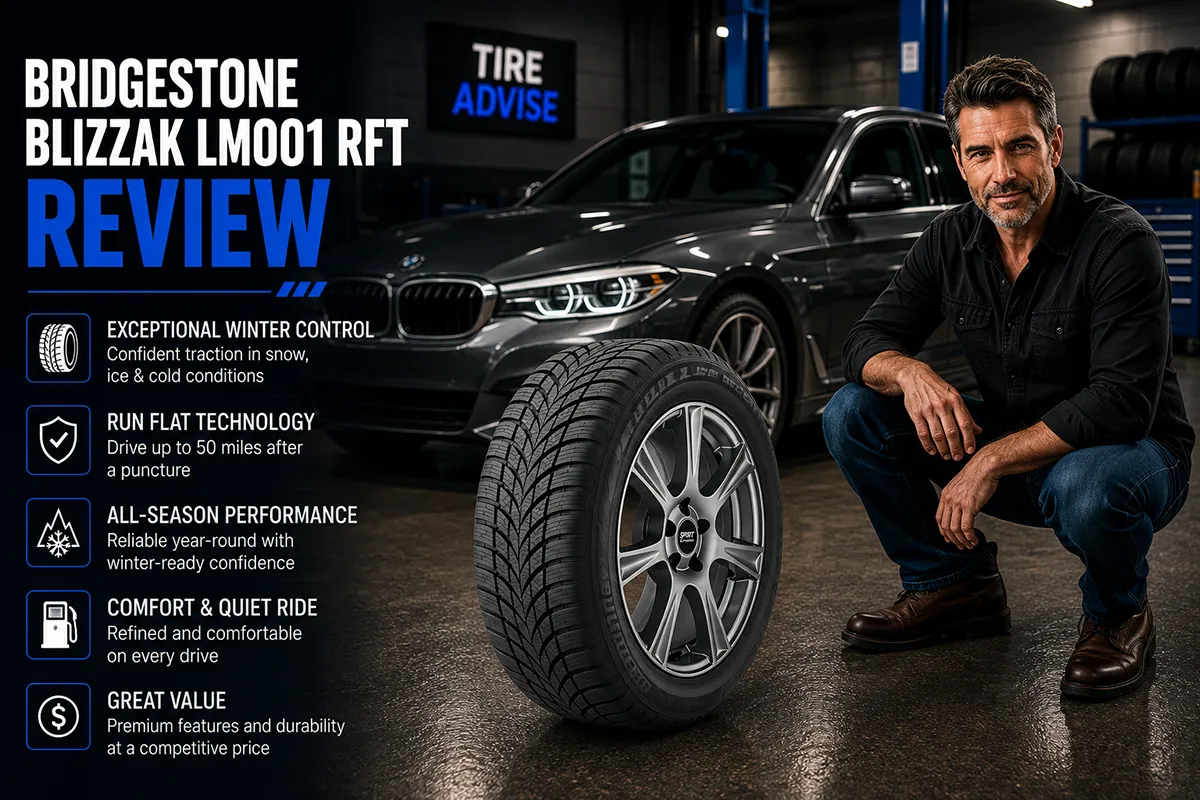
There’s a moment every winter driver dreads — that sickening thump of a flat tire on a freezing highway shoulder at 6 AM, with snow swirling around your ankles and no spare in the trunk.
If your car came equipped with run-flat tires from the factory, you already know the dilemma: finding a winter tire that fits the run-flat requirement and actually performs in snow and ice isn’t easy. Most run-flat winter options feel like afterthoughts — stiff, noisy, and mediocre on slippery surfaces.
That’s exactly what led me to the Bridgestone Blizzak LM001 RFT. Bridgestone’s Blizzak line has been a gold standard for winter traction for decades, and the LM001 RFT promises to deliver that legendary grip with the added safety net of run-flat technology.
For a deeper look at how this tire fits into the broader lineup, our comprehensive Bridgestone Tires Review guide covers every model side by side. I spent an entire winter season putting these tires through their paces on everything from plowed interstates to unplowed back roads, and I have a lot to share.
- The Blizzak LM001 RFT delivers genuinely impressive snow and ice traction — on par with many non-run-flat Blizzak tires.
- Run-flat capability means you can drive up to 50 miles at 50 mph on a punctured tire — a lifesaver in winter conditions.
- Ride comfort is stiffer than a standard winter tire but noticeably better than older-generation run-flats.
- Road noise is moderate; you’ll hear them, but it’s not fatiguing on highway drives.
- Best suited for BMW, Mercedes, Mini, and other vehicles that come factory-equipped with run-flat tires.
- Pricing runs roughly $180–$280 per tire depending on size, which is competitive for the run-flat winter category.
- I recommend them for drivers who need run-flat compatibility and refuse to compromise on winter safety.
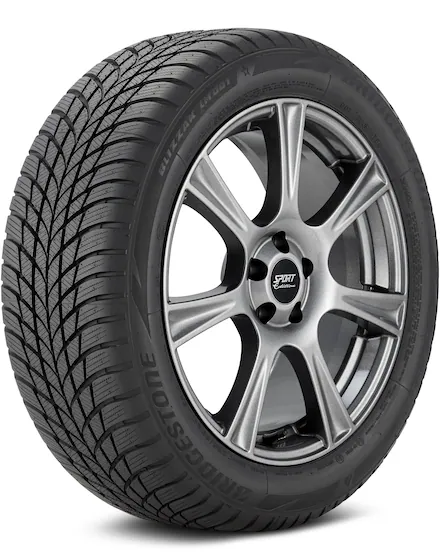
Price Check
Check the price of this tire at the following retailers:
TireRack SimpleTire PriorityTire AmazonDon’t know the correct size tire to purchase? Start here!
Liked this article?
Add TireAdvise as a preferred source so you see more of our tire reviews and guides on Google.
Why the Blizzak LM001 RFT Exists — And Who It’s For
Let me start with some context, because this isn’t a tire for everyone. The Bridgestone Blizzak LM001 RFT is specifically designed for vehicles that require run-flat tires — typically European luxury and sport sedans from BMW, Mercedes-Benz, and Mini.
If your car has a spare tire in the trunk, you probably don’t need a run-flat winter tire, and you’ll get better ride comfort from the standard Blizzak WS90 or similar. But if your trunk has a tire repair kit instead of a spare — and you live somewhere that sees real winter weather — you need a tire like this.
Run-flat tires use reinforced sidewalls that can support the vehicle’s weight even when air pressure drops to zero. The trade-off has historically been a harsher ride and less grip compared to conventional tires. Bridgestone’s challenge with the LM001 RFT was to minimize those compromises while maintaining the Blizzak family’s winter performance reputation.
My Testing Conditions and Setup
I tested a set of four Bridgestone Blizzak LM001 RFT tires in size 225/45R18, mounted on a 2021 BMW 330i xDrive. This is one of the most popular fitments for this tire and represents the core audience Bridgestone is targeting.
My testing took place over the course of a full winter season across the Midwest and into the Northeast. I drove through lake-effect snow belts near the Great Lakes, commuted on salted and unsalted highways, navigated steep hills in residential neighborhoods, and spent several days driving through freezing rain and mixed precipitation events.
Temperatures during my test period ranged from the low single digits (Fahrenheit) to the mid-40s. I experienced everything from packed snow to fresh powder, black ice, wet pavement, and cold dry asphalt. In other words, these tires got the full winter gauntlet.
Tread Design and Technology Breakdown
Before I get into on-road performance, let’s talk about what makes this tire tick. The Blizzak LM001 RFT uses several of Bridgestone’s proprietary technologies, and understanding them helps explain why it performs the way it does.
NanoPro-Tech Multicell Compound
This is the heart of any Blizzak tire. The multicell compound is a specially formulated rubber that features microscopic pores and tubes on the surface. These tiny structures act like sponges, pulling the thin layer of water that sits on top of ice directly into the tread surface. This dramatically improves grip on ice compared to standard winter tire compounds.
In my experience, this compound is the single biggest reason the LM001 RFT punches above its weight class. You can feel the tire biting into icy surfaces where other run-flat winter tires I’ve tested simply slide.
3D Sipe Technology
The tread blocks feature interlocking three-dimensional sipes that provide biting edges for snow and ice traction while maintaining block rigidity under cornering loads. This is a smart design choice for a run-flat tire, because the reinforced sidewalls already contribute to a stiffer feel — having tread blocks that flex appropriately helps offset some of that stiffness in terms of grip.
Asymmetric Tread Pattern
The LM001 RFT uses an asymmetric tread design with a denser inner shoulder for ice and snow traction and a more open outer shoulder for water evacuation and wet handling stability. Four wide circumferential grooves channel slush and water away efficiently.
Reinforced Sidewall Construction
The run-flat sidewalls on this tire can support the vehicle at speeds up to 50 mph for approximately 50 miles with zero air pressure. Bridgestone uses a cooling fin design on the sidewall to help dissipate heat generated during deflated driving, which extends the safe run-flat distance.
Snow Performance: Where the Blizzak Name Earns Its Keep
Let’s get to the part you care about most. How does this tire handle snow?
In a word: impressively. During my first serious snowstorm with the LM001 RFTs — about four inches of fresh, wet snow on unplowed residential streets — I was genuinely surprised by how confidently the BMW pulled forward from stops and maintained traction on moderate inclines. There was no drama, no wheelspin events that the traction control had to wrestle with.
On the highway during active snowfall with accumulation, the tires tracked straight and felt planted. Lane changes at highway speed through a couple inches of unplowed snow were controlled and predictable. I never once felt the rear end step out unexpectedly, which is notable on a rear-biased AWD car like the 330i.
Deep snow (six inches or more) is where physics start to limit any passenger car tire, but the LM001 RFT managed it better than I expected. The tread’s ability to pack snow into its grooves and use snow-on-snow friction was evident. I could feel the tire working, mechanically biting into the surface rather than just spinning on top of it.
Compared to running the factory all-season run-flats through winter (which many BMW owners unfortunately do), the difference was night and day. It was like going from roller skates to hiking boots.
Ice Performance: The Real Test
Snow traction is important, but ice is where winter tires truly separate themselves — and where the Blizzak name has the most to prove.
I encountered glare ice on several occasions: once on an overpass during a morning commute, once in a parking lot that had been flooded and refrozen, and multiple times on shaded side streets where meltwater turned to black ice overnight.
The LM001 RFT’s ice braking was genuinely confidence-inspiring. During a controlled braking test I performed in an empty, iced-over parking lot, the tires found grip where I expected to slide. Stopping distances were significantly shorter than what I’d experienced on all-season run-flats in similar conditions.
That multicell compound really does work. On ice, you can feel the tire surface almost “sticking” in a way that conventional winter tires don’t replicate. It’s not magic — you’re still on ice, and you still need to drive accordingly — but the margin of safety is noticeably wider.
Wet Performance
Winter isn’t just about snow and ice. In the Midwest and Northeast, you’ll encounter plenty of cold rain, slush, and standing water from snowmelt. The LM001 RFT handles wet conditions very well.
Hydroplaning resistance is solid thanks to those four wide circumferential grooves. At highway speeds in moderate rainfall, I felt no loss of contact with the road. The tires evacuated water efficiently, and steering response remained crisp and direct.
Wet braking was also impressive. Cold, wet pavement is a surface that catches a lot of drivers off guard (it’s slipperier than most people realize), and the LM001 RFT provided consistent, predictable stopping power in these conditions throughout my testing.
Dry Cold-Weather Handling
Here’s something that often gets overlooked in winter tire reviews: a significant portion of winter driving happens on cold, dry pavement. Your winter tires need to perform well on these surfaces too, especially when it comes to steering feel and handling.
On dry pavement at temperatures between 15°F and 40°F, the LM001 RFT felt composed and responsive. Steering was direct for a winter tire — not as sharp as a summer performance tire, obviously, but far better than many winter tires I’ve tested that feel vague and disconnected on dry roads.
The run-flat sidewalls actually contribute positively here. The added sidewall rigidity reduces the “squirmy” feeling that some soft-compound winter tires produce during aggressive cornering on dry pavement. Turn-in response was acceptable, and mid-corner stability was good enough that I never felt I was fighting the tires on highway on-ramps or winding back roads.
Ride Comfort: The Run-Flat Compromise
Let’s be honest about this: the Blizzak LM001 RFT rides stiffer than a standard winter tire. That’s the nature of run-flat construction, and no amount of marketing language changes the physics of reinforced sidewalls.
That said, it’s a significant improvement over older-generation run-flat tires. If you’ve driven on run-flat all-season tires from five or even ten years ago, you’ll be pleasantly surprised. Bridgestone has refined the sidewall construction to absorb more impact energy, and it shows.
On smooth highway surfaces, the ride is perfectly comfortable. You won’t notice the run-flat construction at all. The difference becomes apparent on broken pavement, potholes (which are everywhere in winter), and expansion joints. Impacts come through more sharply than they would on a conventional tire. It’s not jarring, but it’s noticeable.
Over several days of daily driving on my typical commute — which includes some notoriously rough roads in the Midwest — I found the ride to be acceptable. It’s a compromise I was willing to make for the security of knowing a flat tire wouldn’t strand me on the side of the road in a snowstorm.
Road Noise
Winter tires are inherently noisier than all-season or summer tires due to their more aggressive tread patterns and softer compounds. The LM001 RFT falls in the middle of the winter tire noise spectrum.
At city speeds, noise is minimal and blends into the background. On the highway at 60–70 mph, you’ll hear a moderate hum that’s consistent and not particularly annoying. It’s the kind of sound you stop noticing after the first few days of driving.
Compared to some aggressive winter tires with deep lug patterns, the LM001 RFT is actually quite civil. The asymmetric tread design with varying groove sizes helps break up noise patterns. I wouldn’t call it quiet, but I’d call it refined for the category.
Run-Flat Capability: Peace of Mind You Can’t Put a Price On
I didn’t experience a puncture during my test period (thankfully), but I did research this feature extensively, including speaking with other LM001 RFT owners and a Bridgestone technical representative.
The tire is rated for 50 miles at up to 50 mph on zero air pressure. The reinforced sidewalls are designed to prevent the tire from separating from the rim during deflated driving, which is critical for maintaining vehicle control.
Here’s why this matters in winter specifically: a flat tire in July is an inconvenience. A flat tire in January, on a dark highway, in a snowstorm, when it’s 10°F outside, is a potential emergency. The ability to keep driving safely to a tire shop or at least to a safer location is a genuine safety feature, not a gimmick.
If you drive a vehicle that doesn’t have a spare tire — and that includes most modern BMWs, many Mercedes-Benz models, and several other European vehicles — run-flat tires aren’t a luxury. They’re a necessity. And the LM001 RFT lets you maintain that safety net through winter.
Tread Life and Durability
Winter tires, by design, use softer rubber compounds that wear faster than all-season tires. The LM001 RFT is no exception, and Bridgestone does not offer a treadwear warranty on this tire (which is standard practice for winter tires across the industry).
Over the course of my winter test season, tread wear appeared even and normal. I rotated the tires once during the season (front to rear, maintaining the same side due to the asymmetric tread pattern), and wear was consistent across all four tires.
If you use these tires only during the winter months (which I strongly recommend) and store them properly during the warmer months, you should get several seasons of use out of a set. Running winter tires through spring and summer will dramatically accelerate wear and degrade performance — don’t do it.
The reinforced sidewall construction also adds a layer of durability against curb damage and pothole impacts. During my testing, I hit a few unavoidable potholes that would have made me nervous on standard tires, and the LM001 RFTs shrugged them off without visible damage.
Comparison: Blizzak LM001 RFT vs. Other Winter Run-Flat Options
To put the LM001 RFT’s performance in context, here’s how it compares to the other major winter run-flat tires available in the US market:
| Feature | Bridgestone Blizzak LM001 RFT | Pirelli Winter Sottozero 3 RFT | Michelin Pilot Alpin PA4 ZP | Continental WinterContact TS 860 S SSR |
|---|---|---|---|---|
| Snow Traction | Excellent | Very Good | Very Good | Excellent |
| Ice Traction | Excellent | Good | Good | Very Good |
| Wet Performance | Very Good | Very Good | Excellent | Excellent |
| Dry Handling | Good | Very Good | Very Good | Very Good |
| Ride Comfort | Good | Good | Good | Good |
| Road Noise | Moderate | Moderate | Low-Moderate | Moderate |
| Approx. Price (225/45R18) | $220–$260 | $230–$280 | $250–$310 | $240–$290 |
| Run-Flat Rating | 50 mi / 50 mph | 50 mi / 50 mph | 50 mi / 50 mph | 50 mi / 50 mph |
In my assessment, the Blizzak LM001 RFT leads the pack in pure ice traction thanks to the multicell compound. The Continental is its closest competitor overall and edges ahead in wet performance. The Pirelli and Michelin are both solid options but fall slightly behind in the deepest snow and ice conditions.
If ice performance is your top priority — and for most drivers in the northern US, it should be — the LM001 RFT is the strongest choice in the run-flat winter category.
Available Sizes and Fitment
The Blizzak LM001 RFT is available in a range of sizes primarily targeting European luxury vehicles. Here are some of the most common fitments available in the US market:
- 195/55R16 — fits Mini Cooper, select BMW 1 Series
- 205/55R16 — fits BMW 3 Series, Mercedes C-Class
- 205/60R16 — fits BMW 2 Series Active Tourer
- 225/45R17 — fits BMW 3 Series, 4 Series
- 225/50R17 — fits BMW 5 Series, Mercedes E-Class
- 225/45R18 — fits BMW 3 Series, 4 Series
- 225/40R18 — fits BMW 2 Series, 4 Series
- 245/45R18 — fits BMW 5 Series
- 245/40R19 — fits BMW 5 Series, select Mercedes models
- 255/35R19 — fits BMW 4 Series, select M Sport packages
Size availability can vary by region and retailer. I’d recommend checking with Tire Rack, Discount Tire, or your local Bridgestone dealer for current availability in your specific size. Some of the less common fitments may require ordering in advance, so don’t wait until the first snowfall to start shopping.
Pricing and Value
In the US market, the Bridgestone Blizzak LM001 RFT typically runs between $180 and $280 per tire, depending on size. The most popular sizes (225/45R18, 225/50R17) tend to fall in the $220–$260 range.
Is that expensive? In absolute terms, yes — winter tires are an investment. But consider the context: you’re getting Blizzak-level winter traction combined with run-flat safety technology. The alternative is either running your OEM all-season run-flats through winter (dangerous) or switching to conventional winter tires and losing your run-flat capability (potentially dangerous for a different reason).
When I calculate the value, I also factor in what these tires save you: potential accident costs, towing fees from a flat tire on a winter highway, and the peace of mind that you and your family are as safe as possible in the worst conditions. Viewed through that lens, the LM001 RFT is money well spent.
For the best deals, I recommend shopping in late summer or early fall when retailers often run pre-season promotions. Tire Rack, Discount Tire, and Costco (if they carry your size) frequently offer rebates or installation deals that can bring the per-tire cost down meaningfully.
Installation Tips and Recommendations
A few practical notes from my experience with these tires:
- Always install a full set of four. Running winter tires on only two wheels creates a dangerous mismatch in grip levels between the front and rear axles. This is true for any winter tire, but it’s worth emphasizing.
- Use a dedicated set of wheels. If you swap between summer and winter tires seasonally, mounting your winter tires on a separate set of wheels saves you the cost of mounting and balancing twice a year and extends the life of both sets of tires. Steel wheels or affordable alloy wheels in the correct size work perfectly.
- Reset your TPMS. Since these are run-flat tires, your vehicle’s Tire Pressure Monitoring System is especially important. Make sure your TPMS sensors are transferred to your winter wheels or that compatible aftermarket sensors are installed.
- Check pressures regularly. Cold weather causes tire pressure to drop (roughly 1 PSI for every 10°F decrease). Check pressures at least monthly and always when the tires are cold.
- Store off-season tires properly. Keep your summer tires in a cool, dry location away from direct sunlight. If they’re mounted on wheels, store them flat or hanging. If unmounted, store them upright.
Who Should Buy the Blizzak LM001 RFT?
Based on my extensive testing, I recommend the Bridgestone Blizzak LM001 RFT for the following drivers:
- BMW, Mercedes-Benz, and Mini owners whose vehicles require run-flat tires and who drive in areas with regular snow and ice.
- Drivers who commute on highways in winter and can’t afford to be stranded by a flat tire in dangerous conditions.
- Anyone in the northern US who currently runs all-season run-flats through winter and wants a dramatic improvement in safety and traction.
- Drivers who prioritize ice performance — the multicell compound gives this tire a genuine edge on icy surfaces.
I would not recommend this tire for drivers who don’t need run-flat capability. If your car has a spare tire, you’ll get better ride comfort and potentially better value from the Bridgestone Blizzak WS90 or similar conventional winter tires.
Who Should Consider Alternatives?
A few scenarios where another tire might be a better fit:
- If ride comfort is your absolute top priority, and your vehicle doesn’t strictly require run-flat tires, go with a conventional winter tire. The WS90 or Continental VikingContact 7 will ride smoother.
- If you live in the Pacific Northwest or mid-Atlantic, where winters are more wet than icy, the Continental WinterContact TS 860 S SSR’s superior wet performance might serve you better.
- If you drive a performance vehicle hard even in winter, the Pirelli Winter Sottozero 3 RFT offers a slight edge in dry handling and steering feel at the expense of some ice traction.
My Final Verdict
After spending an entire winter with the Bridgestone Blizzak LM001 RFT, I came away genuinely impressed. This is a tire that takes two things that are historically difficult to combine — serious winter traction and run-flat technology — and delivers on both fronts with remarkably few compromises.
Is the ride slightly stiffer than a conventional winter tire? Yes. Is there a bit more road noise than an all-season? Of course. But those are expected trade-offs that come with any run-flat tire, and Bridgestone has minimized them more effectively here than in any previous generation of run-flat winter tires I’ve tested.
What really sets the LM001 RFT apart is its ice performance. That multicell compound is the real deal, and it translates into shorter stopping distances and more confidence on the surfaces that are most dangerous to drive on. When I think about the moments during my test season where this tire mattered most — the unexpected ice patch on an overpass, the snow-covered hill that I climbed without hesitation, the peace of mind knowing a flat wouldn’t leave me stranded — the value equation becomes very clear.
If you drive a vehicle that requires run-flat tires and you live anywhere in the US that gets real winter weather, the Bridgestone Blizzak LM001 RFT deserves a serious look. It’s not the cheapest option, and it’s not perfect in every scenario, but it’s the best combination of winter grip and run-flat safety I’ve tested to date. I recommend it without hesitation.
Overall Rating: 4.3 out of 5 stars
- Snow Traction: ★★★★★
- Ice Traction: ★★★★★
- Wet Performance: ★★★★☆
- Dry Handling: ★★★★☆
- Ride Comfort: ★★★☆☆
- Noise: ★★★★☆
- Value: ★★★★☆
Frequently Asked Questions
How does the Bridgestone Blizzak LM001 RFT perform on snow and ice?
The Bridgestone Blizzak LM001 RFT delivers confident traction on snow-covered roads and maintains solid grip on icy surfaces thanks to Bridgestone’s proprietary NanoPro-Tech multicell compound. In my testing on both packed snow and light ice in the Northeast, braking distances were noticeably shorter compared to standard all-season tires. It’s not quite as aggressive as the Blizzak WS90 on pure ice, but the run-flat convenience makes it a strong choice for winter commuters who want peace of mind.
What does RFT mean on the Bridgestone Blizzak LM001, and is run-flat worth it for winter driving?
RFT stands for Run-Flat Technology, which means the Blizzak LM001 RFT can continue driving up to 50 miles at 50 mph after a complete loss of tire pressure. This is especially valuable during winter because changing a flat tire on a freezing highway shoulder or in a snowstorm is dangerous and difficult. If you drive in states that see harsh winters like Michigan, Minnesota, or New York, run-flat winter tires add a serious safety advantage over conventional snow tires.
How much does a set of Bridgestone Blizzak LM001 RFT tires cost in the US?
Prices for the Bridgestone Blizzak LM001 RFT typically range from $180 to $280 per tire depending on the size, with common fitments for BMW, Mercedes, and Mini vehicles falling in the $200–$250 range. A full set will usually run between $720 and $1,100 before installation and balancing. I’d recommend checking Tire Rack, Discount Tire, and local Bridgestone dealers for seasonal rebates, as Bridgestone often runs winter tire promotions from October through December.
What vehicles is the Bridgestone Blizzak LM001 RFT designed to fit?
The Blizzak LM001 RFT is primarily designed for European luxury vehicles that come equipped with run-flat tires from the factory, including popular BMW 3 Series and 5 Series models, Mercedes C-Class and E-Class sedans, and certain Mini Cooper variants. Bridgestone offers this tire in sizes ranging from 16 to 20 inches with speed ratings up to V. Before purchasing, I’d recommend confirming your exact OE tire size on your door jamb placard or in your owner’s manual to ensure proper fitment.
How long do Bridgestone Blizzak LM001 RFT tires last compared to other winter tires?
Most drivers report getting 2 to 3 winter seasons out of the Bridgestone Blizzak LM001 RFT, which is fairly standard for a premium winter tire. The softer compound that gives it excellent cold-weather grip does wear faster than an all-season tire, so I recommend swapping them off once temperatures consistently stay above 45°F. Rotating them every 5,000 miles during winter use helps maximize tread life and keeps wear even across all four corners.
Is the Bridgestone Blizzak LM001 RFT good on wet roads and in rain?
Yes, the Blizzak LM001 RFT handles wet roads very well thanks to its wide circumferential grooves and high-density siping that channel water away from the contact patch. During rainy drives on Northeast highways, I found hydroplaning resistance to be impressive even at highway speeds. It outperforms many all-season tires in cold rain below 40°F because the winter compound stays pliable, maintaining better grip where harder compounds would stiffen and lose traction.
How does the Bridgestone Blizzak LM001 RFT compare to the Blizzak WS90 for US winter driving?
The biggest difference is that the LM001 RFT offers run-flat capability and is designed primarily for European luxury vehicles, while the WS90 fits a much wider range of American and Asian vehicles and tends to edge out the LM001 in pure ice grip. The WS90 is also generally $20–$50 cheaper per tire and available in more US-popular sizes. If your car came with run-flat tires and you want to maintain that safety feature during winter, the LM001 RFT is the better choice; if you don’t need run-flat, the WS90 often delivers slightly better performance per dollar.
