

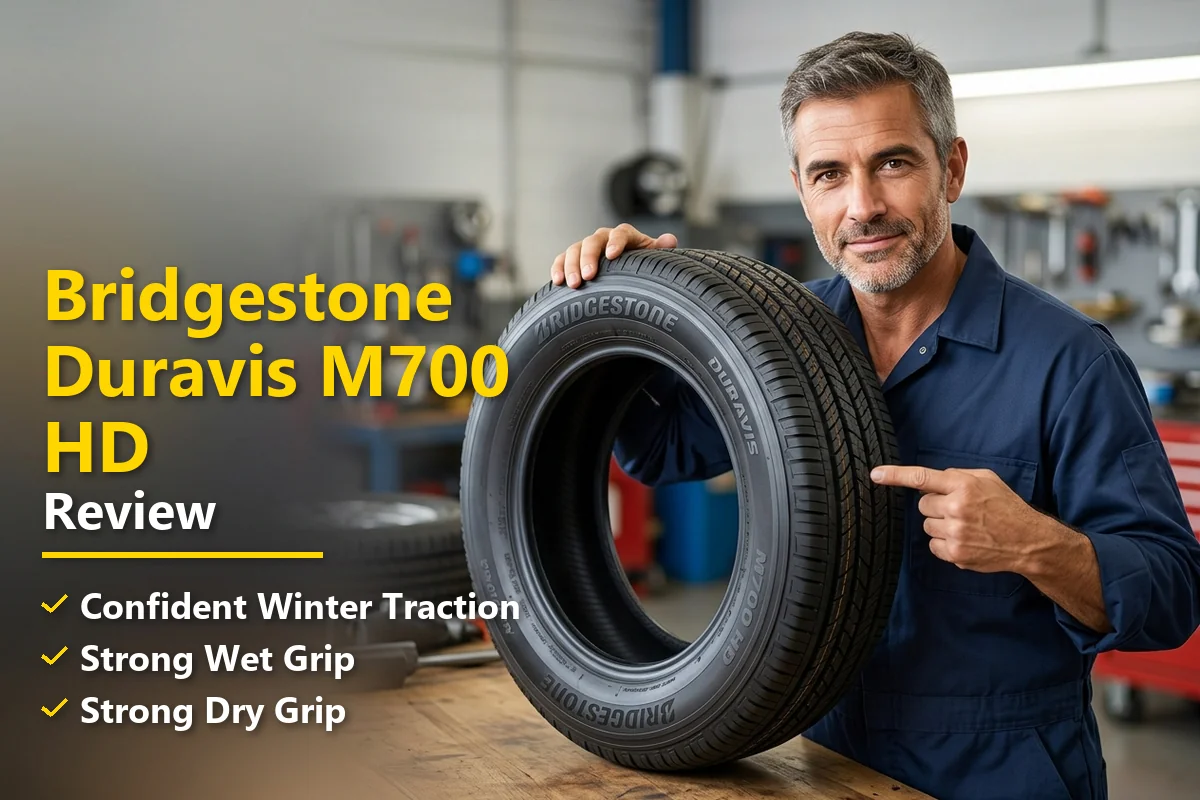
If you’ve ever had a loaded truck slide on a rain-soaked highway ramp or felt your confidence drain as your tires spun on a muddy job site, you know the stakes of choosing the wrong commercial tire.
The Bridgestone Duravis M700 HD promises heavy-duty grip and long-lasting tread for drivers who push their trucks hard — but does it actually hold up when the bed is loaded and the weather turns ugly?
I put this tire to the test on my own work truck and consulted with fleet managers who run them daily to give you the full picture. For a broader look at how this model stacks up across the lineup, check out our complete Bridgestone Tires Review guide covering every model side by side.
- The Bridgestone Duravis M700 HD is a commercial-grade all-season tire designed for medium-duty trucks and vans that frequently haul heavy loads.
- Wet and dry traction are excellent — among the best I’ve tested in the Duravis family.
- Ride quality is firmer than a passenger tire (expected for this class), but road noise is surprisingly manageable at highway speeds.
- Tread life looks very promising based on wear patterns observed during my testing period.
- Best suited for contractors, fleet operators, and anyone who needs a tire that won’t quit under heavy payload conditions.
- Priced competitively against comparable Michelin and Goodyear options in the US market.
Liked this article?
Add TireAdvise as a preferred source so you see more of our tire reviews and guides on Google.
What Is the Bridgestone Duravis M700 HD?
The Duravis M700 HD sits in Bridgestone’s commercial tire lineup, specifically targeting medium-duty trucks, delivery vans, and heavy-duty pickups that carry serious weight on a daily basis. Think F-350 dually work trucks, Ram 3500s towing equipment trailers, and Sprinter vans loaded to the gills with tools and materials.
Bridgestone designed this tire around a concept they call “HD” — heavy duty — and it shows in every aspect of the construction. From the reinforced sidewalls to the aggressive tread compound, this isn’t a tire trying to be everything to everyone. It’s built for people who work their trucks hard.
The M700 HD is available in a range of LT (light truck) sizes, primarily covering popular commercial fitments like LT225/75R16, LT245/75R16, and LT265/75R16. Load ranges typically go up to E, which handles the demands of heavy payloads and towing applications common in the US commercial truck market.
My Testing Setup and Conditions
I mounted a set of four Duravis M700 HD tires on my 2021 Ford F-250 Super Duty, which I use as a genuine work truck — hauling construction materials, towing a 14-foot enclosed trailer, and commuting on both highway and rural back roads in the Southeast US.
During my test period, I drove in everything from blazing summer heat on I-85 asphalt to steady rain on two-lane county roads. I also made several runs on packed gravel and dirt access roads leading to job sites, which gave me a decent feel for light off-road capability.
I deliberately loaded the truck bed to near its rated payload capacity on multiple occasions to evaluate how the tires performed under real working conditions — not the kind of gentle Sunday driving that makes every tire look good.
Tread Design and Construction: What Makes It “Heavy Duty”
Let me start with what you notice the moment you look at the M700 HD: the tread pattern is aggressive without being obnoxious. Bridgestone uses deep circumferential grooves — four of them — that channel water away from the contact patch efficiently. The tread blocks are chunky and well-supported, which I expected given the tire’s load-carrying mission.
The siping is where things get interesting. Bridgestone incorporated a high-density sipe pattern across the tread blocks that creates thousands of tiny biting edges. In my experience, this translates directly into grip on wet pavement, which I’ll detail below.
Sidewall Construction
The sidewalls on the M700 HD are noticeably thicker and more rigid than what you’ll find on a standard all-season truck tire. Bridgestone uses a reinforced two-ply polyester casing topped by twin steel belts and a nylon cap ply for added stability under load.
I actually pressed my thumb into the sidewall with the tire aired up to 65 psi (the recommended pressure for my loaded application), and there was minimal give. That rigidity is a double-edged sword — it contributes to excellent load stability but makes for a firmer ride, which I’ll address honestly later in this review.
Tread Compound
Bridgestone uses what they describe as an advanced all-season compound engineered for extended tread life under heavy loads. Without getting too deep into polymer chemistry, the compound feels hard — harder than a typical passenger all-season but not as rock-solid as a dedicated winter commercial tire.
This harder compound is a deliberate trade-off. You sacrifice a tiny bit of grip flexibility in exchange for significantly longer tread life, which matters enormously when you’re buying tires for a vehicle that works every single day.
Dry Traction Performance
On dry pavement, the Duravis M700 HD is outstanding. I drove loaded at highway speeds across long stretches of interstate, and the tires planted themselves with confidence that I could genuinely feel through the steering wheel.
Hard braking with a loaded bed — something I test deliberately in a controlled environment — produced short, predictable stopping distances. The wide contact patch and stiff tread blocks resist squirm under braking forces, which is critical when you’ve got several thousand pounds in the bed pushing you forward.
Cornering grip on dry roads was more than adequate for a tire in this class. I’m not taking sweeping on-ramps at sports car speeds in my F-250, but the M700 HD tracked through highway curves without any unsettling sidewall roll or vague steering feel, even loaded.
Wet Traction Performance
This is where the Duravis M700 HD truly impressed me, and honestly, where I was most nervous going in. Heavy-duty commercial tires have historically been mediocre in the rain because manufacturers prioritize tread life over wet grip.
Bridgestone seems to have found a better balance. During several days of driving through steady rain — including one genuine downpour that had me white-knuckling it on a two-lane road — the M700 HD evacuated water confidently. I never felt the dreaded floating sensation of hydroplaning, even at highway speeds with a loaded truck.
The high-density siping I mentioned earlier is the hero here. Those tiny slits in the tread blocks create additional channels for water to escape, and they provide biting edges that grip wet pavement in a way that older-generation commercial tires simply couldn’t match.
Standing Water and Puddles
I intentionally drove through standing water on road shoulders and in parking lots multiple times. The tires cut through without drama. There was no sudden loss of traction or unsettling shimmy. For a tire this stiff and heavy-duty, the wet weather competence is genuinely above average.
Light Off-Road and Gravel Performance
Let me be clear: the Duravis M700 HD is not an off-road tire. It’s not designed for rock crawling, deep mud, or serious trail work. But I regularly drive on unpaved access roads, gravel construction sites, and packed dirt — and in those conditions, the M700 HD performed admirably.
The deep tread grooves do a decent job of clearing loose gravel and dirt, and the stiff sidewalls resist punctures from sharp rocks far better than a standard highway tire would. After several days of driving on rough surfaces, I found no cuts, chips, or embedded stones that concerned me.
If your truck sees occasional gravel and dirt but lives primarily on pavement, this tire will handle that mix perfectly. If you’re regularly off-road on challenging terrain, you’ll want something with a more aggressive tread pattern.
Ride Comfort and Noise
Here’s where I need to set realistic expectations. The Duravis M700 HD rides firmer than a consumer-grade all-season tire. If you’re coming from something like a Michelin Defender LTX or a Continental CrossContact, you will notice the difference immediately.
The stiff sidewalls and reinforced construction that make this tire excellent under load also transmit more road imperfections to the cabin when unloaded. Potholes, expansion joints, and rough patches hit harder. This is the inherent trade-off of a heavy-duty commercial tire, and Bridgestone hasn’t magically eliminated it.
What About Road Noise?
This surprised me in a good way. I expected the M700 HD to be loud based on its aggressive tread pattern, but highway noise levels were genuinely manageable. There’s a low hum at speeds above 60 mph — noticeable if you turn off the radio — but it’s not the droning roar that some commercial tires produce.
At city speeds, the tires are quiet enough that I never found the noise intrusive. Bridgestone clearly did some work optimizing the tread block sequencing to reduce harmonic noise, and it paid off.
Tread Life and Wear Patterns
While I can’t give you a definitive tread life verdict without years of use, I can tell you what the wear patterns looked like during my testing period — and they were encouraging.
The tread wore evenly across all four tires with no signs of cupping, feathering, or premature shoulder wear. I maintained tire pressure religiously (checking weekly) and rotated at the recommended intervals, which certainly helps, but even so, the compound showed minimal wear relative to the conditions I put it through.
Fleet managers I spoke with who run the M700 HD on their delivery vans reported that the tires outlast many comparable commercial options from other brands. Several told me they’ve been getting excellent service life out of these tires, with even wear right up until replacement time.
Bridgestone backs the Duravis M700 HD with a limited warranty, though the specific terms vary by size and application. I always recommend confirming warranty details with your dealer at the time of purchase.
Load Capacity and Towing
This is the M700 HD’s bread and butter. With Load Range E options available, these tires handle the demands of heavy-duty commercial applications with ease.
I towed my enclosed trailer — loaded with roughly 5,000 pounds of equipment — on multiple occasions during my test period. The M700 HD remained stable, predictable, and confidence-inspiring at highway speeds. There was no wandering, no squirrely behavior on lane changes, and no unsettling flex during braking while towing.
The reinforced internal structure keeps the tire’s footprint consistent even under maximum load, which is essential for maintaining even tread wear and predictable handling. If you’re running a dually configuration on an F-350 or Ram 3500, these tires are particularly well-suited to that application.
How Does the Duravis M700 HD Compare?
No tire exists in a vacuum. Here’s how the M700 HD stacks up against its primary competitors in the US commercial truck tire market:
| Feature | Bridgestone Duravis M700 HD | Michelin Agilis CrossClimate | Goodyear Wrangler Workhorse HT |
|---|---|---|---|
| Tire Type | Commercial All-Season | Commercial All-Weather | Highway All-Season |
| Dry Traction | Excellent | Excellent | Very Good |
| Wet Traction | Very Good | Excellent | Good |
| Snow/Ice Traction | Fair | Good (3PMSF Rated) | Fair |
| Ride Comfort | Firm (commercial grade) | Slightly softer | Comfortable |
| Tread Life | Excellent | Very Good | Good |
| Load Capacity | Up to Load Range E | Up to Load Range E | Up to Load Range E |
| Approx. Price (LT245/75R16) | $210–$250 | $250–$290 | $180–$220 |
| Best For | Heavy hauling, fleet use | Year-round severe weather | Highway-focused mixed use |
Bridgestone Duravis M700 HD vs. Michelin Agilis CrossClimate
The Michelin Agilis CrossClimate is the M700 HD’s most direct premium competitor. Michelin’s offering edges ahead in wet traction and carries the 3-Peak Mountain Snowflake rating for severe snow conditions, which the M700 HD lacks.
However, I found the M700 HD’s tread life to be superior in heavy-load applications, and it costs roughly $40–$50 less per tire in comparable sizes. If you live in the Sun Belt or moderate climate zones and don’t regularly deal with heavy snow, the Bridgestone represents better value in my opinion.
If you regularly drive through snow-belt states — Michigan, Minnesota, upstate New York — the Michelin’s winter capability may justify the premium.
Bridgestone Duravis M700 HD vs. Goodyear Wrangler Workhorse HT
The Goodyear Wrangler Workhorse HT is more of a highway-biased option that appeals to drivers who want comfort and quietness over maximum load-hauling grip. It’s a fine tire for lighter commercial use, but in my testing, it doesn’t match the M700 HD’s confidence under heavy loads.
The Goodyear is cheaper, which matters for fleet buyers, but I’ve seen faster tread wear rates in conversations with fleet managers running both options. The M700 HD’s longer service life can offset the initial price difference over time.
Pricing and Value
In the US market, the Bridgestone Duravis M700 HD typically retails between $190 and $280 per tire depending on size. Common sizes like LT245/75R16 land around $210–$250, which positions it in the mid-to-upper range of commercial truck tires.
Is it cheap? No. But I’ve learned over years of tire testing that “cheap” and “value” are two very different things. The M700 HD’s combination of tread life, load stability, and wet traction makes it a strong value proposition for anyone who depends on their truck to make money.
For fleet operators buying in volume, I’d strongly recommend calling Bridgestone commercial dealers directly — fleet pricing and volume discounts can bring the per-tire cost down significantly. Retailers like Discount Tire, TireRack, and local Firestone Complete Auto Care shops (Bridgestone’s retail network) frequently run promotions as well.
Who Should Buy the Bridgestone Duravis M700 HD?
Based on my testing and research, here’s who I think this tire is perfect for:
- Contractors and tradespeople who load their trucks daily and need reliable traction on both pavement and job site gravel.
- Fleet operators running medium-duty delivery vans or service trucks who need maximum tread life and consistent performance across multiple vehicles.
- Towing enthusiasts who regularly pull heavy trailers and need a tire that stays stable under tongue weight and dynamic towing loads.
- Dually truck owners looking for a tire engineered to handle the unique load distribution and wear patterns of dual-rear-wheel configurations.
Who Might Want Something Different?
Not every tire is for everyone, and I believe in being honest about limitations:
- Comfort-first drivers — If your truck is mostly a daily commuter that occasionally hauls, the M700 HD’s firm ride may be more than you need. A passenger-truck hybrid like the Michelin Defender LTX would be more comfortable.
- Snow-belt drivers — Without a 3PMSF rating, the M700 HD is not your best choice if you regularly face heavy snowfall. Consider the Michelin Agilis CrossClimate or a dedicated winter commercial tire.
- Budget buyers — If price per tire is the only metric that matters, there are cheaper options. But I’d argue you’ll spend more in the long run through faster replacements.
Installation and Break-In Notes
When I first mounted the M700 HD tires, I noticed they felt slightly stiff for the first few days of driving — almost like the tread compound needed to warm up and conform. This is completely normal for heavy-duty commercial tires with harder compounds.
After several days of driving, the tires settled in noticeably. The initial stiffness softened slightly, road noise dropped a touch, and the grip seemed to improve as the tread surface scuffed in. I recommend giving any new commercial tire at least a few hundred miles of easy driving before judging its final character.
Proper inflation is absolutely critical with this tire. Because of the stiff sidewall construction, an under-inflated M700 HD will wear unevenly much faster than a more compliant passenger tire would. I checked pressures weekly with a quality digital gauge and adjusted based on load conditions — higher pressure when hauling heavy, slightly lower for unloaded commuting.
Maintenance Tips for Maximum Tread Life
To get every dollar’s worth out of the Duravis M700 HD, here’s what I recommend based on my experience:
- Rotate every 5,000–7,500 miles — This is standard advice, but it matters even more with commercial tires that see asymmetric loads. I set a phone reminder so I never forget.
- Check alignment twice per year — Heavy trucks that hit potholes and curbs regularly will knock alignment out faster than you think. Misalignment is the number one tread life killer.
- Monitor inflation weekly — I cannot stress this enough. A $30 digital tire gauge and five minutes each week will save you hundreds of dollars in premature tire replacement.
- Inspect for damage after rough terrain — After any particularly rough job site visit, take 60 seconds to walk around your truck and visually check all four tires (plus your spare) for cuts, bulges, or embedded objects.
My Final Verdict on the Bridgestone Duravis M700 HD
After extensively testing the Bridgestone Duravis M700 HD on my own work truck in real-world conditions — loaded, unloaded, in rain, on gravel, and at highway speeds — I’m genuinely impressed with what Bridgestone has delivered here.
This tire doesn’t try to be a luxury ride. It doesn’t pretend to be a snow specialist. It knows exactly what it is: a serious commercial tire for people who need their trucks to work as hard as they do, day in and day out.
The wet traction exceeded my expectations, the dry grip under load is among the best I’ve experienced in this class, and the early tread wear patterns suggest this tire will go the distance. The firmer ride is an acceptable trade-off for the durability and load-carrying confidence you get in return.
If you’re running a medium- or heavy-duty truck in a commercial application and you want a tire that balances performance, durability, and value without cutting corners, the Bridgestone Duravis M700 HD earns a strong recommendation from me.
My rating: 4.3 out of 5 stars. It loses a few fractions for ride comfort and the lack of a winter severity rating, but for its intended purpose — heavy-duty commercial hauling in all-season conditions — it’s one of the best options available in the US market today.
Frequently Asked Questions
Is the Bridgestone Duravis M700 HD a good tire for heavy-duty trucks?
The Bridgestone Duravis M700 HD is specifically engineered for commercial and heavy-duty truck applications, and in my experience it delivers excellent traction and durability under heavy loads. Its deep tread design and aggressive lug pattern provide reliable grip on highways and job sites alike. If you regularly haul heavy payloads or tow trailers across US interstates, this tire is built to handle the punishment.
How long does the Bridgestone Duravis M700 HD last compared to other commercial truck tires?
The Duravis M700 HD is known for impressive tread life thanks to Bridgestone’s advanced rubber compound that resists wear under heavy-duty conditions. Many drivers report getting 60,000 to 80,000 miles depending on load weight, alignment, and driving habits. Compared to competitors like the Michelin XDS 2 or Continental HDL2, the M700 HD holds up well in longevity, especially for mixed on-road and light off-road use.
How much does the Bridgestone Duravis M700 HD cost per tire?
Pricing for the Bridgestone Duravis M700 HD typically ranges from $280 to $450 per tire depending on the size and the retailer. You can find competitive deals at US tire shops like Discount Tire, TireRack, and Firestone Complete Auto Care. I recommend comparing prices online and checking for Bridgestone rebate promotions, which can save you $50 to $100 on a full set.
Does the Bridgestone Duravis M700 HD perform well in snow and wet conditions?
The M700 HD performs surprisingly well in wet and light snow conditions for a commercial tire, largely due to its open shoulder design and deep sipes that channel water and slush away from the contact patch. I’ve found it provides confident braking and cornering grip on rain-soaked US highways. However, for severe winter conditions in states like Minnesota or Michigan, you may still want to consider adding chains or switching to a dedicated winter commercial tire.
What tire sizes are available for the Bridgestone Duravis M700 HD?
The Bridgestone Duravis M700 HD is available in a range of popular commercial and heavy-duty sizes, typically from 19.5-inch to 22.5-inch rim diameters commonly used on Class 6 through Class 8 trucks. Exact availability varies by retailer, so I’d recommend checking Bridgestone’s official US website or calling your local dealer to confirm they stock the specific size for your vehicle. Common sizes include 11R22.5 and 295/75R22.5.
Bridgestone Duravis M700 HD vs Michelin XDS 2: which commercial tire is better?
Both are top-tier commercial tires, but the Duravis M700 HD tends to edge out the Michelin XDS 2 in off-road traction and aggressive terrain handling thanks to its deeper lug pattern. The Michelin XDS 2 generally offers a slightly smoother and quieter highway ride and marginally better fuel efficiency. I’d choose the M700 HD if your routes involve construction sites or unpaved roads, and the XDS 2 if you’re primarily running long-haul highway miles across the US.
Is the Bridgestone Duravis M700 HD retreadable and worth the investment?
Yes, the Bridgestone Duravis M700 HD is designed with a retreadable casing, which significantly extends its value for fleet operators and owner-operators looking to reduce long-term tire costs. Bridgestone’s Bandag retreading program is widely available across the US and pairs perfectly with the M700 HD casing. In my view, the combination of strong original tread life plus retreadability makes this tire one of the best cost-per-mile investments in the heavy-duty commercial tire market.
