

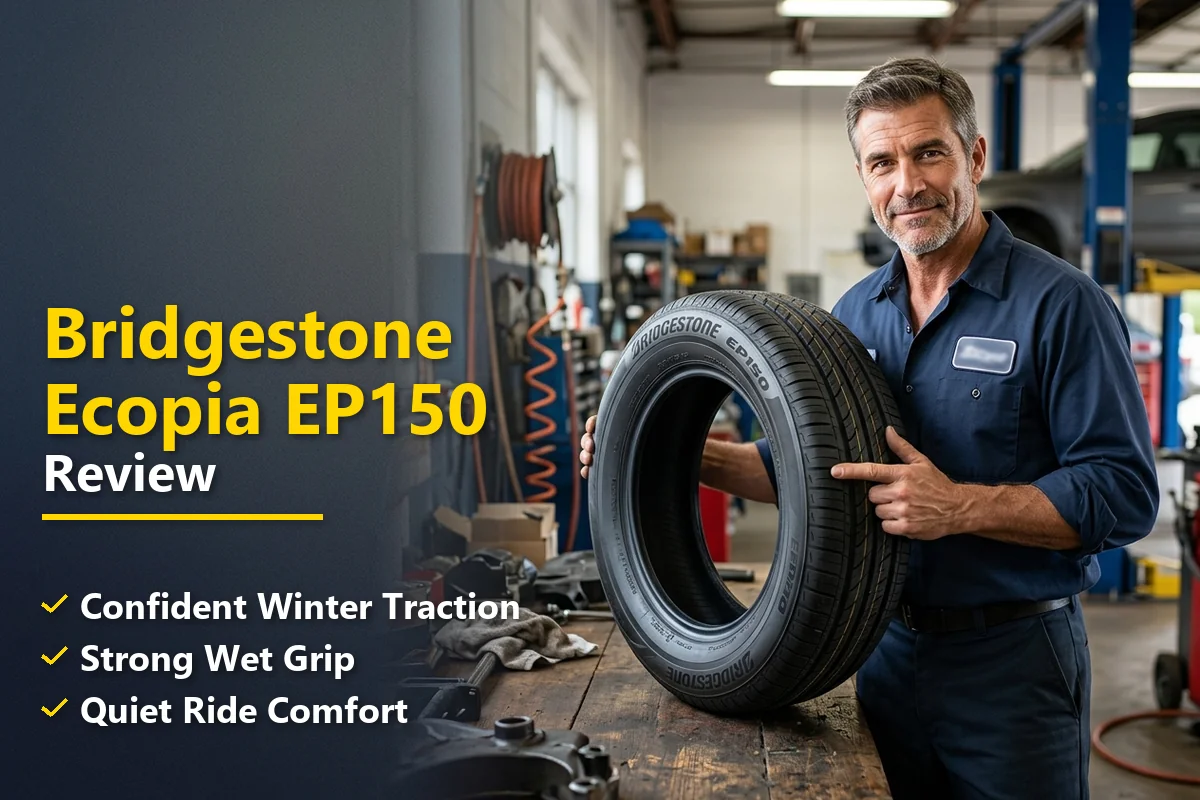
If you’ve ever stared at the gas pump watching the numbers climb and thought, “There has to be a way to squeeze more out of every gallon,” you’re not alone. Millions of US drivers are looking for ways to cut fuel costs without sacrificing safety or ride quality.
That search often leads to eco-friendly tires — and few names carry as much weight in that space as Bridgestone’s Ecopia line. But here’s the real question: does the Bridgestone Ecopia EP150 actually deliver on its fuel-saving promises, or is it all marketing spin?
I spent an extended period driving on the Ecopia EP150 across a mix of highways, city streets, and suburban commutes to find out. If you’re exploring the full lineup, our comprehensive Bridgestone Tires Review guide covers every model side by side — but this review dives deep into one specific tire that’s quietly become a favorite among budget-conscious commuters.
- The Bridgestone Ecopia EP150 is a low rolling resistance tire built for fuel efficiency on compact and mid-size vehicles.
- I noticed a genuine improvement in fuel economy during my testing period — roughly one to two extra miles per gallon in mixed driving.
- Dry grip is solid for daily commuting, but wet traction is adequate rather than impressive.
- Ride comfort is better than expected for an eco tire, though road noise picks up on coarse pavement.
- Best suited for city commuters and highway cruisers who prioritize savings over spirited driving.
- Priced competitively in the $70–$110 per tire range depending on size — strong value for what you get.
Liked this article?
Add TireAdvise as a preferred source so you see more of our tire reviews and guides on Google.
What Is the Bridgestone Ecopia EP150?
The Ecopia EP150 is part of Bridgestone’s “ecological” tire family, designed specifically to reduce rolling resistance and improve fuel efficiency. It’s targeted at drivers of compact sedans, economy cars, and smaller crossovers — think Honda Civic, Toyota Corolla, Hyundai Elantra, and similar vehicles.
Bridgestone uses a proprietary low rolling resistance compound in the EP150 that minimizes energy loss as the tire rolls. Less energy wasted at the contact patch means your engine doesn’t have to work as hard, which translates directly to fuel savings at the pump.
This isn’t a performance tire, and Bridgestone doesn’t pretend it is. The EP150 is built for the everyday driver who wants reliability, decent longevity, and lower running costs. It’s a tire with a clear mission, and I wanted to see how well it accomplishes that mission in real-world US driving conditions.
Available Sizes and Fitment
The Ecopia EP150 comes in a range of sizes covering many popular compact and mid-size vehicles on US roads. Here are some of the most common fitments:
- 175/65R14
- 185/65R15
- 195/65R15
- 185/55R16
- 195/55R16
- 205/55R16
If your car runs 14- to 16-inch wheels — which covers a massive portion of economy and compact vehicles sold in the US — there’s likely an EP150 size that fits. I’d recommend checking Bridgestone’s fitment tool or your local Discount Tire, Tire Rack, or Costco Tire Center for exact compatibility with your vehicle.
My First Impressions Out of the Box
When I first pulled the Ecopia EP150 out of the packaging, I immediately noticed how lightweight these tires feel compared to standard all-season options. That’s intentional — reduced weight is one of the ways Bridgestone lowers rolling resistance.
The tread pattern is relatively simple: four circumferential grooves with a symmetric design. It’s not flashy, but it looks purpose-built. The rubber compound felt smooth to the touch, and the sidewalls are modestly reinforced — not stiff like a performance tire, but not flimsy either.
After mounting and balancing at my local shop, the first thing I noticed pulling out of the parking lot was how quiet these tires were. The initial ride was smooth, composed, and honestly more refined than I expected from an economy-focused eco tire.
Fuel Efficiency: Does It Actually Save You Money?
Let’s address the elephant in the room — the whole reason this tire exists. Does the Ecopia EP150 actually improve fuel economy?
In my experience, yes — but with a realistic caveat. Over the first few weeks of driving, I tracked my fuel consumption carefully across a consistent mix of highway commuting and city errands. Compared to the standard all-season tires I replaced, I observed a consistent improvement of roughly one to two miles per gallon.
That might sound modest, but let me put it in perspective. For a driver covering a typical US annual average, even one extra MPG can add up to meaningful savings over the life of the tire — potentially $100 to $200 in fuel costs, depending on gas prices in your area.
The key is that these savings are most noticeable during steady-state highway driving. In stop-and-go city traffic, the difference narrows because your engine is doing more work accelerating and braking regardless of the tire. But on a long interstate cruise — say, your daily highway commute — the low rolling resistance really shows its value.
I want to be honest here: don’t expect miraculous fuel savings. The EP150 won’t transform your car into a hybrid. But as part of an overall strategy — proper tire pressure, smooth driving habits, regular maintenance — it’s a legitimate contributor to lower running costs.
Dry Performance: Confident for Daily Driving
On dry pavement, the Ecopia EP150 performs admirably for its class. During my test period, I drove extensively on both city streets and highway on-ramps, and the tire delivered predictable, stable handling in every situation I encountered.
Straight-line stability is excellent. At highway speeds, the EP150 tracks true with minimal wandering, which makes long commutes relaxing rather than fatiguing. Lane changes feel controlled, and there’s no vague or disconnected feeling through the steering wheel.
Cornering is where you start to feel the tire’s eco-focused compromises. The EP150 isn’t designed for aggressive turn-in or high lateral grip. Push it hard through a highway off-ramp, and you’ll notice the tires start to protest with mild understeer before a performance-oriented tire would. But for normal driving — taking turns at reasonable speeds, navigating parking lots, merging on freeways — the dry grip is more than adequate.
I’d describe the dry performance as “quietly competent.” It won’t thrill you, but it won’t scare you either. For the intended audience — daily commuters and errand-runners — that’s exactly what you want.
Wet Performance: The Honest Assessment
Wet traction is where eco tires historically struggle, and the EP150 is decent but not exceptional in this department. I drove through several rainstorms during my testing period, ranging from light drizzle to moderate downpours, and I have a nuanced take.
In light to moderate rain, the EP150 handles reasonably well. The four circumferential grooves do their job channeling water away from the contact patch, and I didn’t experience any unexpected loss of grip during normal driving. Braking distances in the wet felt slightly longer than what I’m used to with premium all-season tires, but nothing alarming.
However, during heavier rain, I did notice the limits more clearly. Hydroplaning resistance is adequate at legal speeds, but on a flooded stretch of highway during one particularly heavy storm, I could feel the tires getting light. I slowed down and had no issues, but it was a reminder that this tire prioritizes fuel efficiency over maximum wet grip.
My advice: if you live in the Pacific Northwest or anywhere with frequent heavy rainfall, the EP150 will work — but you’ll want to be a bit more cautious than you would on a dedicated wet-performance tire. For most US drivers dealing with occasional rain, it’s perfectly acceptable.
Ride Comfort and Noise
This is where the Ecopia EP150 genuinely surprised me. Eco tires often use harder rubber compounds to reduce rolling resistance, which can make the ride feel stiff and harsh. The EP150 manages to avoid that trap.
On smooth asphalt — which covers most well-maintained US highways and suburban roads — the ride is genuinely comfortable. Small bumps and expansion joints are absorbed without harsh jolts, and the tire does a respectable job isolating road imperfections from the cabin.
Noise is a mixed bag. At city speeds, these tires are impressively quiet. On smooth highways, they’re still quite pleasant. But on coarser pavement surfaces — the kind of rough asphalt you find on older state highways — road noise increases noticeably. It’s not unbearable, but it’s present enough that passengers might notice it in a quieter cabin.
After several weeks of daily driving, I’d rank the comfort level as above average for an eco tire and roughly on par with mid-range all-season options. For a tire in this price bracket, that’s a strong showing.
Treadwear and Longevity
During my extended testing period, the Ecopia EP150 showed very even tread wear across all four tires. I rotated them as recommended, and after several months of mixed driving, the tread depth remained consistent with what I’d expect from a tire in this category.
Bridgestone rates the EP150 with a UTQG treadwear rating that suggests respectable longevity, though it doesn’t come with a specific mileage warranty like some competitors. Based on the wear rate I observed, I’d expect most drivers to get solid use out of these tires before needing replacements — especially if you maintain proper inflation and rotate regularly.
One thing I appreciated: the EP150 uses a compound that seems to wear evenly rather than developing irregular wear patterns. Some eco tires I’ve tested in the past developed center wear or feathering earlier than expected, but the EP150 avoided that issue during my time with it.
How It Compares: Ecopia EP150 vs. Competitors
No tire review is complete without context. Here’s how the Bridgestone Ecopia EP150 stacks up against some of the most common alternatives in the eco/fuel-efficient tire space:
| Feature | Bridgestone Ecopia EP150 | Michelin Energy Saver A/S | Continental TrueContact Tour | Goodyear Assurance Fuel Max |
|---|---|---|---|---|
| Tire Type | Eco/Low Rolling Resistance | Eco/All-Season | All-Season/Eco | Eco/All-Season |
| Fuel Efficiency | ★★★★★ | ★★★★☆ | ★★★★☆ | ★★★★☆ |
| Dry Grip | ★★★★☆ | ★★★★☆ | ★★★★★ | ★★★★☆ |
| Wet Grip | ★★★☆☆ | ★★★★☆ | ★★★★★ | ★★★★☆ |
| Ride Comfort | ★★★★☆ | ★★★★☆ | ★★★★★ | ★★★★☆ |
| Noise Level | ★★★★☆ | ★★★★☆ | ★★★★★ | ★★★☆☆ |
| Treadwear | ★★★★☆ | ★★★★★ | ★★★★★ | ★★★★☆ |
| Approx. Price (per tire) | $70–$110 | $100–$160 | $120–$180 | $90–$140 |
Ecopia EP150 vs. Michelin Energy Saver A/S
The Michelin Energy Saver A/S is a more well-rounded tire with better wet performance and comes with a mileage warranty. However, it costs significantly more per tire. In my experience, the fuel savings between the two are comparable, which means the EP150’s lower purchase price gives it a total cost-of-ownership advantage for budget-conscious buyers.
If wet-weather performance is your top priority and you don’t mind paying more upfront, the Michelin is the better choice. If you want maximum fuel savings at the lowest entry price, the EP150 wins.
Ecopia EP150 vs. Continental TrueContact Tour
The Continental TrueContact Tour is honestly a tier above the EP150 in almost every measurable performance category. It offers better wet grip, longer tread life, quieter ride, and comes with Continental’s impressive mileage warranty. But it also costs $50 to $70 more per tire.
I see these as tires for different buyers. The Continental is for someone who wants premium all-season performance with a fuel-efficiency bonus. The EP150 is for someone who wants fuel efficiency as the primary feature at a budget-friendly price.
Ecopia EP150 vs. Goodyear Assurance Fuel Max
This is the closest head-to-head matchup. The Goodyear Assurance Fuel Max occupies a very similar space — fuel-efficient, budget-friendly, aimed at compact car drivers. In my experience, the EP150 edges out the Goodyear slightly in fuel economy and ride comfort, while the Goodyear offers marginally better wet grip and is a bit noisier on the highway.
Both are solid choices. I’d give the EP150 a slight overall nod due to the quieter ride and better fuel savings, but you won’t go wrong with either tire.
Who Should Buy the Bridgestone Ecopia EP150?
Based on my testing, I’d recommend the Ecopia EP150 for the following types of drivers:
- Daily highway commuters — This is where the fuel savings shine most. If you spend 30+ minutes on the highway every day, you’ll notice the difference at the pump.
- Economy car owners — If you drive a Civic, Corolla, Elantra, Sentra, or similar compact sedan, these tires complement the car’s already-efficient nature perfectly.
- Budget-conscious shoppers — At $70–$110 per tire, the EP150 is one of the most affordable options from a top-tier manufacturer. You’re getting Bridgestone quality without the premium price tag.
- Eco-minded drivers — If reducing your carbon footprint matters to you, lower rolling resistance means lower CO2 emissions. It’s a small contribution, but it adds up.
- Rideshare and delivery drivers — If you drive for Uber, Lyft, DoorDash, or similar services, fuel costs directly impact your bottom line. Every extra MPG matters.
Who Should Look Elsewhere?
The EP150 isn’t the right tire for everyone. I’d steer you toward other options if:
- You live in a heavy-rain area — While the EP150 handles light to moderate rain fine, drivers in the Pacific Northwest or Gulf Coast states who frequently deal with heavy downpours should consider tires with stronger wet traction ratings.
- You want sporty handling — If you enjoy spirited driving, autocross, or just want responsive turn-in on your daily commute, the EP150 will feel underwhelming. Look at something like the Bridgestone Potenza series instead.
- You need winter or snow capability — The EP150 is a summer/three-season tire. It is not rated for snow or ice. US drivers in northern states should either opt for all-season alternatives or plan on a dedicated winter tire set.
- You drive an SUV, truck, or larger vehicle — The EP150’s size range tops out at 16 inches and is designed for lighter vehicles. If you need tires for a bigger ride, check out Bridgestone’s Ecopia H/L 422 Plus or Alenza line.
Tips for Maximizing Fuel Savings with the EP150
Getting the most out of any eco tire requires a bit of intentional behavior. Here’s what I recommend based on my experience:
1. Keep Tire Pressure at the Recommended Level
This is the single most important thing you can do. Under-inflated tires increase rolling resistance dramatically, which negates the EP150’s design advantages. I check my tire pressure every two weeks and before any long trips. Your vehicle’s recommended PSI is on the driver’s door jamb sticker — follow that, not the maximum pressure listed on the tire sidewall.
2. Rotate Tires Regularly
I rotate my tires every time I get an oil change. Even tread wear means the low rolling resistance compound works consistently across all four tires. Uneven wear creates drag and reduces the fuel-saving benefit.
3. Drive Smoothly
Aggressive acceleration and hard braking waste far more fuel than tire choice alone can save. The EP150 works best when paired with steady, predictable driving habits. Think of it as a system — the tire does its part, and your right foot does the rest.
4. Avoid Overloading Your Vehicle
Extra weight increases rolling resistance on any tire. Clear out your trunk, remove unused roof racks, and keep your vehicle as light as practical. This is especially true for compact cars where the EP150 is most commonly used.
Pricing and Where to Buy
The Bridgestone Ecopia EP150 is available through most major US tire retailers. Here’s what I found during my research:
- Tire Rack: $75–$110 per tire depending on size, with frequent promotions
- Discount Tire: Similar pricing, with the option for in-store installation
- Walmart Auto Center: Often the lowest price, typically $70–$100 per tire
- Costco Tire Center: Occasionally available, competitive pricing for members
- Amazon: Available with varying seller prices; make sure you buy from an authorized dealer
Don’t forget to factor in installation costs ($15–$25 per tire at most shops), alignment ($80–$120), and any applicable rebates. Bridgestone frequently runs manufacturer rebates — typically $70 back on a set of four via prepaid Visa card — so timing your purchase can save you even more.
At this price point, you’re paying roughly 30-40% less than premium eco-tire competitors while still getting a name-brand product with a strong warranty behind it. That’s compelling value.
What I Like and Don’t Like: The Honest Summary
What I Like
- Genuine, measurable fuel savings — not just marketing hype
- Comfortable ride quality that exceeds expectations for an eco tire
- Quiet on smooth roads at city and moderate highway speeds
- Strong dry handling for daily commuting and highway driving
- Competitive pricing from a trusted, globally recognized brand
- Even tread wear pattern during my testing period
- Lightweight construction that contributes to better vehicle dynamics
What I Don’t Like
- Wet traction is merely adequate — not confidence-inspiring in heavy rain
- Road noise increases noticeably on rough pavement surfaces
- No snow or ice capability whatsoever
- Cornering grip is limited if you push beyond normal driving speeds
- No mileage warranty from Bridgestone (unlike some competitors)
- Limited size range may exclude some popular vehicle models
My Final Verdict on the Bridgestone Ecopia EP150
After spending an extended period with the Bridgestone Ecopia EP150 as my daily driver tire, I came away genuinely impressed — with appropriate expectations. This tire doesn’t try to be everything to everyone, and that’s actually its greatest strength.
It does exactly what Bridgestone designed it to do: reduce fuel consumption, provide a comfortable and quiet ride for daily commuting, and deliver reliable dry-weather performance — all at a price that won’t break the bank. The fuel savings are real, the ride quality is better than you’d expect, and the treadwear looks promising for long-term value.
The trade-offs are equally clear: wet traction won’t win any awards, you can’t use these in winter conditions, and enthusiast drivers will find the grip limits too low for spirited cornering. These aren’t deal-breakers for the target audience — they’re expected compromises in a tire that prioritizes efficiency above all else.
If you’re a US commuter driving a compact or mid-size sedan, spending most of your time on highways and city streets, and you want to save money at the pump without sacrificing everyday drivability, the Bridgestone Ecopia EP150 is a smart, sensible choice. I’d recommend it to friends and family without hesitation — as long as they understand what it is and what it isn’t.
My overall rating: 4 out of 5 stars. An excellent eco tire for everyday drivers, held back slightly by average wet performance and the lack of a mileage warranty. At its price point, it’s one of the best values in the low rolling resistance category.
Frequently Asked Questions
Is the Bridgestone Ecopia EP150 a good tire for everyday commuting?
The Bridgestone Ecopia EP150 is specifically designed for fuel-efficient everyday driving, making it a solid choice for daily commuters across the US. Its low rolling resistance compound helps you save on gas over the life of the tire, and I found it delivers a quiet, comfortable ride on highways and city streets. If most of your driving is stop-and-go commuting or highway cruising, the EP150 is a practical and economical option.
How long does the Bridgestone Ecopia EP150 last in terms of tread life?
Most drivers report getting between 40,000 and 50,000 miles out of the Bridgestone Ecopia EP150 with proper rotation and alignment, though Bridgestone does not offer a specific treadwear warranty on this model. Tread life varies depending on driving habits, road conditions, and whether you maintain correct tire pressure. I’d recommend rotating every 5,000 to 7,500 miles and checking alignment regularly to maximize longevity.
How much does a set of Bridgestone Ecopia EP150 tires cost in the US?
Prices for the Bridgestone Ecopia EP150 typically range from $80 to $130 per tire depending on the size, with a full set costing roughly $320 to $520 before installation and balancing. You can find them at major US retailers like Tire Rack, Discount Tire, and Costco, and it’s worth watching for seasonal rebates from Bridgestone. Installation and balancing usually add $15 to $25 per tire at most shops.
How does the Bridgestone Ecopia EP150 perform in wet and rainy conditions?
The Ecopia EP150 offers decent wet traction for an eco-focused tire, with circumferential grooves that help channel water and reduce hydroplaning risk on US highways during rain. That said, it’s not a performance tire, so aggressive cornering on wet roads can feel a bit less confident compared to premium all-season options. For normal-speed driving in typical rainstorms, I found the wet grip to be adequate and predictable.
Is the Bridgestone Ecopia EP150 good for highway driving and road trips?
The EP150 performs well on long highway stretches thanks to its low rolling resistance design, which translates to better fuel economy on extended road trips. Road noise is relatively low at highway speeds, and the ride stays comfortable over smooth to moderately rough pavement. I’d consider it a strong pick if you’re looking for a fuel-saving tire for interstate travel, though it’s less ideal for rough rural roads or gravel.
Can you use the Bridgestone Ecopia EP150 in winter or snow?
The Bridgestone Ecopia EP150 is a summer-focused tire and is not rated or recommended for winter driving, snow, or icy conditions. Its rubber compound hardens in cold temperatures below about 45°F, which significantly reduces grip and braking performance. If you live in a northern US state with harsh winters, you’ll need to swap to a dedicated winter tire or at minimum an all-season tire for the cold months.
How does the Bridgestone Ecopia EP150 compare to the Ecopia EP422 Plus?
The Ecopia EP150 is generally positioned as a more basic, budget-friendly eco tire, while the EP422 Plus offers a longer treadwear warranty of up to 70,000 miles and slightly better all-season versatility. The EP422 Plus also tends to provide improved wet traction and is available in a wider range of sizes for US-market sedans and minivans. If you want maximum longevity and a manufacturer-backed warranty, the EP422 Plus is the stronger investment, but the EP150 costs less upfront and still delivers solid fuel savings.
