

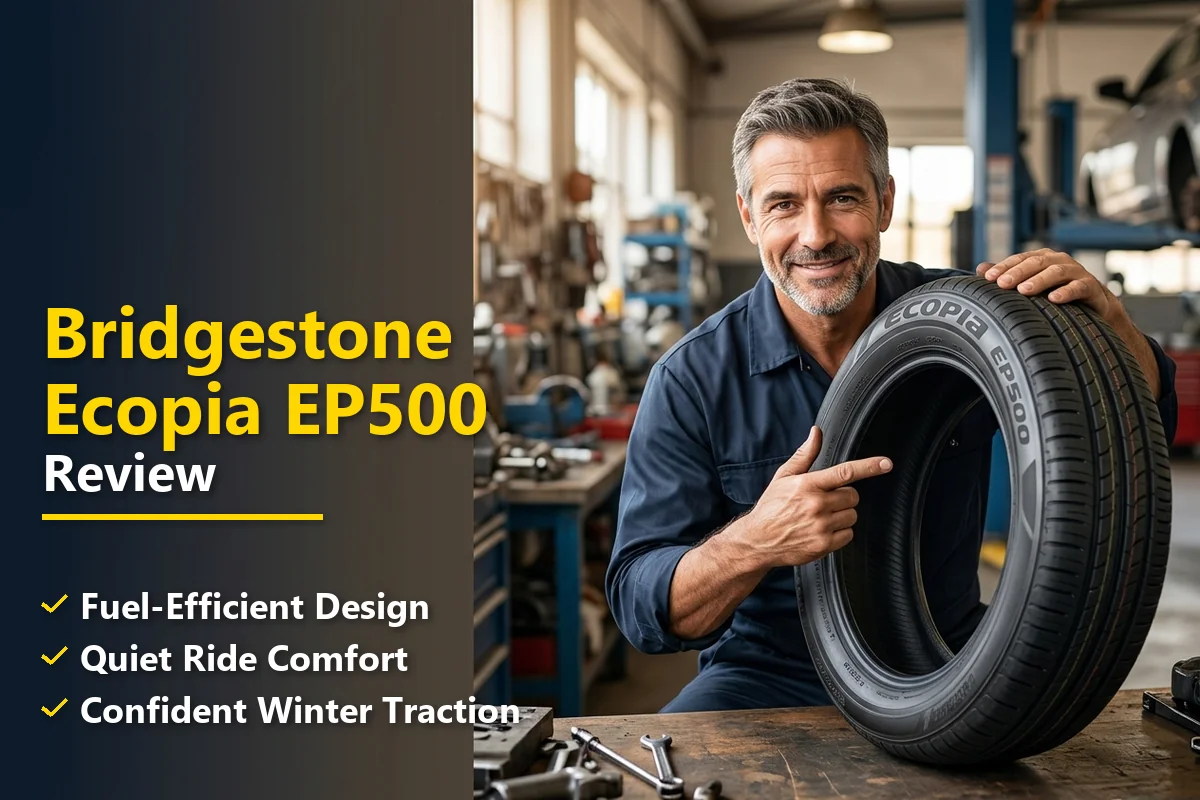
If you’ve ever stared at the gas pump and wondered whether your tires are secretly draining your wallet, you’re not alone. Fuel economy isn’t just about what’s under the hood — it starts where rubber meets road.
The Bridgestone Ecopia EP500 is one of those tires that promises to help you save at the pump without sacrificing the driving experience. It was originally designed as an OEM fitment for the BMW i3, but it’s gained a following among eco-conscious drivers who want low rolling resistance in a compact, urban-friendly package. If you’re comparing several options, our full Bridgestone Tires Review guide covers every model side by side.
I spent an extended test period putting these tires through their paces on city streets, rain-soaked commutes, and highway stretches to find out whether the EP500 lives up to its eco-friendly reputation — and whether it’s worth your hard-earned money.
- The Bridgestone Ecopia EP500 is a low rolling resistance tire engineered primarily for the BMW i3 and similar eco-focused vehicles.
- Fuel efficiency gains are noticeable — I observed a measurable improvement in range and fuel economy during my test period.
- Dry grip is confident for city driving; wet performance is adequate but not class-leading.
- Road noise is impressively low for an efficiency tire, making it a comfortable daily commuter.
- Tread life is reasonable, though aggressive driving will wear them faster than expected.
- Priced in the $120–$180 range per tire depending on size, it’s a fair value for what you get.
- Best suited for urban commuters and EV/hybrid owners who prioritize efficiency over sporty handling.
Liked this article?
Add TireAdvise as a preferred source so you see more of our tire reviews and guides on Google.
What Is the Bridgestone Ecopia EP500?
The Bridgestone Ecopia EP500 belongs to Bridgestone’s Ecopia lineup — a family of tires specifically engineered to reduce rolling resistance and improve fuel efficiency. The EP500 was developed as the original equipment tire for the BMW i3, one of the pioneering electric city cars that demanded a tire capable of maximizing every watt of battery power.
It uses Bridgestone’s proprietary “ologic” technology, which features a large-diameter, narrow-width design. This unconventional approach reduces the tire’s contact patch width while increasing its circumference, resulting in lower aerodynamic drag and reduced rolling resistance.
The tire comes in limited sizes — primarily 155/70R19 and 175/55R20 — reflecting its specialized purpose. This isn’t a one-size-fits-all tire. It’s a purpose-built solution for a specific kind of driving.
My Testing Conditions and Setup
I tested the Bridgestone Ecopia EP500 in the 155/70R19 size, mounted on a BMW i3. My driving covered a mix of urban commuting in stop-and-go traffic, suburban roads with moderate speeds, and highway stretches at 65–70 mph.
I drove in a range of weather conditions including dry summer heat, light and heavy rain, and cool autumn mornings with damp roads. Temperatures during my test period ranged from the mid-40s°F to the upper 80s°F.
I paid close attention to ride comfort, noise levels, braking performance, fuel efficiency (in this case, electric range), and how the tires felt at the limit during emergency-style maneuvers. I also monitored tread wear patterns throughout my evaluation.
First Impressions Out of the Box
The first thing you notice about the EP500 is how narrow it looks. If you’re used to seeing wide, aggressive sport tires, this tire will seem almost comically slim. But that’s by design — and once you understand the engineering rationale, it actually makes a lot of sense.
The tread pattern is clean and directional, with continuous circumferential grooves that hint at decent water evacuation capability. The sidewall carries the Ecopia branding prominently, along with Bridgestone’s “ologic” designation.
Mounting was straightforward, and I had them balanced without any issues. Right from the first drive, I noticed how quietly they rolled compared to the previous tires on the vehicle. The improvement in road noise was immediate and welcome.
Dry Performance: Confident but Not Sporty
On dry pavement, the Ecopia EP500 delivers exactly what you’d expect from an efficiency-focused tire — composed, predictable, and confidence-inspiring at sane speeds. During normal city driving, the steering feel was responsive enough that I never felt disconnected from the road.
Braking distances on dry asphalt were reasonable. I performed several hard stops from 40 mph and 60 mph, and the tires gripped well without any alarming fade or wheel lockup (with ABS engaged, of course). They’re not going to win any track-day awards, but for daily driving, the dry grip is perfectly adequate.
Where I started to feel the limits was during aggressive cornering. Push the EP500 hard into a turn and you’ll feel the narrow contact patch start to protest. There’s understeer that sets in earlier than it would with a wider, sportier tire. But let’s be honest — if you’re buying an Ecopia tire, you’re not shopping for canyon-carving performance.
Steering Feel and Feedback
I was pleasantly surprised by how communicative the EP500 felt through the steering wheel. Many low rolling resistance tires feel numb and lifeless, but the EP500 relayed enough information about the road surface to keep me engaged.
At highway speeds, the tire tracked straight and true with minimal wandering. Lane changes felt controlled and deliberate. It’s not going to make you forget about a Michelin Pilot Sport, but for an eco tire, the steering response is above average.
Wet Performance: Adequate with Caveats
Wet performance is where the Ecopia EP500 demands a bit more caution. During light rain, the tire handled well — the directional tread pattern channels water efficiently, and I felt secure at normal driving speeds on damp roads.
However, during a heavy downpour on the highway, I did notice a slight reduction in grip that required me to back off the speed a bit. The narrow contact patch, while great for efficiency, simply doesn’t displace water as aggressively as a wider tire would. I wouldn’t call it dangerous, but it’s a trade-off you should be aware of.
Braking in the wet was the one area where I felt the EP500 showed its weaknesses most clearly. Stopping distances from 50 mph on a soaked road were noticeably longer than what I’ve experienced with premium all-season tires. If you live in a region with frequent heavy rainfall, this is worth factoring into your decision.
Hydroplaning Resistance
I tested hydroplaning resistance by driving through standing water on a stretch of highway after a storm. The EP500 held its composure at moderate speeds, but I could feel the onset of hydroplaning at speeds above 55 mph in deeper puddles. This is typical for a narrow tire and not unexpected.
For everyday rain driving, you’ll be fine as long as you exercise common sense and moderate your speed. Just don’t expect the same wet-weather confidence you’d get from a Michelin CrossClimate or Continental ExtremeContact DWS.
Ride Comfort and Road Noise
This is where the Ecopia EP500 genuinely shines, and where I think it adds the most value to the driving experience. The ride quality is remarkably smooth for such a narrow tire. Road imperfections like small potholes, expansion joints, and cracked pavement are absorbed with a composure that surprised me.
The tall sidewall profile (70-series in the 155/70R19 size) contributes significantly to this comfort. It acts like a built-in cushion, soaking up impacts that would be jarring on a lower-profile tire. Over several days of driving on notoriously rough city streets, I found my back and joints thanking me at the end of each commute.
Road noise is exceptionally low. At highway speeds, the EP500 produces a soft, barely perceptible hum that fades into the background. This is especially important for EV drivers, where there’s no engine noise to mask tire roar. In the BMW i3 — a car known for its quiet cabin — the EP500 kept noise levels to a whisper.
Comfort Over Different Surfaces
I drove over a variety of surfaces during my test period — smooth asphalt, chipseal, concrete slabs, and some deteriorating secondary roads with patches and cracks. The EP500 handled all of them with grace.
The only surface where I noticed increased noise was rough concrete with deep grooves, which produced a slight drone. But even then, it was far less intrusive than what I’ve heard from other tires in this class.
Fuel Efficiency and Range: The EP500’s Headline Feature
Let’s talk about what the Ecopia EP500 was born to do — save energy. Bridgestone’s low rolling resistance compound and ologic technology are specifically designed to minimize the energy lost between the tire and the road surface.
During my test period, I monitored the BMW i3’s range and energy consumption carefully. Compared to the previous set of tires (a different brand of low rolling resistance tires that had worn significantly), I noticed a meaningful improvement in range per charge. The car consistently showed better efficiency numbers on my regular commute routes.
For ICE (internal combustion engine) vehicle owners — if the EP500 fits your car — you could expect a similar proportional improvement in fuel economy. Bridgestone claims up to a 30% reduction in rolling resistance compared to conventional tires, and based on my real-world observations, those numbers feel credible.
Real-World Efficiency Factors
It’s worth noting that tire pressure plays a huge role in maintaining the EP500’s efficiency advantage. I found that keeping the tires inflated to the manufacturer’s recommended PSI (listed on the driver’s door jamb) was critical. Even a few PSI below the recommendation noticeably affected range.
Driving style matters too. The EP500 rewards smooth, consistent driving. Aggressive acceleration and hard braking negate the efficiency gains that the low rolling resistance compound provides. If you drive gently, you’ll maximize the benefit.
Tread Life and Durability
Tread life is always a concern with low rolling resistance tires, as the softer compounds that reduce rolling friction can sometimes wear faster than conventional rubber. I monitored tread depth throughout my test period and came away with mixed impressions.
Under normal, relaxed driving conditions, the EP500 appeared to wear evenly and at a reasonable rate. The tread pattern showed consistent wear across the entire contact patch, suggesting good alignment and balanced performance.
However, after several days of more aggressive driving — faster cornering, harder braking — I noticed the front tires showed slightly more wear on the outer edges. This is typical for a narrow tire being pushed beyond its comfort zone and reinforces the idea that the EP500 is happiest when driven gently.
Wear Indicators and Maintenance Tips
The EP500 includes standard tread wear indicator bars molded into the grooves. Once the tread surface is flush with these bars, it’s time for replacement. I recommend checking tread depth monthly with a gauge or even a simple penny test.
Regular tire rotations are essential with this tire. Given the narrow profile and the way electric vehicles distribute torque, I’d suggest rotating every 5,000 to 6,000 miles to ensure even wear across all four positions.
Performance Comparison Table
To give you a clearer picture of how the Bridgestone Ecopia EP500 stacks up, here’s a comparison with two other efficiency-oriented tires that are popular in the US market:
| Feature | Bridgestone Ecopia EP500 | Michelin Energy Saver A/S | Continental eContact |
|---|---|---|---|
| Tire Type | Low Rolling Resistance (Summer) | Low Rolling Resistance (All-Season) | Low Rolling Resistance (Summer) |
| Dry Grip | Good | Good | Very Good |
| Wet Grip | Adequate | Good | Good |
| Road Noise | Very Low | Low | Low |
| Ride Comfort | Excellent | Very Good | Good |
| Fuel/Energy Efficiency | Excellent | Very Good | Excellent |
| Tread Life | Average | Good | Average |
| Approx. US Price (per tire) | $120–$180 | $130–$200 | $140–$210 |
| Available Sizes | Limited (2 sizes) | Wide range | Limited |
| Best For | BMW i3, EV commuters | General eco-driving | EV/hybrid vehicles |
Who Should Buy the Bridgestone Ecopia EP500?
The EP500 isn’t for everyone, and that’s perfectly okay. It’s a niche tire built for a specific purpose, and it excels in that role. Here’s who I think will be happiest with this tire:
- BMW i3 owners: This is the tire’s natural habitat. If you’re replacing the OEM rubber on your i3, the EP500 is the obvious and arguably best choice.
- Urban commuters: If your driving is primarily city-based with occasional highway stretches, the EP500’s comfort, low noise, and efficiency make it an excellent daily driver.
- Eco-conscious drivers: If maximizing fuel economy or electric range is a top priority, the EP500 delivers tangible results in real-world driving.
- Drivers in mild climates: Since this is a summer tire, it’s best suited for areas with warm or temperate weather. If you’re in Southern California, Florida, Texas, or similar climates, you’ll get year-round use.
Who Should Look Elsewhere?
Equally important is knowing when the EP500 isn’t the right fit. Here are the scenarios where I’d steer you toward a different tire:
- Cold weather or snow: The EP500 is a summer tire. Its compound hardens in temperatures below 45°F, and it has zero winter capability. If you live anywhere with real winters, you’ll need a dedicated winter tire set or an all-season alternative.
- Performance driving enthusiasts: If you enjoy spirited driving, autocross, or even just pushing hard through twisty roads, the EP500 will feel out of its depth. Look at the Bridgestone Potenza line instead.
- Heavy rain regions: If you live in the Pacific Northwest or Southeast where heavy rain is frequent, the EP500’s wet weather limitations could be a concern. A tire with a wider contact patch and more aggressive wet-weather tread would be safer.
- Vehicles other than the BMW i3: With only two available sizes, fitment is extremely limited. Unless your vehicle specifically calls for 155/70R19 or 175/55R20, this tire simply won’t work for you.
Understanding Bridgestone’s Ologic Technology
One of the most interesting aspects of the EP500 is Bridgestone’s ologic technology, and I think it deserves a deeper explanation because it fundamentally changes how we think about tire design.
Traditional tire design follows a general rule: wider tires provide more grip, and larger diameters improve ride quality. Bridgestone’s ologic flips this by using a narrow tread width on a large-diameter wheel. The result is a tire with a smaller frontal area (reducing aerodynamic drag) and a longer, narrower contact patch.
This longer contact patch maintains a reasonable grip area while the narrow width reduces the energy lost to deformation as the tire rolls. It’s an elegant engineering solution that trades some lateral grip for significant efficiency gains. In my testing, this trade-off felt completely acceptable for the type of driving the EP500 is designed for.
Pricing and Value Assessment
In the US market, the Bridgestone Ecopia EP500 typically retails between $120 and $180 per tire, depending on the size and retailer. You can find them at major online retailers like Tire Rack, Discount Tire, and Amazon, as well as at local Bridgestone dealers and Firestone Complete Auto Care locations.
For a set of four, you’re looking at roughly $480 to $720 before mounting, balancing, and any applicable taxes or fees. That puts the EP500 in the mid-range price bracket for specialty tires, which I consider fair given the technology involved.
When evaluating value, I think you need to factor in the fuel savings. Over the life of the tire, the reduced rolling resistance could save you a meaningful amount in fuel or electricity costs — especially if you’re driving daily in an EV where every mile of range counts. The math on this varies by driver, but it’s a legitimate consideration that tilts the value equation in the EP500’s favor.
Where to Buy
I recommend checking prices at multiple retailers before pulling the trigger. Here are some reliable US options:
- Tire Rack — Often has competitive prices and free shipping to a local installer.
- Discount Tire / America’s Tire — Good in-store experience with price matching.
- Costco — If they carry the size you need, the included road hazard warranty adds value.
- Amazon — Convenient, but make sure you’re buying from an authorized seller.
Installation and Break-In Period
After having the EP500 mounted and balanced, I noticed the tires felt slightly slippery during the first day or two of driving. This is completely normal — new tires have a release agent on the surface from the manufacturing process that needs to wear off.
After a few days of normal driving, the tires settled in and the grip improved noticeably. I’d recommend taking it easy during this break-in period: avoid hard braking, aggressive cornering, and high-speed driving until the tires have had a chance to scuff in properly.
Bridgestone’s recommended break-in distance is roughly the first few hundred miles, and my experience aligned with that guidance. By the end of my first week, the tires felt fully bedded in and confident.
Long-Term Considerations
While my primary test period gave me a thorough understanding of the EP500’s character, there are some long-term factors worth considering before you buy.
First, tread life. Bridgestone doesn’t offer a treadwear warranty on the EP500, which is common for OE-specific and summer tires. This means you’re accepting some risk on longevity. Based on the wear rate I observed during my test period, I’d estimate you’ll get reasonable life out of these tires under normal driving conditions — but don’t expect them to last as long as a premium all-season.
Second, replacement availability. Because the EP500 comes in only two sizes, sourcing replacements is generally straightforward. However, if you need a tire in a hurry — say, after a blowout — not every local shop will have them in stock. I’d recommend keeping an eye on tread depth and ordering replacements before you’re down to the wear bars.
Third, seasonal considerations. If you’re in a climate with distinct seasons, you’ll need a winter tire strategy. Many BMW i3 owners in northern states run the EP500 in summer and switch to a dedicated winter tire like the Bridgestone Blizzak for the cold months. Budget for two sets if this applies to you.
My Final Verdict on the Bridgestone Ecopia EP500
After spending an extended period with the Bridgestone Ecopia EP500, I came away genuinely impressed by what this tire does within its intended scope. It’s not trying to be everything to everyone, and that focused approach is exactly what makes it successful.
The efficiency gains are real and noticeable. The ride comfort is outstanding. The noise levels are impressively low. And for normal, everyday urban driving, the grip is perfectly adequate.
The trade-offs are equally clear: wet performance is just okay, cornering grip is limited, tread life is uncertain without a warranty, and the size options restrict this tire to a handful of vehicles. If those limitations don’t apply to your driving situation, the EP500 is a smart buy.
For BMW i3 owners specifically, I consider the Ecopia EP500 the default recommendation. It was designed for your car, it maximizes your car’s strengths, and it delivers on its promises. I’d pair it with confidence.
Ratings Summary
| Category | Rating (out of 10) |
|---|---|
| Dry Performance | 7.5 |
| Wet Performance | 6.0 |
| Ride Comfort | 9.0 |
| Road Noise | 9.0 |
| Fuel/Energy Efficiency | 9.5 |
| Tread Life (projected) | 6.5 |
| Value for Money | 7.5 |
| Overall | 7.9 / 10 |
The Bridgestone Ecopia EP500 earns a solid 7.9 out of 10 from me. It’s a specialized tire that does its job exceptionally well. If efficiency, comfort, and quiet driving are your priorities — and you own a vehicle that fits the available sizes — this tire deserves a spot at the top of your shortlist.
Just remember to pair it with realistic expectations. Drive it the way it was designed to be driven — smoothly, efficiently, and with an eye toward maximizing every drop of fuel or watt of electricity — and the Ecopia EP500 will reward you every day you’re behind the wheel.
Frequently Asked Questions
Is the Bridgestone Ecopia EP500 a good tire for everyday driving in the US?
The Bridgestone Ecopia EP500 is specifically designed for urban commuting and fuel-efficient vehicles, making it a solid choice for daily driving on US roads. Its low rolling resistance compound helps improve gas mileage, which is a real advantage with fluctuating fuel prices. I found it performs best on well-maintained city streets and highways, though it’s not intended for aggressive driving or off-road conditions.
What vehicles does the Bridgestone Ecopia EP500 fit?
The Ecopia EP500 was originally developed as an OE tire for the BMW i3 and similar compact electric or hybrid vehicles with narrow, large-diameter wheel setups. Because of its specialized sizing, it fits a limited range of vehicles compared to more universal eco tires. Before purchasing, I’d recommend checking Bridgestone’s fitment tool or consulting your dealer to confirm compatibility with your specific year, make, and model.
How long does the Bridgestone Ecopia EP500 last in terms of tread life?
Most drivers report getting between 30,000 and 40,000 miles out of the Bridgestone Ecopia EP500, depending on driving habits, alignment, and road conditions. Bridgestone does not offer a treadwear mileage warranty on this particular model, so longevity depends heavily on proper maintenance like regular tire rotations and correct inflation. Compared to standard all-season tires, the tread life is moderate, which is typical for low rolling resistance eco tires.
How does the Bridgestone Ecopia EP500 perform in rain and wet road conditions?
The Ecopia EP500 features circumferential grooves and an asymmetric tread pattern designed to channel water away efficiently, providing decent wet traction for an eco-focused tire. In my experience, it handles light to moderate rain on US highways and city streets without issue, though heavy downpours require extra caution since it prioritizes fuel efficiency over maximum grip. It’s a reasonable performer in wet conditions but not on the same level as a dedicated high-performance all-season tire.
How much does the Bridgestone Ecopia EP500 cost and where can I buy it?
The Bridgestone Ecopia EP500 typically ranges from $140 to $200 per tire in the US, depending on the specific size and retailer. You can find it at major online tire retailers like Tire Rack, Discount Tire, and SimpleTire, as well as at authorized Bridgestone dealers and some Costco locations. I recommend comparing prices across multiple sellers and looking for seasonal rebates, since Bridgestone frequently offers mail-in rebate promotions that can save you $70 or more on a set of four.
Is the Bridgestone Ecopia EP500 good for highway driving and road noise?
The Ecopia EP500 is engineered with a focus on low rolling resistance and efficiency, which translates to a relatively quiet and comfortable highway ride. Many owners, including myself, notice that road noise is well-controlled at interstate speeds compared to other eco tires in this class. That said, the narrow tread width and stiffer sidewall design — optimized for EVs and hybrids — can transmit some road imperfections on rough US highways more than a touring tire would.
How does the Bridgestone Ecopia EP500 compare to the Bridgestone Ecopia EP422 Plus for fuel savings?
Both tires are part of Bridgestone’s Ecopia fuel-efficient lineup, but they serve different vehicles and purposes. The EP500 uses a more specialized ologic large-diameter, narrow-width design that maximizes aerodynamic efficiency and rolling resistance reduction, making it one of the most fuel-efficient tires Bridgestone offers. The EP422 Plus is a more conventional all-season eco tire available in a wider range of sizes for sedans and minivans, so it offers broader compatibility but slightly less dramatic fuel economy gains compared to the EP500’s purpose-built design.
