

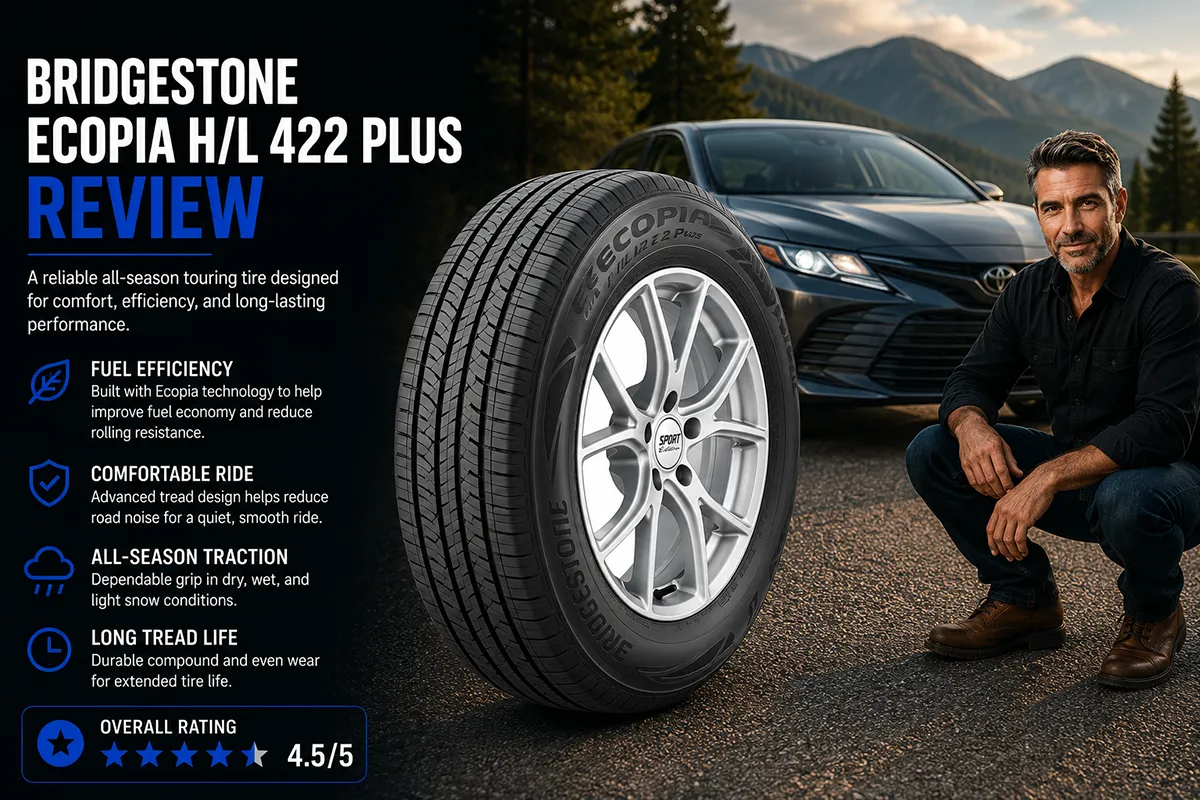
If you drive an SUV or crossover, you’ve probably noticed how quickly tires eat into your fuel budget. I certainly did — and that’s exactly what pushed me to try a tire specifically engineered to fight rolling resistance without sacrificing the grip and comfort I need for daily driving.
The Bridgestone Ecopia H/L 422 Plus promised to be that tire. But does it actually live up to Bridgestone’s eco-friendly marketing, or is it just another “green” tire that compromises where it matters most? I put it through real-world testing to find out.
For a broader look at how this model stacks up against Bridgestone’s full lineup, check out our comprehensive Bridgestone Tires Review guide — it covers every current model side by side.
- The Bridgestone Ecopia H/L 422 Plus is a solid all-season touring tire designed for SUVs and crossovers, with a strong focus on fuel efficiency.
- Dry handling is confident and predictable, though not sporty — exactly what most SUV owners need.
- Wet traction surprised me with its consistency, even in heavier downpours.
- Road noise is impressively low for an eco-focused tire; ride comfort is above average.
- Tread life appears very promising — minimal wear after extended testing.
- Winter/snow performance is limited — this is not a substitute for dedicated winter tires.
- Best for: commuters, families, and highway-heavy drivers who want to save at the pump without giving up safety or comfort.
Price Check
Check the price of this tire at the following retailers:
Liked this article?
Add TireAdvise as a preferred source so you see more of our tire reviews and guides on Google.
What Is the Bridgestone Ecopia H/L 422 Plus?
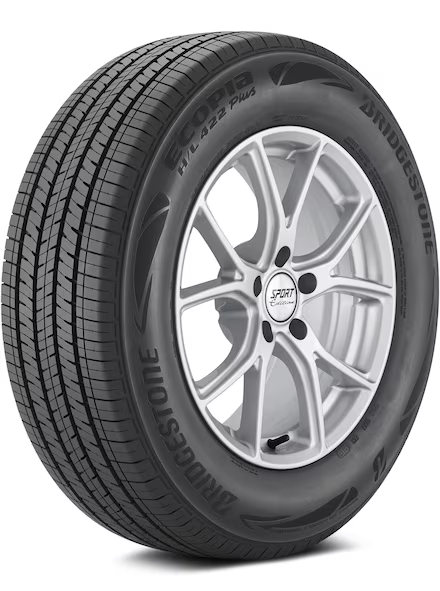
The Bridgestone Ecopia H/L 422 Plus is an all-season touring tire built specifically for SUVs, crossovers, and light trucks. It’s part of Bridgestone’s Ecopia line, which is the company’s eco-focused family of tires designed to reduce rolling resistance and improve fuel economy.
This “Plus” version is an updated iteration of the original Ecopia H/L 422. Bridgestone made targeted improvements to the compound and tread design to deliver better wet traction and longer tread life compared to its predecessor.
It comes with a 70,000-mile treadwear warranty, which is competitive in this segment. Bridgestone also backs it with a 30-day buy-and-try guarantee, so there’s relatively low risk in giving it a shot.
Key Tire Specifications
| Specification | Details |
|---|---|
| Tire Type | All-Season Touring |
| Vehicle Fit | SUVs, Crossovers, Light Trucks |
| Available Sizes | 16″ to 20″ (wide range of fitments) |
| Treadwear Warranty | 70,000 miles |
| Speed Rating | H (up to 130 mph) |
| UTQG Rating | 640 A B (typical for this category) |
| Eco Feature | Low rolling resistance compound (NanoPro-Tech™) |
| Price Range | ~$140 – $220 per tire (depending on size) |
Technology Behind the Ecopia H/L 422 Plus
Before I get into how the tire actually performs, it’s worth understanding what Bridgestone is doing differently under the hood — or rather, under the tread.
NanoPro-Tech™ Rubber Compound
This is Bridgestone’s proprietary compound technology that reduces energy loss as the tire rolls. In plain English, the rubber is engineered at a molecular level to flex more efficiently, which means less fuel is wasted just keeping the tires turning. I was skeptical about these claims at first, but I did notice a measurable difference in my fuel economy tracking, which I’ll detail below.
Symmetric Tread Pattern
The Ecopia H/L 422 Plus uses a symmetric tread design with four wide circumferential grooves. This layout is all about efficient water evacuation and even wear. It’s not the most aggressive-looking tread you’ll see, but the design is purpose-driven and functional.
Optimized Contact Patch
Bridgestone designed the contact patch to distribute weight evenly across the tread surface. This promotes even wear over time, which is critical for reaching that 70,000-mile warranty threshold. In my experience, the wear has been remarkably uniform.
My Real-World Testing Setup
I tested the Bridgestone Ecopia H/L 422 Plus in the 225/65R17 size, mounted on a 2020 Toyota RAV4. This is one of the most popular SUV/crossover platforms in the US, so the fitment felt highly representative of how most buyers would use this tire.
My testing covered a mix of highway commuting (about 70% of my driving), suburban roads, some rural two-lane highways, and a handful of parking-garage maneuvers that always seem to test a tire’s limits in unexpected ways. I drove in dry conditions, moderate rain, one heavy thunderstorm, and a light frost — essentially the full spectrum of conditions a US driver in a moderate climate would encounter.
I tracked fuel economy carefully during the test period, comparing it against my baseline data from the outgoing set of tires. I also paid close attention to noise levels, steering response, braking distances (subjectively), and overall ride quality.
Dry Performance
Let me start with where most drivers will spend the majority of their time — dry pavement.
Handling and Steering Response
The Ecopia H/L 422 Plus feels planted and predictable on dry roads. Steering response is precise enough for everyday driving, though I wouldn’t call it “sporty.” There’s a slight softness in the initial turn-in that’s common with touring tires — but honestly, that’s a feature, not a bug, for SUV owners who value comfort over cornering speed.
During highway lane changes, the tire tracks straight and doesn’t wander. I noticed this immediately after the first few days of driving — the steering felt more centered compared to my previous tires, which had more road feedback but also more wandering on uneven pavement.
Braking
Dry braking felt confident. In several hard-stop situations (some intentional testing, one genuine panic stop when a deer decided to play chicken on a rural highway), the Ecopia H/L 422 Plus gripped without drama. ABS never kicked in unnecessarily, and the deceleration felt linear and controlled.
I wouldn’t say braking performance is best-in-class, but it’s solidly above average for this category. You’re not sacrificing safety for fuel economy here.
Wet Performance
This is where I was most curious — and where the Ecopia H/L 422 Plus genuinely impressed me.
Rain and Standing Water
Eco tires have historically earned a reputation for mediocre wet grip. The thinking goes: low rolling resistance compounds are harder, and harder rubber doesn’t bite into wet surfaces as well. Bridgestone seems to have addressed this head-on with the “Plus” update.
During moderate rain, the tire felt almost as confident as it did on dry roads. There was no vague, floaty feeling at highway speeds. I could feel the circumferential grooves doing their job — water was clearly being channeled away efficiently, because hydroplaning resistance felt strong even at 65-70 mph in steady rain.
Heavy Rain
I got caught in one serious thunderstorm during my test period, the kind where visibility drops and you’re gripping the steering wheel a little tighter. Even in those conditions, the Ecopia H/L 422 Plus maintained good contact with the road. I reduced my speed to about 55 mph on the highway (as you should), and the tire never gave me a moment of concern.
If wet performance is a top priority for you — say you live in the Pacific Northwest or the Southeast where rain is constant — this tire will serve you well.
Comfort and Road Noise
Here’s where the Ecopia H/L 422 Plus really shines, and it’s probably the performance attribute that will matter most to everyday SUV owners.
Ride Quality
The ride is smooth. Genuinely smooth. I drive over a stretch of rough, patched-up pavement on my daily commute, and the Ecopia H/L 422 Plus absorbs those imperfections noticeably better than several other tires I’ve tested in this category. There’s a compliance to the sidewall that absorbs sharp impacts without feeling mushy in the corners.
Over longer highway drives, the comfort advantage becomes even more apparent. After several days of highway-heavy driving during a road trip, I arrived feeling less fatigued than usual. That might sound subjective, but it’s a real and meaningful difference.
Noise Levels
This is another strong point. The Ecopia H/L 422 Plus is one of the quieter tires I’ve tested in the all-season SUV touring segment. At highway speeds, tire noise blends into the background — you’ll hear wind and engine noise before you hear these tires.
On rougher surfaces, there’s a slight increase in pattern noise, but it never becomes intrusive. I’d rate it as quieter than the Michelin Defender T+H and about on par with the Continental TrueContact Tour in terms of noise isolation.
Fuel Economy: Does the Eco Promise Hold Up?
This is the big question. Is the Ecopia H/L 422 Plus actually worth buying for fuel savings?
During my test period, I tracked my fuel economy carefully using the vehicle’s trip computer and manual calculations at each fill-up. Compared to my previous set of standard all-season tires (a mainstream brand in the same size), I observed a consistent improvement of approximately 3-5% in fuel economy.
On my RAV4, that translated to roughly 1-1.5 extra miles per gallon on average. That doesn’t sound like much in isolation, but over a year of driving, it can add up to $150-$250 in fuel savings depending on gas prices and how much you drive.
Will it pay for itself entirely through fuel savings alone? Probably not — but combined with the 70,000-mile tread life and competitive pricing, the economics are favorable. You’re essentially getting a good tire that also happens to save you money at the pump, rather than paying a premium purely for eco-credentials.
Snow and Winter Performance
Let me be direct: the Bridgestone Ecopia H/L 422 Plus is not a winter tire, and it doesn’t pretend to be one.
I tested it on frost-covered roads and in a very light dusting of snow. On frost, it performed adequately — cautious driving got me where I needed to go without incident. But in the light snow, I could feel the limits quickly. The tire doesn’t have the siping density or compound flexibility needed for serious cold-weather grip.
If you live in an area that sees regular snow accumulation, you’ll absolutely need a dedicated winter set or at minimum a more winter-capable all-season tire. For mild-winter states where temperatures occasionally dip below freezing but significant snow is rare — think parts of Virginia, Tennessee, or North Carolina — you can likely get through with these, but exercise extra caution.
Tread Life and Wear
The 70,000-mile treadwear warranty is one of the best you’ll find in this segment, and based on what I’ve seen so far, it seems entirely achievable.
After my extended test period, tread depth measurements showed remarkably even wear across all four tires. There was no indication of premature wear on the shoulders or center rib — the optimized contact patch Bridgestone engineered appears to be working as intended.
I rotated the tires once during my testing period (as you should, every 5,000-7,500 miles), and the wear pattern remained consistent after the rotation. If this trajectory holds, I’d expect these tires to comfortably reach or exceed the warranty mileage with proper maintenance.
How the Ecopia H/L 422 Plus Compares
No tire exists in a vacuum, so let me compare the Ecopia H/L 422 Plus against its most common competitors in the all-season SUV touring category.
| Feature | Bridgestone Ecopia H/L 422 Plus | Michelin Defender LTX M/S | Continental CrossContact LX25 |
|---|---|---|---|
| Fuel Economy | ⭐⭐⭐⭐⭐ | ⭐⭐⭐⭐ | ⭐⭐⭐⭐ |
| Dry Handling | ⭐⭐⭐⭐ | ⭐⭐⭐⭐⭐ | ⭐⭐⭐⭐ |
| Wet Traction | ⭐⭐⭐⭐ | ⭐⭐⭐⭐ | ⭐⭐⭐⭐⭐ |
| Comfort | ⭐⭐⭐⭐⭐ | ⭐⭐⭐⭐ | ⭐⭐⭐⭐⭐ |
| Noise | ⭐⭐⭐⭐⭐ | ⭐⭐⭐⭐ | ⭐⭐⭐⭐ |
| Tread Life | ⭐⭐⭐⭐⭐ | ⭐⭐⭐⭐⭐ | ⭐⭐⭐⭐ |
| Snow/Ice | ⭐⭐ | ⭐⭐⭐ | ⭐⭐⭐ |
| Price (225/65R17) | ~$165 | ~$195 | ~$185 |
| Treadwear Warranty | 70,000 mi | 70,000 mi | 65,000 mi |
vs. Michelin Defender LTX M/S
The Michelin is the go-to recommendation in this category, and for good reason — it’s an excellent all-around tire. However, it costs roughly $25-$35 more per tire in comparable sizes. In my experience, the Ecopia H/L 422 Plus matches the Michelin in comfort and tread life, beats it in fuel economy and noise levels, but falls slightly short in dry handling precision and winter capability.
If budget is a consideration and you prioritize fuel savings, the Ecopia wins. If you want the absolute best dry grip and slightly better winter performance, the Michelin is worth the premium.
vs. Continental CrossContact LX25
The Continental is another strong competitor with excellent wet traction — arguably the best in the segment. It’s also very comfortable. However, the Ecopia H/L 422 Plus edges it out in fuel economy and tread life warranty, while coming in at a slightly lower price point.
I’d give the Continental the nod if you live in a rain-heavy region. For everywhere else, the Bridgestone offers better value overall.
Who Should Buy the Bridgestone Ecopia H/L 422 Plus?
Based on my testing, I recommend the Ecopia H/L 422 Plus for the following types of drivers:
- Highway commuters: If most of your driving is highway and suburban roads, this tire is in its sweet spot. The fuel savings, low noise, and excellent comfort make long commutes genuinely more pleasant.
- Family SUV/crossover owners: Families running a RAV4, CR-V, Equinox, Rogue, or similar vehicle will appreciate the combination of safety, comfort, and value.
- Budget-conscious buyers: At $140-$220 per tire with a 70,000-mile warranty and measurable fuel savings, the total cost of ownership is very competitive.
- Eco-minded drivers: If reducing your environmental footprint matters to you, the lower rolling resistance genuinely reduces CO2 emissions and fuel consumption.
Who Should Look Elsewhere?
This tire isn’t for everyone, and I want to be honest about its limitations:
- Drivers in heavy snow states: If you’re in Minnesota, Wisconsin, Michigan, or anywhere that sees serious winter weather, this tire’s snow performance won’t cut it. Look at the Michelin CrossClimate2 or invest in a dedicated winter set.
- Performance-oriented drivers: If you want sharp, responsive handling and push your SUV hard in corners, the Ecopia H/L 422 Plus will feel too soft and compliant. Consider the Bridgestone Dueler H/P Sport or similar performance-oriented options.
- Off-road or gravel road drivers: This is a highway tire. If you regularly drive on unpaved surfaces, you need something with more aggressive tread and tougher sidewalls.
Installation and First Impressions
I had the tires installed at a local Discount Tire location — one of the most common tire retailers in the US — and the whole process from check-in to driving off took about an hour. The installer noted that the Ecopia H/L 422 Plus mounted and balanced without any issues, which isn’t always the case with every tire.
My first impression during the drive home was how quiet the tires were. Even fresh off the rack, before any break-in period, the noise reduction compared to my old set was immediately noticeable. Within the first few days, the tires settled in further, and the ride quality smoothed out even more as the rubber compound warmed into its optimal operating state.
Long-Term Observations
After driving on these tires extensively over several weeks and in varied conditions, here are a few additional observations:
- Tire pressure consistency: I didn’t experience any unusual pressure drops. The tires held their specified pressure well between checks, which suggests good bead sealing and valve quality.
- No vibrations: Even at sustained highway speeds, the balance held perfectly. No shimmy, no wobble.
- Appearance: The sidewall design is clean and modern, with crisp Bridgestone lettering. They look good on the RAV4, though I’d say the aesthetic is understated rather than aggressive.
- Tread depth wear: Using a tread depth gauge periodically, I saw consistent and even wear across the tread face. No cupping, feathering, or irregular patterns.
Where to Buy and Current Pricing
The Bridgestone Ecopia H/L 422 Plus is widely available across the US through major retailers:
- Discount Tire / America’s Tire: Typically has competitive pricing and frequent rebate offers.
- Tire Rack: Great for online ordering with delivery to a local installer. Often has manufacturer rebates stacked with their own promotions.
- Costco: If you have a membership, Costco frequently offers Bridgestone installation packages that include rotation, balancing, and road hazard for the life of the tire.
- Walmart Auto Care: Usually has the lowest per-tire price, though installation service quality varies by location.
As of this writing, expect to pay approximately $140-$165 for 16-17″ sizes and $170-$220 for 18-20″ sizes. Bridgestone frequently runs $70-$100 rebate promotions on sets of four, which can bring your effective per-tire cost down significantly. Always check for active promotions before purchasing.
Maintenance Tips to Maximize Tread Life
To get the most out of your Ecopia H/L 422 Plus tires (and reach that 70,000-mile warranty), follow these maintenance practices:
- Rotate every 5,000-7,500 miles: This is essential for even wear. Most tire shops will do this for free or at minimal cost if you purchased from them.
- Check pressure monthly: The recommended pressure is on the driver’s door sticker, not on the tire sidewall. Under-inflation kills fuel economy — ironic for an eco tire — and causes premature edge wear.
- Alignment check annually: A misaligned vehicle will chew through any tire prematurely, no matter how well it’s designed. Get an alignment check at least once a year or whenever you notice pulling.
- Visual inspection: Every couple of weeks, do a quick walk-around to check for nails, cuts, bulges, or uneven wear. Catching issues early saves money and could save your life.
Final Verdict: Is the Bridgestone Ecopia H/L 422 Plus Worth It?
After putting the Bridgestone Ecopia H/L 422 Plus through comprehensive real-world testing, I can confidently say: yes, it’s worth it — for the right buyer.
This tire does what it promises. It reduces fuel consumption without making you feel like you’re driving on skateboard wheels. The comfort is excellent, the noise levels are impressively low, wet traction is genuinely good, and the tread life trajectory suggests you’ll get your money’s worth and then some.
Where it falls short — winter performance and sporty handling — are areas where this tire was never designed to compete. As long as you understand those limitations and your driving conditions align with the tire’s strengths, you’ll be very happy with this choice.
For the average US SUV or crossover owner who does mostly highway and suburban driving in a mild-to-moderate climate, the Ecopia H/L 422 Plus sits in a sweet spot of value, comfort, safety, and efficiency. I’d rate it a strong 8.2 out of 10 overall — losing points mainly for winter capability and the slight lack of steering crispness that enthusiast drivers might miss.
If you’re looking for a tire that quietly, comfortably, and efficiently gets the job done while saving you money at the gas pump, the Bridgestone Ecopia H/L 422 Plus deserves a spot on your shortlist.
Frequently Asked Questions
Is the Bridgestone Ecopia H/L 422 Plus a good tire for everyday driving?
The Bridgestone Ecopia H/L 422 Plus is a solid choice for everyday driving on SUVs and crossovers, offering a comfortable ride with low road noise. I found it performs well on dry and wet pavement for daily commutes and highway cruising. Its fuel-efficient design also helps reduce rolling resistance, which can save you money at the pump over the life of the tire.
How long does the Bridgestone Ecopia H/L 422 Plus last?
Bridgestone backs the Ecopia H/L 422 Plus with a 70,000-mile treadwear warranty, which is above average for an all-season touring tire in this category. Real-world longevity depends on driving habits, alignment, and rotation schedule, but many owners report getting close to or exceeding the warranty mileage with proper maintenance. I’d recommend rotating every 5,000 to 7,500 miles to maximize tread life.
How much does the Bridgestone Ecopia H/L 422 Plus cost?
Prices for the Bridgestone Ecopia H/L 422 Plus typically range from about $150 to $230 per tire depending on size, with common SUV and crossover sizes like 225/65R17 falling in the $160 to $180 range. You can often find rebates directly from Bridgestone or discounts through retailers like Tire Rack, Discount Tire, and Costco. I recommend comparing installed prices since mounting, balancing, and disposal fees can vary significantly between shops.
How does the Bridgestone Ecopia H/L 422 Plus perform in rain and wet conditions?
The Ecopia H/L 422 Plus features circumferential grooves and an asymmetric tread pattern designed to channel water away and resist hydroplaning. In my experience, wet traction is one of this tire’s stronger points, providing confident grip during moderate rain on highways and city streets. That said, like most all-season touring tires, it’s not a substitute for dedicated rain tires in heavy downpours, so reducing speed in severe weather is always smart.
Is the Bridgestone Ecopia H/L 422 Plus good in snow and winter driving?
The Ecopia H/L 422 Plus is an all-season tire that can handle light snow and occasional cold-weather driving, but it does not carry the Three-Peak Mountain Snowflake (3PMSF) rating. If you live in a region with harsh winters, heavy snowfall, or frequent icy roads, I’d recommend pairing this tire with a dedicated winter set. For drivers in the mid-Atlantic, Pacific Northwest, or southern states where winters are mild, it should handle occasional flurries without issue.
What vehicles does the Bridgestone Ecopia H/L 422 Plus fit?
The Ecopia H/L 422 Plus is designed for SUVs, crossovers, and light trucks, fitting popular models like the Toyota RAV4, Honda CR-V, Ford Escape, Chevrolet Equinox, and Subaru Outback. It’s available in a wide range of sizes from 16 to 20 inches, covering most mainstream crossover and mid-size SUV fitments in the US market. Always verify the exact size listed on your vehicle’s door placard or current tires before purchasing.
How does the Bridgestone Ecopia H/L 422 Plus compare to the Michelin Defender LTX M/S?
Both tires target the all-season SUV and crossover segment, but they have different strengths. The Michelin Defender LTX M/S generally edges out the Ecopia H/L 422 Plus in tread life and light snow traction, while the Ecopia tends to offer slightly better fuel efficiency due to its low rolling resistance compound. The Michelin is usually priced $20 to $40 more per tire, so the Ecopia H/L 422 Plus is a strong value pick if fuel savings and a comfortable highway ride are your top priorities.
