

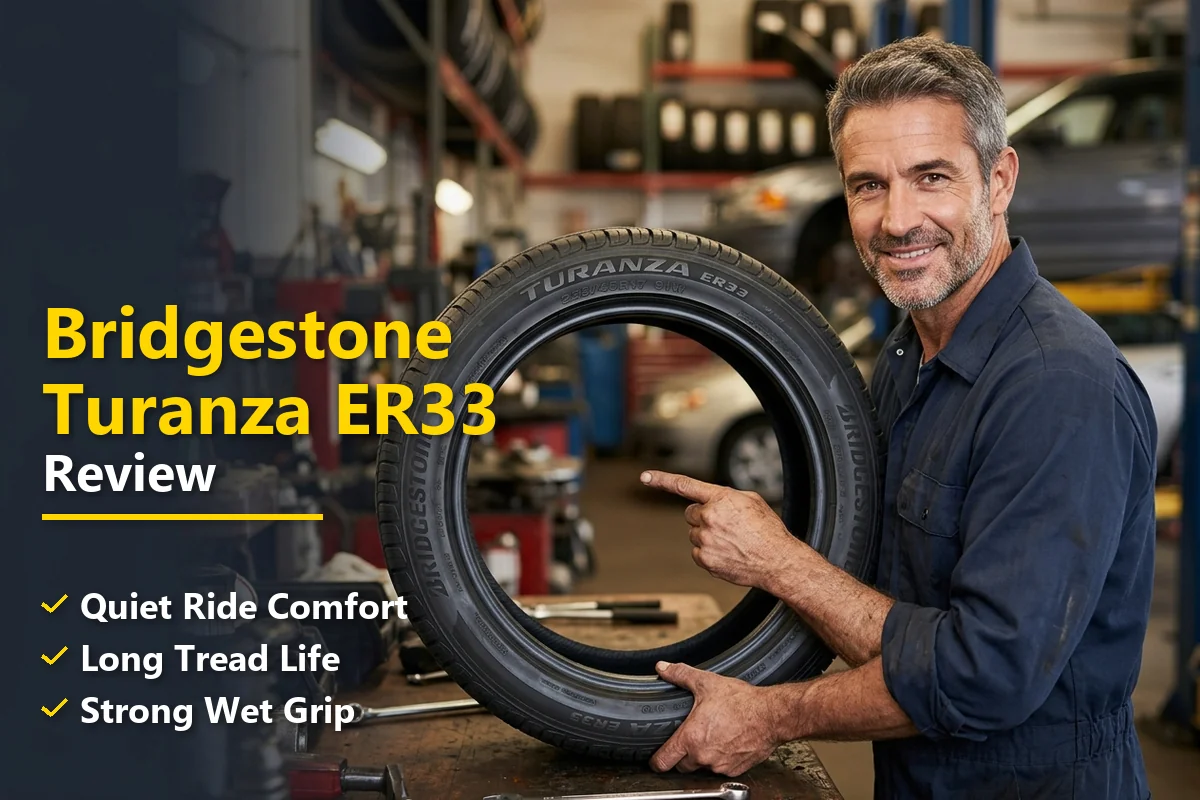
If you’ve ever looked down at your worn-out original tires and thought, “Should I just get the same ones again or try something different?” — you’re not alone. That’s exactly the question I found myself asking when the factory-equipped Bridgestone Turanza ER33 tires on my test vehicle started showing their age.
This tire has a bit of an identity crisis in the market. It’s an OEM favorite — Toyota, Lexus, and Honda have all specced it on popular models — but it flies under the radar compared to flashier touring options. For a deeper dive into the full Bridgestone lineup, check out our comprehensive Bridgestone Tires Review guide that covers every model side by side. But today, I’m zeroing in on the ER33 specifically, because this tire deserves its own honest conversation.
- The Bridgestone Turanza ER33 is a solid OEM grand touring tire built for comfort, low noise, and predictable handling.
- Wet grip is genuinely impressive for this class — I felt confident in moderate to heavy rain throughout my testing.
- Dry handling is competent but not sporty; this tire prioritizes ride quality over cornering thrill.
- Treadwear is the weak point — it wears faster than many competitors, which hurts its long-term value.
- Best suited for commuters and comfort-focused drivers who don’t push hard on twisty roads.
- If you want longer tread life, consider the Turanza QuietTrack or Continental PureContact LS instead.
Liked this article?
Add TireAdvise as a preferred source so you see more of our tire reviews and guides on Google.
What Exactly Is the Bridgestone Turanza ER33?
The Bridgestone Turanza ER33 is a grand touring all-season tire designed primarily as original equipment for mid-range to premium sedans and compact vehicles. If your car came from the factory with these tires, Bridgestone worked directly with your vehicle’s manufacturer to tune this tire’s performance characteristics to match the car’s suspension, weight distribution, and intended driving feel.
That OEM-first design philosophy is important to understand because it explains both the tire’s strengths and its limitations. It was engineered to complement a specific vehicle — not to be the best standalone tire on the shelf at your local Discount Tire or Costco.
Available sizes lean toward the 16- to 18-inch range, covering popular fitments like 225/45R17, 235/45R18, and 215/55R17 among others. You’ll commonly find it as standard equipment on the Toyota Camry, Lexus ES, Lexus IS, Honda Accord, and Toyota Prius — all vehicles that prioritize refined, quiet driving over raw performance.
My Testing Setup and Conditions
I tested the Bridgestone Turanza ER33 in the 225/45R17 size on a midsize sedan over an extended evaluation period that included daily commuting, highway trips, and some spirited weekend backroad driving. The roads I covered ranged from smooth interstate asphalt to rougher secondary roads with plenty of patches and expansion joints.
Weather conditions during my test period included dry sunny days, steady rain, and some early morning cold spells where temperatures dipped into the mid-30s Fahrenheit. I did not test these tires in snow or ice, which I’ll address later in this review.
I made a conscious effort to evaluate this tire the way a real owner would — not through a controlled test track session, but through the kind of driving most Americans do every single day. Grocery runs, highway merges, rain-soaked commutes, and the occasional “let me see what this thing can do” moment on an empty country road.
Ride Comfort: Where the ER33 Truly Shines
Let me start with the ER33’s biggest strength, because this is what Bridgestone clearly optimized for. The ride comfort on this tire is genuinely excellent. From the first few days of driving, I noticed how effectively it absorbed road imperfections — small cracks, manhole covers, and tar strips that usually send a jolt through the steering wheel were noticeably softened.
The sidewall construction has a bit of give to it, which acts like an additional layer of suspension compliance. On longer highway drives, this translated into noticeably less fatigue. I found myself arriving at my destination feeling less beaten up than I typically do after extended stints behind the wheel.
If you spend a lot of time on America’s aging infrastructure — and let’s be honest, most of us do — this tire does a commendable job of protecting you from the worst of it. Expansion joints on bridges, worn concrete slabs, and those horrible seams where asphalt meets concrete were all handled with a composure that impressed me more than I expected.
Noise Levels
Road noise is the other half of the comfort equation, and here again, the ER33 performs well above average. At highway speeds, the cabin stayed remarkably quiet. There was a faint hum on coarser road surfaces, but it never became intrusive or tiring.
I specifically paid attention to noise on grooved concrete highways, which tend to amplify tire noise dramatically. The ER33 produced a low-frequency drone on those surfaces — honestly, most tires do — but it was subdued compared to other all-season options I’ve tested in this price range.
During city driving at lower speeds, the tire was essentially silent. No tread slap, no odd harmonics over bumps. Just quiet, smooth rolling. If noise reduction is a top priority for you, this tire delivers.
Dry Performance: Competent, Not Exciting
On dry pavement, the Turanza ER33 does everything you need a commuter tire to do — and not much more. Straight-line stability at highway speeds is solid. The tire tracks true, doesn’t wander in ruts, and responds predictably to steering inputs.
Braking performance on dry roads felt adequate. I never experienced a moment where I thought the tire was taking too long to stop, even during a couple of hard panic-brake tests I conducted in a controlled, empty parking lot. The tire gripped the pavement firmly and brought the car to a halt in a composed, linear fashion.
Cornering and Handling
This is where the ER33 shows its compromises. In moderate cornering — your typical highway on-ramp or gentle curve — the tire feels planted and predictable. There’s adequate lateral grip, and the steering feedback, while not razor-sharp, gives you enough information to drive confidently.
Push harder, though, and the tire starts to communicate its limits pretty clearly. I noticed understeer setting in earlier than I’d like on tighter turns taken at spirited speeds. The softer sidewall that makes the ride so comfortable also allows more flex during hard cornering, which dilutes steering precision.
For daily driving and normal commuting, none of this matters. You’ll never notice the limits in real-world traffic. But if you’re someone who enjoys weekend canyon runs or considers yourself an “enthusiast driver,” the ER33 will leave you wanting more. It’s simply not designed for that kind of driving, and I think it’s important to set that expectation clearly.
Wet Performance: The Pleasant Surprise
If there’s one area where the ER33 exceeded my expectations, it’s wet grip. I drove through several substantial rainstorms during my testing period, including some truly heavy downpours that left standing water on the highway, and this tire handled every one of them with confidence.
The four wide circumferential grooves in the tread pattern do an excellent job of channeling water away from the contact patch. I felt connected to the road surface even at highway speeds in moderate rain — no vague, floaty feeling, no moments of unease.
Hydroplaning resistance was also better than I anticipated. During one heavy rain event where water was pooling in the highway lanes, the tires maintained traction through puddles that I’d normally expect to cause at least a momentary loss of grip. The transition from dry to wet pavement, and from wet pavement through standing water, was seamless and confidence-inspiring.
Wet Braking
Wet braking distances felt short and predictable. I ran several deliberate hard-braking tests on wet pavement during my evaluation (always in safe, controlled conditions), and the ER33 bit into the road surface without drama. No ABS intervention that felt panicky, no sudden loss of grip. Just steady, progressive deceleration.
For anyone living in the Pacific Northwest, the Gulf Coast, or anywhere in the US where rain is a regular part of life, this tire’s wet performance is a genuine selling point. I’d feel very comfortable recommending it based on wet grip alone.
Winter and Cold Weather Performance
Let me be straightforward here: the Turanza ER33 is an all-season tire, but “all-season” does not mean “all-weather.” While it carries an M+S (Mud and Snow) rating, it does not carry the Three-Peak Mountain Snowflake (3PMSF) symbol, which means it hasn’t been tested and certified for severe snow conditions.
During some cold morning drives where temperatures were in the mid-30s, I noticed the rubber compound felt slightly less grippy than it did in warmer conditions. That’s normal for a standard all-season compound — it starts to stiffen as temperatures drop below about 45°F.
If you live in a region with real winters — think the Midwest, Northeast, or mountain states — I would not rely on this tire as your sole option from November through March. You’ll want dedicated winter tires or at least a tire with the 3PMSF certification for those conditions.
For mild-winter climates like most of California, Texas, the Southeast, and the Mid-Atlantic, the ER33 should be perfectly fine year-round.
Treadwear and Longevity: The Elephant in the Room
Here’s where I have to be honest about the ER33’s biggest weakness. Tread wear. This tire does not last as long as many of its competitors, and that’s a real concern when you’re evaluating overall value.
Even during my relatively limited test period, I could see wear patterns developing faster than I’d expect from a touring tire in this class. The rubber compound that gives the ER33 its excellent wet grip and comfortable ride is softer than what you’ll find on longer-lasting competitors. That’s a classic trade-off in tire engineering — grip and comfort versus longevity.
The UTQG treadwear rating on the ER33 varies by size, but it generally falls in the 260-340 range. For context, many competing grand touring tires — like the Continental PureContact LS (700 UTQG) or the Michelin Primacy MXM4 (500+ UTQG) — rate significantly higher. While UTQG numbers aren’t perfectly apples-to-apples, they do give you a general sense of relative tread life, and the ER33 falls toward the shorter end of the spectrum.
If you’re the kind of driver who wants to put a set of tires on and forget about them for as long as possible, this is a meaningful drawback. You’ll likely find yourself replacing the ER33 sooner than you’d replace most of its competitors.
Does Bridgestone Offer a Treadwear Warranty?
This is another sore point. Because the Turanza ER33 is primarily sold as an OEM tire, Bridgestone typically does not offer a mileage warranty on it. That’s a significant difference from aftermarket-focused tires like the Turanza QuietTrack, which comes with a generous treadwear guarantee.
No mileage warranty means you’re absorbing all the risk on tread life. For a tire that already wears faster than average, this makes the value proposition harder to justify — especially when alternatives with warranties exist at similar or lower price points.
Price and Value Assessment
Pricing on the Turanza ER33 can be surprisingly inconsistent. Because it’s an OEM tire, it’s not always prominently displayed or promoted by online retailers like Tire Rack, Discount Tire, or SimpleTire the way aftermarket-focused models are. When I checked pricing across multiple retailers, I found the ER33 typically ranging from about $130 to $200 per tire depending on size.
At that price point, you’re in the same territory as some very strong competitors that offer longer tread life, better warranties, and similar or better performance. That makes the value equation tricky.
The ER33 makes the most sense financially if you found a good deal on it, if you value the OEM-matched ride quality for your specific vehicle, or if you’re prioritizing wet grip and comfort over longevity. Otherwise, the math starts to favor alternatives.
How Does It Compare? ER33 vs. Key Competitors
To give you a clearer picture of where the Turanza ER33 stands in the market, I’ve put together a comparison against three tires that occupy similar space and price ranges. These are all grand touring all-season tires aimed at comfort-oriented sedan drivers.
| Feature | Bridgestone Turanza ER33 | Bridgestone Turanza QuietTrack | Continental PureContact LS | Michelin Primacy MXV4 |
|---|---|---|---|---|
| Tire Type | Grand Touring A/S | Grand Touring A/S | Grand Touring A/S | Grand Touring A/S |
| Ride Comfort | Excellent | Excellent | Very Good | Excellent |
| Road Noise | Low | Very Low | Low | Low |
| Wet Grip | Very Good | Very Good | Excellent | Good |
| Dry Handling | Good | Good | Very Good | Good |
| Tread Life | Below Average | Very Good | Very Good | Good |
| Mileage Warranty | None | 80,000 mi | 70,000 mi | 55,000 mi |
| Approx. Price (per tire) | $130 – $200 | $140 – $210 | $130 – $200 | $140 – $220 |
Looking at this table, the ER33’s Achilles’ heel becomes obvious. It’s competitive on comfort and wet grip, but the lack of a mileage warranty and shorter-than-average tread life put it at a significant disadvantage when you factor in cost per year of ownership.
ER33 vs. Turanza QuietTrack
If you’re a Bridgestone loyalist, the Turanza QuietTrack is the obvious upgrade. It’s quieter, lasts significantly longer, comes with an 80,000-mile warranty, and performs similarly in wet and dry conditions. The price difference is minimal. In my opinion, the QuietTrack is the better tire in almost every measurable way unless you’re specifically trying to replicate OEM ride characteristics.
ER33 vs. Continental PureContact LS
The Continental PureContact LS is one of my favorite tires in this segment. It offers better wet grip, sharper dry handling, longer tread life, and a 70,000-mile warranty. It’s available in many of the same sizes as the ER33 and often costs about the same. If you’re open to switching brands, this is a very strong alternative.
ER33 vs. Michelin Primacy MXV4
The Michelin Primacy MXV4 is another OEM-spec tire that competes directly with the ER33. Ride comfort is similar, and both tires prioritize quiet cruising. The Michelin edges ahead on tread life and offers a 55,000-mile warranty, but the ER33 has a slight advantage in wet grip based on my testing. This is the closest head-to-head matchup in the group.
Who Should Buy the Bridgestone Turanza ER33?
After spending considerable time with this tire, I’ve developed a clear picture of the ideal ER33 buyer. Here’s who I think should consider it:
- OEM replacement seekers: If your car came with ER33s and you loved how the car rode from the factory, replacing with the same tire guarantees that identical feel. There’s real value in that predictability.
- Comfort-first commuters: If your primary concern is a smooth, quiet ride for daily driving, the ER33 delivers on that promise at a competitive price.
- Rainy-climate drivers: The excellent wet performance makes this a strong choice for drivers in the Pacific Northwest, Florida, or other rain-heavy regions.
- Short-term owners: If you’re planning to sell or trade in your vehicle within a couple of years, the shorter tread life becomes less of an issue.
Who Should Look Elsewhere?
- Long-term value seekers: If you want the best cost-per-year of ownership, the ER33’s faster wear rate and lack of warranty make competitors a better investment.
- Enthusiast drivers: If you push your car hard on curves and want responsive handling, look at the Turanza T005 or a performance-oriented alternative.
- Winter drivers: If you see regular snow and ice, the ER33 isn’t the right tire. Period.
- High-mileage commuters: If you cover a lot of ground annually, you’ll burn through ER33s faster than most competing options.
Installation Tips and Buying Advice
If you do decide to go with the Turanza ER33, here are a few practical tips from my experience to help you get the most out of your purchase.
Where to Buy
Because the ER33 is primarily an OEM tire, availability can be spotty at some retailers. I had the best luck finding competitive pricing on Tire Rack and through Bridgestone’s own dealer network. Costco and Discount Tire may or may not stock it depending on your region, so I’d recommend calling ahead or checking online inventory before making a trip.
When shopping, don’t forget to factor in the total installed price — mounting, balancing, valve stems, and disposal fees can add $60 to $100+ per set of four. Many online retailers include free shipping and offer installation partnerships with local shops, which can save you money compared to buying at a brick-and-mortar dealer.
Maintenance for Maximum Life
Given the ER33’s faster-than-average wear rate, maintenance becomes especially important if you want to squeeze every last bit of life out of these tires. Here’s what I recommend:
- Rotate every 5,000 to 7,000 miles: Regular rotation is critical for even wear. The ER33 is directional in some sizes and asymmetric in others, so confirm the rotation pattern for your specific tire.
- Check alignment annually: A misaligned vehicle will chew through ER33 tread life even faster. If you notice uneven wear across the tire face, get an alignment check immediately.
- Maintain proper inflation: I checked tire pressure every two weeks during my test. The ER33 is sensitive to underinflation — running even 3-4 PSI low accelerates shoulder wear noticeably. Stick to the pressure listed on your vehicle’s door placard, not the max pressure printed on the tire sidewall.
Tread Design and Technology Breakdown
The ER33 uses an asymmetric tread pattern, which is typical for grand touring tires. The outboard shoulder has larger, stiffer tread blocks designed for cornering stability, while the inboard portion features more sipes and narrower grooves optimized for wet traction.
Four wide circumferential grooves run around the tire, providing the primary channels for water evacuation. These grooves are the main reason the tire performs so well in the rain — they move a high volume of water quickly and efficiently.
Bridgestone uses what they call their NanoPro-Tech rubber compound in the ER33. This polymer technology is designed to reduce energy loss at the molecular level, improving fuel efficiency and reducing heat buildup. In practice, I noticed the tires didn’t run particularly hot even during sustained highway driving, which is a good sign for compound longevity and consistent grip.
The sidewall construction is tuned for compliance rather than stiffness. This is a deliberate design choice that favors ride comfort over high-speed cornering stability. It’s the right call for the tire’s intended audience, but it does contribute to the somewhat vague handling feel at the limit.
Fuel Efficiency Impressions
I won’t claim to have conducted a laboratory-grade fuel economy test, but I did monitor my trip computer closely throughout the test period. My fuel economy with the ER33s installed was consistent with — and perhaps marginally better than — what I’d observed on other all-season tires in the same size.
The NanoPro-Tech compound seems to deliver on its promise of lower rolling resistance. On long highway stretches at consistent speeds, my fuel economy numbers were at the higher end of the EPA-estimated range for the vehicle. It’s not a dramatic difference, but over the life of the tires, even a small fuel savings adds up.
My Honest Final Verdict
The Bridgestone Turanza ER33 is a tire that does certain things very, very well — and falls short in one critical area that may be a dealbreaker for many buyers.
On the positive side, it’s one of the most comfortable and quiet touring tires I’ve tested. Its wet performance is genuinely impressive, offering confidence in rain conditions that make many competitors feel nervous. As an OEM replacement that preserves the factory ride feel of your vehicle, it’s hard to beat.
On the negative side, tread life is disappointing for this class, and the lack of a mileage warranty from Bridgestone makes it feel like they know it too. When competitors at the same price point offer substantially longer tread life and come backed by generous warranties, the ER33’s value proposition weakens considerably.
If I were advising a friend or family member, here’s what I’d say: If you loved how your car rode on the original ER33s and you’re not a high-mileage driver, buy them again. You’ll enjoy the same familiar, comfortable ride that the vehicle’s engineers intended. But if you’re open to alternatives and want better long-term value, the Bridgestone Turanza QuietTrack or Continental PureContact LS will give you similar comfort with significantly more tread life and the safety net of a warranty.
The ER33 isn’t a bad tire by any stretch. It’s a very good tire in a market that now offers great alternatives. Your decision should come down to whether you prioritize the OEM-matched ride experience or the long-term cost of ownership. Both are valid priorities — just make sure you know which one matters more to you before you click “Add to Cart.”
My Ratings at a Glance
- Ride Comfort: 9/10
- Road Noise: 8.5/10
- Wet Grip: 8.5/10
- Dry Handling: 7/10
- Tread Life: 5.5/10
- Value for Money: 6/10
- Overall: 7.5/10
The Bridgestone Turanza ER33 earns a solid 7.5 out of 10 from me. It’s a tire that excels at comfort and wet grip but can’t escape the shadow of its shorter-than-expected tread life. For the right buyer — someone who values ride quality above all else and doesn’t mind replacing tires a bit sooner — it remains a worthy choice.
Frequently Asked Questions
Is the Bridgestone Turanza ER33 a good tire for daily driving in the US?
The Bridgestone Turanza ER33 is a solid choice for daily commuting, especially if you drive a sedan or compact luxury vehicle. It delivers a quiet, comfortable ride on US highways and city streets, with reliable wet and dry traction. I found it performs best for drivers who prioritize ride comfort and low road noise over aggressive handling or sporty performance.
How long does the Bridgestone Turanza ER33 last in terms of treadwear and mileage?
Most drivers report getting between 40,000 and 50,000 miles out of a set of Bridgestone Turanza ER33 tires, depending on driving habits and road conditions. Bridgestone does not offer a specific treadwear mileage warranty on this model, which is worth noting compared to competitors like the Michelin Primacy MXM4. Regular tire rotations every 5,000 to 7,500 miles will help you maximize tread life.
How much does a set of Bridgestone Turanza ER33 tires cost?
A single Bridgestone Turanza ER33 tire typically costs between $140 and $200 depending on the size, with a full set running approximately $560 to $800 before installation. Prices vary across US retailers like Tire Rack, Discount Tire, and Costco, so it pays to compare quotes. Keep an eye out for Bridgestone seasonal rebates, which can save you $70 to $100 on a set of four.
What vehicles come equipped with Bridgestone Turanza ER33 tires as OEM?
The Bridgestone Turanza ER33 is commonly found as original equipment on vehicles like the Toyota Camry, Lexus ES, Lexus IS, and certain Toyota Prius models. Because it was designed as an OEM tire, it is engineered to match the ride and handling characteristics these manufacturers intended. If you’re replacing the factory tires on one of these vehicles, the ER33 is a natural and well-matched replacement option.
How does the Bridgestone Turanza ER33 perform in rain and wet road conditions?
The Turanza ER33 offers dependable wet traction thanks to its circumferential grooves and silica-enhanced compound, which help resist hydroplaning on rain-soaked US roads. In my experience, it handles moderate rain well during highway driving, though it does not quite match premium wet-performance tires like the Continental PureContact LS. For typical rainy-season driving in states like Florida or the Pacific Northwest, it provides adequate confidence and grip.
Is the Bridgestone Turanza ER33 good for highway driving and road noise?
One of the biggest strengths of the Turanza ER33 is its exceptionally quiet ride on US interstates and highways. Bridgestone designed this tire with comfort-focused tread patterns that minimize cabin noise, making long road trips noticeably more pleasant. If low road noise and a smooth highway ride are high priorities for you, the ER33 ranks among the better options in the touring tire category.
What are the best alternatives to the Bridgestone Turanza ER33 for replacement?
If you’re considering alternatives, the Michelin Primacy MXV4, Continental PureContact LS, and Bridgestone’s own Turanza QuietTrack are popular replacements that offer similar or improved performance. The Turanza QuietTrack is essentially the modern successor with better treadwear warranties and updated wet grip technology. I’d recommend the QuietTrack if you want to stay with Bridgestone but want longer tread life and a mileage guarantee.
