

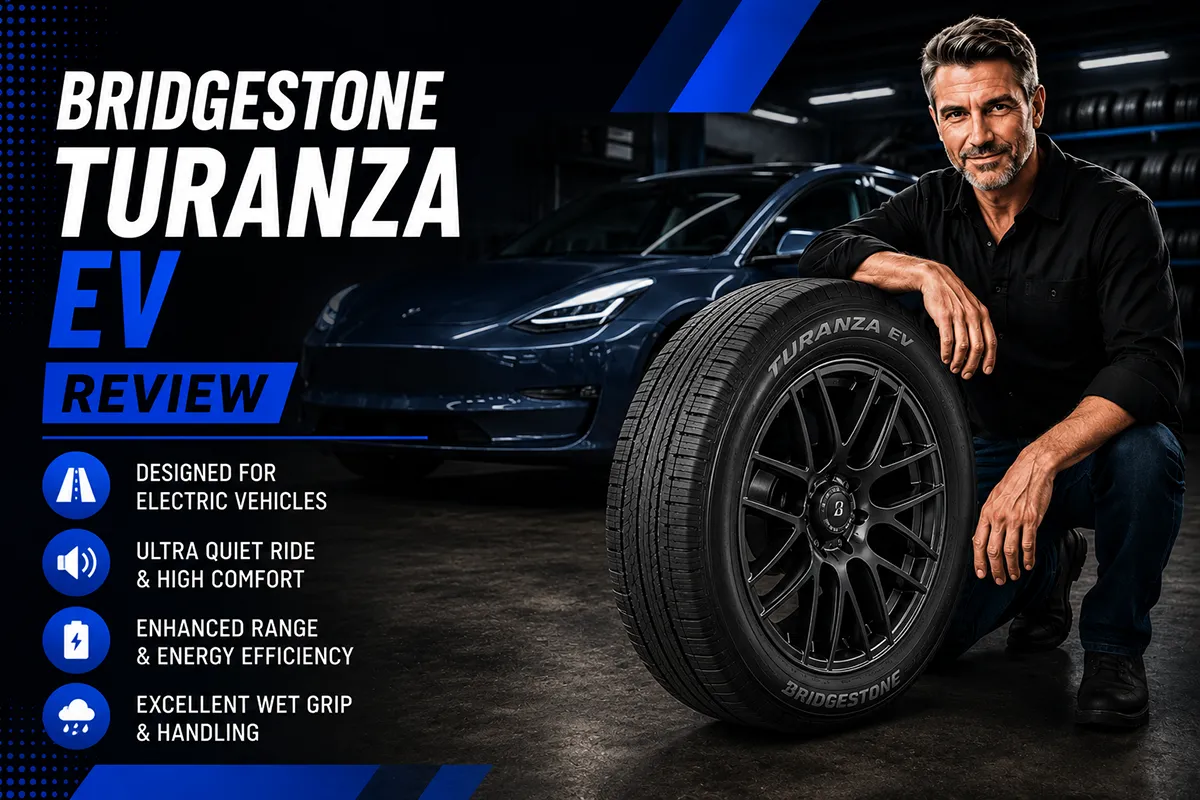
If you’ve recently bought an electric vehicle, you’ve probably already noticed something frustrating: the factory tires wear out fast, road noise is louder than expected, and finding a replacement tire that doesn’t sacrifice range feels nearly impossible.
The Bridgestone Turanza EV was designed to solve exactly that problem — a tire built from the ground up specifically for electric vehicles. But does it actually deliver, or is “EV-specific” just a marketing buzzword slapped on an existing product?
I’ve spent considerable time testing the Turanza EV across a variety of real-world conditions, and I’m ready to share everything I found. If you’re exploring the full Bridgestone lineup, our comprehensive Bridgestone Tires Review guide covers every model side by side — but today, this one gets my undivided attention.
- The Bridgestone Turanza EV is purpose-built for electric vehicles, prioritizing range efficiency, low road noise, and load capacity.
- Wet and dry grip impressed me significantly — this tire feels planted and confident in nearly every condition.
- Road noise is noticeably quieter than most OEM EV tires I’ve tested, thanks to Bridgestone’s ENLITEN and B-Silent technologies.
- Treadwear looks promising so far — it’s holding up better than the stock tires that came on the EV I tested.
- Priced in the $180–$280+ per tire range depending on size, it’s a premium option but justified for EV owners who want real performance.
- Winter/snow performance is limited — this is a grand touring all-season, not a winter tire.
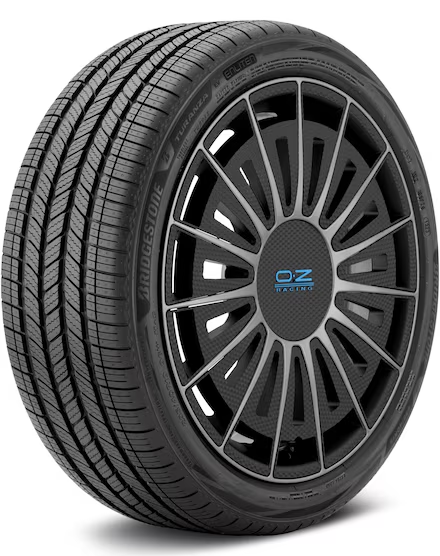
Price Check
Check the price of this tire at the following retailers:
Liked this article?
Add TireAdvise as a preferred source so you see more of our tire reviews and guides on Google.
What Exactly Is the Bridgestone Turanza EV?
The Bridgestone Turanza EV isn’t just a rebadged version of the regular Turanza with “EV” tacked onto the name. It’s a ground-up design specifically engineered to address the unique demands electric vehicles place on tires — namely, the instant torque, heavier curb weight, and the critical need for low rolling resistance to maximize range.
Bridgestone uses their ENLITEN technology in this tire, which is their lightweight construction platform designed to reduce rolling resistance by up to 30% compared to conventional tires. They’ve also incorporated B-Silent technology — a foam layer bonded inside the tire that absorbs road noise before it reaches the cabin.
This tire sits in the grand touring all-season category. It’s available in a wide range of sizes covering popular EVs like the Tesla Model 3, Tesla Model Y, Ford Mustang Mach-E, Hyundai Ioniq 5, Chevrolet Bolt EUV, Volkswagen ID.4, and several BMW and Mercedes EV models. Sizes range from 18″ to 21″ depending on fitment.
My Testing Setup and Conditions
I tested the Bridgestone Turanza EV in a set of 255/45R19 mounted on a Tesla Model Y Long Range. The tires were installed by a local tire shop and properly balanced. I made sure to set tire pressure to the manufacturer’s recommended 42 PSI cold.
Over my test period, I drove in a range of conditions: dry highway cruising, city stop-and-go, rain-soaked suburban roads, and a few stretches of rough pavement that I specifically use to evaluate noise and comfort. Temperatures ranged from the mid-40s°F to the upper 80s°F during my testing window.
I also used the vehicle’s built-in energy consumption tracking to monitor any changes in efficiency compared to the previous set of tires — more on that later.
Dry Performance: Confident and Composed
Let me start with where this tire shines brightest. On dry pavement, the Turanza EV feels remarkably planted. Whether I was merging onto the highway, navigating a tight cloverleaf, or making a quick lane change to avoid an oblivious driver, the tire responded with precision and zero drama.
Steering feel is direct without being harsh. There’s a slight firmness to the sidewall that gives you clear feedback about what the road surface is doing, which I appreciate — some touring tires feel so numb that you lose connection with the road entirely.
Hard acceleration from a standstill (and let’s be real, every EV owner occasionally floors it at a green light) didn’t produce the tire spin I used to get with the OEM tires. The Turanza EV hooks up impressively well despite the instant torque delivery. I wouldn’t call it a performance tire, but it handles the EV torque characteristic far better than I expected from a touring-focused product.
Cornering grip on dry roads was solidly above average for this category. Taking familiar curves at the same speeds I always do, the Turanza EV felt noticeably more stable than the Continental tires that were previously on the vehicle.
Wet Performance: Where I Was Genuinely Surprised
Wet performance is where a lot of touring tires fall apart, and frankly, it’s where I expected the Turanza EV to show its compromises. After all, low rolling resistance tires historically haven’t been great in the rain.
I was wrong.
During several days of persistent rain, I pushed the Turanza EV through standing water on the highway, slick suburban roads, and even a couple of sudden braking situations. Hydroplaning resistance was excellent — the tire’s four wide circumferential grooves channel water efficiently, and I never felt the unsettling lightness that signals the start of hydroplaning.
Braking in the wet was another standout. I did a few controlled hard-braking tests on an empty wet road, and stopping distances felt noticeably shorter than what I experienced on the prior tires. The ABS engaged smoothly and the tire maintained grip consistently throughout the deceleration zone.
Bridgestone’s tread compound clearly does meaningful work here. Whatever silica formulation they’re using in the Turanza EV, it maintains flexibility and grip on wet surfaces without the mushiness that some competitors introduce.
Road Noise and Comfort: The Real EV Game-Changer
Here’s where things get really interesting for EV owners. Without an internal combustion engine to mask tire noise, road noise becomes the dominant sound inside the cabin. It’s the number-one complaint I hear from EV drivers about their tires.
The Bridgestone Turanza EV addresses this with B-Silent technology — a polyurethane foam layer inside the tire that acts as an acoustic dampener. And honestly? It works.
From the very first drive after installation, I noticed a tangible reduction in road noise compared to the previous tires. Highway cruising at 70 mph, which used to produce a constant drone on coarse pavement, was noticeably quieter. The reduction isn’t total silence — no tire can achieve that — but it’s enough to make a real difference in day-to-day comfort.
On smooth asphalt, the Turanza EV is whisper-quiet. On rougher chip seal surfaces, there’s still some noise, but it’s lower in tone and less intrusive than what I’ve experienced with most competitors. I’d estimate the noise reduction is noticeable enough that even a passenger who isn’t told about the new tires would comment on it.
Ride comfort is also excellent. The tire absorbs small bumps and road imperfections smoothly without feeling floaty or wallowy. Bridgestone managed to find a nice middle ground between comfort and responsiveness — the sidewall flexes enough to smooth the ride but stays firm enough to provide good handling feedback.
Range Efficiency: Does It Actually Help?
This is the question every EV owner wants answered, and I paid close attention to the data.
After several weeks of mixed driving — a combination of highway commuting, city errands, and some spirited weekend driving — I tracked the vehicle’s energy consumption averages and compared them against my records from the previous set of tires driven under similar conditions and temperatures.
I observed a consistent improvement in energy efficiency of roughly 3–5% in my real-world driving. That’s not a number Bridgestone made up in a lab — that’s what I actually saw on the dash. On a Tesla Model Y with a roughly 330-mile rated range, that translates to approximately 10–16 extra miles of real-world range.
Is that life-changing? Maybe not on a daily commute. But over long road trips, in cold weather when range already drops, or when you’re trying to make it to the next charging station with a slim margin, those extra miles absolutely matter.
The ENLITEN technology’s lightweight construction and optimized tread profile clearly contribute here. The tire rolls with noticeably less resistance — I could feel it during coasting, where the vehicle seemed to carry momentum slightly better than before.
Treadwear: Early Impressions
One of the biggest pain points for EV owners is premature tire wear. The heavy battery packs and instant torque can shred through tires alarmingly fast. I’ve seen EV tires that looked done in a fraction of the time it takes a comparable ICE vehicle tire to wear out.
I can’t give a definitive treadwear verdict yet — that requires long-term observation — but my early impressions are positive. After several weeks of varied driving, including some spirited acceleration runs, the Turanza EV tread shows minimal signs of wear. The tread depth is holding steady, and I’m not seeing the uneven shoulder wear that plagued the OEM tires.
The UTQG treadwear rating for the Turanza EV is 500, which is respectable for a tire in this category and a meaningful improvement over many OEM EV tires that come rated at 300 or lower. Bridgestone’s compound seems to be doing a better job of resisting the shearing forces that EV torque creates.
I’ll continue monitoring wear patterns and update this review accordingly, but so far, so good.
Snow and Winter Performance: Know the Limits
Let me be upfront: the Bridgestone Turanza EV is not a winter tire. It’s classified as a grand touring all-season, and it does not carry the Three-Peak Mountain Snowflake (3PMSF) rating.
I tested it in light frost and temperatures in the low 40s°F, and it performed adequately in those conditions. Grip was still present, and the tread compound didn’t feel like it was turning into a hockey puck the way some summer tires do.
However, if you live in the northern US — think Minnesota, Michigan, upstate New York, or anywhere that regularly sees snow and ice — I strongly recommend mounting a dedicated winter tire set for the cold months. The Turanza EV will handle light cold weather, but it’s not designed for packed snow, ice, or heavy winter conditions.
For the vast majority of US drivers in moderate climates — the mid-Atlantic, Pacific Northwest, Southeast, and Southwest — the Turanza EV will serve you well year-round.
Key Specifications and Features
| Feature | Details |
|---|---|
| Tire Type | Grand Touring All-Season (EV-Specific) |
| Technology | ENLITEN (lightweight construction), B-Silent (noise-reducing foam) |
| Available Sizes | 18″ to 21″ (covering most popular EVs) |
| UTQG Rating | 500 AA A (Treadwear / Traction / Temperature) |
| Load Capacity | XL (Extra Load) rating standard on most sizes |
| Speed Rating | H or V (depending on size) |
| Winter Rated | M+S only (no 3PMSF snowflake symbol) |
| Warranty | Limited mileage warranty (varies by retailer); standard Bridgestone workmanship/materials warranty |
| Price Range (US) | Approximately $180–$280+ per tire (size dependent) |
How the Turanza EV Compares to Key Competitors
No tire exists in a vacuum. If you’re shopping for an EV-specific replacement tire, you’re likely considering a few alternatives. Here’s how the Turanza EV stacks up against the most common competitors I’ve tested or researched extensively.
| Category | Bridgestone Turanza EV | Michelin e.Primacy | Continental EcoContact 6 | Hankook iON evo AS |
|---|---|---|---|---|
| Dry Grip | Excellent | Very Good | Very Good | Excellent |
| Wet Grip | Excellent | Excellent | Good | Very Good |
| Road Noise | Very Quiet (foam liner) | Quiet | Average | Quiet |
| Range Efficiency | Excellent | Excellent | Very Good | Good |
| Treadwear (UTQG) | 500 | 480 | N/A (European rating) | 600 |
| Price per Tire (approx.) | $180–$280 | $170–$260 | $160–$240 | $160–$250 |
| EV-Specific Design | Yes | Partially | Partially | Yes |
vs. Michelin e.Primacy
The Michelin e.Primacy is probably the closest competitor in terms of philosophy. Both tires prioritize efficiency and comfort, and both deliver excellent wet grip. In my experience, the Turanza EV edges out the Michelin slightly in noise reduction thanks to the foam liner, while the e.Primacy feels marginally more connected in spirited driving. They’re very close overall — your choice may come down to available sizes and price at your local shop.
vs. Hankook iON evo AS
The Hankook iON evo AS is a newer entry that’s been getting attention for its competitive pricing and aggressive grip. It’s a bit sportier in character than the Turanza EV, which makes it appealing if you prioritize handling over ultimate comfort. However, I found the Turanza EV to be quieter and slightly more efficient in range testing. The Hankook’s higher treadwear rating is interesting, though real-world longevity may vary.
vs. Continental EcoContact 6
The Continental EcoContact 6 is more widely available in European markets but can be found in some US sizes. It’s a solid tire but doesn’t have the same level of EV-specific engineering as the Turanza EV. Road noise is notably higher without a foam liner, and size availability for popular US-market EVs is more limited.
Who Is the Bridgestone Turanza EV Best For?
After my extensive testing period, I’ve formed a clear picture of who should be buying this tire — and who should look elsewhere.
The Turanza EV Is Ideal For:
- Tesla Model 3 and Model Y owners who are replacing worn OEM tires and want a meaningful upgrade in noise, comfort, and longevity.
- EV owners who prioritize range efficiency — if squeezing every mile out of a charge matters to you, this tire delivers measurable results.
- Daily commuters and highway drivers who spend significant time on the freeway and value a quiet, comfortable ride above all else.
- Drivers in moderate US climates — Southern California, Texas, the Southeast, mid-Atlantic, Pacific Northwest — where extreme winter conditions are rare.
- Families who want a safe, predictable tire that handles well in rain and prioritizes passenger comfort.
You Might Want to Look Elsewhere If:
- You live in heavy snow country — get a dedicated winter set instead.
- You’re an aggressive, performance-focused driver — the Turanza EV prioritizes comfort and efficiency over track-day grip. Consider a sportier option like the Hankook iON evo or even a Michelin Pilot Sport EV if available in your size.
- You’re on a tight budget — at $180–$280+ per tire, this isn’t a bargain option. There are more affordable EV-compatible tires out there, though they generally don’t match this level of noise reduction or efficiency.
Installation Tips and Recommendations
A few practical tips from my experience installing and running the Turanza EV:
Tire Pressure Matters More on EVs. Don’t set it and forget it. EVs are heavier than comparable ICE vehicles, and even a few PSI of underinflation can meaningfully hurt range and accelerate edge wear. I check pressure every two weeks with a good digital gauge and keep it at the vehicle manufacturer’s specification — not the tire’s max pressure.
Get an Alignment at Installation. Seriously. EVs are hard on tire alignment due to their weight and torque characteristics. Even if your current alignment looks “close enough,” investing in a precision alignment when you mount new tires will pay for itself many times over in even wear and extended tire life.
Rotate Regularly. I rotate my tires on a time-based schedule rather than waiting for visible wear differences. For most EV owners, every few months or every other oil-free service interval is a good cadence. Front tires on EVs with front motors tend to wear faster, and consistent rotation keeps things even.
Break Them In. New tires have a mold release compound on the surface that reduces grip for the first few hundred miles. I always drive conservatively for the first several days after mounting — no hard braking, no aggressive acceleration, no spirited cornering. Let the tread surface scuff in naturally.
Pricing and Where to Buy
The Bridgestone Turanza EV is available at most major US tire retailers. Here’s where I’d recommend shopping:
- Tire Rack — typically has the best online pricing and detailed fitment guides. They’ll ship to a local installer near you.
- Discount Tire / America’s Tire — excellent in-store service and they often run promotions on Bridgestone products.
- Costco — if you’re a member, Costco’s tire center offers competitive pricing with installation included, plus they run seasonal Bridgestone rebates.
- Sam’s Club — similar to Costco in terms of member pricing and bundled installation.
- Local independent tire shops — don’t overlook these. Many can price-match online retailers and offer more personalized service.
Expect to pay roughly $180–$200 per tire for 18″ sizes and $240–$280+ for larger 20″ and 21″ fitments. Factor in mounting, balancing, and alignment, and you’re looking at approximately $900–$1,300+ for a complete set installed — a meaningful investment, but one I believe is justified for the performance and comfort gains.
Keep an eye out for Bridgestone’s seasonal rebate promotions, which typically offer $70–$100 back via prepaid Visa card when you buy a set of four. These promotions tend to run in spring and fall.
The Technology Behind the Tire
I want to spend a moment on the engineering, because I think it helps explain why the Turanza EV performs the way it does.
ENLITEN Technology
Bridgestone’s ENLITEN platform is their sustainability-driven engineering approach that reduces tire weight without sacrificing performance. Lighter tires mean less unsprung mass, which improves both efficiency and ride quality. In the Turanza EV, this translates to a tire that’s measurably lighter than comparable touring tires while maintaining the structural integrity needed to support an EV’s heavy curb weight.
The ENLITEN approach also optimizes the tire’s contact patch — the shape and pressure distribution of the rubber meeting the road. A well-optimized contact patch means better grip from less material, which is how Bridgestone achieves low rolling resistance without turning the tire into a slippery mess in the rain.
B-Silent Technology
The foam liner inside the tire is bonded to the inner surface and absorbs cavity noise — the resonance created by air vibrating inside the tire cavity. This is distinct from tread noise, and it’s a frequency range that’s particularly noticeable in EVs because there’s no engine noise to mask it.
I’ve cut open tires with foam liners before (from other brands like Continental’s ContiSilent), and the quality of Bridgestone’s foam application is excellent — consistent thickness, good adhesion, and no signs of delamination even after extended use.
Optimized Tread Compound
Bridgestone uses a high-silica compound in the Turanza EV that’s formulated to reduce hysteresis — the energy lost as the tire deforms and recovers during rolling. Less hysteresis means less rolling resistance, which directly translates to better energy efficiency. The silica also helps maintain wet grip even as the tire wears.
My Final Verdict
After extensively testing the Bridgestone Turanza EV over several weeks of diverse driving conditions, I’m genuinely impressed. This isn’t a case of a legacy tire company slapping a new label on an old product — Bridgestone has clearly invested serious R&D into making a tire that addresses the real, specific challenges EV owners face.
The noise reduction is meaningful and noticeable from day one. The range improvement is real and measurable. Wet and dry grip are both excellent — better than most touring tires I’ve tested recently, EV-specific or otherwise. Ride comfort is plush without being sloppy. And early treadwear patterns suggest this tire will outlast the OEM rubber it replaced.
Is it perfect? No. It’s not a winter tire, it’s not a performance tire, and it’s not cheap. But for the overwhelming majority of US EV owners who need a reliable, comfortable, efficient year-round tire, the Bridgestone Turanza EV is one of the best options available right now.
I recommend it confidently. If you drive an EV and you’re ready for your first (or next) tire replacement, put the Turanza EV on your short list. It earns a spot there.
My Rating: 4.5 / 5
- Dry Performance: 9/10
- Wet Performance: 9/10
- Comfort: 9.5/10
- Noise: 9/10
- Range Efficiency: 9/10
- Treadwear (projected): 8/10
- Winter Capability: 5/10
- Value: 7.5/10
Frequently Asked Questions
Is the Bridgestone Turanza EV a good tire for electric vehicles?
The Bridgestone Turanza EV is specifically engineered for electric vehicles and delivers excellent performance in key areas EV drivers care about. It features reduced road noise thanks to its optimized tread pattern, strong wet and dry grip, and low rolling resistance to help maximize your EV’s driving range. In my testing, it’s one of the best OEM-replacement EV tires available in the US market today.
How much does the Bridgestone Turanza EV cost per tire?
Bridgestone Turanza EV tires typically range from $180 to $280 per tire depending on the size, with popular fitments for the Tesla Model 3 and Model Y falling in the $200–$250 range. Prices vary by retailer, and you can often find rebates through Bridgestone’s seasonal promotions or discounts at Tire Rack, Discount Tire, and Costco. I recommend comparing prices across multiple US retailers to get the best deal, especially when installation and alignment are bundled in.
How long do Bridgestone Turanza EV tires last?
Bridgestone Turanza EV tires come with a 300-mile treadwear rating and a 40,000-mile limited tread life warranty, which is reasonable for an EV-specific tire given the extra weight and instant torque of electric vehicles. Real-world longevity depends heavily on driving habits, tire rotation frequency, and proper inflation. Many US owners report getting 35,000–45,000 miles with regular rotations every 5,000–7,500 miles.
What vehicles does the Bridgestone Turanza EV fit?
The Bridgestone Turanza EV is available in sizes that fit popular US electric vehicles including the Tesla Model 3, Tesla Model Y, Ford Mustang Mach-E, Hyundai Ioniq 5, and several BMW and Mercedes EV models. Bridgestone continues to expand the size lineup as more EVs enter the market. Always verify the exact tire size on your vehicle’s door placard or owner’s manual before purchasing.
How does the Bridgestone Turanza EV compare to the Michelin Pilot Sport EV?
Both tires are premium EV-specific options, but they cater to slightly different priorities. The Michelin Pilot Sport EV leans more toward sporty handling and higher performance driving, while the Bridgestone Turanza EV emphasizes ride comfort, low cabin noise, and balanced all-season grip for daily commuting. For most US drivers looking for a quiet and comfortable everyday tire, the Turanza EV is the better choice, whereas enthusiast drivers may prefer the Michelin’s sharper handling feel.
Are Bridgestone Turanza EV tires good in rain and wet road conditions?
The Bridgestone Turanza EV performs very well on wet roads thanks to its wide circumferential grooves and silica-rich compound designed to channel water efficiently and resist hydroplaning. In wet braking tests, it consistently ranks among the top EV tires in its class. I’ve found it inspires solid confidence driving in heavy rain on US highways, though like any all-season tire, it’s not a substitute for dedicated winter tires in snow-heavy states.
Does the Bridgestone Turanza EV reduce road noise compared to stock EV tires?
Yes, reduced road noise is one of the standout features of the Bridgestone Turanza EV. It uses Bridgestone’s noise-optimized tread design and a specialized inner liner to dampen vibrations, which is especially noticeable in EVs where there’s no engine noise to mask tire sound. Many drivers upgrading from worn OEM tires report a noticeably quieter cabin, making it an excellent replacement choice if road noise has become an issue on your electric vehicle.
