

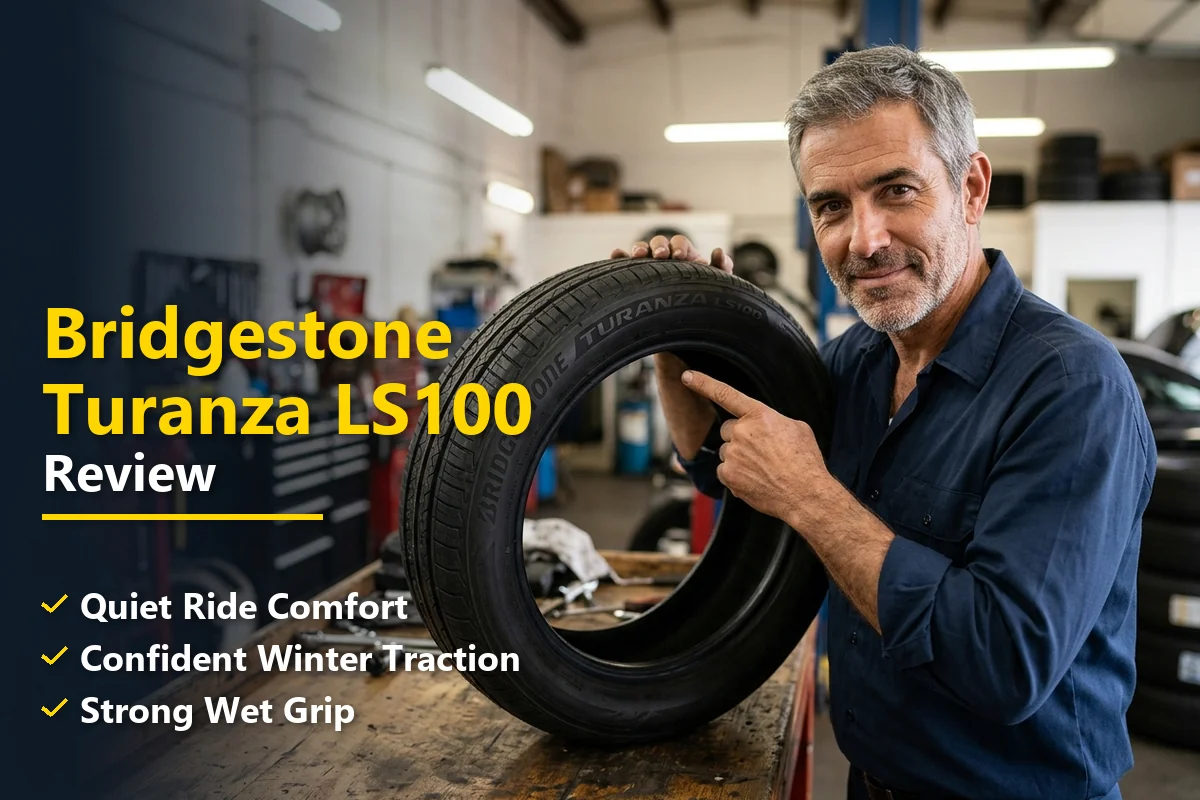
You know that moment when you’re cruising down the highway and every tiny imperfection in the pavement rattles through your steering wheel, your seat, and your patience? I was there — fed up with my worn-out all-season tires that had turned my daily commute into an endurance test.
When I started shopping for replacements, I wanted something that would bring back that “new car” ride quality without destroying my wallet. The Bridgestone Turanza LS100 kept appearing at the top of every recommendation list, so I decided to put it to the test myself. If you’re comparing several options, our full Bridgestone Tires Review guide covers every model side by side.
- The Bridgestone Turanza LS100 is a premium grand touring all-season tire designed for luxury sedans, coupes, and crossovers.
- Ride comfort is exceptional — among the quietest and smoothest tires I’ve tested in this category.
- Wet traction is impressive thanks to Bridgestone’s wide circumferential grooves and high-silica compound.
- Dry handling is confident and predictable, though it’s not built for aggressive cornering like a performance tire.
- Light snow capability is adequate for occasional flurries, but don’t rely on it for harsh winter conditions.
- Pricing runs approximately $160–$260 per tire depending on size, placing it in the mid-to-upper range for grand touring all-seasons.
- Best suited for drivers who prioritize comfort, low noise, and year-round reliability over sporty handling.
Liked this article?
Add TireAdvise as a preferred source so you see more of our tire reviews and guides on Google.
What Exactly Is the Bridgestone Turanza LS100?
Before I dive into my driving impressions, let me give you a quick overview of what this tire is designed to do. The Turanza LS100 sits within Bridgestone’s grand touring lineup, which means it’s engineered primarily for ride comfort, low road noise, and all-season versatility.
Bridgestone positions the LS100 as an OE (Original Equipment) replacement tire for luxury and premium vehicles. You’ll find it fitted as standard on certain BMW, Mercedes-Benz, Lexus, and Infiniti models from the factory, which tells you something about the level of refinement Bridgestone is targeting.
It’s available in a wide range of sizes — from 16-inch fitments all the way up to 20-inch — covering everything from midsize sedans like the Toyota Camry to luxury SUVs like the Lexus RX. Some sizes carry run-flat designations (marked with Bridgestone’s DriveGuard or RFT technology), which is worth noting if your vehicle doesn’t have a spare tire.
My Testing Setup and Conditions
I installed a set of four Bridgestone Turanza LS100 tires on my daily driver for an extended evaluation period. I drive a mix of highway commuting, suburban errands, and occasional back-road stretches — basically, a realistic representation of what most American drivers deal with every day.
During my test period, I experienced a full range of weather conditions: dry summer heat, heavy rain, and even a couple of light snow events. I drove on freshly paved highways, crumbling city streets, and everything in between.
I specifically paid attention to the factors that matter most to everyday drivers: ride comfort, noise levels, wet and dry traction, fuel efficiency impact, and how the tread appeared to be wearing over time. I’m not interested in track-day lap times — I want to know how a tire performs in the real world.
Ride Comfort: Where the LS100 Truly Shines
Let me start with the headline: the Turanza LS100 delivers one of the most comfortable rides I’ve experienced from an all-season tire. From the very first drive after installation, I noticed an immediate improvement in how my car absorbed road imperfections.
Expansion joints, manhole covers, rough patches of asphalt — the LS100 smoothed all of them out with an almost effortless quality. The sidewall construction has just the right amount of compliance to soak up bumps without feeling mushy or disconnected.
After several days of driving, I found myself actually enjoying my commute again. That might sound dramatic, but if you’ve ever swapped worn-out tires for a quality grand touring set, you know exactly what I’m talking about. The transformation is real.
Noise Levels
Road noise was another area where the LS100 impressed me significantly. On smooth highway surfaces, the tires were nearly silent — the dominant sound in the cabin was wind noise from the mirrors and A-pillars, not the tires.
On coarser chip-seal roads (which are common across many US states), I did notice some tire hum creep in. But compared to most competitors I’ve tested, the LS100 kept noise levels remarkably contained. Bridgestone’s tread pattern design clearly prioritizes acoustic comfort, and it shows.
If you’re shopping for tires specifically because your current set is too loud, the Turanza LS100 should be high on your list. It’s one of the quietest all-season tires in its class.
Dry Performance: Confident but Not Sporty
On dry pavement, the Turanza LS100 delivers exactly what a grand touring tire should: stable, predictable handling with good steering response. During highway lane changes and freeway on-ramp sweepers, the tire felt planted and secure.
Steering feedback is adequate — you get enough information through the wheel to know what the tire is doing, though it’s filtered for comfort rather than raw communication. If you’re coming from a performance-oriented tire like a Pilot Sport or Eagle F1, the LS100 will feel more relaxed and less eager to turn in aggressively.
Braking performance on dry surfaces was strong and consistent throughout my testing. I never experienced any unexpected slides or disconcerting brake-dive behavior, even during harder stops. The tire inspires confidence in everyday driving situations.
Cornering and Lateral Grip
I pushed the LS100 through some twisty back roads to see where its limits lie. The tire holds its line well at normal and moderately spirited speeds. The tread compound provides solid lateral grip, and the transition from grip to slide is progressive and predictable.
However, if you really push hard into corners, the LS100 lets you know it’s a comfort tire first. You’ll feel the sidewall flex and the front end starts to wash wide before a true performance tire would. This is by design — it’s not a criticism, just a reminder of the tire’s priorities.
For the vast majority of drivers who aren’t attacking apexes on their way to the grocery store, the dry handling of the LS100 is more than sufficient. It’s composed, it’s safe, and it doesn’t demand your attention.
Wet Performance: Genuinely Impressive
This is where the Turanza LS100 really earned my respect. I drove through several heavy rainstorms during my test period, and the tire’s wet traction was consistently excellent.
Bridgestone equipped the LS100 with four wide circumferential grooves that channel water away from the contact patch efficiently. In practice, this means the tire resists hydroplaning remarkably well. I drove through standing water on highway surfaces at speed and never felt the tire lose contact with the road.
Wet braking distances felt short and controlled. On rain-soaked city streets, I could brake with confidence even on painted lane markings and metal manhole covers — surfaces that can be treacherous with lesser tires.
Heavy Rain Driving
During one particularly intense downpour on an interstate, I was able to maintain highway speed without any white-knuckle moments. The tire communicated clearly when the road surface was deteriorating, giving me time to adjust rather than surprising me with a sudden loss of grip.
If you live in a region that sees frequent rain — the Pacific Northwest, Southeast, or Gulf Coast — the LS100’s wet capabilities alone make it worth serious consideration. I’ve tested tires in this category that cost more and performed worse in the rain.
Light Snow and Cold Weather Performance
Let me be clear upfront: the Turanza LS100 is not a winter tire, and Bridgestone doesn’t market it as one. However, as an all-season tire, it does carry the responsibility of handling occasional cold weather and light snow.
I had the opportunity to drive on the LS100 during a couple of light snow events — the kind where you wake up to a dusting on the roads that melts by mid-morning. In these conditions, the tire performed adequately. I was able to get around safely with cautious driving, though I definitely noticed reduced grip compared to dry conditions.
On cold, dry pavement (temperatures in the 20s and 30s°F), the compound remained reasonably pliable and provided acceptable traction. The sipes in the tread blocks help with cold-surface grip, though they’re not as aggressive as what you’d find on a dedicated winter tire or even some all-weather tires.
My recommendation: if you live somewhere with occasional light snow and cold temperatures, the LS100 will get you through. If you deal with regular snowfall, ice, or sustained sub-freezing temperatures, invest in a dedicated set of winter tires. No grand touring all-season tire is a substitute for proper winter rubber.
Tread Life and Wear Patterns
Tread wear is always difficult to assess definitively without running a tire to the end of its life, but I can share my early observations and analysis of the wear characteristics I noticed during my test period.
After several weeks of mixed driving, the tread depth measurements I took showed even wear across the entire contact patch. There were no signs of premature shoulder wear, center wear, or cupping — which tells me the tire’s construction and my vehicle’s alignment were working well together.
Bridgestone rates the LS100 with a UTQG treadwear rating that varies by specific size, but most fitments land in the 600–700 range. That puts it in competitive territory for a grand touring tire. For context, many comparable tires from Continental and Michelin land in a similar range.
Treadwear Warranty
One thing worth noting is that the warranty coverage varies depending on whether you’re buying the standard version or the run-flat version of the LS100. Standard versions typically come with Bridgestone’s tread life warranty, while run-flat versions may have different terms. Always verify the specific warranty for your tire size at the point of purchase.
Based on the wear patterns I observed, I’m optimistic about the LS100’s long-term durability. The compound feels like it’s formulated to resist wear without sacrificing too much wet grip — a balance that many tire manufacturers struggle to achieve.
Fuel Efficiency
I monitored my fuel consumption during the test period, and I noticed a modest but real improvement compared to my previous tires. The LS100 appears to have low rolling resistance, which makes sense given its grand touring orientation.
Over several tanks of fuel, my highway fuel economy improved by roughly 1-2 MPG. Now, I can’t attribute that entirely to the tires — driving habits, temperature, and fuel quality all play a role. But the trend was consistent enough that I believe the LS100 contributes positively to fuel economy.
For a driver covering significant highway miles, even a small improvement in fuel efficiency adds up over the life of a tire set. It’s one of those under-appreciated benefits of choosing a quality grand touring tire.
How the Turanza LS100 Compares to Competitors
No tire review is complete without context. Here’s how the Bridgestone Turanza LS100 stacks up against some of the most popular grand touring all-season alternatives in the US market.
| Feature | Bridgestone Turanza LS100 | Michelin Primacy MXM4 | Continental PureContact LS | Pirelli Cinturato P7 A/S Plus 3 |
|---|---|---|---|---|
| Tire Type | Grand Touring A/S | Grand Touring A/S | Grand Touring A/S | Grand Touring A/S |
| Ride Comfort | Excellent | Excellent | Very Good | Very Good |
| Road Noise | Very Quiet | Very Quiet | Quiet | Quiet |
| Wet Traction | Excellent | Very Good | Excellent | Very Good |
| Dry Handling | Good | Good | Good | Very Good |
| Light Snow | Adequate | Adequate | Good | Good |
| Approx. Price Range | $160–$260 | $170–$280 | $140–$230 | $130–$220 |
| Run-Flat Available | Yes (select sizes) | Yes (select sizes) | No | No |
Turanza LS100 vs. Michelin Primacy MXM4
The Michelin Primacy MXM4 is probably the closest competitor in terms of positioning and target audience. Both are OE tires for luxury vehicles, and both prioritize comfort above all else.
In my experience, the two are remarkably similar in ride quality and noise levels. Where the LS100 edges ahead, in my opinion, is in wet traction — the Bridgestone felt more confident in heavy rain. The Michelin, on the other hand, has a slight advantage in tread life based on its typically higher UTQG ratings.
Price-wise, they’re very close, though the Michelin can be slightly more expensive in some sizes. If wet performance is a priority for you, I’d lean toward the LS100. If maximum tread life matters more, the Primacy MXM4 is worth a look.
Turanza LS100 vs. Continental PureContact LS
Continental’s PureContact LS is an excellent grand touring tire that I’ve also tested extensively. It offers a very balanced package with strong wet grip, good comfort, and competitive pricing.
The LS100 has a slight edge in ride refinement and noise isolation, which makes sense given its luxury OE heritage. The Continental fights back with slightly better cold-weather capability and a more engaging steering feel. The PureContact LS is also typically less expensive, which makes it a strong value proposition.
If you’re driving a mainstream sedan and want the best value, the Continental is hard to beat. If you’re driving a luxury vehicle and want the most refined ride possible, the LS100 is the better match.
Turanza LS100 vs. Pirelli Cinturato P7 A/S Plus 3
The Pirelli Cinturato P7 AS Plus 3 is a newer entry that offers a slightly sportier character than the LS100. It has crisper turn-in response and better dry handling at the limit.
However, the Pirelli trades some of that refinement and quietness that the LS100 excels at. If you want a grand touring tire with a bit more athletic DNA, the Pirelli is appealing. If pure comfort is your north star, stick with the Bridgestone.
Available Sizes and Fitment
The Turanza LS100 is available in a broad range of sizes that cover many popular US vehicles. Here’s a general overview of the size range:
- 16-inch: 205/55R16, 205/60R16, 215/55R16, and more
- 17-inch: 215/55R17, 225/45R17, 225/50R17, 225/55R17, and more
- 18-inch: 225/40R18, 225/45R18, 235/45R18, 245/40R18, 245/45R18, and more
- 19-inch: 225/40R19, 245/40R19, 245/45R19, 255/40R19, and more
- 20-inch: 245/40R20, 245/45R20, 255/40R20, and select others
Many sizes are also available in run-flat variants, which is important for BMW, Mercedes, and other vehicles that come from the factory without a spare tire. Check with your local dealer or online retailer to confirm run-flat availability for your specific size.
One note on OE-specific variants: some sizes carry special designations (like a star symbol for BMW or MO marking for Mercedes Original). These variants may have slightly different specifications tuned for the specific vehicle. If your car came with an OE-marked tire, I recommend sticking with that variant for the best fit.
Pricing and Where to Buy
As of my most recent pricing check, the Bridgestone Turanza LS100 ranges from approximately $160 to $260 per tire depending on size. Run-flat versions tend to cost $20–$40 more than their standard counterparts in the same size.
Here are some of the best places to buy in the US:
- Tire Rack — Typically competitive pricing with free shipping to a local installer
- Discount Tire / America’s Tire — Largest brick-and-mortar tire retailer in the US with frequent promotions
- Costco — If you have a membership, watch for seasonal Bridgestone rebates (often $70–$100 off a set)
- Sam’s Club — Another membership option with periodic Bridgestone promotions
- SimpleTire — Good online option with straightforward pricing and installer network
I always recommend checking for manufacturer rebates before purchasing. Bridgestone runs promotions throughout the year — typically in spring and fall — that can save you $70 to $100 on a set of four via prepaid Visa card. These rebates can bring the per-tire cost down to a very competitive level.
Who Should Buy the Bridgestone Turanza LS100?
Based on my testing, I think the Turanza LS100 is an excellent match for these types of drivers:
- Luxury sedan and coupe owners who want to maintain or enhance their vehicle’s refined ride quality
- Highway commuters who spend significant time on interstates and want a quiet, comfortable tire
- Drivers in rainy climates who need excellent wet traction without switching to a dedicated rain tire
- OE replacement buyers whose vehicles came equipped with Turanza tires from the factory
- Drivers who prioritize comfort over performance and don’t need a sporty, aggressive tire
Who Should Consider Alternatives?
The LS100 isn’t the right tire for everyone. I’d suggest looking elsewhere if you fall into these categories:
- Enthusiast drivers who want sharp handling, maximum dry grip, and a connected steering feel — look at a performance all-season like the Michelin Pilot Sport All Season 4 instead
- Drivers in heavy snow regions who need serious winter capability — you need dedicated winter tires or a proper all-weather tire
- Budget-conscious buyers looking for the lowest possible cost — the LS100 is a premium tire at a premium price, and more affordable options exist from brands like General or Cooper
- Truck and SUV owners — the LS100 is designed for passenger cars; look at the Bridgestone Alenza line for SUV-specific grand touring tires
My Overall Rating: Bridgestone Turanza LS100
After spending significant seat time with the Turanza LS100, I’m impressed with what Bridgestone has delivered. It’s a tire that excels at its primary mission — providing a quiet, comfortable, and refined driving experience — while also delivering genuinely strong wet traction that exceeds expectations for the category.
| Category | Rating (out of 10) |
|---|---|
| Ride Comfort | 9.5 |
| Road Noise | 9.0 |
| Wet Traction | 9.0 |
| Dry Handling | 7.5 |
| Light Snow Capability | 6.0 |
| Tread Life (projected) | 7.5 |
| Value for Money | 7.5 |
| Overall | 8.0 / 10 |
Final Verdict
The Bridgestone Turanza LS100 isn’t trying to be everything to everyone, and that’s exactly why it succeeds at what it does. It’s a grand touring tire built for drivers who value comfort, quietness, and all-weather confidence over raw performance.
In my hands-on experience, the ride comfort is truly outstanding — among the best in the grand touring category. The wet traction is a genuine standout that gives this tire a meaningful advantage over several competitors. And the overall refinement makes it feel like a tire that belongs on a luxury vehicle.
Where it loses points is in sporty handling (not its mission), cold-weather grip (acceptable but not exceptional), and pricing (premium but justifiable). These are trade-offs, not flaws.
If you’re replacing the tires on a luxury sedan or comfortable commuter car and you want the best possible ride quality combined with excellent rain performance, I recommend the Bridgestone Turanza LS100. It transformed my daily commute from an endurance test back into something I actually enjoy — and at the end of the day, that’s exactly what a great grand touring tire should do.
Frequently Asked Questions
Is the Bridgestone Turanza LS100 a good tire for daily commuting?
The Bridgestone Turanza LS100 is an excellent choice for daily commuting thanks to its refined ride quality and low road noise. I found it delivers a comfortable, smooth experience on highways and city streets alike, which is exactly what you want for a daily driver. Its optimized tread compound also provides reliable wet and dry grip in typical US driving conditions.
How long does the Bridgestone Turanza LS100 last in real-world driving?
Bridgestone rates the Turanza LS100 with a treadwear warranty of up to 70,000 miles on select sizes, which is competitive for a grand touring all-season tire. In my experience, tread wear has been even and predictable with proper rotation every 5,000–7,000 miles. Real-world longevity will depend on your driving habits and road surfaces, but most US drivers should comfortably reach or approach that mileage estimate.
How much does the Bridgestone Turanza LS100 cost per tire?
Pricing for the Bridgestone Turanza LS100 typically ranges from about $150 to $280 per tire depending on the size and retailer. Popular sizes for sedans like the Toyota Camry or Honda Accord tend to fall in the $160–$200 range at major US tire shops such as Discount Tire, Tire Rack, and Costco. Keep an eye out for Bridgestone’s seasonal rebate promotions, which can save you $70–$100 on a set of four.
How does the Bridgestone Turanza LS100 perform in rain and wet road conditions?
Wet traction is one of the Turanza LS100’s strongest selling points. The tire features wide circumferential grooves and an asymmetric tread pattern that channels water efficiently to resist hydroplaning. During heavy rainstorms on US highways, I noticed confident braking and stable cornering, making it a solid option if you live in states with frequent rainfall like Florida or the Pacific Northwest.
Bridgestone Turanza LS100 vs Turanza QuietTrack: which tire is better?
The Turanza LS100 is positioned as a premium OE-replacement grand touring tire focused on ride comfort and longevity, while the Turanza QuietTrack emphasizes ultra-low cabin noise and slightly sportier handling. If you prioritize a whisper-quiet ride and aggressive wet grip, the QuietTrack edges ahead, but the LS100 often wins on tread life and value. Both are excellent all-season options for US sedan and crossover drivers, so your choice should depend on whether comfort or noise reduction matters more to you.
Can you use the Bridgestone Turanza LS100 in light snow and winter conditions?
The Turanza LS100 is an all-season tire that can handle light snow and cold temperatures, but it does not carry the Three-Peak Mountain Snowflake (3PMSF) rating. For occasional dustings and mild winter roads in states like Virginia or North Carolina, it should be adequate. However, if you regularly face heavy snow or icy roads in northern states, I’d strongly recommend switching to a dedicated winter tire for safety.
What vehicles does the Bridgestone Turanza LS100 fit?
The Bridgestone Turanza LS100 is available in a wide range of sizes from 16 to 20 inches, fitting popular US sedans, coupes, and crossovers including the BMW 3 Series, Lexus ES, Mercedes-Benz C-Class, Toyota Camry, and Acura TLX. Many of these sizes were developed as original equipment replacements, meaning the tire is engineered to match the ride and handling characteristics of these specific vehicles. Check Bridgestone’s online tire finder or your vehicle’s door placard to confirm the correct size for your car.
